Why UK Transit Liability Is Different From the U.S. Model
When you miss a connection in the UK, the rules that determine who pays for the consequences are structurally different from the U.S. system described in the decision intelligence summary. In the U.S., protection is a mix of Department of Transportation (DOT) regulation and airline-specific contracts of carriage. In the UK, the core framework is a single, harmonised regime: UK261 (the post-Brexit counterpart to EU261), layered on top of airline contracts and airport minimum-connection rules.
This difference matters because it changes how risk is allocated:
- In the U.S., concrete benefits (meals, hotels, rebooking on other carriers) are largely policy choices disclosed in each airline’s customer service plan.
- In the UK, certain benefits are legally mandated when disruption is within the airline’s control and the itinerary is covered by UK261, while other elements still depend on airline policy and ticket structure.
To understand airline liability in UK transit, it helps to map the U.S. concepts in the summary onto the UK context:
- Single-ticket vs. self-transfer: The same structural divide exists. A through-ticket that meets the airport’s Minimum Connection Time (MCT) shifts most missed-connection risk to the airline. Separate tickets leave the traveller exposed.
- Regulatory backbone: Where the U.S. relies on DOT rules plus airline promises, the UK relies on UK261 plus airline promises. UK261 defines when compensation and “right to care” apply; contracts of carriage fill in the gaps.
- Economic incentives: Airlines in both systems have incentives to minimise cash outflows, classify disruptions as outside their control, and steer passengers toward vouchers rather than refunds.
The rest of this article uses that U.S. decision-intelligence framework to analyse UK transit liability: which mechanisms shift risk between airline and traveller, how ticket design changes exposure, and where uncertainty remains despite UK261.
Single Ticket vs. Self-Transfer: The Core Liability Split in UK Transit
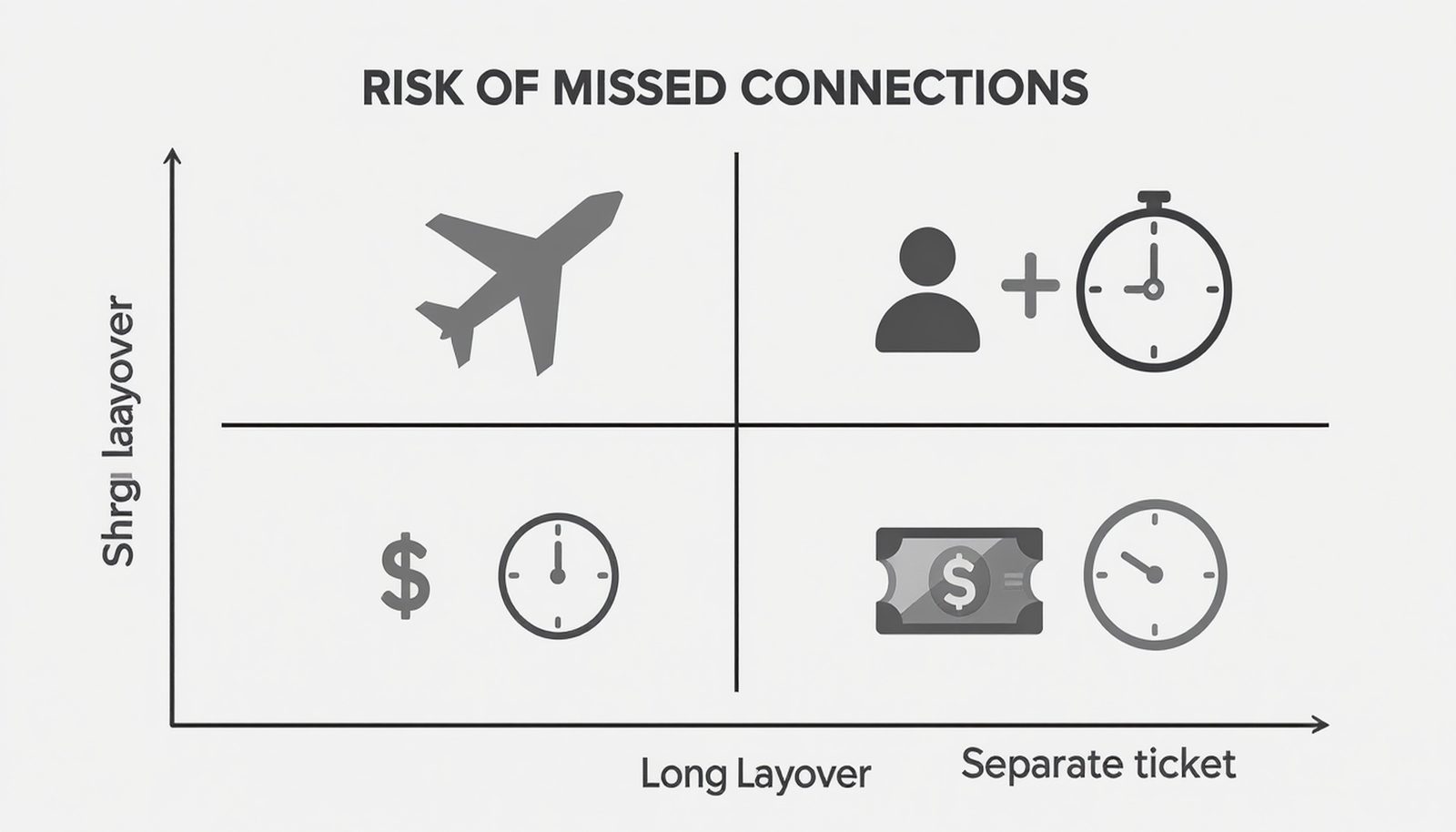
The main determinant of airline liability in UK transit is not the airport or the airline brand; it is how your itinerary is constructed. The U.S. analysis highlights a structural divide between protected, single-ticket itineraries and unprotected self-transfers. The same mechanism operates in the UK, even under UK261.
Single-ticket UK transit that meets MCT
On a single ticket, all legs are part of one contract of carriage. If you are flying, for example, Edinburgh–London Heathrow–New York on one ticket, and the Edinburgh–Heathrow leg is delayed so you miss the Heathrow–New York flight, the operating carrier on the disrupted leg generally bears responsibility for getting you to your final ticketed destination.
Mechanically, several things follow:
- Minimum Connection Time (MCT): Airlines and airports define an MCT for each connection (e.g., domestic–international at Heathrow). If your itinerary was sold with a connection at or above MCT, the airline has implicitly accepted that the connection is feasible.
- Missed connection due to delay or cancellation: If the first leg is delayed or cancelled and you miss the onward flight, the airline must re-route you to your final destination at no extra fare, subject to seat availability, because you have not yet been transported as contracted.
- UK261 overlay: If the disruption is within the airline’s control and meets UK261 thresholds (for example, a long delay or cancellation), you may also be entitled to compensation and “right to care” (meals, accommodation, communication), in addition to re-routing.
The key mechanism is that the airline has sold you a single transport promise from origin to final destination. Once you are in transit in the UK on that ticket, the airline cannot treat each leg as a separate gamble you chose; the risk of missed connections is internalised by the carrier.
Self-transfer itineraries through UK airports
Self-transfer itineraries—separate tickets stitched together by the traveller—mirror the U.S. “unprotected” scenario. For example, you might buy one ticket from Manchester to London Gatwick on a low-cost carrier, and a separate long-haul ticket from Gatwick to Dubai on a different airline.
In this structure:
- Each ticket is a separate contract. The first airline’s obligation ends when it delivers you to Gatwick under that ticket.
- If the first flight is delayed and you miss the second, the second airline can treat you as a no-show. It has no contractual obligation to rebook you for free, because you failed to present yourself on time for check-in or boarding under that separate contract.
- UK261 may still apply to the delayed first flight (for example, compensation for the delay itself), but it does not extend to the consequences on your separate onward ticket.
This is the same risk described in the U.S. summary: the traveller bears almost all replacement-ticket risk. The UK regime does not convert a self-transfer into a protected connection simply because it occurs at a UK airport.
Comparing risk exposure by itinerary type
The table below maps the U.S. risk logic onto UK transit scenarios:
| Scenario | Ticket structure | Who bears missed-connection risk? | Typical outcome in UK transit |
| Through-connection at Heathrow on one ticket | Single ticket, meets MCT | Airline | Re-routing to final destination at no extra fare; UK261 care/compensation if criteria met. |
| DIY connection at Gatwick on two tickets | Separate tickets | Traveller | First airline may owe UK261 compensation for delay; second airline can treat you as no-show and charge for a new ticket. |
| Interline connection on one ticket via a UK hub | Single ticket across partner airlines | Ticketing airline, operationally the disrupted carrier | Re-routing under the through-ticket; liability shared internally between carriers, not with the passenger. |
The trade-off mirrors the U.S. analysis: tight, self-constructed connections can reduce travel time or cost, but they externalise disruption risk onto the traveller. Single tickets internalise that risk within the airline system, at the price of less flexibility and sometimes higher fares.
How UK261 Interacts With Airline Policies in Transit
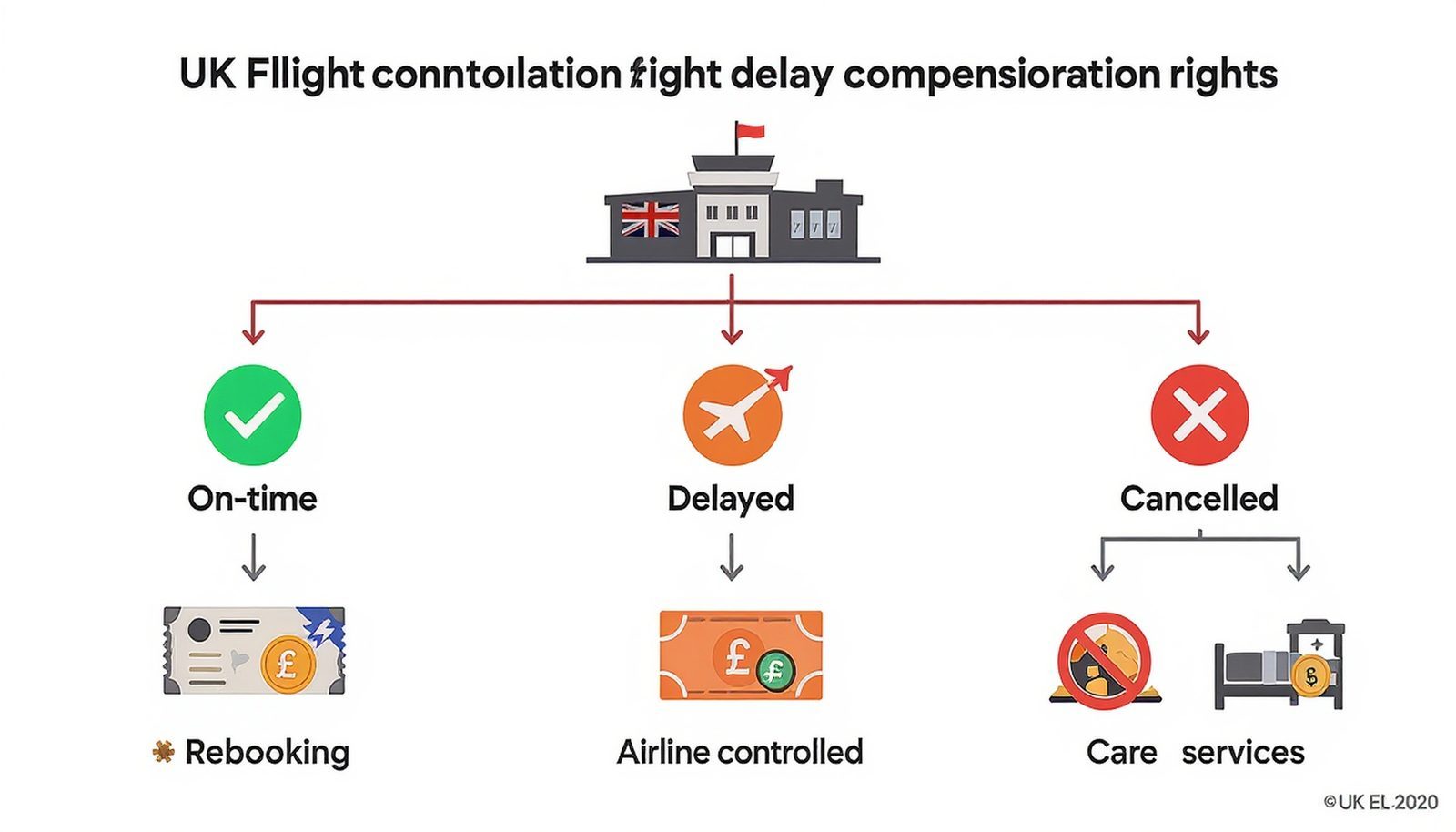
The U.S. summary emphasises that DOT rules set a floor, while airline customer service plans determine concrete benefits like hotels and meals. In the UK, UK261 plays a similar floor-setting role, but with more prescriptive obligations in some areas and the same variability in others.
UK261 as the regulatory floor
UK261 applies to:
- Flights departing from UK airports on any airline.
- Flights to the UK on UK or certain qualifying carriers (mirroring EU261 logic, but with UK-specific scope).
In a UK transit context, this means that if your disrupted leg departs from a UK airport, UK261 is likely to apply. The mechanisms are analogous to the U.S. “automatic refund rule,” but with different triggers and remedies:
- Cancellation or long delay: If your flight is cancelled or significantly delayed, you have a right to choose between re-routing and refund of the unused portion of the ticket (and sometimes the used portion if the trip purpose is defeated).
- Right to care: After certain delay thresholds, the airline must provide meals, refreshments, and, if necessary, hotel accommodation and transport between airport and hotel.
- Compensation: For disruptions within the airline’s control that meet distance and delay thresholds, fixed-sum compensation may be due.
These rights attach to the disrupted flight itself, not to the entire chain of self-constructed travel. On a single ticket, however, the “trip” is defined as the origin–destination pair on that ticket, so missed onward legs are treated as part of the same disruption event.
Airline discretion on rebooking and interline solutions
Where the U.S. system leaves rebooking on other carriers largely to airline policy, the UK framework is similar: UK261 requires re-routing “under comparable transport conditions” but does not force an airline to buy you a seat on a competitor in all circumstances.
In practice, airlines weigh:
- Internal capacity: If the airline can rebook you on its own later flight, it will usually prefer that to paying another carrier.
- Cost vs. regulatory risk: In extreme disruption, refusing to use other carriers may appear unreasonable and invite regulatory scrutiny or complaints, but there is no automatic obligation to interline.
- Commercial agreements: Existing interline or codeshare agreements make it cheaper and operationally easier to rebook you on partners.
This mirrors the U.S. dynamic described in the summary: airlines have economic incentives to minimise cash and external rebooking costs, so they interpret “comparable transport conditions” in ways that favour their own network, unless pushed by regulation or reputational risk.
Vouchers vs. cash in the UK context
The U.S. analysis notes that airlines steer passengers toward vouchers instead of cash refunds. The same incentive exists in the UK. Under UK261, if you are entitled to a refund, it must be in cash (or original form of payment) unless you voluntarily accept a voucher.
The mechanism is behavioural rather than legal:
- Airlines present vouchers as the default or “faster” option.
- Frontline staff may not emphasise the cash alternative.
- Travellers under time pressure in transit may accept vouchers without fully considering the trade-offs (expiry, restrictions, airline solvency risk).
As in the U.S., the gap is between formal rights and realised outcomes. The law gives you a cash baseline; airline processes nudge you toward non-cash solutions that preserve the airline’s liquidity.
Time vs. Money: Designing UK Transit Connections Under Uncertainty

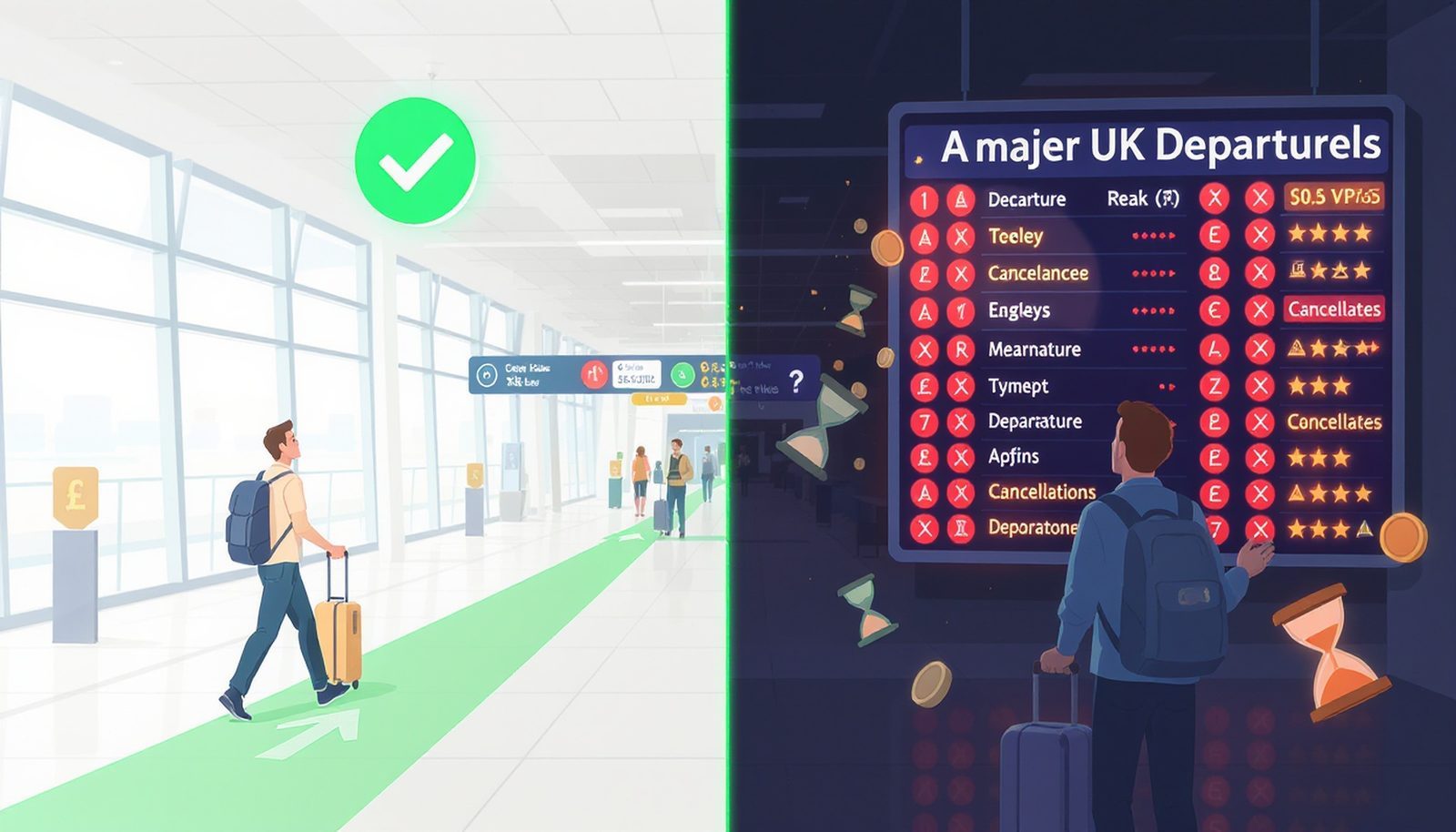
The U.S. decision intelligence highlights a structural trade-off: tight connections reduce total travel time but increase exposure to missed-connection costs, especially on self-constructed itineraries. In UK transit, the same trade-off exists, but UK261 modifies the payoff structure on protected itineraries.
Short layovers on single tickets
On a single ticket through a UK hub, a short layover is primarily a comfort and disruption-risk issue, not a direct financial risk. If you miss the connection because the inbound flight is delayed, the airline must re-route you. UK261 may also provide care and compensation.
However, several mechanisms can still make short layovers costly in non-monetary ways:
- Limited rebooking options: If the last flight of the day is missed, you may be stranded overnight even though the airline pays for hotel and meals.
- Knock-on commitments: Non-refundable hotels, tours, or meetings at your final destination are not covered by UK261; the airline’s liability is limited to transport and defined care or compensation.
- Operational classification: If the airline classifies the delay as outside its control (for example, weather), compensation may not be payable, even though re-routing and care still are.
Short layovers on single tickets therefore shift the risk from “buying a new ticket” to “arriving much later and losing downstream value,” which UK261 does not fully monetise.
Short layovers on self-transfer itineraries
On separate tickets, the trade-off is sharper and closer to the U.S. scenario described in the summary. A short self-transfer through a UK airport compresses the buffer against delays that are statistically common (the U.S. figure of around 20% of flights delayed 15+ minutes is a useful benchmark for understanding that delays are not rare events).
Mechanically, a short self-transfer increases:
- Probability of misalignment: Even modest delays on the first leg can make you miss check-in or boarding cut-off for the second ticket.
- Exposure to replacement-ticket prices: If you miss the second flight, you may have to buy a new ticket at walk-up prices, which are often highest when disruption is widespread.
- Complexity of claims: You may be eligible for UK261 compensation on the first flight, but that compensation is not calibrated to cover the full cost of a long-haul replacement ticket.
UK261 compensates for the delay of the first flight, not for the financial architecture of your self-constructed itinerary. The law does not “insure” your decision to chain separate contracts.
Longer layovers and structural risk reduction
Longer layovers in UK transit reduce the probability that ordinary delays will cause missed connections. This is true for both single tickets and self-transfers, but the payoff differs:
- On single tickets, longer layovers mainly reduce the chance of overnight stays and extensive re-routing, improving reliability rather than changing who pays.
- On self-transfers, longer layovers directly reduce the probability that you will have to buy a new ticket, which is a much larger financial risk.
The trade-off is time and sometimes fare cost versus risk. Airlines and booking platforms often highlight shorter total travel times as “better” options, but from a liability perspective, the “best” option may be a longer layover that keeps you within the envelope of what UK261 and airline policies can realistically protect.
Risk, Ambiguity, and Enforcement Gaps in UK Transit
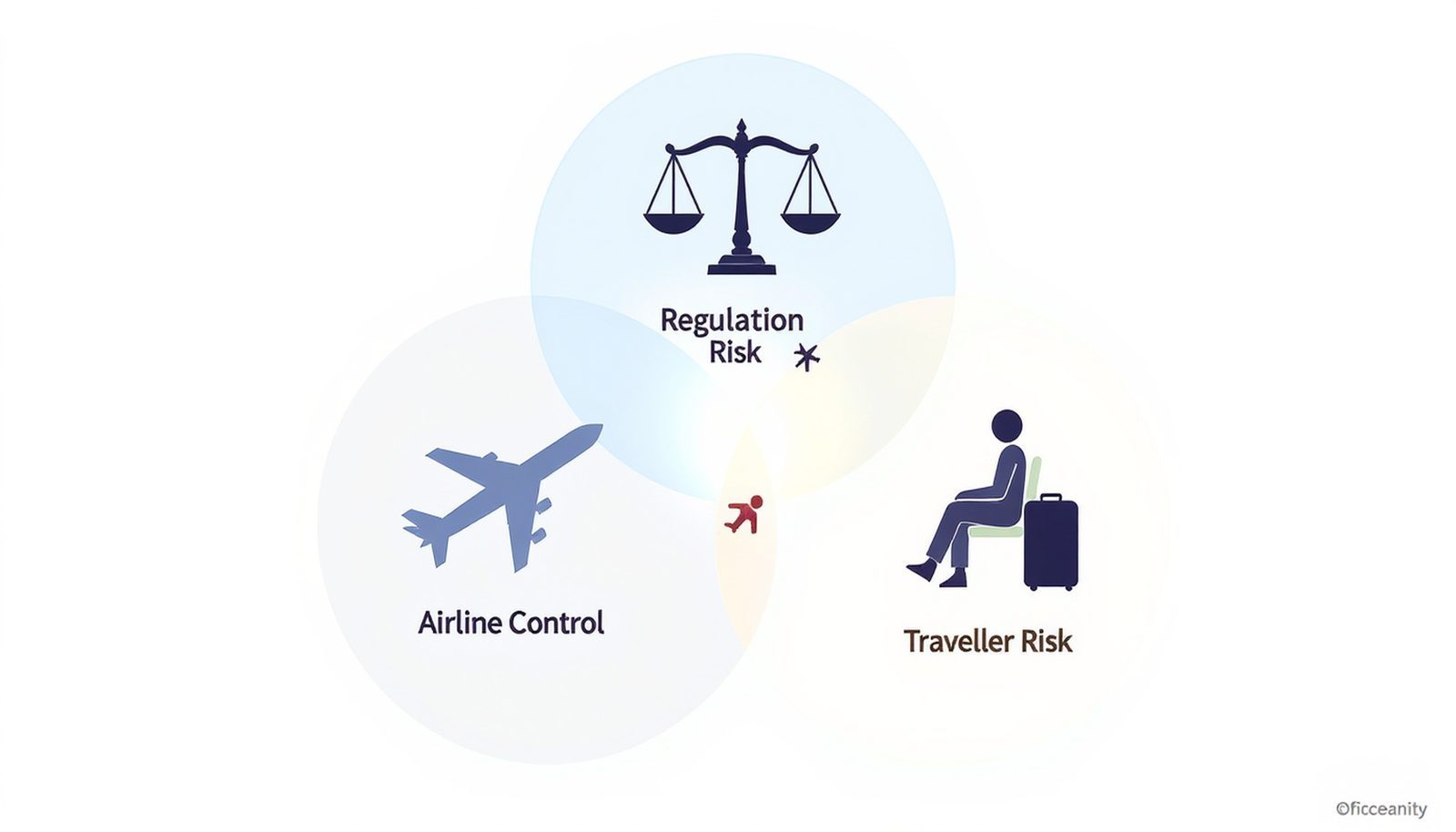
Even with UK261, there are structural uncertainties in UK transit that mirror the gaps identified in the U.S. analysis. These uncertainties do not remove your rights, but they affect how reliably those rights are realised in practice.
Classification of disruptions: within vs. outside airline control
The U.S. summary notes a lack of quantitative data on how often airlines classify disruptions as controllable vs. uncontrollable. The same opacity exists in the UK context. UK261 compensation often hinges on whether the cause of disruption is within the airline’s control.
Mechanically, this creates a classification game:
- Airlines have an economic incentive to frame disruptions as extraordinary circumstances (for example, weather, air traffic control restrictions) that exempt them from compensation.
- Travellers and regulators have limited visibility into the operational data that would confirm or challenge these classifications.
- Disputes often require individual complaints, documentation, and sometimes legal action, which many passengers will not pursue.
The result is a gap between the theoretical scope of UK261 compensation and the compensation actually paid in UK transit scenarios.
Enforcement mechanisms and complaint-driven outcomes
The U.S. system relies heavily on complaint-driven enforcement via the DOT’s Aviation Consumer Protection Division. The UK system similarly relies on passengers to initiate complaints, either directly with airlines, through alternative dispute resolution (ADR) schemes, or via regulators.
In practice:
- Frontline staff may deny or understate entitlements, especially in complex transit situations.
- Passengers must document delays, missed connections, and expenses, then escalate when claims are rejected.
- Regulators and ADR bodies can order compensation or refunds, but the process is slow relative to the immediacy of transit disruption.
This enforcement lag means that, in the moment of disruption, the effective protection is often whatever the airline voluntarily offers, not the full set of rights on paper.
Systemic factors: hubs, congestion, and seasonality
The U.S. analysis notes a lack of detailed breakdown by airport and season. The same analytical gap exists for UK transit. However, the mechanism is clear: some hubs and seasons structurally increase missed-connection risk.
- Hub congestion: Major UK hubs like Heathrow operate near capacity. Small perturbations (weather, ATC restrictions) can cascade into significant delays.
- Seasonality: Peak travel periods (summer holidays, Christmas) increase load factors and reduce spare capacity for rebooking, making missed connections more painful even when rights are clear.
- MCT design: Airports and airlines set MCTs that balance commercial attractiveness (shorter connections) against operational reality. If MCTs are set aggressively, more passengers will be sold connections that are feasible on paper but fragile in practice.
These systemic factors do not change the legal framework, but they change the probability distribution of outcomes within that framework. A legally protected right is more valuable when the system has enough slack to honour it quickly.
Balanced Conclusion: What UK Travellers Can Infer From U.S. Decision Intelligence
The U.S. decision-intelligence summary describes a fragmented system where DOT rules and airline policies jointly determine outcomes, and where travellers must navigate a complex mix of rights, incentives, and enforcement gaps. UK transit operates under a more unified legal regime (UK261), but many of the same structural dynamics apply.
From a decision-intelligence perspective, several grounded conclusions follow:
- Ticket structure is the primary risk lever: Whether in the U.S. or UK, single tickets that meet MCT internalise missed-connection risk within the airline system. Self-transfers externalise that risk to the traveller, and UK261 does not fully offset it.
- Regulation sets floors, not ceilings: UK261, like DOT rules, defines minimum obligations. Airlines can and do offer more, but they also design policies and processes to minimise cash outflows and preserve operational flexibility.
- Economic incentives shape behaviour: Airlines in both systems have incentives to classify disruptions as outside their control, to favour vouchers over cash, and to rebook within their own networks. These incentives explain much of the friction travellers experience in transit.
- Enforcement is reactive: Rights exist, but their realisation often depends on passengers documenting events and pursuing complaints. In the moment of disruption, the practical outcome is driven by airline discretion and system capacity.
- Time–risk trade-offs are structural: Short connections, especially on self-constructed itineraries, are structurally riskier. UK261 can soften the impact on protected itineraries but does not turn high-risk designs into low-risk ones.
For travellers transiting the UK, the useful takeaway is not a checklist but an understanding of mechanisms: how contracts of carriage, UK261, airport MCTs, and airline incentives interact to allocate risk. Once those mechanisms are clear, choices about ticket type, connection length, and response to disruption become more transparent trade-offs rather than opaque gambles.