I don’t book flights or hotels until I know the real cost of the trip. Not the fantasy number in my head. The actual, slightly uncomfortable total that includes food, local transport, and all the boring extras we love to ignore.
If you’ve ever come home from a “cheap” getaway and then avoided your credit card statement, this guide is for you. We’ll walk through a simple, reusable total trip cost calculator you can use before you book anything.
Think of this as a practical travel budget calculator guide. We’ll decide what to include, how to structure your numbers, and how to stress-test your budget so you’re not surprised later.
1. Decide Your Trip Framework Before You Touch a Calculator
Most people jump straight to flight prices. I start one step earlier: I define the framework of the trip. Without this, any vacation cost breakdown is just a guess with nice formatting.
Here’s what I lock in first:
- Destination type: budget-friendly (e.g., Southeast Asia, Eastern Europe) vs. high-cost (Japan, Scandinavia, big US cities).
- Trip length: total days on the ground, not just nights.
- Travel style: Budget, Mid-range, or Luxury. Be honest, not aspirational.
- Group type: solo, couple, family, or friends. Shared costs change everything.
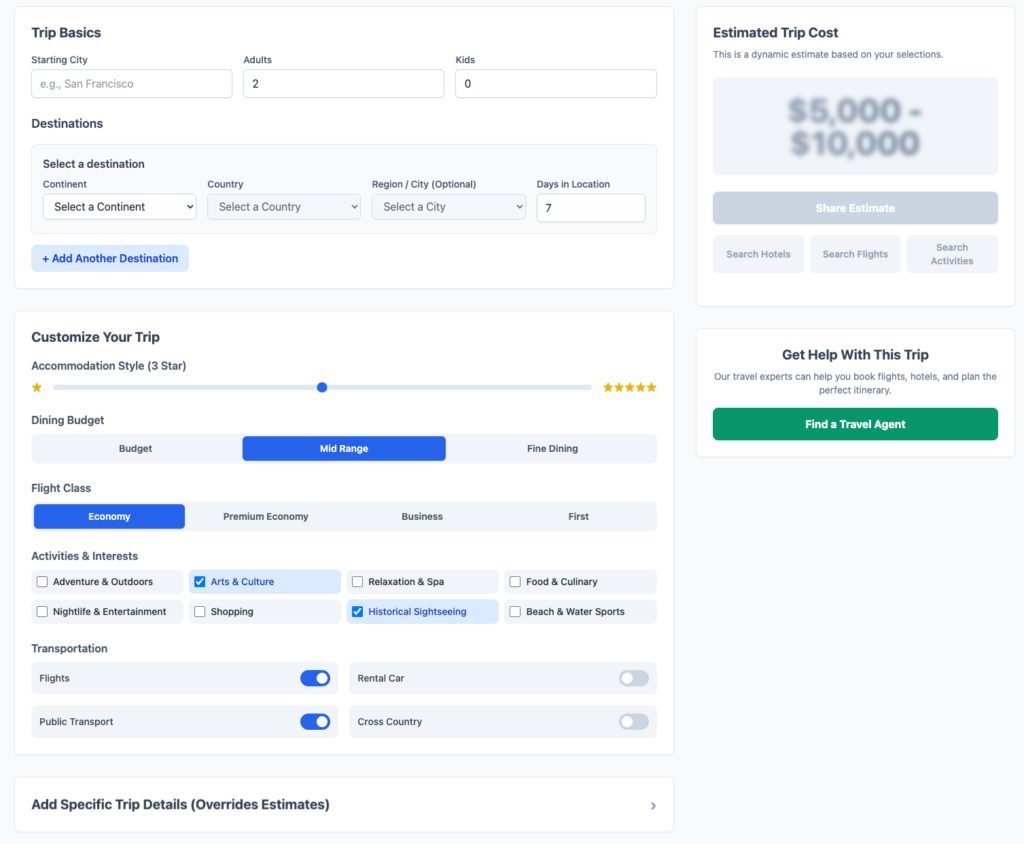
Tools like the Trip Cost Calculator and Trip Budget Calculator use exactly these variables. They’re built on tourism data, not vibes, so they’re a good sanity check when you’re trying to estimate your full trip cost.
At this stage, I’m not chasing exact numbers. I’m asking:
Is this a cheap-region, long-trip situation?
Or an expensive-region, short-hit, spend-big weekend?
That answer shapes every number you enter later and keeps your pre trip budget planning grounded in reality.
2. Build a Simple Structure: Categories, Per-Day vs. Per-Trip
Now we turn the framework into an actual calculator. You can use a spreadsheet, a notes app, or an online travel budget calculator like MiniWebtool’s Travel Budget Calculator. The tool doesn’t matter as much as the structure.
I split my budget into these core travel expense categories:
- Flights & long-distance transport (per person, per trip)
- Accommodation (per night, for the group)
- Food & drinks (per person, per day)
- Local transport (per person, per day)
- Activities & attractions (per person, per trip)
- Insurance & visas (per person or group, per trip)
- Extras & shopping (per trip)
- Contingency buffer (10–15% of everything)
This mirrors how smarter total trip cost calculator tools work. For example, MiniWebtool treats flights and activities as per-person totals, accommodation as a nightly group cost, and food/transport as per-person daily costs. That structure matters because it keeps your math consistent when you change group size or trip length.
In your own trip cost spreadsheet template, add columns like:
- Category
- Unit type (per person / per group / per day / per trip)
- Unit cost
- Quantity (days, nights, people)
- Total (Unit cost × Quantity)
Once this is set up, you’re not guessing. You’re just filling in boxes and building a clear vacation cost breakdown for flights, hotel, food, and transport.
3. Lock in Flights and Big Transport First
Flights are usually the most visible cost, so I like to pin them down early—but only after I’ve set the framework. I treat flights as per-person, per-trip costs.
Here’s how I estimate them realistically:
- Check 2–3 comparison sites and airline sites directly.
- Look at average prices over a month, not just one lucky day.
- Add baggage fees, seat selection, and any likely extras.
Guides like the UnitCalcPro vacation budget guide and TravelClosely’s budget calculator repeat the same advice: be flexible with dates, travel in shoulder season, and consider mid-week flights. That’s where the savings usually hide.
Don’t forget other long-distance transport:
- Trains between cities
- Long-distance buses
- Ferries or inter-island flights
These can be major cost drivers in places like Europe, Africa, or the Caribbean, as Advised Traveler points out. If you’re comparing package deals vs DIY travel costs, this is where DIY can quietly get expensive.
Once I have a realistic flight number, I plug it into my calculator and ask: If flights are already this high, does the rest of the trip still make sense?
Sometimes the answer is no—and that’s useful to know before you hit “Book”.
4. Estimate Accommodation, Food, and Local Transport by Day
This is where most budgets quietly explode. People underestimate daily costs, especially in expensive cities or during high season. A solid daily travel budget for food and transport keeps you honest.
I like the approach used by Sum.money’s vacation budget calculator: pick a tier (Budget, Mid-range, Luxury) and use a daily cost per person as a starting point. They use global averages like:
- Budget: around $80/day per person
- Mid-range: around $250/day per person
- Luxury: $700+/day per person
Those numbers include accommodation, food, activities, and local transport. I don’t copy them blindly, but they’re a good reality check when you’re trying to calculate vacation cost before booking.
Here’s how I break it down in my own calculator:
Accommodation
- Estimate a nightly rate for the whole group.
- Multiply by number of nights.
- Add taxes, resort fees, cleaning fees, and parking if relevant.
I also adjust for location: central hotels often mean higher nightly costs but lower transport costs. Remote stays flip that. This is a key part of any cost guide for flights and accommodation—you’re always trading one line item against another.
Food & drinks
- Set a daily food budget per person.
- Check if breakfast is included; if yes, lower your daily estimate.
- Plan for a mix: cheap meals, markets, and a couple of splurges.
Sum.money suggests strategies like cooking some meals, eating where locals eat, and shifting your main meal to lunch when prices are lower. Those small tweaks can shave a lot off your daily total and make your travel cost planning more realistic.
Local transport
- Estimate a daily transport cost per person (metro, buses, rideshares).
- Increase it if your accommodation is far from the center.
- For road trips, include fuel, tolls, parking, and rental insurance.
Once I have daily numbers, I multiply by trip length and plug them into the calculator. Then I look at the total and ask: Does this daily spend match how I actually travel, or how I wish I traveled?
That one question can save you from a lot of travel cost planning mistakes.
5. Add Activities, Insurance, and All the Boring Extras
This is the part most people skip—and the part that wrecks their budget later. These are the hidden travel costs and fees that don’t show up in the headline price.
I treat these as per-trip costs:
- Activities & attractions: museums, tours, safaris, diving, day trips, theme parks.
- Insurance: travel insurance, rental car insurance if needed.
- Visas & health fees: especially for parts of Africa, Asia, and some island destinations.
- Pre-trip costs: gear, luggage, vaccines, SIM cards, eSIMs.
- Shopping & souvenirs: even a modest number here is better than pretending it’s zero.
Several calculators, including UnitCalcPro and MiniWebtool, explicitly call out these categories. They also recommend a 10–15% contingency fund on top of your total to cover surprises.
I usually do this:
- Add up all categories (flights, accommodation, food, transport, activities, extras).
- Multiply the subtotal by 1.10 or 1.15.
That buffer is what saves you when you miss a connection, decide to join a last-minute tour, or discover that your “cheap” taxi ride from the airport is anything but. It’s the difference between a calm trip and a stressed one.
6. Stress-Test Your Budget: What If You’re Wrong?
Even with a good calculator, your first draft is just that—a draft. I like to stress-test my numbers before I commit. Think of it as running a few “what if” simulations on your total trip cost calculator.
Here’s how:
Scenario 1: Prices are 15% higher than you expect
- Increase your daily costs and flights by 15%.
- Check if the trip is still affordable.
If that extra 15% breaks your budget, you’re cutting it too close. Better to find that out now than halfway through the trip.
Scenario 2: You shorten or lengthen the trip
- Reduce the number of nights by 2–3 and see how much you save.
- Or add a few days in a cheaper region and see how the daily average changes.
Tools like TravelClosely’s calculator are built for this: you can tweak trip length, number of travelers, and see the impact instantly. It’s a simple way to compare different versions of the same trip without rebuilding your whole budget.
Scenario 3: You downgrade one category
- Try cheaper accommodation but keep food and activities the same.
- Or keep your hotel and cut back on paid tours.
This is where you decide what matters more: the room, the food, or the experiences. There’s no right answer, but your calculator will show you the trade-offs and help you plan a more affordable trip without guessing.
7. Turn Your Total into a Savings Plan (or a Hard No)
Once you have a total trip cost, you’re not done. You still need to answer one question: Can I actually fund this without stress?
That’s where a savings planner comes in. The Sum.money calculator, for example, takes your total budget, the time until departure, and your current savings, then tells you exactly how much to save per month or per week.
You can copy that logic easily:
- Take your total trip cost.
- Subtract what you’ve already saved for travel.
- Divide the remainder by the number of months until your trip.
If that monthly number feels unrealistic, that’s your signal. You either:
- Push the trip back.
- Shorten it.
- Change destination or travel style.
The point of a travel budget calculator isn’t to make you feel bad. It’s to give you a clear, honest picture before you lock in non-refundable flights and hotels.
Once you’ve built your own calculator—or adopted one of the online tools—you can reuse it for every trip. Change the destination, tweak the daily costs, adjust the group size, and you’ll see instantly whether this is a book it now
trip or a not yet
trip.
Either way, you’re deciding with your eyes open. And that’s the whole point.