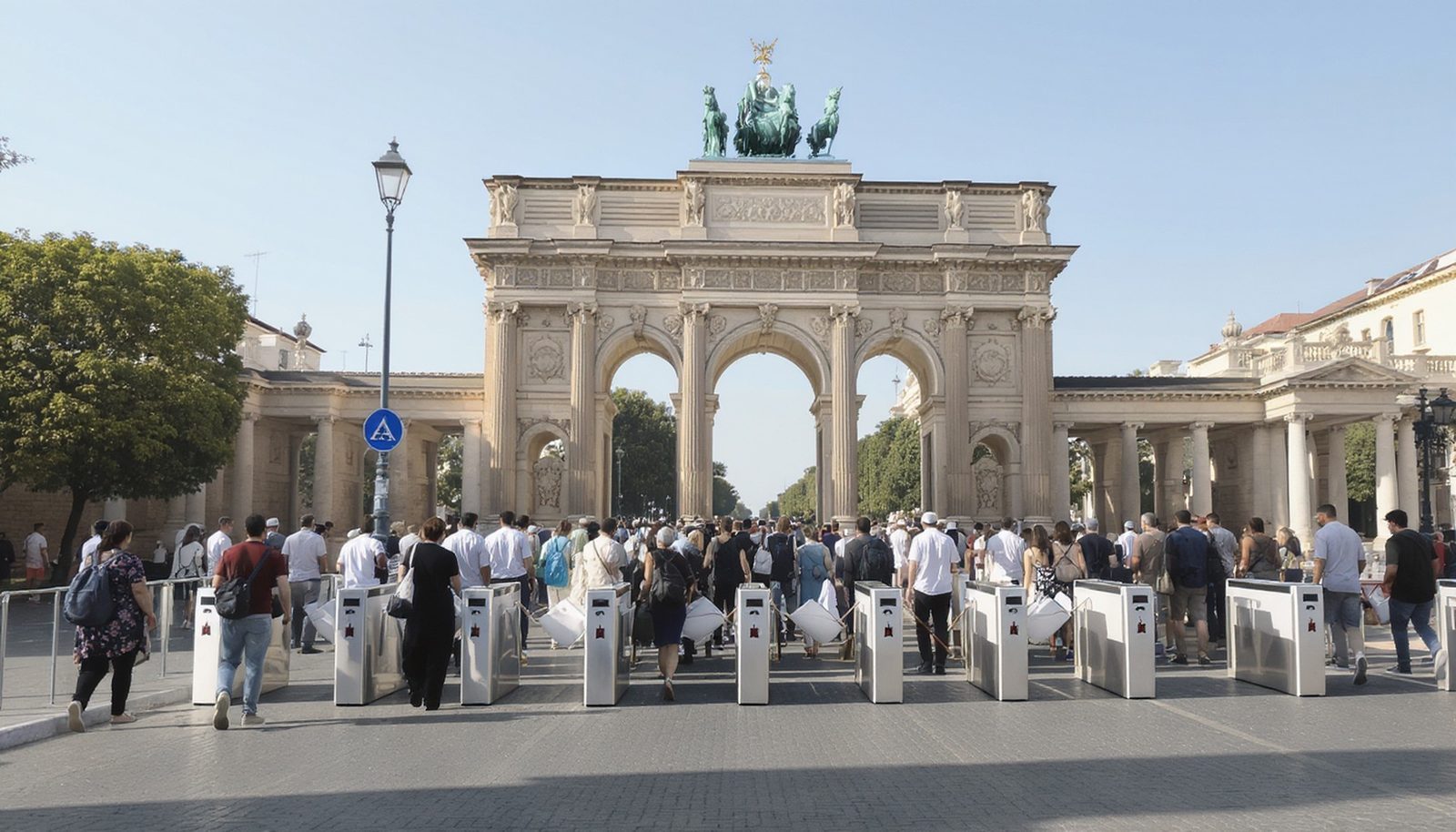
Featured context: why city entry is becoming a pricing decision, not just a ticket
More cities now use entry reservations, timed slots, or congestion fees for visitors. Others still allow open access, where you just show up and move around freely. Behind both approaches is the same logic you see in airline pricing: each side has a reservation pricea walk-away point that decides whether the visit happens at all.
This article is a Destination-focused look at how reservation-based entry compares with open access. I use the idea of reservation price to show why cities choose one model over the other, and how you can decide when, where, and how to visit.
Instead of listing attractions, I focus on trade-offs: cost, flexibility, crowding, and risk. Each section below is a decision you face when you choose between cities or plan time in a city that uses reservations.
Decision 1: Choose between predictable reservations and flexible open access
At the core, you are choosing between two systems:
- Reservation-based entry: You book a time slot or day pass in advance, often with a cap on visitor numbers.
- Open access: You enter whenever you arrive, with no prior booking.
Economically, a city with reservations is setting its own reservation price for crowding and revenue. It wants to avoid the point where extra visitors make the experience worse than the extra income is worth. Open-access cities accept more crowding in exchange for simplicity and possibly higher visitor numbers.
Traveler trade-off:
- If your personal reservation price for hassle and uncertainty is low (you really dislike queues and last-minute stress), reservations fit you better.
- If your reservation price for rigidity is low (you dislike fixed times and non-refundable slots), open access may suit you more, even with heavier crowds.
In reality, you rarely face a pure choice. Many destinations mix both. A city may be open access overall but require reservations for certain zones, museums, or peak hours. The key is to notice which parts of your trip follow reservation rules and which parts stay open.
Decision 2: Match your own reservation price to the city's pricing and access rules
In economics, reservation price is the maximum you will pay (or the minimum you will accept) before you walk away. For city entry, you carry several quiet reservation prices in your head:
- Money: the maximum fee you will pay for entry, congestion charges, or timed tickets.
- Time: the longest queue or waiting time you will tolerate.
- Rigidity: the highest level of schedule constraint you will accept (fixed entry times, penalties for lateness).
Cities also have their own thresholds:
- Minimum revenue per visitor they need to cover infrastructure and crowd management.
- Maximum crowd density they will tolerate before residents and visitors suffer.
Your visit only happens if your reservation prices overlap with the city's. This overlap is the bargaining range or zone of possible agreement. For example:
- If your maximum acceptable entry fee is 8 and the city's minimum is 8, any price between 88 works.
- If your maximum acceptable queue is 30 minutes but the city's open-access system often creates 90-minute queues, there is no overlap unless you change your expectations or the city changes its system.
Practical implications for travelers:
- Write down your thresholds before you book: maximum daily entry fee, maximum queue time, and how many fixed-time commitments you can handle in a day.
- Compare cities or neighborhoods by how their systems match your thresholds. A reservation-heavy historic center can work well if you value predictability. A more open-access city may be better if you care more about spontaneity.
- Use your BATNA (best alternative to a negotiated agreement): if a city's entry rules go beyond your thresholds, look at other destinations or off-peak seasons instead of pushing yourself past your comfort zone.
Decision 3: Accept dynamic pricing or re-time your visit
Many cities and attractions now use dynamic pricing, similar to airlines and ride-sharing. Prices change with demand, time of day, and season. This applies reservation price logic directly: the system tries to charge each visitor as close as possible to their maximum willingness to pay.
For city entry, this can show up as:
- Higher fees for peak days or hours.
- Discounts for early-morning or late-evening slots.
- Seasonal surcharges during festivals or holidays.
You face a clear choice:
- Pay more to go when you want and accept the city's peak-time pricing.
- Shift your visit to off-peak times so you stay under your own reservation price.
Because we cannot use specific numbers here, focus on patterns instead of exact prices:
- Expect weekends and holidays to sit near the upper end of what visitors will tolerate.
- Expect shoulder hours (early or late) to be priced to attract more flexible visitors.
- Expect last-minute availability to be either very cheap (if demand is weak) or very expensive (if demand is high and capacity is tight).
How to decide:
- If your schedule is fixed but your budget is flexible, accept dynamic pricing and book early to avoid extreme peaks.
- If your budget is tight but your schedule is flexible, aim for off-peak slots and build your day around them.
- If both budget and schedule are tight, look at other cities or attractions where open access still dominates and dynamic pricing is softer.
Decision 4: Choose booking channels based on how they use reservation prices
Different booking channels use reservation price logic in different ways. Even without exact data, you can guess their incentives:
- Official city or attraction websites usually set the base rules: caps, time slots, and official fees.
- Online travel agencies (OTAs) may bundle city entry with transport or accommodation and use your total willingness to pay to capture more value.
- Meta-search platforms compare options but may not show every fee or restriction clearly.
- On-site purchase (if allowed) swaps price transparency for queue risk and possible sell-outs.
Each channel is guessing your reservation price and trying to capture as much of it as it can. Your job is to pick the mix of price, risk, and clarity that suits you.
| Channel | Typical advantages | Typical risks | Best for travelers who'' |
| Official city/attraction site | Most direct rules; fewer intermediaries; clearer caps and time slots. | Less bundling; may not show cheaper third-party options. | Want transparency and control over specific entry times. |
| OTA bundles | Combine entry with transport/hotel; one payment. | Harder to see true price of each component; change fees. | Value convenience over granular price optimization. |
| Meta-search | Quick comparison of multiple offers. | May omit fees or restrictions; information overload. | Are willing to invest time to find marginal savings. |
| On-site purchase | Maximum spontaneity; no pre-commitment. | Sell-out risk; long queues; potential higher prices at peak. | Have high tolerance for uncertainty and waiting. |
Decision logic:
- If your reservation price for complexity is low, use official sites or simple bundles, even if they are not the absolute cheapest.
- If your reservation price for overpaying is low, use meta-search to map the price range, then book directly when you can.
- If your reservation price for risk is high (you really dislike being turned away), avoid relying on on-site purchase in reservation-heavy cities.
Decision 5: Set your own walk-away rules to avoid overpaying or over-committing
Travelers often mix up reservation price with a vague feeling that something is expensive. That confusion leads to two common mistakes:
- Accepting non-refundable, rigid reservations that sit above their true comfort level.
- Refusing fair prices early, then paying more later when choices shrink.
To avoid this, treat your planning like a negotiation with the city's system.
Step 1: Define your reservation prices explicitly
- Maximum daily budget for city entry, passes, or congestion fees.
- Maximum number of fixed-time reservations per day (for example, no more than two timed entries).
- Maximum acceptable penalty for changes or cancellations.
Step 2: Compare offers to your thresholds, not to each other
- If a timed entry fits within your thresholds, treat it as acceptable even if you think it might be slightly cheaper later.
- If an offer goes beyond your thresholds, walk awayeven if it is sold as a discount or a last chance.
Step 3: Keep your reservation prices private
In classic negotiation, you never reveal your reservation price. In travel, you cannot fully hide it from algorithms, but you can avoid signaling desperation:
- Do not lock yourself into non-refundable options too early if your plans are still loose.
- Avoid last-minute booking habits that force you to accept whatever is left.
- Use alternative dates or nearby cities as a BATNA: if one city's entry system becomes too strict or too expensive, you have somewhere else to go.
Decision 6: Evaluate non-price costscrowding, local impact, and experience quality
Reservation systems are not only about money. Cities also use them to manage non-price costs like overcrowding, damage to heritage sites, and resident frustration. Open access often shifts these costs onto visitors and locals through congestion and weaker experiences.
From your side, you need to weigh:
- Reservation-based entry usually cuts crowding at specific times and places. This improves experience quality but reduces spontaneity.
- Open access keeps spontaneity high but can push crowding beyond your tolerance, which raises the time price of your visit.
Think of your time and comfort as part of the price you pay. A free but overcrowded square can cost you more in stress and lost time than a moderately priced, well-managed entry system.
How to incorporate this into your planning:
- When you compare cities, include expected crowding and queue times, not just entry fees.
- If you are sensitive to crowding, treat reservation systems as a feature, not a nuisance, as long as they stay within your flexibility limits.
- If you value spontaneity most, accept that you may pay in time and comfort instead of money.
Risks, uncertainties, and edge cases in city entry systems
City entry policies are still changing, so you face several uncertainties and edge cases. You should factor these into your plans.
1. Policy changes and pilot programs
- Cities may add or remove reservation systems with little notice, especially as tests or pilot projects.
- Information can lag across channels. Official sites may update faster than OTAs or guide content.
- Decision implication: Check official sources again close to your travel date, especially if your plan depends on open access.
2. Incomplete transparency about dynamic pricing
- Platforms rarely explain the exact rules behind price changes.
- You cannot reliably pick the single best time to book. You can only work with patterns (peak vs off-peak, early vs late).
- Decision implication: Do not chase perfect timing. Anchor your choices to your reservation prices and acceptable ranges.
3. Misaligned incentives between intermediaries and cities
- Intermediaries may push higher-margin products (bundles, premium slots) over options that best match your thresholds.
- Cities may favor resident comfort over visitor flexibility and tighten caps or raise fees during sensitive periods.
- Decision implication: Cross-check offers on at least two channels (for example, the official site and one aggregator) before you commit.
4. Edge cases: high-demand events and sudden shocks
- During major events, the city's effective reservation price for visitors can jump: higher fees, stricter caps, or even entry bans for non-residents.
- During shocks (health crises, security incidents), systems may switch quickly between open access and strict reservations.
- Decision implication: If your trip overlaps with such events, expect more volatility and build stronger BATNAs: alternative dates, nearby cities, or different trip types.
5. Regulatory and fairness uncertainties
- Consumer-protection rules may limit some forms of price discrimination, but enforcement varies by country and city.
- You may still face opaque fees or conditions that are legal but feel unfair.
- Decision implication: Read refund and change terms carefully, especially for timed entries and bundles, and avoid offers that go beyond your tolerance for ambiguity.
Putting it all together: a simple framework for choosing between reservation-heavy and open-access cities
You can make your destination choice more deliberate by turning the earlier decisions into a simple framework.
Step 1: Classify the city or area
- Is it moving toward reservation-heavy management (timed entries, caps, dynamic pricing)?
- Is it still mostly open access with few formal controls?
- Is it a hybrid, with certain zones or attractions under reservation rules?
Step 2: Map your own thresholds
- Budget: maximum daily spend on entry and related fees.
- Flexibility: maximum number of fixed-time commitments per day.
- Risk tolerance: acceptable chance of queues, sell-outs, or policy changes.
Step 3: Check for overlap (the bargaining range)
- If the city's system fits comfortably within your thresholds, go ahead and use reservations strategically to cut uncertainty.
- If the city's system keeps pushing you beyond your thresholds, look at other destinations or different seasons.
Step 4: Choose booking channels that match your priorities
- Use official sites when you want clarity and control.
- Use aggregators to understand the price range, but be careful not to get pushed into bundles that exceed your thresholds.
- Use on-site purchase only when your tolerance for uncertainty and queues is high.
Step 5: Treat your plan as a negotiation, not a one-shot decision
- Revisit your thresholds if conditions change (new fees, new caps, or new crowding information).
- Be ready to walk away from specific time slots, attractions, or even cities that no longer fit your reservation prices.
When you see city entry as a negotiation between your reservation prices and the city's, you can choose more deliberately where to go, when to book, and how much structure you accept. This approach will not remove uncertainty, but it turns vague discomfort into clear trade-offs you can manage.