
I’ve done the move for work while still working full time
dance more than once. It’s stressful, expensive, and full of tiny traps no one warns you about. This guide is the playbook I wish I’d had the first time I had to relocate for work on short notice.
We’ll walk through the real decisions you face when you’re relocating for a job on a tight timeline: what a corporate relocation cost breakdown actually looks like, how to keep your day job from imploding, and how to push back (politely) when the relocation package doesn’t match reality.
Think of this as a cost and stress control manual, not a fluffy list of generic moving tips. If you’re relocating for work while full time, you need something more practical than that.
1. First Decision: Is Your Relocation Package Actually Enough?
Before you pack a single box, ask one blunt question: does your relocation package cover a realistic move, or is it wishful thinking on HR’s part?
Most companies offer one of three setups when it comes to corporate relocation benefits:
- Lump sum: A flat amount (often $5,000–$15,000 for many mid‑level domestic moves) paid directly to you. Flexible, but every dollar is your problem to manage, and the hidden costs of corporate relocation can eat through it fast.
- Fully managed: A relocation management company books movers, flights, temporary housing, and more. Less flexibility, more hand‑holding, and usually a clearer corporate relocation cost breakdown.
- Core‑flex: A few
must have
benefits (household goods, travel) plus a menu of optional services you can pick from. Good for tailoring the move to your life.
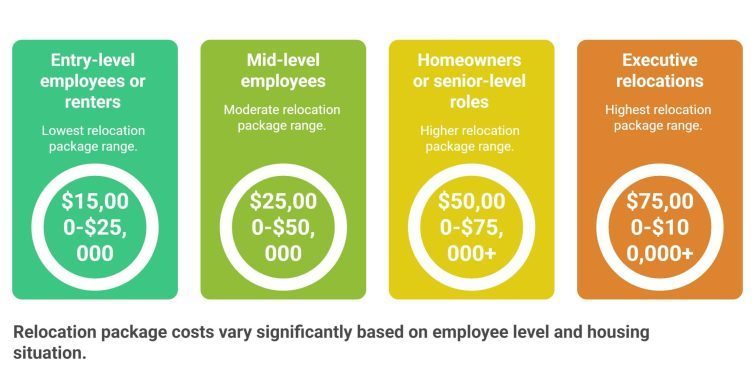
According to benchmarks like CapRelo and moveBuddha, typical U.S. domestic ranges look roughly like this:
- Entry‑level renters: about $5,000–$15,000
- Mid‑level professionals: about $15,000–$35,000
- Executives with homes/families: $55,000–$90,000+ (especially with home sale help)
Now compare that to your reality:
- Are you a renter or homeowner?
- Is this a local move, cross‑country, or international?
- Single, couple, or kids + pets in the mix?
- Do you need temporary housing, or can you move straight into a new place?
If your lump sum is $7,500 but you’re moving a family of four across the country with a car and a dog, you already know the math doesn’t work. That’s not pessimism; it’s just arithmetic.
This is where an employee relocation package comparison becomes useful. Look at what peers in similar roles and locations typically receive. If your offer is clearly on the low end for a fast corporate relocation, that’s a signal.
Takeaway: Don’t accept the package at face value. Compare your offer to realistic ranges and your actual life. If there’s a gap, you either negotiate or plan for out‑of‑pocket costs.
2. Second Decision: DIY vs. Professional Movers (When You Still Have a Day Job)
On a tight timeline, while working full time, the should I just rent a truck and DIY this?
question is dangerous. It looks cheaper. It rarely is once you factor in time, stress, and the cost of rushed relocation mistakes to avoid.
Here’s what the commercial moving world tells us about cost baselines:
- Small office / small household‑equivalent moves: often $1,000–$5,000 for local moves, depending on volume and access.
- Larger or more complex moves: $15,000+ is common when there’s more furniture, IT, or distance involved.
- Hourly rates: professional crews often run $80–$200+ per hour depending on market and crew size.
Yes, those numbers are for offices, but the pricing logic is the same for your household: labor hours drive cost. Stairs, elevators, long walks from truck to door, and dense furniture all add time and money.
Now layer in your reality:
- You’re still working 40–60 hours a week.
- You probably can’t take a full week off just to pack.
- You may need to be online and productive the day after the move.
DIY sounds heroic until you’re answering emails at midnight, surrounded by half‑packed boxes and a disassembled bed frame. The stress of moving for work while working full time is real, and it has a cost.
How I’d decide:
- Choose professional movers if your relocation package covers most of it, you’re moving more than a studio, or you have a tight start date. For a short notice corporate move, this is often the only way to stay sane.
- Consider partial DIY (you pack, they move) if you’re short on cash but long on evenings and weekends. This can be an affordable corporate relocation strategy if you’re disciplined.
- Full DIY only makes sense if you have minimal stuff, flexible timing, and a strong back—or a lot of helpful friends.
Takeaway: When you’re still working full time, your most valuable asset isn’t the $300 you save on movers. It’s your time, energy, and ability to show up functional in your new role.

3. Third Decision: What Exactly Is Covered (and Where Will You Get Burned)?
This is where most people get surprised. The relocation package sounds generous until you hit the fine print and the exceptions
. That’s where the hidden costs of corporate relocation live.
Typical benefits might include:
- Household goods move (packing, loading, transport, unloading)
- Travel to the new location (flights, mileage, hotels)
- Temporary housing for a few weeks or months
- Car shipping or mileage reimbursement
- Storage for a limited period
- Tax gross‑up (to offset taxes on taxable benefits)
But here’s what often isn’t covered or is capped:
- Long‑carry fees: when movers have to walk more than a set distance from truck to door.
- Stair/elevator surcharges: especially in urban buildings.
- Extra stops: like picking up items from storage or a second address.
- Storage beyond a short window: 30–60 days is common; after that, it’s on you.
- Vehicle shipping: often excluded or heavily capped.
- Pet relocation: usually your problem unless you’re at a senior level.
Commercial move guides (like The Boss Magazine) also highlight hidden fees for things like specialty items, utility disconnection/reconnection, and complex access. The same patterns show up in personal relocations and fast corporate relocation costs.
What to clarify with HR or the relocation vendor:
- Is there a cap on total moving costs? What happens if we go over?
- Are packing and unpacking included, or just transport?
- Is storage included? For how long? At what cost after that?
- Are cars covered? One or multiple?
- Is there a tax gross‑up on lump sums or reimbursements?
Don’t be shy about asking for specifics in writing. We usually cover that
is not a policy.
Takeaway: Your goal is to turn a vague promise into a clear list of covered and uncovered items. Every uncovered item is either a negotiation point or a line in your personal budget.

4. Fourth Decision: How to Build a Realistic Budget (Fast)
Once you know what’s covered, you need a real budget. Not a guess. Not a we’ll see.
A line‑by‑line estimate you can stress‑test—especially if the cost of moving for a new job quickly is higher than you expected.
Commercial relocation guides give us some useful rules of thumb:
- Direct moving costs often scale with size and volume (more stuff = more money).
- Local moves are often billed hourly; long‑distance moves are priced by weight and distance.
- Extra services like packing, assembly, storage, and logistics planning can add hundreds or thousands of dollars.
Translate that into a personal relocation budget like this:
- Household goods move
Get at least three quotes. Ask for:- Base move cost (packing, loading, transport, unloading)
- Estimated weight or volume
- Any surcharges (stairs, elevators, long carries, fuel)
- Travel and temporary housing
Estimate:- Flights or mileage for everyone
- Hotels or short‑term rentals (often 2–8 weeks)
- Meals and incidentals (even if partially reimbursed)
- Cars and pets
Decide whether you’re driving or shipping vehicles. Add vet visits, crates, and pet transport if needed. - Setup costs
Think deposits, utility setup fees, new furniture, and anywe’ll just buy it there
items. - Buffer for surprises
Based on industry experience, add 10–20% on top of your best estimate. Long‑carry fees, extra boxes, and storage creep up fast.
Now overlay your relocation package on top of that budget. Where there’s a gap, you have three options:
- Negotiate more support.
- Cut costs (sell or donate items, reduce storage, DIY some packing).
- Plan for out‑of‑pocket and decide if the move is still worth it.
If you like structure, treat this as your personal corporate move budgeting checklist. It doesn’t have to be fancy—just accurate.
Takeaway: A written budget is your stress‑reduction tool. It turns vague anxiety into specific numbers you can act on.

5. Fifth Decision: Timeline vs. Sanity – How Fast Can You Actually Move?
Companies love aggressive timelines: Can you start in four weeks?
Meanwhile, you’re staring at a lease, a family, and a calendar that doesn’t bend. That’s the reality of a tight deadline employee relocation.
Here’s the tension: the faster the move, the more it usually costs. Commercial movers see this all the time—compressed timelines mean more crews, more trucks, and more overtime. The same logic applies to your household move and your corporate relocation timeline planning.
On a tight timeline, you need to decide what you’re optimizing for:
- Minimize downtime: You want to be online and functional almost immediately.
- Minimize cost: You’re willing to stretch the move over more days or weeks.
- Minimize chaos: You want a phased move (e.g., you move first, family follows later).
Some practical moves:
- Phase the move: Ship essentials first (bed, basic kitchen, work setup). The rest can follow later or go into short‑term storage.
- Use temporary housing strategically: Sometimes it’s cheaper to live in a corporate apartment for a month while you house‑hunt than to rush into a bad lease.
- Negotiate start dates: Ask for a later official start or a soft start (remote first, then in‑person) if the move window is unrealistic.
Remember: your employer has a stake in you not burning out or showing up half‑functional. Framing the conversation as Here’s what I need to be fully productive by Day 1
is more effective than This is too hard.
Takeaway: A tight timeline doesn’t mean you have to accept chaos. Use phasing, temporary housing, and negotiation to protect your energy and your wallet.
6. Sixth Decision: How to Keep Working While Everything Is in Boxes
This is the part no one budgets for: your productivity. Corporate relocation guides talk about downtime
as a cost for businesses. For you, downtime is missed work, late projects, and a bad first impression in a new role.
So you plan your move like an IT cutover: minimal downtime, clear fallback, and a checklist. When you’re relocating for work while full time, this matters as much as the boxes themselves.
Non‑negotiable steps:
- Protect your work setup: Laptop, chargers, monitor, headset, and any critical documents travel with you, not in the moving truck.
- Schedule the move around your calendar: Avoid moving on days with major meetings or deadlines. Block your calendar early.
- Test your new internet before Day 1: If possible, arrive a day early or have someone on site to confirm connectivity.
- Have a backup plan: Hotspot, coworking space, or a nearby café with reliable Wi‑Fi for the first few days.
Think like the office IT teams in those relocation case studies: they plan cutovers, label everything, and test before go‑live. You’re doing the same, just for your home office.
Takeaway: Your employer is paying for your brain, not your boxes. Protect your ability to work by treating your home office like mission‑critical infrastructure.

7. Seventh Decision: What to Negotiate (Without Being a Pain)
If your package doesn’t match your reality, you have two choices: quietly absorb the cost or negotiate. I’m biased toward negotiation, but with data and a calm tone.
Here’s what’s often negotiable:
- Higher lump sum or cap: Especially if you’re moving long‑distance, own a home, or have a family.
- Temporary housing duration: Extending from 30 to 60 days can be the difference between panic‑renting and finding a good place.
- Storage coverage: If your move‑in date lags behind your move‑out date.
- Car shipping: Even a partial reimbursement helps.
- Tax gross‑up: So you’re not paying taxes on the benefits out of pocket.
How to frame the ask:
- Show your budget and where the gaps are.
- Explain how the extra support will help you be fully productive faster.
- Offer trade‑offs if needed (e.g.,
If we can extend temporary housing, I can handle more of the packing myself.
).
Companies know relocation is expensive. They also know losing a new hire or having them underperform is more expensive. You’re not asking for charity; you’re aligning incentives and clarifying the balance between company relocation benefits vs out of pocket costs.
Takeaway: A calm, data‑driven conversation about relocation costs is part of being a professional, not a diva.
8. Final Decision: Is This Move Worth It—for You?
One last, uncomfortable question: Is this move actually worth it for your life, not just your career?
By now you should have:
- A clear relocation package (what’s covered, what’s not).
- A realistic budget with a buffer.
- A timeline that’s at least somewhat under control.
- A plan to stay productive through the chaos.
Now zoom out:
- Does the role, pay, and growth justify the financial and emotional cost?
- Are you okay with the risk that the job might not be permanent, but the move is?
- Is your family or partner genuinely on board, or just tolerating it?
This is where a step by step corporate relocation guide stops being theoretical and becomes personal. You’re not just checking boxes; you’re deciding what kind of life you want on the other side of this move.
Final takeaway: Treat your relocation like a project with a budget, a timeline, and clear success criteria. The more intentional you are, the less you’ll feel like the move is something happening to you—and the more it becomes a strategic choice you’re making for your own future.