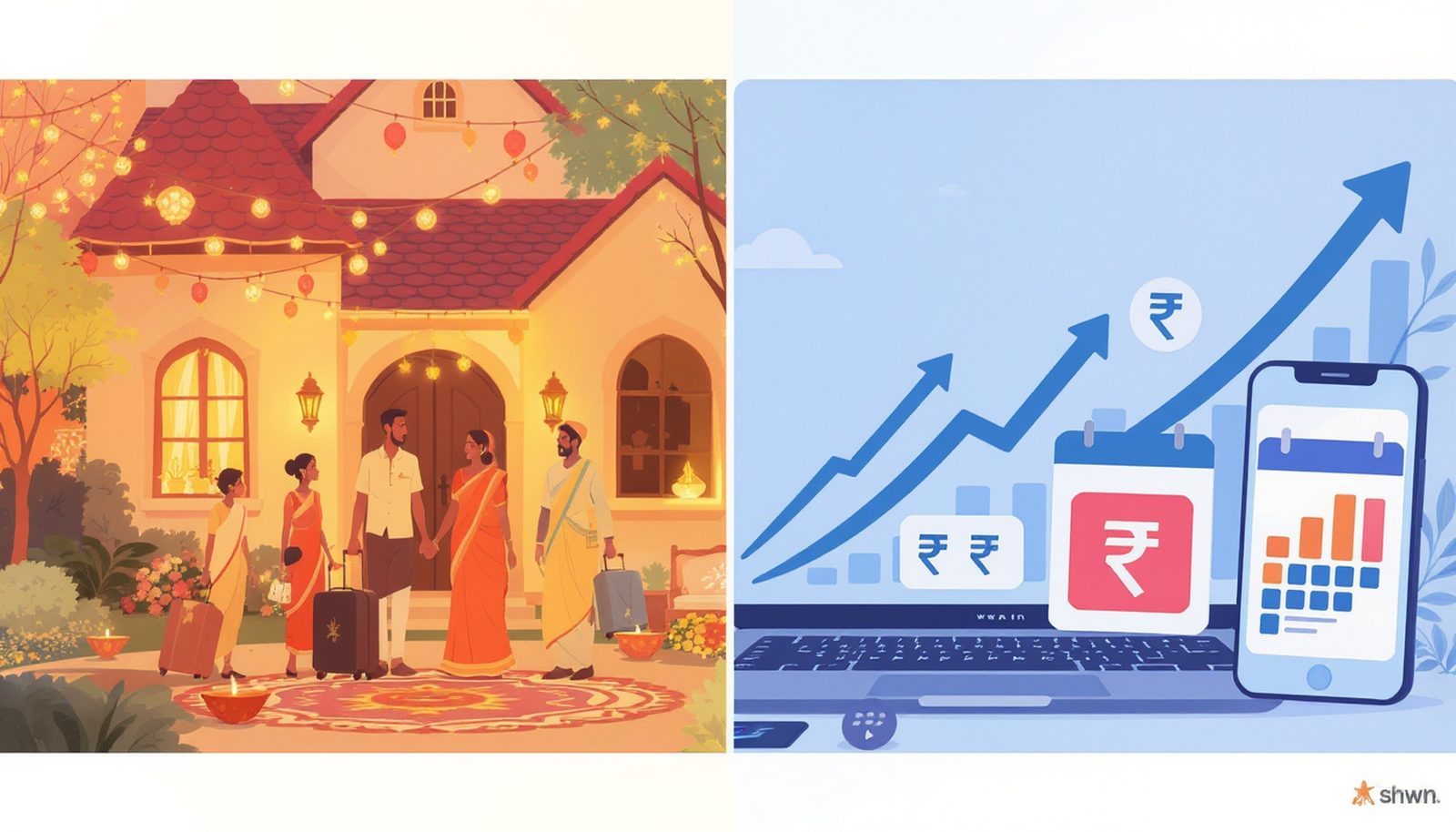
Diwali used to mean packed trains, crowded buses, and a once-a-year family reunion. Increasingly, it also means browser shock: airfares that resemble international tickets for a one-hour hop, and Premium Tatkal rail prices that triple overnight. This is not random greed; it is the predictable outcome of how India’s transport system prices scarcity during emotionally charged festival weeks.
This article sits in the Destination '2 Avoid Mistakes space. Instead of listing hacks, it dissects the logic behind Diwali surge pricing. Understanding that logic is the only reliable way to decide whether to travel on-peak, shift dates, or switch modes when “Diwali airfare surge versus shifting travel dates” becomes a household debate.
1. Why Diwali Has Become a Predictable Surge-Pricing Season
Diwali is no longer just a peak; it is a scheduled stress test for India’s dynamic pricing systems. Airlines and Indian Railways both use yield-management algorithms that continuously adjust prices based on remaining inventory, booking pace, and historical patterns. Around Diwali, these systems face an unusually strong and emotionally inelastic demand curve.
Three mechanisms interact:
- Emotionally anchored demand: For many travelers, Diwali dates are non-negotiable. People will pay more, borrow, or cut other expenses rather than skip a once-a-year family gathering. Algorithms “see” this as bookings that keep coming despite rising prices.
- Finite, pre-committed capacity: Airlines and railways cannot add unlimited seats at short notice. Aircraft rotations, crew duty limits, and saturated rail corridors into metros mean that the number of seats around Diwali is largely fixed weeks in advance.
- Dynamic pricing tuned to scarcity: As seats fill, the system moves remaining inventory into higher fare buckets. When demand is strong and capacity is tight, the last 10–20% of seats can be priced at 3–4x off-peak levels.
The result is a festival surge pattern that repeats each year:
- Fares on the 1–2 peak outbound days (towards hometowns) and 1–2 peak return days (back to metros) rise sharply.
- Shoulder days in the same week remain significantly cheaper, even on identical routes and airlines.
- Rail quotas that once acted as a safety valve (like Premium Tatkal) now mirror airline-style surge, eroding their role as an affordability backstop.
From a traveler’s perspective, this often feels like exploitation. From the system’s perspective, it is a rational response to a predictable annual spike in demand under capacity constraints.
2. The Cost Stack Behind Diwali Airfare Spikes
To understand why airlines lean so heavily on Diwali surge pricing, it helps to unpack the structural cost pressures that raise their breakeven point. While we lack precise percentage contributions for each factor, the direction of impact is clear.
2.1 Structural cost drivers
- Weaker rupee: A significant share of airline costs—aircraft leases, maintenance, insurance, and some technology systems—are dollar-denominated. When the rupee weakens, these costs rise in local-currency terms even if the underlying dollar prices are stable.
- High aviation turbine fuel (ATF) taxes: ATF is heavily taxed in India compared with many markets. Fuel is already one of the largest cost components; high taxes amplify its impact, especially on shorter domestic sectors where fuel is a larger share of total cost.
- Leases and maintenance: Modern narrow-body aircraft are often operated on operating leases. Lease rentals and heavy maintenance checks are priced in dollars and must be paid regardless of how full flights are.
- Aircraft groundings and retrofits: Engine issues and mandated retrofits can ground aircraft for weeks or months. Each grounded aircraft removes hundreds of seats per day from the system, tightening capacity and raising the revenue pressure on remaining flights.
These factors push up the minimum revenue per seat airlines need to stay viable. When off-peak competition keeps fares low, peak periods like Diwali become crucial for recovering fixed costs.
2.2 How airlines use Diwali to recover revenue
Dynamic pricing allows airlines to treat Diwali as a revenue-recovery window. Two mechanisms are particularly important:
- Recovering both legs on one direction: On routes with heavy one-way festival flows (e.g., metro '2 Tier-2 city before Diwali, reverse after), airlines may price the high-demand leg so that it effectively covers a large share of the cost of the lower-demand leg. This is why a one-way ticket can sometimes cost nearly as much as a typical round trip.
- Monetizing the last seats aggressively: Because fixed costs are largely covered by earlier bookings, the last seats can be priced at very high levels. If even a small fraction of travelers accept these prices, the revenue contribution is disproportionately large.
In a year when Diwali-week capacity is slightly lower than the previous year—domestic flights per week down around 3.1% after earlier double-digit growth—this logic intensifies. Fewer seats plus strong demand equals more pricing power for the algorithm.
3. Railways’ Premium Tatkal: From Safety Valve to Surge Engine
Indian Railways historically acted as the affordability backstop for festival travel. Even if flights were expensive, a sleeper-class ticket was usually within reach. The introduction and evolution of Premium Tatkal has complicated that picture.
3.1 How Premium Tatkal changes last-minute rail pricing
Premium Tatkal is a quota of last-minute seats priced dynamically above the regular Tatkal fare. While the exact algorithm is not fully transparent, its behavior around Diwali shows some clear patterns:
- Stepwise price jumps: As the Premium Tatkal quota fills, fares can jump in discrete steps, sometimes reaching up to three times the base fare.
- Small quota, high leverage: Because the quota is limited, each booking moves the remaining seats into higher price bands quickly when demand is strong.
- Convergence with airfares: On some routes and dates, Premium Tatkal AC fares approach or even exceed low-cost carrier airfares booked well in advance.
Mechanically, this means that the rail safety net is conditional on early action. For travelers who decide late—or who lack the digital access and awareness to book as soon as bookings open—the system behaves more like an airline: high prices for the last seats.
3.2 Who loses when rail pricing becomes dynamic
The shift has equity implications:
- Lower-income travelers: Those who cannot pay upfront months in advance, or who rely on cash rather than digital payments, are more likely to end up in the Premium Tatkal window.
- Digitally excluded travelers: People without reliable internet or familiarity with online booking tools are slower to secure low-fare quotas.
- Uncertain-schedule workers: Migrant workers and gig-economy employees often cannot confirm leave until close to the festival, pushing them into the most expensive fare buckets.
In effect, the system charges a “late decision” penalty that is highest for those with the least flexibility and liquidity.
4. Diwali Airfare Surge vs Shifting Travel Dates: The Core Trade-off
For households, the practical question is not whether surge pricing exists—it clearly does—but whether it is worth shifting travel dates to avoid it. The answer depends on how the pricing algorithms treat different days within the Diwali window.
4.1 How algorithms see the Diwali week
Dynamic pricing systems do not “know” Diwali in cultural terms; they infer it from patterns:
- Historical booking curves show that certain dates see faster and earlier bookings.
- Search and booking activity spikes for specific outbound and return days.
- Corporate and leisure demand mix shifts, with more family and migrant travel.
The system responds by:
- Setting higher starting fares for the most popular dates.
- Moving through fare buckets faster as seats sell.
- Leaving shoulder days with more low-fare inventory for longer.
This creates a price gradient across the week: peak days are expensive, shoulder days less so, even though the physical product (same aircraft, same train) is identical.
4.2 Comparing options: peak vs shoulder vs mode shift
Without inventing specific rupee amounts, we can still map the relative trade-offs travelers face when deciding between peak-day flights, shifted dates, and rail alternatives.
| Option | Relative Cost (vs off-peak) | Time & Convenience | Risk & Uncertainty |
| Fly on peak Diwali dates | Highest (often 3–4x off-peak) | Fastest, most convenient; aligns with family schedules | High price volatility; limited recourse if fares spike further |
| Fly on shoulder days (shift dates) | Moderate (significantly below peak, above off-season) | Requires leave flexibility; may mean missing key rituals | Lower volatility; more fare options and competition |
| Rail regular quota (booked early) | Low to moderate | Slower; potential waitlists; more predictable if booked early | Lower price risk; availability risk if late to book |
| Premium Tatkal rail (last-minute) | High (up to ~3x base fare) | Slower than air; often the only option when late | High price risk; seats may still sell out |
| Multimodal (bus + secondary airport, etc.) | Variable; can be cheaper than peak flights | Longer, more complex itineraries; night travel common | Higher disruption risk; coordination challenges |
The key mechanism is that time flexibility converts into money saved. Shifting travel by even 24–48 hours can move you from the “peak” row to the “shoulder” row in this table, where algorithms are less aggressive because demand is less compressed.
5. Capacity Constraints: Why Adding Seats Is Harder Than Raising Prices
Both airlines and railways face structural limits on how much capacity they can add for Diwali, especially in the short term. This asymmetry—prices can move quickly, capacity cannot—is central to understanding surge behavior.
5.1 Airlines: aircraft, crew, and rotations
For airlines, adding a Diwali flight is not as simple as “turning on” an extra plane:
- Aircraft availability: Grounded aircraft due to engine issues or retrofits reduce the fleet. Leasing additional aircraft just for a few weeks is expensive and operationally complex.
- Crew duty limits: Pilots and cabin crew have regulated duty hours. Squeezing in extra rotations around peak days risks breaching safety limits or requires costly overtime and standby arrangements.
- Airport infrastructure: Slot-constrained airports (especially major metros) cannot easily accommodate many additional take-offs and landings during peak hours.
Given these constraints, airlines often find it more feasible to raise prices on existing flights than to add marginal capacity that may not be fully utilized outside the peak window.
5.2 Railways: saturated corridors and prestige projects
Indian Railways faces its own bottlenecks:
- Track saturation: Key corridors into major cities run near capacity, especially at night and early morning when festival travelers prefer to move.
- Train path constraints: Each additional train requires a path that does not conflict with existing services. During Diwali, the timetable is already dense.
- Prestige vs capacity: High-profile trains like Vande Bharat improve speed and comfort but do not necessarily add large volumes of low-cost seats at the same pace as demand growth.
In this environment, pricing becomes the primary rationing tool. Instead of adding enough seats for everyone who wants to travel at the same time, the system uses higher prices to allocate scarce seats to those willing and able to pay more.
6. Regulation, Algorithms, and the Policy Tension
India’s regulatory stance has shifted from direct control to light-touch oversight. This change is crucial for understanding why Diwali surge pricing is now largely algorithm-driven.
6.1 From fare bands to post-hoc monitoring
Until 2022, domestic airfares in India were subject to banded pricing—regulators set minimum and maximum fares for certain sectors and time windows. These bands were scrapped, and the Directorate General of Civil Aviation (DGCA) moved to a model where:
- Airlines are free to set fares based on market conditions.
- DGCA collects data and monitors for “unreasonable” pricing.
- Direct intervention is reserved for emergencies or extreme cases.
During festival spikes, ministers may issue public appeals and assign tariff monitoring units, but these are soft tools. They rely on voluntary compliance and reputational pressure rather than hard caps.
6.2 The transparency and fairness debate
This regulatory posture has sparked debate among stakeholders:
- Airlines’ position: They argue that market-determined pricing and long-run capacity expansion are the only sustainable ways to keep fares in check. Temporary caps, they claim, would distort incentives and could even reduce capacity.
- Consumer groups and some lawmakers: They highlight opaque algorithms, emotional exploitation during cultural events, and the absence of targeted protections. Proposals include temporary festival caps, real-time fare indices, and mandatory transparency on how dynamic pricing works.
- Pilots’ associations and staff unions: They sometimes align with consumer concerns, especially when aggressive scheduling and pricing create operational stress.
The core policy tension is between market logic (prices should reflect demand and cost) and social expectations (culturally significant travel should remain broadly accessible). With banded pricing gone, algorithms now operate with wide latitude, and the burden of managing surge risk falls largely on households.
7. Behavioral Shifts: How Travelers Adapt Under Surge Pricing
As Diwali fares rise 20–52% year-on-year on key routes, traveler behavior is adjusting in ways that reveal how people trade time, comfort, and certainty against cost.
7.1 Earlier and more strategic bookings
One visible shift is towards earlier booking:
- Families with predictable schedules lock in tickets months ahead to avoid surge.
- Digitally savvy travelers track fare trends and pounce when prices dip.
- Some households pre-book multiple options (e.g., rail and air) and cancel one later, shifting risk back onto the system.
This behavior flattens the booking curve slightly but also means that low-fare inventory disappears earlier, leaving late deciders facing a steeper price wall.
7.2 Secondary airports, red-eye flights, and multimodal workarounds
Another adaptation is the willingness to accept less convenient options:
- Secondary airports: Travelers may fly into or out of secondary airports if fares are lower, then complete the journey by road.
- Red-eye flights: Night flights that were once less popular become attractive if they are priced below prime-time departures.
- Multimodal itineraries: Combinations like overnight bus + morning flight, or train to a nearby city + shared cab, become more common.
These choices effectively convert time and comfort into money. The system’s pricing signals nudge travelers into more complex, sometimes riskier itineraries to stay within budget.
8. Risks, Uncertainties, and Who Bears Them
Surge pricing during Diwali introduces several layers of risk and uncertainty that are not evenly distributed across travelers.
8.1 Price volatility and planning risk
Dynamic pricing makes it hard to know whether today’s fare is “good enough” or whether waiting will help or hurt. This creates:
- Decision paralysis: Households may delay booking in the hope of a drop, only to face higher prices later.
- Overpayment risk: Others may book early at a high fare, then see lower prices later for similar seats.
Without transparent fare indices or clear rules, travelers operate under information asymmetry: the algorithm knows more about demand patterns than they do.
8.2 Social and financial exposure
There are also unquantified but significant social and financial risks:
- Households priced out: Some families simply cannot afford to travel at all, especially when fares approach a week’s salary.
- Borrowing to travel: Others may take on short-term debt to fund Diwali trips, increasing financial stress.
- Unequal recourse: Well-connected or corporate travelers may secure negotiated fares or priority waitlist clearances; informal workers and migrants have fewer options.
Because we lack robust metrics on how many people are priced out or pushed into debt, the true social cost of surge pricing remains under-examined.
8.3 Policy uncertainty
Finally, there is uncertainty about future regulation:
- If temporary caps or transparency mandates are introduced, pricing patterns could change significantly.
- If capacity expansion accelerates, competitive pressure might soften surges over time.
- If neither happens, Diwali may solidify as a permanent “surge season,” with expectations of high fares baked into household planning.
For now, travelers must make decisions under a regime where algorithms are stable, but rules are fluid.
9. Balanced Takeaways: Navigating Diwali Surge Without Illusions
Diwali surge pricing is not a glitch; it is the logical outcome of dynamic pricing algorithms operating in a system with structural cost pressures, constrained capacity, and light-touch regulation. Airlines and railways use these tools to manage scarcity and recover costs. Regulators prioritize market flexibility over direct control. The result is a predictable annual pattern of fare spikes that collides with deep social expectations about family and festival.
For travelers, the key is to see the system clearly:
- Prices are signals of scarcity, not moral judgments. Peak-day fares are high because many people want the same limited seats at the same time.
- Time flexibility is the most powerful lever households control. Shifting travel dates, even slightly, moves you into a different part of the algorithm’s curve.
- Rail is no longer a guaranteed low-cost fallback at the last minute. Premium Tatkal behaves more like airline surge than a safety net.
- Multimodal and off-peak strategies trade comfort and simplicity for cost savings; they are rational responses to the system’s incentives.
At the same time, there are legitimate concerns about equity, transparency, and social impact. Without clearer rules on algorithmic pricing and better data on who is being priced out, the burden of adjustment falls disproportionately on those with the least flexibility and financial cushion.
Until policy and capacity catch up, Diwali will remain India’s annual fare stress test. Understanding the mechanisms behind “Diwali airfare surge versus shifting travel dates” does not eliminate the trade-offs, but it does turn them from a painful surprise into a conscious choice.