Choosing a Category: Why This Is a Destination Decision About Frontier, Not Just a Fee List
This article is a Destination-focused guide because your real “destination” is not just a city. It is Frontier’s specific way of running flights. When you fly Frontier, you choose how you want to travel as much as where you go. Boarding rules, bag rules, and fees all connect. You need to understand that system before you pick Frontier for any route.
Instead of listing prices that change all the time, this guide explains the decision logic behind Frontier’s boarding and bag policies so you can decide:
- When Frontier makes sense for your route.
- Which bag and boarding options to buy (or avoid).
- How to trade time, risk, and comfort against cost.
All recommendations come from the provided decision intelligence: no made-up prices, no hidden data. The focus is on structure, trade-offs, and risk, not on exact dollar amounts that will be outdated by the time you fly.
Decision 1: Is Frontier’s Boarding–Bag System Compatible With Your Risk Tolerance?

Frontier’s model is built on aggressive unbundling. The base fare is low, but almost everything else costs extra. Boarding metrics and bag policies are not side details. They are key tools for revenue and operations. Before you even compare prices, you need to decide if this system fits your risk tolerance and travel style.
How Boarding Metrics Drive Bag Behavior
Frontier has moved from four to seven boarding groups. Earlier groups are usually reserved for:
- Elites and certain credit card holders.
- Travelers who bought specific bundles.
- Travelers who paid for a carry-on or priority boarding.
This structure does two things:
- Monetizes boarding position: earlier boarding is sold through bags and bundles.
- Controls overhead bin demand: by tying carry-on purchases to earlier groups, Frontier can better predict and manage bin use.
Because doors usually close around 15 minutes before departure, boarding metrics also act as a punctuality enforcement tool. Late arrivals, especially in later groups, face a higher risk of denied boarding.
Who This System Favors
Frontier’s boarding–bag design rewards travelers who:
- Are highly price-sensitive and willing to trade comfort and certainty for lower fares.
- Can arrive early and accept strict cutoffs.
- Travel light or can choose smartly between a personal item, carry-on, and checked bag.
- Are comfortable dealing with dynamic, opaque fees and running mock bookings to test options.
It penalizes travelers who:
- Have tight connections or cannot arrive early at the airport.
- Travel with families or groups that need to sit together and coordinate bags.
- Value predictable, all-in pricing more than the lowest headline fare.
Decision Test: Should You Even Start a Frontier Booking?
Use this quick test before you spend time comparing fares:
- If you need schedule certainty (important meetings, events, or fixed connections), Frontier’s strict boarding and dynamic fees are a poor structural fit.
- If you are flexible on dates and times, can arrive early, and are willing to plan a bit, Frontier can be a rational choice.
If you fail the first test (you need certainty and low risk), it is usually better to treat Frontier as a last resort, not a default, no matter how low the base fare looks.
Decision 2: Personal Item Only vs Paid Bags – How Boarding Metrics Change the Math
The most important cost decision on Frontier is not the base fare. It is which bag setup you choose. Boarding metrics are designed to push you toward certain choices, especially paid carry-ons that also unlock earlier boarding.
Three Core Bag Strategies
Frontier’s system effectively forces you to choose among three strategies:
- Strategy A: Personal item only (no paid bags).
- Strategy B: Paid carry-on (often with earlier boarding).
- Strategy C: Checked bag (with later boarding unless bundled).
Because actual fees are dynamic and route-dependent, the key is to understand how each strategy interacts with boarding metrics and risk, not the exact price.
Strategy A: Personal Item Only – Lowest Cost, Highest Constraints
This strategy aims to keep your total cost close to the base fare by avoiding all bag fees. It works best when:
- You are traveling solo or as a very light-packing couple.
- Your trip is short (1–3 days) and does not require bulky items.
- You can fit everything into a bag that meets Frontier’s personal item size limits.
Boarding impact:
- You will likely be in a later boarding group, because you did not buy a carry-on or bundle.
- Overhead bin space does not matter much because your bag must fit under the seat.
- Your main risk is denied boarding if you arrive late, since you have no priority in the queue.
Trade-off: You keep cost low but accept strict packing limits and higher exposure to operational risk if you cut arrival times close.
Strategy B: Paid Carry-On – Paying for Both Space and Time
Buying a carry-on on Frontier is not just about where your bag goes. It is about when you board. Carry-on purchases often place you in an earlier boarding group, which has several effects:
- Higher chance of overhead bin availability.
- Less stress about finding space and being forced to gate-check.
- Some buffer against the strict door-closing time, because your group boards earlier.
This strategy is best when:
- You need more than a personal item but want to avoid baggage claim.
- You value earlier boarding for bin space and lower stress.
- You are willing to pay a premium for both space and time.
Trade-off: You pay more than with Strategy A, but you reduce packing stress and some operational risk. For many travelers, this is the most balanced option, especially on busy routes.
Strategy C: Checked Bag – Lower Cabin Stress, Different Risks
Checked bags on Frontier are priced dynamically and can be expensive if you buy them late or at the airport. However, they change your risk profile:
- You do not worry about overhead bin competition.
- You may still be in a later boarding group unless you bought a bundle with earlier boarding.
- You add baggage handling risk (delays, misrouting) and must wait at baggage claim.
This strategy works when:
- You have bulkier items or are traveling for longer periods.
- You are less sensitive to arrival time at destination because of baggage claim.
- You can buy the checked bag early online to avoid airport price spikes.
Trade-off: You move risk from boarding stress to baggage handling and time at destination. This can be rational for longer trips but is often inefficient for short, simple itineraries.
Comparing Strategies: Cost vs Risk vs Convenience
| Strategy | Typical Boarding Group | Main Benefit | Main Risk |
| Personal item only | Later | Lowest total cost | Strict packing limits, higher denial risk if late |
| Paid carry-on | Earlier | Bin space, earlier boarding, no baggage claim | Higher fee, dynamic pricing |
| Checked bag | Later (unless bundled) | More packing capacity | Baggage delays, claim time, dynamic fees |
Because Frontier’s bag and boarding fees change often, the right decision is not fixed. Always run a mock booking with each strategy and compare the total cost, including the value you place on earlier boarding and lower risk.
Decision 3: Paying for Earlier Boarding – When Does It Actually Make Sense?
Frontier sells earlier boarding indirectly through carry-ons, bundles, and elite status. The key question is not “Is priority boarding nice?” but “When does earlier boarding change my risk or comfort enough to justify the cost?”
Operational Reality: Doors Closing 15 Minutes Before Departure
Frontier’s doors usually close around 15 minutes before departure, earlier than many travelers expect. This has several effects:
- If you are in a late boarding group and arrive close to departure time, you have less buffer before the door closes.
- Gate agents have less flexibility to help late arrivals without delaying the flight.
- Travelers who misjudge security or walking time are more likely to be denied boarding.
Earlier boarding does not change the door-closing time, but it reduces your exposure to last-minute chaos, long lines, and bin shortages.
When Earlier Boarding Is Worth Paying For
Earlier boarding is most worth paying for when:
- You are traveling with a carry-on that must go in the overhead bin.
- You are traveling with children or mobility constraints and need extra time to settle.
- You are on a highly utilized route where bin space will likely be tight.
- You have a tight schedule at destination and want to avoid gate-check delays.
In these cases, paying for a carry-on or bundle with earlier boarding is not just a comfort upgrade. It is a risk management tool.
When Earlier Boarding Is Mostly Cosmetic
Earlier boarding matters less when:
- You are traveling with only a personal item that fits under the seat.
- You are on a lightly loaded flight where bin space is unlikely to be tight.
- You have ample time at both origin and destination and can tolerate minor delays.
In these situations, paying for earlier boarding is mostly about comfort. If your goal is to keep total cost low, you should usually skip it.
Practical Approach: Treat Earlier Boarding as an Insurance Product
Because Frontier’s fees are dynamic, you cannot rely on fixed price rules. Instead, treat earlier boarding like an insurance product:
- Ask: “What is the cost to me if I end up gate-checking, boarding last, or missing the flight?”
- If the potential cost (missed event, lost time, stress) is high, paying for earlier boarding is rational.
- If the potential cost is low, keep your money and accept the risk.
Decision 4: Bundles, Discount Den, and Passes – When Add-Ons Change Bag and Boarding Economics

Frontier sells a mix of products—bundles, Discount Den, promo codes, GoWild! passes, and a co-branded credit card—that can change what you pay for bags and boarding. The problem is that these products sit on top of dynamic fees, so it is easy to misjudge their value.
Bundles: Pre-Paying for a Pattern of Behavior
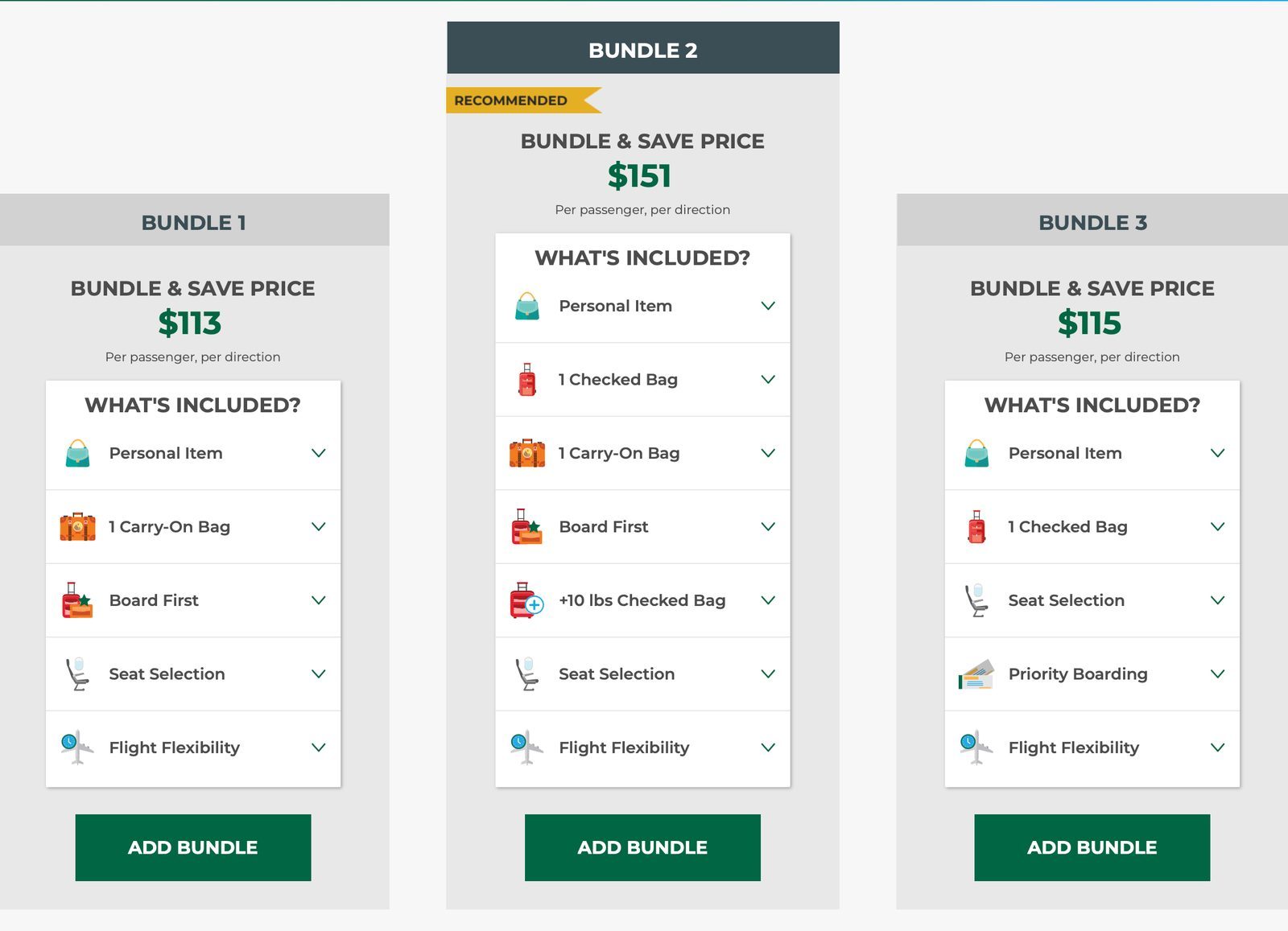
Bundles usually combine items like:
- Carry-on and/or checked bag.
- Seat selection.
- Earlier boarding.
- Sometimes change flexibility.
The logic is simple: Frontier knows many travelers will buy these items separately, so it offers a package at a discount compared with buying each piece individually at that moment. But because single-item fees are dynamic, the value of a bundle is also dynamic.
When a bundle makes sense:
- You know you will need at least two of the included items (for example, carry-on + seat selection).
- You are traveling on a route/date where individual bag and seat fees are high.
- You value the predictability of one upfront price.
When a bundle is a trap:
- You are drawn in by the “discount” but would not have bought all the pieces on their own.
- You are on a route/date where individual fees are low, so the bundle’s “discount” is not real.
- You are traveling very light and only need a personal item.
The smart move is to build a manual comparison during booking. Price your trip with and without the bundle, using your real plan (for example, one carry-on, no seat selection), not the bundle’s full feature list.
Discount Den and Promo Codes: Shifting the Baseline Fare
Discount Den and promo codes mainly change the base fare, not the structure of bag and boarding fees. But they can change how you feel about the deal:
- A lower base fare can make high bag fees feel more acceptable, even if the total trip cost is similar to a legacy carrier.
- Promo codes may apply only to the fare, not to bags or bundles, so they do not touch your main cost drivers.
Use these tools to cut cost, but do not let them distract you from the bag and boarding decisions that actually shape your experience.
GoWild! Pass: Extreme Flexibility Required

The GoWild! all-you-can-fly pass is built for off-peak, last-minute travel. Key features include:
- Short booking windows (for example, 1 day domestic, 10 days international).
- Taxes and fees per segment that add up quickly.
- Blackout dates that remove many high-demand periods.
From a boarding and bag angle, the pass does not remove bag or seat costs. You still must choose between personal item, carry-on, and checked bag, and you still deal with the seven-group boarding system.
Who the pass is for:
- Travelers with extreme schedule flexibility who can travel off-peak and accept last-minute planning.
- People who can fly often enough that the per-trip cost (including taxes and bag fees) becomes attractive.
Who should avoid it:
- Anyone with fixed vacation dates or limited time off.
- Families or groups that need to coordinate schedules and sit together.
- Travelers who dislike last-minute changes and disruption risk.
In practice, the pass shifts flexibility risk onto you. If you cannot use that flexibility, the “unlimited” value disappears fast.
Decision 5: Frontier vs Legacy Carriers – When the Boarding–Bag System Makes Frontier a Bad Deal
Travelers rarely see a clear comparison between a typical Frontier trip and a legacy carrier. Even without exact prices, you can still use a solid decision framework.
Step 1: Build a Realistic Frontier Scenario
For your route and dates, run a mock booking on Frontier and note:
- Base fare.
- Bag fees for your planned setup (personal item only, carry-on, or checked bag).
- Seat selection cost if you care where you sit.
- Any bundle that matches your behavior and its total price.
Then calculate a total trip cost that reflects how you actually travel, not the cheapest theoretical option.
Step 2: Build a Legacy Carrier Scenario
On a legacy carrier (for example, a major U.S. airline), run a similar mock booking:
- Base fare (often higher than Frontier’s).
- Bag fees (usually more stable and sometimes with a free carry-on).
- Seat selection costs, if any.
Legacy carriers often have more predictable fee structures and may include a carry-on in the base fare, which changes the comparison a lot.
Step 3: Compare Total Cost and Risk
Once you have both scenarios, compare:
- Total cost for your real behavior.
- Schedule reliability and rebooking rules if something goes wrong.
- Boarding and bag experience (for example, included carry-on vs paid, boarding group rules).
Frontier is a rational choice when:
- The total cost is meaningfully lower than legacy carriers after you add realistic bags and seats.
- You accept the higher operational risk from strict boarding and limited support.
- You can adjust your packing and timing to Frontier’s constraints.
Frontier is a poor choice when:
- The total cost is only slightly lower than a legacy carrier.
- You value predictability, customer support, and schedule control.
- You are traveling with family or on a time-sensitive trip.
Risks, Uncertainties, and Edge Cases in Frontier’s Boarding–Bag System
Frontier’s model brings several risks and unknowns that are not fully documented. Understanding them helps you decide if the savings are worth it.
Uncertain Frequency of Denied Boarding Due to Late Arrival
We know doors usually close about 15 minutes before departure and that boarding groups are tightly managed. But we do not have clear data on:
- How often travelers are denied boarding for arriving after their group is called.
- How consistently gate agents enforce cutoffs across airports and routes.
- What compensation or rebooking options exist in these cases.
Because of this, you should take a conservative posture: arrive early and do not count on leniency.
Opaque and Volatile Ancillary Pricing
Bag and seat fees are dynamically priced by route, date, and purchase timing. Even frontline agents may give inconsistent answers. This creates several risks:
- You may under-budget for bags and boarding and face sticker shock at checkout.
- You may overpay for bundles or add-ons because you cannot see a stable fee table.
- You may misjudge whether Frontier is actually cheaper than a legacy carrier.
The only real fix is to simulate your exact trip and avoid assumptions based on past flights or other routes.
Irregular Operations and Support Limitations
We do not have detailed comparative data on how Frontier handles delays and cancellations versus legacy carriers, but the low-cost model usually means:
- Less generous rebooking options.
- Possibly longer waits for customer support.
- Fewer alternative flights on the same carrier if your flight is canceled.
For holders of passes or bundles, disruptions can be especially painful if your travel windows are tight or blackout dates apply. You should treat Frontier as a higher-variance option: the trip may be cheap, but the downside in disruption cases can be large.
Edge Cases: Families, Groups, and Special Needs
Families and travelers with special needs face extra complexity:
- Seat selection is dynamically priced and opaque, so it is hard to guarantee sitting together without overpaying.
- Coordinating multiple bags and boarding groups raises the chance of confusion or missed calls.
- Any last-minute change can ripple across several tickets, increasing cost and stress.
Unless the savings are large and you are comfortable managing these issues, families and groups are often better off with carriers that have more predictable policies.
Putting It All Together: A Framework for Frontier Boarding and Bag Decisions
Frontier’s boarding metrics and bag policies are not random fees. They are a designed system that shifts cost and risk onto travelers who value certainty and convenience, while rewarding those who are flexible and very price-sensitive.
To decide whether and how to fly Frontier, use this framework:
- Step 1: Assess your risk tolerance. If you need high reliability and low stress, treat Frontier as a last resort.
- Step 2: Choose a bag strategy. Decide between personal item only, paid carry-on, or checked bag based on trip length, packing needs, and how much you will pay for earlier boarding.
- Step 3: See earlier boarding as risk management. Pay for it when bin space, family needs, or tight schedules make delays costly; skip it when you can live with uncertainty.
- Step 4: Test bundles and passes against your real behavior. Only buy bundles, Discount Den, or GoWild! if they clearly lower your total cost for the way you actually travel.
- Step 5: Compare against legacy carriers. Always build a realistic total-cost scenario for both Frontier and at least one legacy carrier before you choose.
When you treat boarding metrics and bag policies as core design features instead of fine print, you can make clear, deliberate choices about when Frontier is a useful tool—and when it is just extra risk you do not need.