
I’ve sat in enough airport lounges and quarterly budget reviews to notice the same pattern: we obsess over airfare and hotel rates, and almost completely ignore the human cost of business travel.
On paper, a typical trip looks manageable. Around $1,272 for a U.S. domestic trip and $4,570 for an international one, according to WorldMetrics. Or roughly $799 per person per day when you bundle everything together. That’s already a big number.
But here’s the uncomfortable question worth sitting with as you read this:
If you added burnout, turnover, and lost productivity to your travel budget, would half of your trips still make sense?
Once you start looking at the hidden costs of frequent business travel, a lot of “standard” trips stop looking like a good deal.
1. Are You Budgeting for the Trip, or for the Person You’re Sending?
Most companies budget for itineraries, not humans.
We track flights, hotels, per diems. We rarely track what happens to the person who’s on their 14th domestic trip this year (which, in some organizations, is close to the average, per WorldMetrics).
Here’s the visible side of a typical trip:
- Domestic flight: $350–$550
- Hotel: $150–$300 per night
- Meals: $50–$75 per day
- Local transport: $30–$70 per day
- Incidentals: $20–$50 per day
Now the invisible side—the part that rarely shows up in a corporate travel budget analysis:
- Two half-days lost to transit and delays
- Sleep disruption and jet lag
- Backlog of emails and decisions piling up
- Family strain and personal life friction
When I look at travel policies, I often see a subtle but dangerous assumption: As long as the trip is approved and within budget, the impact on the person is acceptable.
That’s rarely true.
Practical shift: instead of asking Can we afford this trip?
start asking Can this person afford this trip, in terms of energy, focus, and health?
That one question changes which trips you approve—and how you think about the real cost of frequent flyer employees to the company.
2. The Productivity Black Hole: How Much Output Disappears When Someone Flies?
We talk about travel as if it’s neutral time. It isn’t. It’s often a productivity black hole.
The basic productivity loss formula is simple, as outlined by the Productivity Loss Calculator:
Productivity Loss = (Expected Output − Actual Output) × Unit Value
Let’s make this concrete.
Say you send a manager who typically produces $2,000 of value per working day (not salary, but the value of decisions, deals, and work they move forward). This is where the lost productivity from business trips really shows up.
- 3-day domestic trip
- 1 day mostly lost to travel (outbound + return)
- 2 days at 50–60% productivity due to meetings, logistics, and fatigue
Rough estimate:
- Expected output: 3 days × $2,000 = $6,000
- Actual output: maybe 1.5 days of real productive work = $3,000
- Productivity loss: $3,000
Now add the direct trip cost. A typical 3-day domestic trip runs around $990–$1,293 according to Zippia. So your real cost is closer to:
$1,200 (trip) + $3,000 (lost productivity) ≈ $4,200
And that’s for one person, one short trip.
Scale that across a team doing 10–20 trips a year each, and you’re quietly burning six figures in productivity without a single line item in your budget. This is the part of business travel ROI calculation that most companies skip.
What I recommend you do:
- Assign a rough daily value to key roles (even a range is fine).
- Estimate realistic productivity on travel days (often 20–60%, not 100%).
- Include this in your trip approval form as a simple field:
Estimated productivity cost: $X
.
Once you see that number next to the airfare, some trips will suddenly look absurd.
3. Burnout: The Line Item You Never See Until People Quit
Frequent travel doesn’t just make people tired. It rewires their lives around airports, hotel rooms, and constant context switching. Over time, that’s a recipe for burnout.
Look at the pattern:
- Average of 14 domestic trips per year for some employees
- Trips often stacked around quarter-end, launches, or big deals
- Recovery time rarely built into schedules
Burnout doesn’t show up as a single dramatic event. It shows up as:
- Slower decisions
- More mistakes
- Shorter tempers with colleagues and clients
- Increased sick days and
mental health days
And eventually, it shows up as a resignation email.
Here’s the uncomfortable math: replacing a high performer can easily cost 50–200% of their annual salary when you factor in recruiting, onboarding, and lost ramp-up time. If heavy travel is a major reason they leave, part of that cost belongs in your travel budget as the cost of employee turnover from travel.
Signals your travel program is burning people out:
- People joke about
living in airports
ornot knowing what time zone they’re in
- Top performers start refusing trips or pushing them onto junior staff
- Teams quietly celebrate when a trip gets canceled
Policy shifts that actually help:
- Cap trips per person per quarter, not just per budget.
- Guarantee no-meeting recovery mornings after red-eyes or long-haul flights.
- Let people opt out of non-critical trips without career penalty.
If you wouldn’t put mandatory monthly red-eye flights
in a job description, be careful about normalizing it in practice. Budgeting for employee travel burnout isn’t soft; it’s risk management.
4. Turnover and Talent: Is Your Travel Policy a Recruiting Risk?
Business travel used to be a perk. For many people now, it’s a red flag.
Look at who travels: business travelers are predominantly higher-income professionals, often in roles where they have options. They can choose employers who respect their time and health.
At the same time, companies are spending more per trip for senior people. Booking.com’s business data shows decision-makers average about $1,986 per trip, compared with $1,771 for non-senior travelers. Larger companies often spend over $2,000 per trip.
So you’re paying more to send your most valuable people on the most exhausting trips. That’s the financial impact of road warrior employees in one sentence.
Now layer in this reality: hybrid and remote work have changed expectations. Around 65% of companies expect remote work to permanently reduce business travel by 20–30%, yet 58% of hybrid companies are seeing a 40% increase in short, frequent trips. Fewer big trips, more constant ping-ponging.
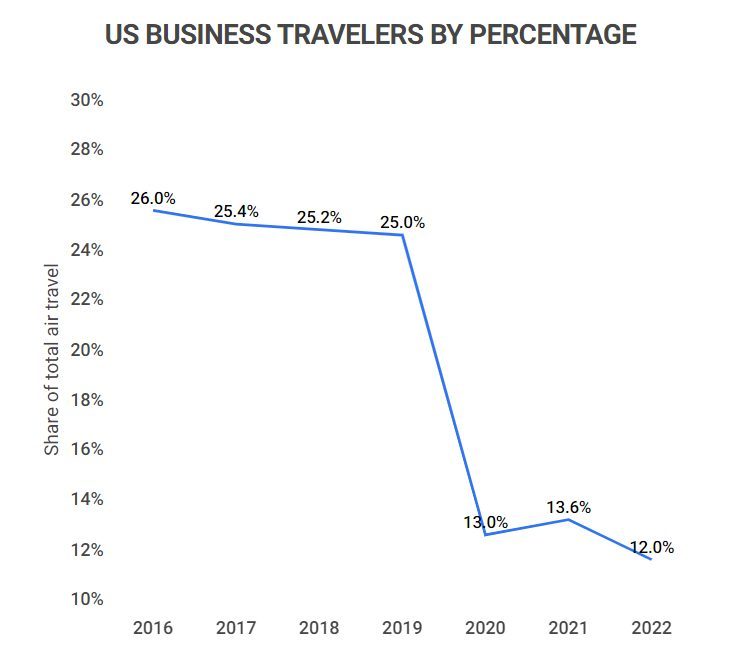
Where this hits talent:
- Candidates ask,
How often would I need to travel?
and they mean it. - High performers quietly self-select out of roles that require constant flights.
- Your employer brand gets tagged as
great experience, brutal lifestyle
.
If your travel expectations are out of sync with the market, you’ll pay for it in higher salaries, slower hiring, and more churn. The link between employee retention and business travel is no longer theoretical; people talk about it openly in interviews.
What I’d build into any modern travel policy:
- Clear, written travel frequency expectations by role.
- Optionality: more use of local reps, partners, or virtual meetings for repeat visits.
- Transparent trade-offs: if a role truly requires heavy travel, compensate and support accordingly.
Travel can still be a perk, but only if it’s purposeful, not relentless.
5. Hidden Financial Costs: The 10–20% You’re Not Seeing
Even if you ignore burnout and turnover for a moment, your travel budget is probably wrong by double digits.
Some numbers that should bother you:
- U.S. corporate travel costs jumped 11% in 2022 vs. 2021.
- About 41% of hidden costs like parking and tolls go unreported.
- Budgets often overshoot by up to 15% due to overlooked incidentals like city taxes and last-minute transport.
Then there’s out-of-pocket spend. Booking.com’s data suggests travelers pay around $700 per trip from their own pocket, mostly on dining, entertainment, and tips. Even if they get reimbursed later, that’s a cash-flow and trust issue.
When people feel like they’re constantly fronting money for the company, resentment builds. That’s a cultural cost, not just a financial one—and another example of corporate travel hidden expenses that never show up in a spreadsheet.
Where I see the biggest leaks:
- Last-minute bookings (airfare can be 25–40% higher vs. 21–30 days in advance).
- Premium ground transport by default instead of by exception.
- Hotel-adjacent meals that blow past reasonable per diems.
- Foreign transaction fees and random city taxes no one budgeted for.
Simple fixes that actually work:
- Use per-diem systems benchmarked to GSA or similar rates instead of itemized chaos.
- Require a short justification for any booking inside a 7-day window.
- Make expense tools non-negotiable: no more manual spreadsheets.
Once you clean up the basics, you can redirect those savings into better travel conditions instead of just more trips.
6. When Is a Trip Actually Worth It? A Simple Decision Framework
Not all trips are bad. Some are game-changing. The problem is we treat them all the same.
To decide when a trip is really worth it—and when a remote meeting would do just fine—it helps to run a quick, honest check. Think of it as a lightweight business travel policy cost guide.
1. Strategic value
- Is this trip tied to a specific, measurable outcome? (deal size, renewal risk, project milestone)
- Could the same outcome be achieved via a high-quality virtual meeting?
2. Total cost (not just T&E)
- Direct cost: flights, hotels, meals, transport, incidentals.
- Productivity cost: days partially or fully lost.
- Human cost: impact on health, family, and burnout risk.
3. Timing and frequency
- Is this trip clustered with others for the same person?
- Is there a smarter way to batch meetings to reduce total travel?
4. Substitution options
- Can a local colleague or partner attend instead?
- Can we combine this with another trip to avoid duplication?
If the strategic value doesn’t clearly exceed the total cost, the default should be: don’t go. In many cases, business travel vs remote meeting costs will favor staying put.
And if you do go, be intentional:
- Stack high-value meetings into the same trip.
- Protect recovery time on the calendar before and after.
- Use the trip to deepen relationships, not just tick boxes.
Travel should feel like a deliberate investment, not a reflex.
7. Designing a Travel Program That Doesn’t Quietly Break Your Team
If you’re serious about fixing this, you don’t need a 50-page policy. You need a few strong, non-negotiable principles that balance business travel ROI with the real cost of business travel fatigue and productivity loss.
Here’s how I’d design a modern travel program.
1. Make total cost visible
- Every trip request shows: direct cost + estimated productivity cost.
- Quarterly reviews include burnout and turnover indicators, not just spend.
2. Put guardrails around frequency
- Set soft caps on trips per person per quarter.
- Flag people who exceed those caps for manager review.
3. Protect recovery as part of the budget
- Build in
no-meeting
blocks after long-haul or red-eye flights. - Allow flexible work-from-home days post-trip.
4. Use tech, but don’t hide behind it
- Leverage AI tools and chatbots to cut planning time (some companies see 40% reductions).
- Use real-time tracking for safety, not surveillance.
5. Treat travel as a privilege, not a punishment
- Give people a say in how often they travel.
- Offer meaningful perks on necessary heavy-travel roles (extra PTO, wellness support, better class of travel when justified).
In other words: design a travel program you’d be willing to live under yourself. If your road warriors are quietly breaking down, your corporate travel budget analysis is incomplete.
8. The Real Question: What Are You Actually Optimizing For?
Corporate travel is rebounding. Global business travel spending is projected to hit $1.7 trillion, surpassing pre-pandemic levels. The temptation is to slide back into old habits: more trips, more miles, more status.
But if you’re honest, what are you optimizing for?
- Airline status and hotel points?
- Activity that looks like progress?
- Or actual outcomes, delivered by people who aren’t exhausted?
When you start budgeting for burnout, turnover, and lost productivity, a lot of standard
business travel stops looking rational. That’s not a bad thing. It’s a chance to rebuild something better—and to finally see the hidden costs of frequent business travel for what they are.
If you want a simple next step, try this:
- Pick one team that travels a lot.
- Estimate the productivity cost of their last quarter of trips.
- Ask them, privately:
Which of these trips were truly worth it?
The answers might change how you budget for travel next year—and how many people are still around to take those trips.