I love a good guided tour. Someone else handles the logistics, I just show up with coffee and curiosity. But there’s one line in almost every brochure that quietly wrecks a lot of budgets:
Some free time to explore on your own.
Sounds harmless, right? Relaxing, even. In reality, that “free time” is often the most expensive part of your trip—because it’s the part you pay for out of pocket.
Let’s unpack what that really means, how the cost of free time on tours adds up, and how to budget for all those extras and add‑ons without coming home to a nasty credit‑card bill.
1. The Itinerary Trap: What “Free Time” Really Means for Your Wallet
When I read a tour itinerary now, I don’t start with the glossy photos. I start with the gaps.
- “Breakfast included” usually means lunch and dinner are on you.
- “Afternoon at leisure” means you’re paying for whatever you do from 1–6 p.m.
- “Optional excursion” means not included in the base price.
Most escorted tours bundle the big stuff—hotels, transport, a few tickets, some meals. That’s the part you see in the headline price. What you don’t see is the daily drip of costs hiding in those “free” pockets of time: meals, taxis, small entry fees, and all the little things that don’t show up in the brochure.
If you want to spot tour package hidden costs, grab the day‑by‑day schedule and literally mark it up:
- Circle every meal that’s not mentioned.
- Highlight every block of “free time,” “at leisure,” or “explore on your own.”
- Underline anything labeled “optional,” “suggested,” or “not included.”
That marked‑up itinerary becomes your real budget worksheet. It shows you exactly where the tour ends and your wallet begins—and where those tour extras and add‑ons are likely to sneak in.
Takeaway: Don’t just ask, “What’s included?” Ask, What exactly is not included, and how many hours per day is that?

2. Meals Off the Tour: The Silent Budget Killer
Food is where a lot of people get blindsided. The brochure says daily breakfast and several dinners included
and your brain quietly files the rest under “probably cheap.” It rarely is.
On many mid‑range Europe tours, for example, you’ll see something like:
- Breakfast: usually included at the hotel.
- Lunch: almost always on your own.
- Dinner: maybe half included, half on your own.
Now do some quick math for a typical city:
- Lunch: €12–€20 per person
- Dinner: €20–€35 per person (more if you add wine or dessert)
- Snacks, coffee, water: €5–€10 per day
That’s €40–€60 per person per day just on food that isn’t in your tour price. Over a 10‑day trip, you’re looking at €400–€600 per person—before you even think about a splurge meal.
In pricier places (Scandinavia, Switzerland, central Paris), those numbers climb fast. In cheaper regions, they drop—but they almost never disappear. If you’re wondering how much spending money for a guided tour you really need, meals off the tour are a huge part of the answer.
Here’s how I handle it now:
- Count how many lunches and dinners are on my own.
- Assign a realistic average (for example, €15 for lunch, €25 for dinner).
- Multiply it out and add a 10–20% buffer for that one amazing restaurant I’ll inevitably find.
Takeaway: Your “free” evenings are often a €40–€60 line item per day. Treat them like another tour cost, not an afterthought.
3. Optional Excursions: Smart Upgrade or Budget Booby Trap?
Optional excursions are where tours quietly turn into tiered products. The base price gets you the skeleton. The add‑ons put meat on the bones.
Typical examples:
- Evening river cruise with dinner
- Cooking class or wine tasting
- Side trip to a nearby town or viewpoint
- Cultural show or folk performance
These can easily run $40–$150 per person each. Do two or three and you’ve quietly added several hundred dollars to your “all‑in” tour. This is where budgeting for optional excursions really matters.
Here’s how I decide what’s worth it:
- Check if you can DIY it. Could you book the same experience yourself for less, without wrecking your schedule? Sometimes yes (a museum ticket). Sometimes no (a complex day trip that the tour company has dialed in).
- Look at the time cost. If the optional excursion uses your only free afternoon in a city you’re excited about, is that how you want to spend it?
- Pre‑price everything. Before I leave, I list each optional excursion, its cost, and mark it as
must‑do
,nice‑to‑have
, orskip
.
Many operators let you prepay optional excursions. I like this for two reasons:
- It locks in the cost before exchange rates or prices move.
- It keeps my on‑the‑ground spending lower and more predictable.
Takeaway: Treat optional excursions like a menu. Decide what you’ll “order” before you’re tired, jet‑lagged, and easily upsold on the bus.
4. Tips, “Free” Tours, and the Gratuity Gray Zone
Tipping on tours is where a lot of people either overspend out of guilt or under‑budget out of confusion. It’s one of those tour not included expenses that doesn’t look big on paper but adds up fast.
On many guided tours, you’ll be expected (or strongly encouraged) to tip:
- Tour manager / director: often around $7–$9 per person per day
- Driver: around $4–$5 per person per day
- Local guides: $2–$3 per person per tour
On a 10‑day tour, that can easily be $150–$200 per person in tips alone if you follow the guidelines. Many people don’t factor this into their free time activities travel budget at all.
Then there are the “free” walking tours in cities you visit before, after, or during your main tour. They’re technically pay‑what‑you‑want, but guides usually earn only from tips. A common range is:
- €10 for a good tour
- €15 for a very good one
- €20+ if it was outstanding or you’re in a pricier city
Do two or three of those and you’ve added another €30–€60 per person to your “free time” budget.
My approach now:
- Before I go, I calculate a tipping total based on the tour’s own guidelines.
- I set aside that amount in cash (or a mix of cash and card where appropriate).
- I mentally add one or two “free” walking tours to my budget at €15–€20 each.
Takeaway: Tips aren’t a surprise; they’re a known cost. Treat them like part of the tour price, not a last‑minute extra.
5. Local Transport, Little Fees, and the “Mistake Tax”
Guided tours feel all‑inclusive until you step off the bus during free time. Then the meter starts running.
Common extras you’ll pay for yourself:
- Metro, tram, or bus rides during free time
- Taxis or rideshares when you’re tired or it’s late
- Small museum or church entry fees not covered by the tour
- Locker fees, cloakrooms, public toilets in some countries
- ATM fees and foreign transaction fees
Individually, these look tiny. Together, they can easily hit $10–$20 per day per person. They’re classic out of pocket costs on group tours that rarely get mentioned in the sales pitch.
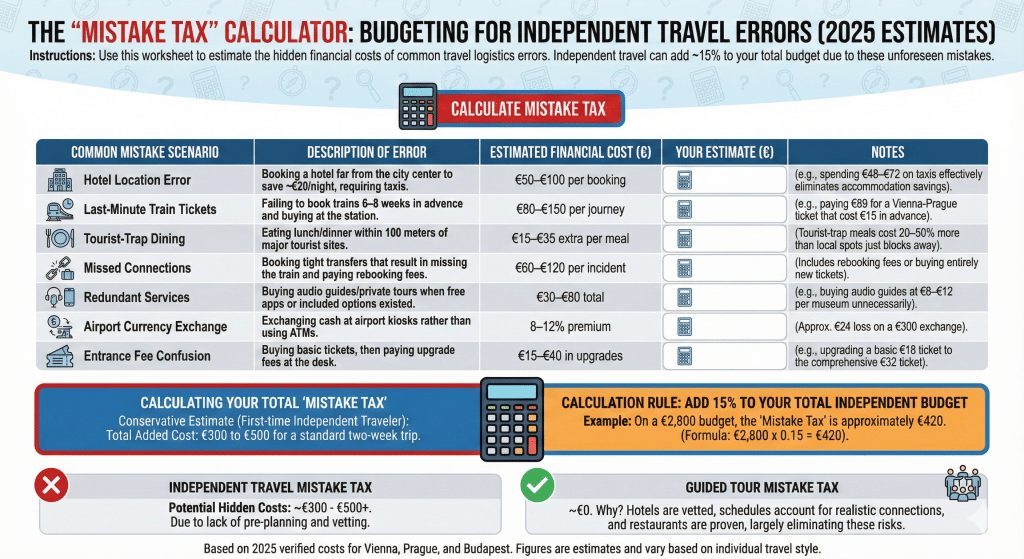
Then there’s what I call the “mistake tax”—the money you lose when you’re tired, rushed, or confused:
- Buying the wrong train ticket and having to buy another.
- Booking a timed museum slot and then missing it because you misread the meeting point.
- Paying a premium for last‑minute tickets because you didn’t reserve ahead.
On fully independent trips, this can be huge. On tours, it’s smaller but still real, especially in your free time. I now assume I’ll “waste” 5–10% of my daily budget on small errors and frictions. If I don’t, great—I’ve just given myself a little buffer.
Takeaway: Build in a line for friction costs
—transport, small tickets, and the occasional mistake. They’re part of real‑world travel, not a failure.
6. Souvenirs, Coffee Breaks, and the Psychology of “I’m on Vacation”
A lot of our “overbudget” moments aren’t about prices. They’re about mood.
Free time is when you’re most likely to say:
We’re only here once, let’s just do it.
It’s vacation, I deserve this.
It’s just a little extra.
That “little extra” might be:
- Daily gelato or coffee breaks
- Impulse souvenirs
- Upgrading to the nicer restaurant because the terrace looks perfect
- Grabbing a taxi instead of walking 20 minutes
None of these are wrong. In fact, they’re often the moments you remember most. The problem is pretending they’re not going to happen and then acting surprised when your card statement disagrees.
To keep my souvenir and meal budget on tours under control, I do this:
- Set a daily “fun money” amount for snacks, coffee, and small treats.
- Set a total souvenir budget for the whole trip.
- Track it loosely in my notes app so I don’t drift too far.
Takeaway: You will buy the coffee, the gelato, and the cute thing in the shop window. Budget for them on purpose instead of pretending you’re above it.
7. Building a Realistic “Free Time” Budget (Without Killing the Fun)
So how do you turn all of this into actual numbers? If you’ve ever underestimated the cost of free time on tours, this is where things start to feel clearer.
For a typical mid‑range guided tour, I now budget per person, per day roughly as follows (adjust for your destination):
- Meals not included: $40–$60
- Local transport & small fees: $10–$20
- Tips (averaged out): $10–$15
- Optional excursions (averaged): $10–$30
- Fun money (coffee, snacks, small treats): $10–$20
That gives you a realistic range of about $80–$145 per person per day on top of your tour price, depending on how activity‑heavy and food‑focused you are.
Then I add:
- Souvenirs: a fixed trip amount (say $100–$300).
- Mistake buffer: 5–10% of the total I just calculated.
One more thing: I try to pre‑pay what I can—optional excursions, some tickets, maybe a special dinner reservation. That way, my on‑the‑ground spending is mostly for day‑to‑day living, not big surprises.
If you’ve ever compared guided tour vs independent travel costs, this kind of breakdown is useful on both sides. Tours don’t eliminate extra spending; they just move it into different categories.
Takeaway: Your tour price is the starting point, not the final number. A clear daily budget for free time turns a vague worry into a simple plan.

8. How to Use Free Time So It Feels Rich, Not Expensive
Here’s the upside: the parts of a tour that aren’t included can also be the most personally meaningful. A simple local lunch, a neighborhood walk, a free viewpoint at sunset—these often beat the big, packaged experiences.
To make your free time feel rich without overspending, I like to:
- Do light research before I go. A few saved spots on a map—affordable local restaurants, free viewpoints, interesting neighborhoods—go a long way.
- Mix paid and free. If I splurge on a special dinner, I pair it with a free museum, park, or self‑guided walk that afternoon.
- Use the guide as a resource. During the tour, I ask:
If you had €15 for lunch around here, where would you go?
orWhat’s your favorite free thing to do in this city?
Free time isn’t a trap by default. It only gets expensive when you treat it as an afterthought. When you plan for it—financially and mentally—it becomes the part of the tour that feels most like your trip, not just the company’s itinerary.
And that’s really the goal: not to spend less at all costs, but to spend on purpose, so every extra feels like a choice, not a surprise.