I hear the same line all the time: Europe is too expensive, Southeast Asia is cheap, and traveling at home in the U.S. is basically free because I can drive and couch-surf.
None of that is fully true.
Once you add up flights, hotels, and local transport, the trip that looks cheapest on Instagram or in your head often isn’t the cheapest in real life. This guide breaks down the real cost of a budget vacation in the U.S., Europe, and Southeast Asia so you can stop guessing and start planning with actual numbers.
1. The Flight Trap: When the “Cheap Region” Starts Expensive
Most people compare daily costs and ignore the big ugly number at the top of the spreadsheet: flights.
If you’re starting in the U.S., your departure airport and trip length can completely flip which region is actually cheaper overall. That’s where a real cheap trip cost comparison has to start.
- To Europe (from U.S. East Coast): often around $400–$900 round-trip, 7–12 hours. According to Budget Your Trip data summarized here, flights to Europe from the East Coast are usually 20–40% cheaper than flights to Asia.
- To Asia (esp. Southeast Asia): more like $700–$1,200, 15–24 hours. From the West Coast, though, flights to Bangkok or similar can be $500–$850, sometimes cheaper than Europe.
- Within the U.S.: domestic round-trips can be anywhere from $150–$600+ depending on season and distance. Not always the bargain people assume.
So what does that mean in practice for a real usa vs europe travel costs comparison?
- If you’re on the East Coast and planning a short trip (1–2 weeks), Europe often wins on total cost because the flight is cheaper and you don’t have enough days for Southeast Asia’s low daily costs to offset the expensive ticket.
- If you’re on the West Coast or planning a long trip (4+ weeks), Southeast Asia’s higher flight cost can be spread over many cheap days, making it the better value.
- For a U.S. road trip, you might skip airfare entirely, but you’ll pay in gas, car wear, and often higher nightly costs than you expect.
Takeaway: Don’t ask Which region is cheaper?
Ask How many days am I going for, and from which airport?
That one shift changes the whole travel cost breakdown by destination.

2. Daily Budget Reality Check: What $50 vs $100 Actually Buys You
Once you land, the game changes. Now it’s about accommodation, food, and the small daily stuff that quietly drains your wallet.
This is where Southeast Asia usually crushes both Europe and the U.S.—but the story is more nuanced than Asia is cheap, Europe is expensive.
Typical backpacker-style daily ranges (per person)
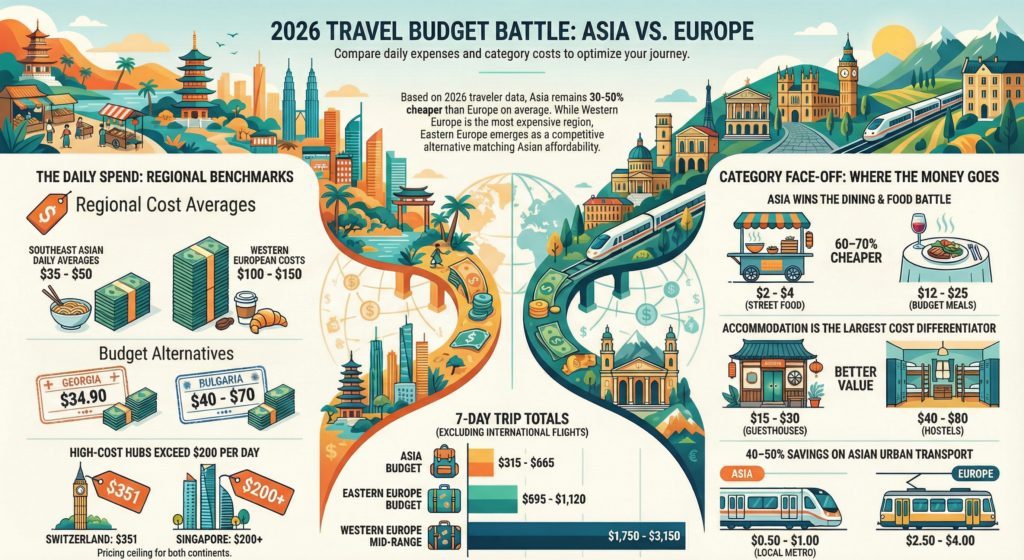
- Southeast Asia: about $20–$40/day for budget travel. Multiple sources put realistic backpacker budgets around $800–$1,500/month depending on pace and comfort (example breakdown).
- Europe: more like $60–$100/day for basic backpacking, and $2,000–$2,500/month is common for budget travelers in Western Europe.
- U.S.: highly variable, but if you’re paying for accommodation, a realistic budget often lands in the $70–$120/day range for modest hotels, food, and gas/transport in many cities.
If you’re comparing a Europe vs Southeast Asia trip cost, this is where the gap really opens up.
Accommodation: where the gap really explodes
- Southeast Asia: hostel dorms $5–$15, simple guesthouses $15–$30. You can live decently on very little.
- Europe: hostel dorms often start at $25–$30 and can hit $40–$50 in expensive cities. Even camping can be over $20 per night.
- U.S.: hostels exist but are rare outside major cities. Budget motels often run $70–$120 per room before taxes in many areas.
Food: the silent budget killer
- Southeast Asia: street food meals $2–$5. You can eat well for under $10/day if you’re disciplined.
- Europe: restaurant meals often start around $12–$25 per person. Groceries and picnics can bring this down, but you have to be intentional.
- U.S.: fast food and diners can be $10–$15 per meal with tax and tip. Sit-down restaurants easily hit $20–$30+ per person.
Takeaway: If you’re paying for accommodation and eating out at least once a day, Southeast Asia is usually 30–60% cheaper than Europe and often cheaper than traveling in your own country. But that doesn’t automatically make it the best choice for you. A realistic southeast asia travel budget breakdown still has to match how you like to travel.
3. Local Transport: Trains, Buses, Scooters and the Cost of Friction
Local transportation is where the cheap trip
myth gets messy. It’s not just about ticket prices; it’s about how much time, stress, and energy you pay along the way.
When you compare flights, hotels and local transport costs, this is the part most people underestimate.
Europe: expensive but efficient
- Dense network of trains, buses, and budget airlines.
- Budget airlines (Ryanair, EasyJet, Wizz Air) can be incredibly cheap if you book early—but baggage and airport transfers add up.
- Trains are comfortable and scenic, but long-distance routes can be pricey unless you plan ahead or use passes strategically.
The upside: you waste less time. Connections are predictable, delays are manageable, and you can hit multiple countries in a week without losing days to chaos.
Southeast Asia: cheap but chaotic
- Long-distance travel is often by bus, minivan, boat, or budget airline.
- Overnight buses save on accommodation but can be uncomfortable and sometimes sketchy.
- Domestic flights are often very affordable, especially with carriers like AirAsia, and can save you a full day of travel.
- Local transport (tuk-tuks, scooters, rideshares) is cheap but requires more negotiation and risk tolerance.
You’ll spend less money but more energy. Plans change, buses are late, and you need to be okay with uncertainty.
U.S.: the land of long distances
- Road trips are the default. Gas, tolls, parking, and car wear all add up.
- Intercity buses and trains exist but are often slower and less frequent than in Europe.
- Domestic flights can be reasonable if booked early, but last-minute prices are brutal.
Takeaway: Europe charges you more money and less stress. Southeast Asia charges you less money and more friction. The U.S. charges you in distance and car dependence. When you think about local transportation costs for tourists, decide which currency you’re willing to pay in.
4. Region vs. Region: When Europe Is Actually “Cheap” and Asia Isn’t
Another myth: Europe is expensive, Asia is cheap.
That’s like saying U.S. is cheap, New York is expensive
and stopping there. It hides the real opportunities.
If you zoom in, the daily travel expenses by region start to look very different.
Inside Europe
- Very expensive: Switzerland, Scandinavia, UK, France. Daily costs can easily hit €130–€180+ per person in peak season.
- Mid-range: Italy, Spain, Portugal, Germany, Netherlands.
- More affordable: Eastern and some Southern countries—Poland, Bulgaria, Romania, Georgia, Serbia, parts of the Balkans. Daily budgets in the $40–$70 range are realistic and can rival pricier Asian destinations.
Inside Asia
- Very cheap (especially for long stays): Thailand, Vietnam, Indonesia, Laos, Nepal, India. Comfortable travel under $50/day is very doable.
- Expensive outliers: Japan, Singapore, Hong Kong. These can match or exceed Western European prices.
- Hidden costs: some major cultural and UNESCO sites charge entry fees that add up, especially if you’re sightseeing heavily.
Where does the U.S. fit?
Think of the U.S. as a mix of Western Europe prices (big cities, national park gateway towns) and Eastern Europe prices (smaller cities, off-season areas) with fewer hostels and less public transport.
Takeaway: If you’re flexible on where in Europe or Asia you go, you can make either region fit a tight budget. Eastern Europe can be as affordable as many Asian countries. Japan and Singapore can blow your Asia is cheap
assumption in a week and completely change your personal cheap trip cost comparison.

5. Comfort vs. Cost: What Kind of Trip Are You Actually Buying?
Here’s the uncomfortable truth: you’re not just buying days abroad.
You’re buying a style of experience.
Two people can spend the same amount of money and come home with totally different stories. That’s why a simple usa vs europe travel costs chart never tells the whole story.
Europe: structure and predictability
Europe tends to offer:
- Highly organized infrastructure and reliable transport.
- Consistently decent hostel and hotel standards.
- Easy border crossings and dense cultural attractions.
It’s ideal if you value smooth logistics, want to see a lot in a short time, and don’t want every bus ride to be an adventure.
Southeast Asia: flexibility and chaos
Southeast Asia often means:
- Lower daily costs but more unpredictability.
- Long bus rides, scooters, and last-minute plan changes.
- A strong backpacker culture and highly social hostels.
It’s perfect if you’re okay with messy logistics, want to stretch your budget, and enjoy a fast-paced, social environment where plans are made over beers, not spreadsheets.
U.S.: familiarity and independence
Traveling in the U.S. gives you:
- No language barrier (for most Americans).
- Easy access to your own car and familiar systems.
- Less culture shock, but also less of that
far from home
feeling.
Takeaway: A cheap
trip that doesn’t match your comfort level isn’t cheap. If constant negotiation and uncertainty will burn you out, paying more for Europe or staying in the U.S. might actually be the better value.

6. The Budget You Don’t See: Pace, Extras, and Tiny Overspends
Most people blow their budget not on one big mistake, but on hundreds of tiny ones.
Those are the hidden costs of cheap travel that rarely show up in your initial spreadsheet.
Pace of travel
Moving every 2–3 days is expensive everywhere:
- More transport tickets.
- Less chance to cook or find local deals.
- More
we’re tired, let’s just eat somewhere close
meals.
Slowing down—staying a week or more in one place—can cut your daily costs dramatically in the U.S., Europe, and Southeast Asia alike.
Extras that quietly add up
- Alcohol and nightlife.
- Coffee shop work sessions.
- Souvenirs and impulse shopping.
- Data plans, roaming, and eSIMs.
- Day tours and attraction tickets.
In Europe, you’re often saved by free city experiences—walking tours, public squares, churches, viewpoints. In Asia, attraction fees can be higher relative to daily costs, so sightseeing days can spike your budget.
Takeaway: The region matters less than your habits. A disciplined traveler in Europe can spend less than a careless traveler in Southeast Asia in a week. Many so-called budget travel mistakes in Europe are really just everyday overspends: too many taxis, too many restaurant meals, too many rushed days.
7. So… Where Is the Real “Cheap Trip” for You?
Let’s put it all together. Forget the generic advice for a moment and look at your own situation.
If you have 7–14 days
- East Coast U.S.: Europe often wins on total cost vs. Asia because of cheaper flights and shorter travel time.
- West Coast U.S.: Europe and Asia can be similar; choose based on what experience you want, not just price.
- Staying in the U.S.: can be cheaper if you drive and share accommodation, but don’t assume it’s a bargain—run the numbers and compare the cost of traveling in the US vs Europe for your exact dates.
If you have 3–8 weeks
- Southeast Asia usually becomes the best value, especially if you move slowly and avoid the most expensive cities.
- Eastern Europe can be a strong middle ground: cheaper than Western Europe, easier than Southeast Asia.
If you care more about comfort than cost
- Leaning toward Europe or a slower, well-planned U.S. trip makes sense.
- Pick fewer destinations, stay longer, and use trains or direct flights to reduce friction.
If you care more about stretching your budget than anything else
- Southeast Asia is hard to beat for long-term travel and classic backpacking budget Southeast Asia vs Europe comparisons.
- But be realistic about your tolerance for chaos, heat, and long travel days.
Final thought: The cheapest
trip isn’t the one with the lowest daily cost or the cheapest flight. It’s the one where your time, energy, and money are all spent on things you actually care about. Start there, then pick the region that matches—and let the cheap flights and hotel pricing work around that, not the other way around.