Choosing the Right Power Bank Size: How Watt-Hours Shape Your Trip
When you fly, the key number on a power bank is not mAh. It is Wh (watt-hours). Airline rules use Wh, so your choice should start there.
Most major aviation regulators (like IATA and the FAA) use three main thresholds:
- Up to 100 Wh: Usually allowed in carry-on without airline approval.
- 100–160 Wh: Often allowed in carry-on, but may need airline approval and can have quantity limits.
- Over 160 Wh: Typically not allowed on passenger flights at all.
Most consumer power banks are sold using mAh, not Wh. So you need to link capacity to the rules:
- Conversion: Wh ≈ (mAh ÷ 1000) × nominal voltage (usually 3.6–3.7 V for lithium cells). A 20,000 mAh pack at 3.7 V is about 74 Wh.
- Safe zone for hassle-free travel: Power banks up to about 26,800 mAh (≈ 99 Wh) sit just under the 100 Wh limit.
- High-capacity packs (laptop bricks, power stations): These often exceed 100 Wh and move into a more heavily checked category.
The trade-off is simple:
- If you want maximum compatibility and minimal questions at security, choose a power bank clearly labeled under 100 Wh.
- If you need laptop-level power or multi-day off-grid use, you can look at 100–160 Wh devices, but you accept more checks, possible airline pre-approval, and a higher chance of refusal at the gate.
For most travelers, especially if you are wondering whether a special service or fee is “worth it,” the easiest plan is to stay under 100 Wh and avoid edge cases.
Carry-On vs Checked Luggage: Where Power Banks Must Go
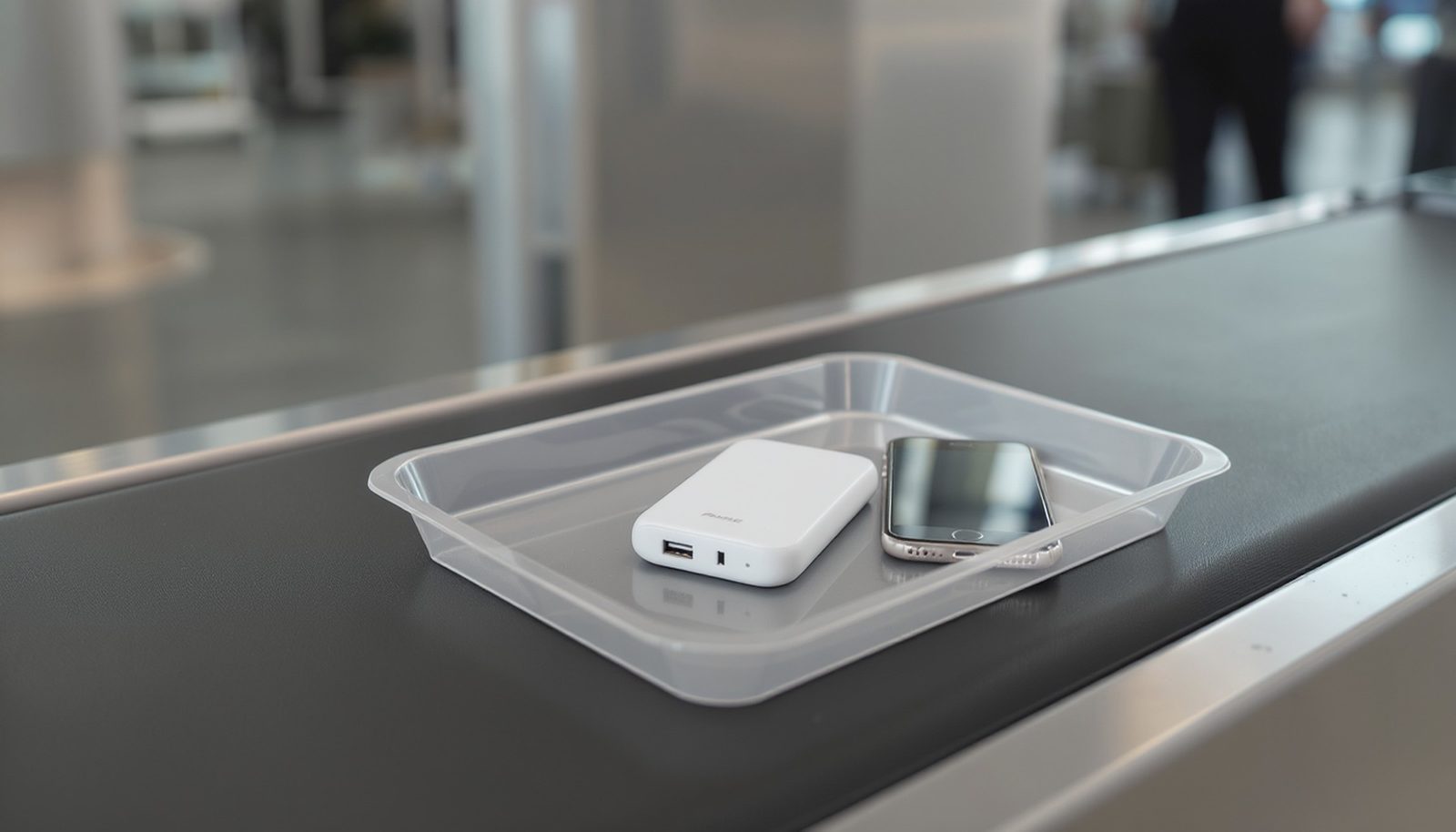
Airline and safety rules treat lithium batteries as a fire risk. This leads to one firm rule: power banks go in carry-on, not checked baggage.
The reason is simple risk control:
- In the cabin, crew can see smoke, use fire procedures, and reach the device.
- In the hold, a battery fire is harder to spot and handle, so regulators restrict or ban loose lithium batteries there.
What this means when you pack:
- Always put power banks in your cabin bag or personal item, even small ones.
- Do not check a suitcase that has power banks inside, especially if the bag might be taken at the gate on a full flight.
- If staff ask you to gate-check a carry-on, take out all power banks and other loose lithium batteries first.
Some edge cases to keep in mind:
- Built-in batteries (like in laptops or tablets) are usually allowed in both cabin and checked bags, but airlines still prefer them in the cabin.
- Smart luggage with built-in power banks may require you to remove the battery module before you check the bag.
- Some airlines or airports enforce these rules more strictly than others, but the safety logic is similar worldwide.
To keep things simple and low-stress, treat every standalone power bank as carry-on only, no matter the size.
Labeling, Documentation, and How Strictly Airlines Enforce Wh Limits
Even if your power bank is within the Wh limits, what happens at security depends a lot on how clearly its capacity is shown and how staff read it.
Key things that affect decisions:
- Clear Wh marking: A power bank that shows “XX Wh” on the case is quick for staff to approve.
- Only mAh shown: Security may need to convert or may not bother, which raises the chance of delay or confiscation if the number looks big.
- No visible capacity marking: This is the riskiest case; staff may play it safe and refuse the item.
How this usually looks in real life:
- At many airports, small, common power banks under about 20,000 mAh pass with little attention.
- Larger or unusual devices, especially ones that look like mini power stations, draw more scrutiny.
- Some staff will ask you to show the Wh rating or search the model online if they are unsure.
You can make this smoother by planning ahead:
- Choose power banks with printed Wh values on the case.
- Keep a photo or PDF of the product specs (showing Wh) on your phone.
- If staff ask, calmly explain the Wh rating and that it is under the standard limit. Do not argue if they still say no; they have the final say.
Some services or fees claim to “solve” battery issues, like special handling or storage rooms. In practice, if your device is clearly under 100 Wh and well labeled, you rarely need to pay extra for special treatment. These services mainly matter when you carry borderline or non-compliant devices.
Multiple Power Banks, High-Capacity Devices, and When Extra Services Might Be Worth Paying For
Even if each power bank is under the Wh limit, carrying several at once changes how security may see you.
Typical limits and concerns you might face:
- Quantity limits: Some airlines cap the number of spare batteries or power banks (for example, two units between 100–160 Wh, or a “reasonable” number under 100 Wh).
- Visual impression: A bag full of power banks can trigger extra screening, even if each one is allowed.
- Purpose questions: Staff may ask why you need so many and whether they are for personal use.
How this affects your choices:
- If you are a typical traveler with one or two sub-100 Wh power banks, you do not need any special service. Normal security is usually enough.
- If you carry multiple high-capacity devices (for example, for filming, fieldwork, or events), you face a higher chance of delays, questions, or partial refusal.
- In those higher-risk cases, pre-arranging approval with the airline and bringing documentation helps more than any last-minute paid service at the airport.
Now to the idea behind the keyword “is blue gate confiscation room worth paying” (understood here as paying for a special storage or handling service when your power bank might be confiscated):
- Where such services exist, they usually store non-compliant items until you return or arrange shipping.
- They can be worth the cost if the device is expensive, hard to replace, and clearly non-compliant (for example, over 160 Wh or a banned design).
- They are rarely worth it for common, cheap power banks that you can replace at your destination.
So the more your setup differs from a simple, clearly compliant one, the more you should plan ahead. Paying for storage or handling is a last-resort backup, not a replacement for choosing the right gear.
Risk, Uncertainty, and How Airline Enforcement Can Vary by Route and Staff
Rules may be clear on paper, but enforcement is not always the same. This uncertainty is part of your planning.
Where differences come from:
- Different countries and regulators: Some airports follow international guidelines very strictly; others are looser or add local rules.
- Individual staff judgment: Security officers and gate agents have discretion. Two people can see the same device and decide differently.
- Operational context: In busy times, staff may rely on quick visual checks. During higher security alerts, they may look more closely.
Common risk situations:
- Unlabeled or poorly labeled devices being refused even if they are technically allowed.
- High-capacity packs near 160 Wh being treated as banned, especially if staff are unsure of the exact rules.
- Transit airports using stricter standards than your departure airport, which can cause problems mid-journey.
Ways you can manage this uncertainty:
- Set up your gear so that you can afford to lose or surrender any single power bank without ruining your trip.
- Choose one or two well-documented, clearly labeled devices instead of many unclear ones.
- If you are unsure, check your airline’s battery policy before you book, especially for long-haul or multi-leg trips.
On whether paying for a storage or “confiscation room” type service is worth it, this uncertainty cuts both ways:
- If you carry a non-compliant but valuable device, such a service can be a sensible way to avoid total loss.
- If your device is compliant but staff disagree, paying a fee may feel unfair but might still be cheaper than missing your flight while you argue.
- The best way to avoid this choice is to pick equipment that sits well within common limits and is easy to explain.
Practical Comparison of Power Bank Options for Air Travel
The table below shows how different power bank types fit airline rules and what you gain or lose with each.
| Type | Typical Wh | Airline Treatment | Pros | Cons |
| Small phone power bank | 20–40 Wh | Carry-on, rarely questioned | Very low risk, easy to pack | Limited capacity |
| Standard travel power bank | 40–100 Wh | Carry-on, generally allowed | Good balance of power and compliance | Must still be in cabin, not checked |
| High-capacity laptop power bank | 100–160 Wh | Carry-on, may need airline approval | Can power laptops and multiple devices | More scrutiny, possible quantity limits |
| Portable power station | 160+ Wh | Often prohibited on passenger flights | Excellent off-grid capability | High risk of refusal or confiscation |
For frequent flyers, a robust and simple strategy is:
- Use one or two power banks under 100 Wh with clear labels.
- Keep larger power solutions at your destination (ship them, rent locally, or use them only for ground travel).
- Save any paid storage or handling services for rare cases when you knowingly carry non-compliant but high-value gear.
This approach keeps conflicts with airline staff low, reduces the need for last-minute paid fixes, and makes your trips more predictable while still giving you enough power for normal use.