Frontier’s cheap fares come with a very tight operation. The airline runs on strict boarding cutoffs, little slack at the gate, and not much room for staff to bend rules. If you understand how these cutoffs work, you can turn a low fare into a smooth trip instead of an expensive last-minute ticket.
This article is a Destination-focused decision guide. Here, your “destination” is not just the city you fly to. It is also getting past the Frontier gate without being denied boarding. Each section walks through a specific decision or trade-off you face as a traveler, using a clear risk-and-constraints view instead of generic tips.
Deciding How Early to Arrive at the Airport: Time Buffer vs. Cost and Convenience
Frontier’s business model depends on fast turnarounds and low staffing. That creates a built-in tension for you as a traveler:
- Arrive early → lower denial risk, higher time cost.
- Arrive late (but “on time” by your standards) → higher denial risk, lower time cost.
To choose wisely, you need to know how boarding cutoffs usually work and where your risk jumps.
How boarding cutoffs usually work in practice
Exact times can vary by airport and route, but Frontier and similar ultra-low-cost carriers usually have three key thresholds:
- Check-in / bag drop cutoff – often around 45–60 minutes before departure for domestic flights. If you miss this, you may be denied even if you could still reach the gate.
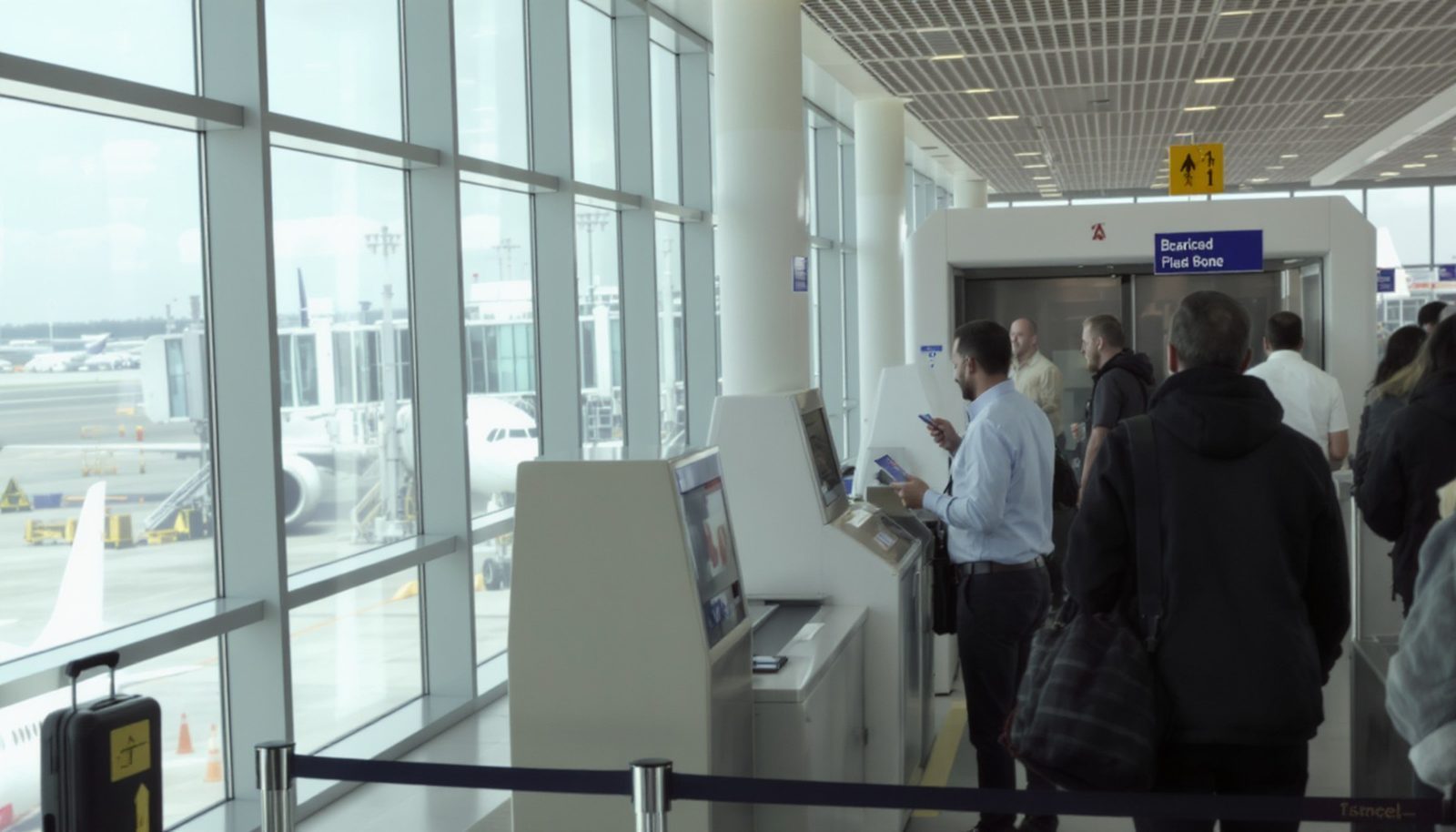
- Security and gate arrival – you need to clear security and reach the gate before boarding starts. For Frontier, boarding can start as early as 45 minutes before departure on busy flights.
- Boarding gate cutoff – the point when the agent closes the door and removes you from the manifest, often 15–20 minutes before scheduled departure.
Unlike some legacy airlines, Frontier usually treats these cutoffs as hard valves, not soft guidelines. Once the “gate valve” closes, reopening it can disrupt the whole operation, so it rarely happens.
Why Frontier’s model makes late arrivals especially risky
Several built-in limits make Frontier less forgiving than full-service airlines:
- Tight turn times – planes are scheduled to land, unload, reload, and depart quickly. One late passenger can delay the whole chain.
- Lean staffing – fewer gate agents and supervisors means less capacity to handle exceptions or escort late passengers.
- Fee-based recovery – if you miss your flight, you often end up paying for same-day changes or a new ticket. That is part of the revenue model.
So once the boarding “gate” closes, the cost of reopening it is high for the airline. That is why they rarely do it.
Practical decision rule: how much buffer to build
Since we are not using exact times, think in terms of risk bands, not precise minutes:
- Low-risk band – you arrive at the airport early enough that even a long security line and a gate change still leave you at the gate before boarding starts. This usually means planning to be through security about an hour before departure.
- Medium-risk band – you plan to reach the gate around the time boarding starts. Any delay (slow security, long bag drop line, crowded train to the terminal) can push you into denial territory.
- High-risk band – you plan to reach the gate close to scheduled departure and assume boarding will still be open. With Frontier, this is where denial risk jumps sharply.
The trade-off is straightforward: every 15 minutes of buffer you cut saves time but raises the chance that one small delay pushes you past a hard cutoff.
Choosing Between Carry-On Only vs. Checked Bags: Operational Simplicity vs. Upfront Cost
Your baggage choice changes how many “valves” you must pass through before boarding. Each extra step adds another point where things can go wrong and you can be cut off.
How baggage choice changes your risk profile
- Carry-on only
- Fewer required interactions with staff (no bag drop).
- More flexibility if you arrive close to cutoff, as long as you are checked in and have a boarding pass.
- But Frontier often charges for carry-on bags, so you pay more upfront.
- Checked bag
- You must meet the check-in and bag drop cutoff, which is usually earlier than the boarding cutoff.
- Long lines at bag drop can push you past the cutoff even if you reached the airport “on time” by your own standard.
- Oversize or overweight bags can trigger extra checks and fees, which add delay.
In valve terms, a checked bag adds another gate that must be open at the right time. If that gate closes (bag drop cutoff), your path to boarding is blocked, no matter what happens later at security or the gate.
Cost vs. reliability trade-off
Since we are not using specific fee amounts, think in relative terms:
- Carry-on only – often a higher bag fee on many Frontier fares, but lower denial risk because you skip the bag drop cutoff.
- Checked bag – possibly lower carry-on fee but higher operational risk. If you miss the bag drop cutoff, you may need to buy a new ticket or pay a same-day change fee.
Your key decision is whether the extra bag fee is worth the lower denial risk. If you have a tight schedule or a connection from another flight, paying more for carry-on only can be a smart way to manage risk.
Table: Baggage choice vs. denial risk
| Option | Extra steps before gate | Denial risk drivers | When it makes sense |
| Carry-on only | Security only | Security delays, late arrival at gate | Short trips, tight connections, high risk aversion |
| Checked bag | Bag drop + security | Bag drop cutoff, long lines, bag issues | Long trips, lower time sensitivity, willingness to accept higher denial risk |
Managing the Gate Cutoff Itself: Reading Signals vs. Assuming Flexibility
Once you are past security, your last big decision point is how you behave at the gate as cutoff time approaches. Many travelers treat the scheduled departure time as the real deadline. With Frontier, the gate closure time is the true hard stop.
Why the “door close” is more like a gate valve than a dimmer
Think of a gate valve in plumbing. It is meant to be either fully open or fully closed. Half-open use causes turbulence and damage. Frontier’s boarding process works in a similar way:
- When boarding is fully open, agents are focused on scanning and moving people quickly.
- As the cutoff nears, agents feel pressure to finish counts, close the door, and push back on time.
- Once the door is closed, reopening it is operationally expensive and therefore rare.
If you assume the airline will “throttle” the process for you—keeping the door half-open while you finish a meal or a call—you are reading the system wrong.
Signals that the gate is about to “close” on you
Since we are not using exact times, watch for clear, visible signs:
- Announcements shifting from general boarding to final boarding for your flight.
- Gate agents calling specific passenger names or using “this is the final call” messages.
- Agents stepping away from the podium toward the jet bridge door and scanning fewer or no new boarding passes.
- Boarding pass scanners being powered down or covered.
These are like seeing the valve stem move to its end position. They show the system is going from open to closed, and your window is almost gone.
Decision rule: how to act in the last 30 minutes before departure
To cut denial risk, treat the last 30 minutes before scheduled departure as a high-alert period:
- Stay within sight of the gate once boarding starts. Avoid long bathroom or food runs.
- Respond right away if your name is called or you see a final boarding message.
- Do not assume the printed boarding time on your pass is the last possible moment. Agents can speed up or slow down boarding based on operations.
You are choosing between comfort and certainty. Leaving the gate area for a better seat or food makes it easier to miss the subtle signs that the boarding valve is about to close.
Handling Edge Cases: Connections, Delays, and Policy vs. Discretion
Most denial risk comes from clear, known cutoffs. But edge cases add extra complexity. These are the moments when travelers often expect flexibility, yet Frontier’s low-cost model limits how flexible staff can be.
Self-built connections vs. through tickets
Many travelers mix a Frontier flight with another airline on separate tickets to save money. That creates a key choice:
- Through ticket (single itinerary)
- The airline has some responsibility to rebook you if a delay causes a misconnection.
- Gate agents may have more reason to help because the problem stays within the airline’s own network.
- Self-built connection (separate tickets)
- Frontier treats you as a new origin passenger. If you miss the cutoff, it is usually on you.
- Denial risk is much higher because any delay on the first flight eats into your buffer for the second.
The trade-off is clear. Self-built connections can be cheaper but raise denial risk a lot if your first flight is late or immigration/security takes longer than you planned.
Weather and operational delays
When weather or operations delay a flight, many travelers assume boarding cutoffs will shift in a simple, predictable way. In reality:
- Boarding may still start close to the original time if the airline wants to be ready to leave as soon as a slot opens.
- Gate changes can happen, forcing you to move quickly between terminals or concourses.
- Announcements may be irregular if staff are juggling several disrupted flights.
In these situations, your safest move is to stay close to the gate and listen for updates constantly, even if the departure time keeps sliding. Treat the system as unstable: the “valve position” can change fast, and app or website times may lag what is happening at the gate.
Staff discretion vs. written policy
Some travelers count on a kind gate agent to bend the rules. With Frontier, several limits make that less likely:
- Agents are judged on on-time performance and may have little authority to override cutoffs.
- Reopening a closed door can require ground crew and pilot coordination, which is rarely worth it for one passenger.
- Low staffing means agents have less time to handle special cases.
From a planning point of view, do not base your strategy on exceptions. Assume written or system-enforced cutoffs will apply as designed. If someone makes an exception for you, treat it as a bonus, not something you can expect.
Risk and Uncertainty: What You Can’t Control and How to Hedge Against Denial
Even with careful planning, some things stay outside your control. Your goal is not to remove all risk. Your goal is to see where uncertainty is highest and decide how to hedge against it.
Uncontrollable variables
- Security wait times – can spike without warning due to staffing, equipment issues, or sudden crowds.
- Airport layout – long walks between check-in, security, and gates can add time you did not plan for.
- System glitches – check-in kiosks, mobile boarding passes, or app alerts can fail or lag.
- Operational decisions – Frontier can change boarding times, gate assignments, or cutoffs based on aircraft and crew needs.
Hedging strategies that don’t rely on guesswork
Even without exact data, you can still make clear choices to lower denial risk:
- Time hedging
- Plan to reach the airport early enough that even a long security line still leaves you at the gate before boarding starts.
- For early-morning flights, factor in that public transport or rideshares may be less frequent.
- Process simplification
- Use carry-on only when you can, so you remove the bag drop cutoff from your risk chain.
- Check in online as soon as it opens to avoid kiosk or counter problems.
- Information redundancy
- Watch both airport screens and the airline app. If they do not match, take that as a sign to ask a gate agent directly.
- Keep boarding passes in more than one form (mobile and printed) so a tech issue does not block you at the last minute.
Recognizing when risk is unavoidably high
Some trips carry higher denial risk with Frontier no matter what you do:
- Tight self-built connections from another airline.
- Arriving at the airport close to the bag drop cutoff with checked luggage.
- Travel during peak holiday periods when lines and disruptions are more likely.
In these cases, the smart move may be to accept higher upfront costs (earlier arrival, carry-on fees, or even a different flight time) to avoid the much bigger cost of being denied boarding and buying a last-minute replacement ticket.
Summary: Turning Frontier’s Boarding Cutoffs into a Manageable System
Frontier’s boarding process works more like a chain of binary valves than a flexible, adjustable system. Each stage—check-in, bag drop, security, gate boarding—has a point where it flips from open to closed. Once it closes, reopening it is costly and therefore rare.
To cut denial risk without relying on specific times or fees, focus on how the system is built:
- Arrive early enough to be through security before boarding starts, not just before departure.
- Use carry-on only when the extra cost is worth removing a failure point.
- Stay near the gate once boarding begins and treat final calls as real last chances, not suggestions.
- Avoid tight self-built connections that depend on Frontier bending its own cutoffs.
- Hedge against uncertainty with time buffers, simpler processes, and backup information sources.
If you treat Frontier’s boarding cutoffs as a system of hard open/closed gates instead of negotiable guidelines, you can make clearer choices about time, money, and denial risk—and reach your destination with fewer nasty surprises.