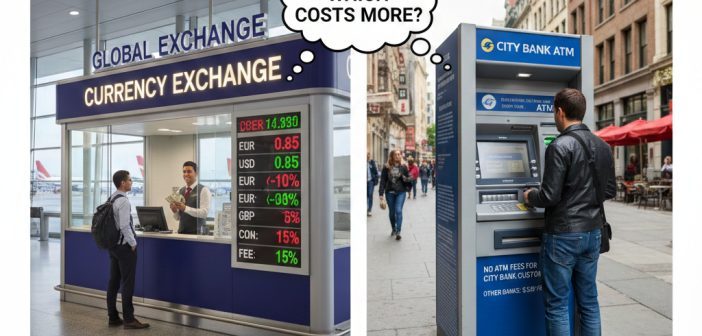
I used to treat airport ATMs and exchange counters as a small convenience tax. A few dollars here, a few there. Then I actually did the math.
Once you stack ATM surcharges, your bank’s fees, foreign transaction charges, and those sneaky bad exchange rates, the cost of using an airport ATM stops being a minor fee. It turns into a quiet, recurring tax on every trip.
Let’s unpack what really happens when you grab cash at the airport, how much you’re losing on airport ATM exchange rates, and how to keep more of your money for the trip itself instead of subsidizing airport landlords and ATM operators.
The Airport Trap: Why That First ATM Is Almost Always the Worst Deal
You walk out of arrivals, spot an ATM glowing in the corner, and your brain goes: Just get it over with.
That moment of fatigue and impatience is exactly what the airport is built around.
Airport ATMs and exchange counters operate in a captive-audience environment. You’re tired, rushed, and still figuring out where you are. They pay high rent and often share revenue with the airport, so they make it back by:
- Charging higher ATM surcharges than typical city ATMs
- Using worse exchange rates than the real market rate
- Hiding costs behind “no commission” claims while baking the fee into the rate
At many airports, the total markup on an airport cash withdrawal can easily hit 5–10% of your withdrawal. On €300, that’s €15–€30 gone before you even leave the terminal.
Airport exchange counters are often worse than airport ATMs. They’ll proudly show 0% commission
while quietly offering a rate that’s 8–10% off the real interbank rate. You don’t see a fee line, but you still pay it in the spread.
My rule now: airport cash is for emergencies only. Enough for a taxi, a snack, maybe the first night. Nothing more. For anything beyond that, airport ATM vs city ATM is not even a contest—city wins almost every time.

The Hidden Killer: Bad Exchange Rates vs Visible Fees
Most travelers fixate on the visible fee on the screen: $3, $5, $7. That’s not where the real damage is.
The real cost is usually the exchange-rate spread – the gap between the true market rate and the rate you’re given at the ATM or counter.
For example:
- Real market rate: 1 USD = 0.92 EUR
- Airport ATM rate: 1 USD = 0.86 EUR
On a $500 withdrawal:
- At market rate, you’d get about €460
- At the airport rate, you get about €430
- You’ve just lost €30 – roughly 6.5% – before any visible fee
Now layer on top:
- ATM operator surcharge: $5–$10
- Your bank’s out-of-network fee: $2–$5
- Foreign transaction fee: often around 3%
Suddenly, that quick cash
from an airport ATM can cost close to 10% of the withdrawal. This isn’t a rare horror story—this is what many U.S. travelers actually pay when they use airport ATMs in Europe and accept all the defaults.
This is why city bank ATMs are usually cheaper and a better way to get cash abroad. They tend to:
- Use rates much closer to the interbank rate
- Charge lower or no local surcharges
- Be less aggressive with tricks like dynamic currency conversion
If you only remember one thing about airport ATM fees: the worst cost is the rate you don’t see, not the fee you do.
Dynamic Currency Conversion: The Button That Quietly Robs You
If you’ve ever seen a screen that says something like:
Do you want to be charged in USD instead of EUR?
you’ve met Dynamic Currency Conversion (DCC).
It sounds helpful. It shows you the amount in your home currency. It feels safer and more familiar. But here’s what’s really going on behind that friendly screen:
- The ATM or card terminal applies its own terrible exchange rate
- They add a hidden markup of several percent over what Visa or Mastercard would use
- You lock in that bad rate on the spot, often on top of other foreign currency withdrawal fees
Meanwhile, if you choose to be charged in the local currency (EUR, JPY, etc.), your bank or card network uses a rate that’s usually much closer to the real market rate. Even if your bank charges a small foreign transaction fee, it’s usually still cheaper than DCC.
So when the screen asks:
- “Convert to USD?” → No.
- “Continue with conversion?” → No.
- “Without conversion” → Yes.
Different machines phrase it differently, especially at airports where dynamic currency conversion is pushed hard, but the rule is simple: always choose the local currency. If you’re not sure, assume the option that looks slightly more confusing is probably the cheaper one.

How Much Are You Really Losing? A Realistic Scenario
Let’s put some numbers on this. Imagine you’re an American landing in Europe and you withdraw €300 at an airport ATM because you want cash right away.
Here’s a very typical stack of costs for that airport cash withdrawal:
- Airport ATM surcharge: €5–€7
- Bad exchange rate: 4–7% worse than market (say €12–€21 on €300)
- Your bank’s out-of-network fee: $2–$5
- Foreign transaction fee: ~3% (another ~€9 on €300)
- DCC markup (if you accept it): another 3–5%
Even without DCC, you might be losing €25–€35 on that one withdrawal. With DCC on top, you can easily push past a 10% total cost.
Now imagine you do this:
- Once on arrival
- Once mid-trip
- Once before leaving
That’s three hits. On a two-week family trip, you’re suddenly down the cost of a nice dinner, a day trip, or a couple of museum tickets. Repeat this over multiple trips and you’re talking hundreds to over a thousand euros over a few years – just for using the wrong machines in the wrong places.
Meanwhile, if you had:
- Used a city bank ATM instead of an airport ATM
- Chosen local currency every time and declined conversion
- Used a card with no foreign transaction fees
you might have paid only a couple of euros per withdrawal, or nothing at all. That’s the difference between falling into travel money exchange rate traps and quietly sidestepping them.
Airport vs City vs Bank: Choosing the Least Bad Option
There’s no single perfect method for everyone, but if you care about the cost of using an airport ATM, there is a clear hierarchy.
Airport exchange counters
- Usually the most expensive option
- High markups, often 5–10% or more
No commission
signs hide the cost in the rate- Use only for small emergency amounts
Airport ATMs
- Sometimes better than counters, but still pricey overall
- High surcharges and aggressive DCC prompts
- Often run by independent operators, not banks
- Use only if you must, and withdraw just enough to reach the city
City bank ATMs
- Usually the best balance of cost and convenience
- Rates close to interbank, fewer nasty surprises
- Look for ATMs attached to major bank branches, not random standalone machines
Banks (home or destination)
- Good for larger planned exchanges
- Often safer and more transparent than random currency shops
- May waive fees for existing customers
- Require planning and business hours
Multi-currency / travel cards (Wise, Revolut, Monzo, etc.)
- Often offer near-interbank rates
- Low or no foreign transaction fees
- Let you lock in rates ahead of time
- Great for card payments; ATM withdrawals may still have limits or small fees
These options are the core of any international ATM fee comparison. Once you see them side by side, the best way to get cash abroad becomes much clearer.
The strategy I use now:
- Carry a small amount of backup cash in a major currency (USD/EUR)
- If I must use the airport: withdraw minimal cash from an ATM, decline DCC, and accept that this is my “airport tax”
- Once in the city: find a bank-branded ATM and do a larger, less frequent withdrawal
- Use a no-foreign-fee card for most purchases and avoid unnecessary cash

Psychology vs Planning: Why We Keep Paying the Airport Tax
On paper, all of this sounds obvious. So why do so many smart travelers still get burned by hidden fees at airport ATMs and bad airport exchange rates?
Because money exchange is a classic “low urgency, high consequence” task. It feels like something you can always do later. Until later becomes the boarding gate or the arrivals hall.
A few mental traps that cost people real money:
- Planning fallacy:
I’ll sort it out before the trip.
Then you don’t. - Procrastination: Foreign currency feels abstract until you’re standing in a new country with no cash.
- Availability bias: The airport kiosk is visible, staffed, and reassuring. So it feels safer, even if it’s objectively worse.
- Time pressure: With 40 minutes to boarding, you’re not going to compare rates on your phone.
The result: people who would never accept a 10% markup on a laptop happily accept it on €500 of travel money.
The fix isn’t heroic discipline. It’s small, boring preparation that makes it easy to avoid airport ATM charges without thinking too hard:
- Check your bank’s ATM and foreign transaction fees a week before you fly
- Identify at least one bank ATM near your hotel or in the city center
- Download a rate app (like XE) and know roughly what a fair rate looks like
- Decide in advance:
I will only use airport cash for emergencies.
Once you’ve made that decision at home, it’s much easier to stick to it when you’re jet-lagged and staring at a glowing ATM in the arrivals hall.

A Simple, Low-Stress Strategy to Stop Overpaying
If you want a practical, low-effort plan, here’s a checklist you can copy into your notes app. Think of it as your quick airport ATM cost guide.
Before you travel
- Pick one main card with no or low foreign transaction fees
- Check if your bank reimburses ATM fees or has partner banks abroad
- Note your bank’s daily ATM limit and any foreign withdrawal caps
- Install a currency rate app and glance at the current rate so you can spot bad offers
On arrival
- If you must use the airport: withdraw just enough for transport and basics
- At the ATM, always choose local currency and decline any conversion to your home currency
- Avoid standalone, touristy-looking ATMs if there’s a bank-branded one nearby
During your trip
- Use bank ATMs in the city for larger, less frequent withdrawals
- Balance fees vs safety: fewer withdrawals mean fewer fees, but don’t carry more cash than you’re comfortable with
- Pay by card where possible, especially with a no-foreign-fee card or a good travel card
Red flags to avoid
No commission
signs at airport counters- ATMs that look temporary, standalone, or plastered with tourist slogans
- Any screen that offers to convert to your home currency instead of charging in local currency
- Multiple small withdrawals from high-fee locations like airports and casinos
The goal isn’t perfection. It’s to move from bleeding money without noticing
to losing a few euros here and there at most.
Once you understand how airport ATMs and exchange counters are stacked against you, it’s surprisingly easy to step around the worst of it.
Next time you land and reach for that first ATM, pause for two seconds and ask yourself: Is this really an emergency, or am I just tired? Your future self – and your travel budget – will be glad you did.