
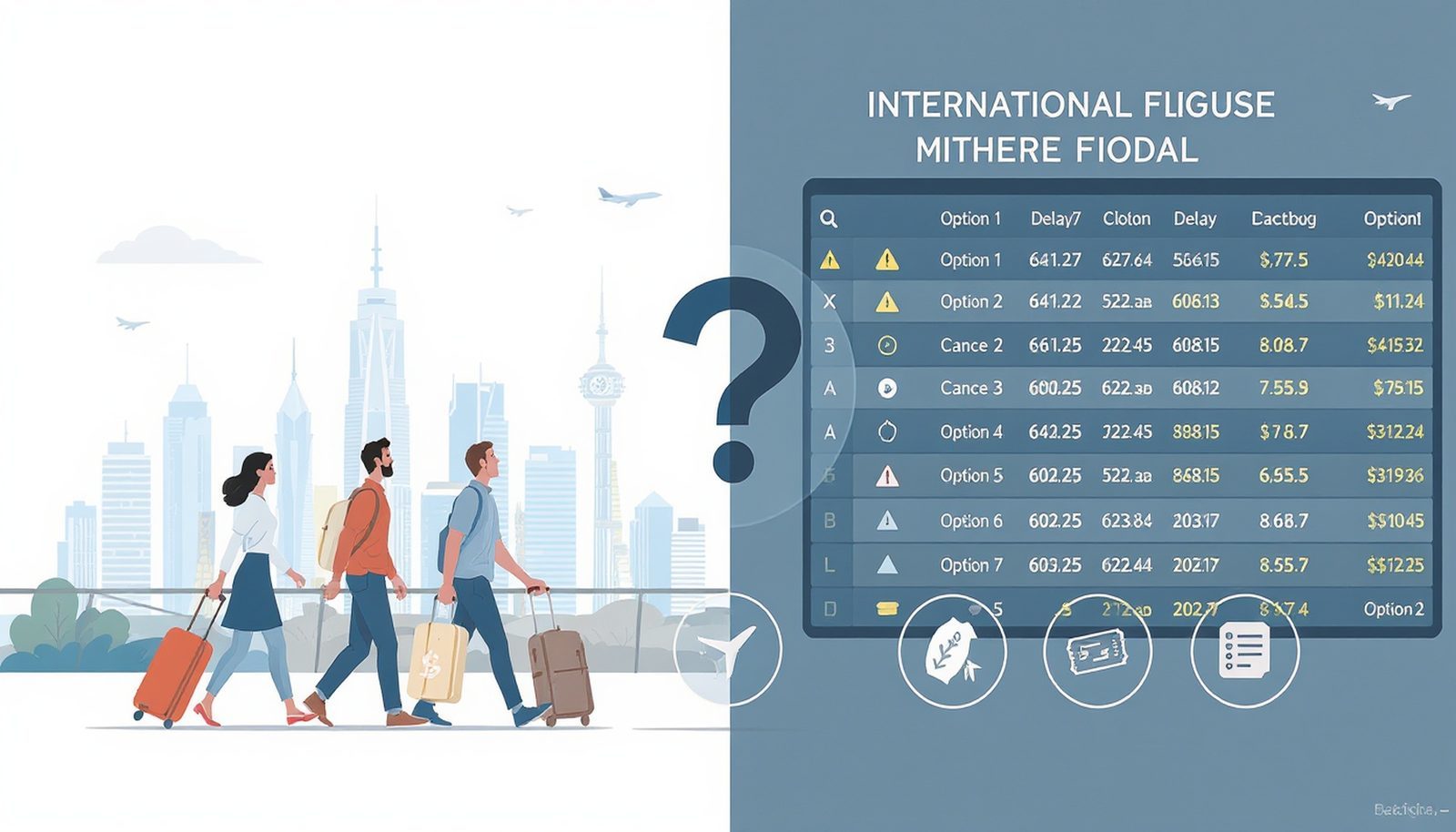
Why this is a Destination decision: staying in the U.S. vs. leaving and re‑entering
Adjustment of Status (AOS) and consular processing are usually framed as procedural immigration choices. Underneath, they are destination choices under uncertainty: do you remain in the United States while your case is processed, or do you leave and attempt to re‑enter through a consulate abroad?
Airline schedule change rules and rebooking rights now shape that decision in a structural way. When consular backlogs are high, the risk is not only visa delay; it is being stuck abroad with sunk travel costs and limited flexibility to return. U.S. Department of Transportation (DOT) refund standards change the payoff matrix: they determine when you can turn a disrupted trip back into cash, and when you are confined to vouchers or rebooked itineraries that no longer match your immigration timing.
This article fits the Destination category because the core question is where you physically locate yourself during processing—inside the U.S. (AOS) or outside (consular)—and how airline disruption rules alter the risk profile of each path.
Mechanics of airline schedule change rules and why they matter for AOS vs. consular choices
DOT rules draw a sharp line between airline‑initiated disruption and traveler‑initiated change. That distinction is central when you plan travel around immigration milestones such as consular interviews, medical exams, or the end of lawful stay.
When an airline cancels a flight or imposes a significant schedule change and you decline to travel, you are entitled to a cash refund, even on a nonrefundable ticket. DOT operationalizes “significant” using concrete thresholds:
- Domestic flights: departure or arrival shift of 3 hours or more.
- International flights: departure or arrival shift of 6 hours or more.
- Structural changes: change of origin or destination airport, added connections, or downgrade in cabin.
- Accessibility-related changes: certain modifications that affect disabled passengers’ access.
These thresholds convert what used to be ambiguous inconvenience into a rules‑based trigger for refunds. For someone choosing between AOS and consular processing, the mechanism works like this:
- If you book international travel for a consular interview and the airline significantly changes the schedule, you can decline to travel and reclaim cash. That reduces the financial penalty of abandoning the consular path if backlogs or risks look worse than expected.
- If you accept the rebooking, you typically lose the right to a cash refund for that ticket, even if the new timing no longer aligns with your immigration window.
- For AOS, where you may avoid international travel entirely, these rules are less likely to be triggered, but they still matter for domestic trips tied to biometrics or relocation within the U.S.
DOT rules do not tell you whether to choose AOS or consular processing. They define how reversible your travel‑related commitments are when airline operations change unexpectedly.
Comparing AOS vs. consular paths through the lens of airline disruption
To see how airline schedule change rules interact with immigration strategy, it helps to compare the two paths as different “destinations” with distinct exposure to flight disruption and refund mechanics.
| Dimension | AOS (stay in U.S.) | Consular processing (travel abroad) |
| Core physical destination | Remain in the U.S. while case is processed. | Leave the U.S., attend consular interview abroad, then re‑enter. |
| Dependence on international flights | Lower; international travel often optional and sometimes risky for status. | High; at least one round trip is structurally required. |
| Exposure to schedule change thresholds | Mostly domestic thresholds (3+ hour shifts) for internal moves or appointments. | International thresholds (6+ hour shifts, airport changes, added connections) are central. |
| Value of cash refund rights | Moderate; refunds help if you must cancel domestic trips, but immigration status is not tied to those flights. | High; refunds can be the difference between being stuck abroad with sunk costs and being able to reset your plan. |
| Risk of being stranded by airline disruption | Lower; disruption may cause missed appointments but not international stranding. | Higher; cancellations or long delays can strand you abroad while your status or visa validity window is in flux. |
| Interaction with nonrefundable tickets | Nonrefundable domestic tickets remain sunk if flights operate; disruption rights are secondary. | Nonrefundable international tickets can be converted to cash only if the airline triggers a qualifying change and you decline to travel. |
| Ancillary fee exposure (baggage, seats, Wi‑Fi) | Present but usually smaller; domestic baggage delays have shorter thresholds. | Greater; long‑haul baggage delays and lost‑bag definitions can affect critical documents and timing. |
The key point is that consular processing structurally ties your immigration outcome to international flight performance. AOS decouples immigration progress from airline reliability, making airline rules a secondary concern rather than a primary risk driver.
Airline schedule changes, rebooking rights, and the consular backlog trap
Consular backlogs create a timing mismatch: your visa interview or issuance may be delayed, but your flights are booked on fixed dates. Airline schedule change rules determine how much flexibility you have when those dates stop matching reality.
Under DOT standards, if the airline cancels your flight or imposes a significant change, you can decline to travel and receive a cash refund. This matters in several ways:
- Pre‑interview travel: If a consular post postpones your interview but your outbound flight still operates as scheduled, the airline disruption rules do not help you. The ticket remains nonrefundable because the change is traveler‑initiated, not airline‑initiated.
- Post‑interview return: If your return flight is canceled or significantly delayed while you are abroad, you can reclaim cash instead of accepting a rebooking that might push you past a lawful re‑entry window or personal constraints.
- Schedule change before departure: If the airline moves your international flight by 6+ hours or changes airports, you can use the refund right to step back from the consular trip entirely if backlog risk has increased.
The trade‑off is clear:
- Accepting rebooking solves the immediate travel problem but locks you into the consular path and forfeits the cash refund.
- Declining to travel and taking the refund preserves financial flexibility but may leave you abroad longer than planned or force you to abandon the consular attempt.
Because U.S. practice does not guarantee cash compensation for inconvenience alone, airlines often respond to disruption with vouchers or credits. These are only useful if you continue to travel, which presumes you are still pursuing the consular route. If your assessment of backlog risk changes, vouchers are less valuable than cash.
Ancillary fees, baggage rules, and immigration-critical items
Ancillary services—baggage, seat selection, Wi‑Fi, upgrades, lounge access—are governed by outcome‑based rules: if the service is not delivered through no fault of the traveler, the fee must be refunded. For consular travelers, the most consequential ancillary category is baggage.
DOT defines when baggage delays become “significant” for refund purposes:
- Domestic itineraries: checked‑bag fees must be refunded if bags are significantly delayed beyond 12 hours.
- International itineraries: thresholds range from 15 to 30 hours depending on flight duration.
However, airlines retain discretion over when a bag is declared “lost.” That hybrid regime—regulator‑defined delay thresholds plus airline‑defined loss—creates variability in how quickly you can recover baggage fees and, in some cases, compensation for contents.
For AOS vs. consular decisions, the mechanism is indirect but important:
- Consular travelers often carry documents, medical records, and evidence in checked baggage. A significant delay can jeopardize interview readiness, even if fees are eventually refunded.
- Because airlines control the “lost” designation, you may face a period where your documents are missing but not officially lost, limiting your ability to claim compensation.
- AOS applicants, by staying in the U.S., avoid exposing critical documents to international baggage risk altogether.
Ancillary fee refunds convert some add‑on costs from sunk to contingent, but they do not remove the operational risk of missing documents or delayed arrival. That operational risk weighs more heavily on consular processing than on AOS.
Airline schedule change timing, rebooking rights, and nonrefundable fares
Nonrefundable tickets are central to the cost structure of consular travel. DOT rules do not change their basic nature: if the flight operates as scheduled and you decide not to fly, the ticket remains nonrefundable. The only way to convert it to cash is for the airline to cancel or significantly change the flight and for you to decline to travel.
This creates a specific timing dynamic:
- Before airline changes: Your decision to pursue consular processing commits you to nonrefundable international tickets whose value depends on airline performance, not consular timing.
- After airline changes: If the airline triggers a qualifying change, you gain a temporary option: accept rebooking (stay on the consular path) or take a refund (regain flexibility, possibly pivot to AOS).
- After you accept rebooking: The option to reclaim cash is effectively gone; you are now bound to the new itinerary unless the airline disrupts it again.
For AOS, nonrefundable tickets are more likely to be domestic and less tightly coupled to immigration milestones. A missed domestic trip may be inconvenient, but it rarely determines whether you can re‑enter the country.
In practice, this means that consular processing exposes you to layered risk:
- Consular backlog risk (interview and issuance delays).
- Airline operational risk (cancellations, long delays, airport changes).
- Contractual risk (nonrefundable fare rules that only soften when the airline, not you, changes the plan).
AOS largely removes the second and third layers from the immigration‑critical part of your journey, because you are not relying on international flights to maintain or regain status.
Risk and uncertainty: where the rules leave gaps
DOT standards clarify many rights, but they do not eliminate uncertainty. Several gaps are particularly relevant when weighing AOS against consular processing.
- Enforcement uncertainty: The rules require airlines to notify passengers of cancellations, significant changes, and refund rights, but available information does not detail how consistently airlines comply or what penalties they face for non‑compliance. Your ability to exercise rights may therefore depend on how proactive you are, especially when abroad for consular processing.
- Lost‑bag definitions: While delay thresholds are standardized, each airline decides when a bag is officially “lost.” There is no cross‑carrier comparison here, so the timing of baggage fee refunds and compensation is uncertain. For consular travelers carrying critical documents, this is a nontrivial risk.
- Behavioral uncertainty: There is no structured assessment of how often passengers accept rebooking and thereby forfeit refunds. In a stressful consular context, many travelers may prioritize getting home quickly over preserving cash, even when that choice locks them into a weaker immigration position.
- Fare class interactions: The rules do not fully explain how refund and ancillary fee rights play out across fare classes like basic economy versus premium. Basic economy often has more restrictive change policies, which may interact with disruption rights in ways that are not fully documented.
- Real‑world refund vs. voucher rates: There is no quantitative comparison of how often airlines provide cash refunds versus vouchers in practice. For consular travelers, this matters because vouchers are less useful if you decide to abandon or delay the consular route.
These uncertainties mean that while the legal framework is clearer, the practical risk of being stranded abroad, out‑of‑pocket, or without critical documents remains difficult to quantify. AOS, by reducing reliance on international flights, sidesteps many of these unmeasured risks.
Balanced conclusion: how airline rules tilt, but do not decide, AOS vs. consular choices
Airline schedule change rules, refund entitlements, and ancillary fee protections do not dictate whether you should choose AOS or consular processing. They do, however, reshape the risk landscape of each destination choice.
For consular processing, the combination of consular backlogs and airline disruption rules creates a high‑variance environment. You gain some protection: if airlines cancel or significantly change your flights, you can reclaim cash and avoid being locked into bad timing. Ancillary and baggage rules convert some add‑on costs into contingent charges. Yet you remain exposed to being physically stranded abroad, to gaps in enforcement, and to airline discretion over lost baggage and compensation.
For AOS, the main effect of these rules is indirect. By staying in the U.S., you decouple your immigration progress from international airline performance. Domestic travel for appointments is still subject to disruption, but the stakes are lower: missed flights rarely determine whether you can re‑enter the country, and the financial exposure is typically smaller.
In trade‑off terms:
- Consular processing offers potential speed or procedural advantages in some cases but embeds your immigration outcome inside a system of airline schedules, nonrefundable fares, and variable enforcement of refund rights.
- AOS may involve longer processing times or different eligibility constraints, but it structurally reduces your dependence on international flights and the associated disruption risks.
The decision between AOS and consular processing ultimately turns on immigration law, personal circumstances, and risk tolerance. Airline schedule change rules do not override those factors, but they change the cost of being wrong about consular backlogs. Understanding how and when you can convert disrupted travel back into cash—and when you cannot—clarifies the real contours of the destination choice you are making.