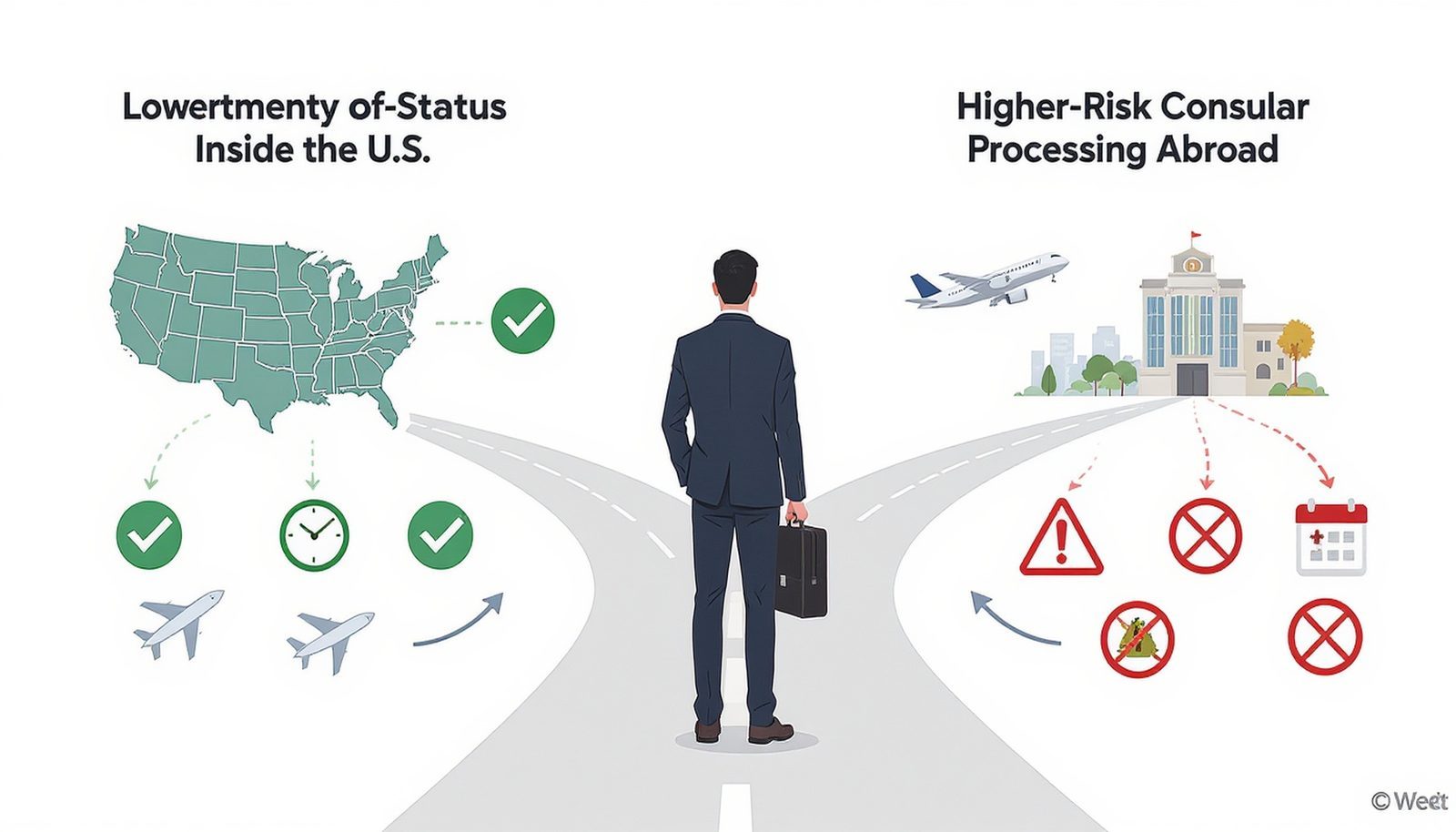
Why this is a “Destination” decision: your lawful status depends on where you wait
Adjustment of Status (AOS) and consular processing are often described as paperwork choices. In practice, they are travel and location choices: where you physically “destination” yourself while your immigrant or nonimmigrant case is pending. That location choice directly interacts with U.S. airline schedule change rules and Department of Transportation (DOT) refund regulations.
Choosing AOS usually means remaining inside the United States, reducing exposure to international flight disruption and border uncertainty. Choosing consular processing usually means leaving the U.S., waiting abroad for an interview slot, and relying on long-haul flights that are structurally more exposed to significant schedule changes and cancellations.
This article treats AOS versus consular processing as a destination risk problem: where you base yourself while the immigration system and airline system both operate under stress. We focus on how airline schedule change timing and rebooking rights amplify or mitigate the risk of being stranded abroad, missing interviews, or losing money on nonrefundable tickets and ancillary fees.
The core mechanism: how airline schedule change rules interact with immigration timelines
To understand the travel risk in AOS versus consular processing, you need to see how two systems mesh:
- Immigration system: USCIS processing queues for AOS versus State Department consular queues and interview backlogs.
- Airline system: DOT rules on when a schedule change or cancellation triggers a right to a cash refund, and when you are limited to rebooking or credits.
DOT rules create a binary distinction that matters for immigration travelers:
- Significant change or cancellation: If the airline cancels your flight or makes a significant schedule change (for example, a departure or arrival shift of several hours, an airport change, added connections, or a downgrade), and you choose not to travel, you are entitled to a cash refund for the ticket and certain ancillary fees.
- Minor change or operational delay: If the change is below DOT’s significant thresholds, or you accept the rebooking and travel, you generally lose the right to a cash refund and are limited to whatever the airline’s contract of carriage and customer service plan provide.
For immigration travelers, the mechanism works like this:
- Consular path: You must align three moving parts: consular interview date, visa issuance timing, and international flight reliability. A significant schedule change close to your interview can force a trade-off: accept a badly timed rebooking to avoid missing the interview, or decline to travel and take a refund, potentially losing your slot and extending your time abroad.
- AOS path: You usually avoid the need for a time-critical international flight until after your status is resolved or advance parole is issued. Airline schedule changes still matter, but they rarely threaten your ability to attend a decisive immigration appointment because you are already in the U.S.
The key is that DOT rules protect your money more than your immigration outcome. You can often get a refund if the airline significantly disrupts your itinerary, but the rules do not compensate you for missing a consular interview or overstaying abroad. That asymmetry is central to the AOS versus consular destination decision.
Comparing AOS and consular processing as travel-risk destinations
From a travel perspective, AOS and consular processing expose you to different types of airline and schedule-change risk. The table below structures the comparison using only mechanisms implied by DOT rules and known consular backlogs, without numerical estimates.
| Dimension | AOS (stay in U.S.) | Consular processing (wait abroad) |
| Primary location risk | Risk of status gaps or work/travel limits inside the U.S. | Risk of being stuck abroad while consulate backlogs fluctuate. |
| Dependence on international flights for key milestones | Lower: main milestones (biometrics, AOS interview) are domestic. | Higher: must travel abroad for interview and return on time. |
| Exposure to long-haul schedule changes | Indirect: mostly affects post-approval or discretionary travel. | Direct: long-haul flights to/from the U.S. are central to the process. |
| Impact of a significant schedule change before a critical date | Usually manageable with domestic rebooking; immigration event is nearby. | Can jeopardize consular interview or return before status/visa expiry. |
| Refund rights if airline cancels or significantly changes flight | Same DOT rights, but less pressure to accept bad rebooking because immigration deadlines are looser. | Same DOT rights, but strong pressure to accept rebooking even if inconvenient to avoid missing interview. |
| Ancillary fee exposure (seats, bags, Wi‑Fi) | More trips may be domestic; ancillary refunds still apply when services not delivered. | International segments often carry higher ancillary fees; failures on those flights create larger refund stakes. |
| Flexibility if airline disruption coincides with government rescheduling | Higher: USCIS reschedules domestically; no border crossing needed. | Lower: must coordinate consulate, airline, and border entry rules simultaneously. |
The structural pattern is clear: consular processing concentrates risk into a few high-stakes international trips, while AOS spreads risk over time but keeps it mostly domestic. DOT’s schedule change and refund rules apply equally, yet their practical impact differs because the consequences of missing a flight are much more severe when your lawful ability to enter or re-enter the U.S. is at stake.
Timing dynamics: when airline schedule changes matter most for each path
Airline schedule changes are not all equal. Their impact depends on when they occur relative to your immigration milestones and what choices you make at the moment of disruption. The decision tension is different for AOS and consular processing.
Pre-departure changes: before you leave the U.S.
For consular processing, the first critical moment is the outbound flight to your interview country.
- If the airline cancels or significantly changes your outbound flight (for example, moving it by several hours or adding a connection that makes same-day arrival impossible), DOT rules say you can decline to travel and claim a cash refund.
- But immigration reality pushes the other way: if you decline to travel, you may miss your consular interview and fall back into the backlog, extending your time abroad or forcing you to re-plan the entire trip.
For AOS, pre-departure changes on domestic flights to biometrics or interviews are usually easier to absorb. You can often rebook on the same day or travel by alternative means without crossing borders. The DOT refund right still exists for significant changes, but the immigration stakes are lower because you are not trying to cross an international boundary to attend the appointment.
In-trip disruptions: while you are abroad
Once you have left the U.S. for consular processing, the return flight becomes the critical link. Here, airline schedule changes interact with visa issuance and entry rules:
- If your return flight is canceled or significantly changed after your visa is issued, DOT rules again give you a refund option if you decline to travel.
- However, declining to travel may not be realistic: you may be under pressure to re-enter the U.S. before a job start date, school term, or personal obligations. You are likely to accept whatever rebooking is offered, even if it is inconvenient, because the immigration cost of delay is high.
For AOS, international travel during a pending case (for example, using advance parole) is structurally similar to consular travel, but it is often discretionary. If a significant schedule change occurs, you may have more flexibility to cancel the trip, take a refund, and avoid risk to your status by staying in the U.S.
Post-disruption choices: rebook, refund, or abandon the trip
DOT rules create a pivotal decision point:
- If you accept rebooking or travel on the significantly changed flight, you generally forfeit the right to a cash refund.
- If you decline to travel after a significant change or cancellation, you can claim a refund for the ticket and certain ancillary fees.
For consular processing, this decision is entangled with consular backlog risk:
- Accepting rebooking may mean arriving late, traveling overnight, or connecting through less reliable hubs, but you preserve your interview slot.
- Declining to travel protects your money but may push you back into a long queue, extending your time abroad and delaying status resolution.
For AOS, the same decision is usually less consequential. You can often prioritize the refund or a better-timed rebooking without risking your place in an immigration queue, because the key events are domestic and less dependent on a single international flight.
Ancillary fees, nonrefundable tickets, and how much you can actually lose
Both AOS and consular travelers often buy nonrefundable tickets and pay ancillary fees for seat selection, baggage, or Wi‑Fi. DOT rules change the risk profile when airlines disrupt your plans.
Nonrefundable tickets: when they become refundable
Under normal circumstances, nonrefundable tickets live up to their name: if you change your mind or your immigration plans shift, you may be limited to credits or change fees according to the airline’s policies. But when the airline cancels or significantly changes your flight and you choose not to travel, DOT rules require a cash refund even for nonrefundable tickets.
For consular processing, this means:
- If a significant schedule change makes it impossible to reach your interview on time and you decide to abandon the trip, you can recover the ticket cost.
- However, you cannot recover the lost time in the consular queue or the cost of rescheduling the immigration process itself.
For AOS, the same rule provides a safety net for domestic or optional international trips. If an airline disruption makes a trip pointless or risky for your status, you can decline to travel and reclaim your fare, reducing the financial penalty for prioritizing immigration stability.
Ancillary fees: when service non-delivery matters
DOT rules also tie refunds for ancillary fees to service non-delivery. If you paid for a specific service and the airline did not provide it, you may be entitled to a refund. Examples include:
- Checked baggage fees when bags are lost or significantly delayed.
- Seat selection fees when you are involuntarily moved to a different seat type.
- Wi‑Fi fees when the service does not work.
- Preferred boarding or other paid perks that are not delivered.
For consular travelers, these ancillary fees are often higher on long-haul flights, so the financial stakes of service failures are larger. But again, the rules protect your money, not your immigration outcome. A lost bag or missed connection can still cause you to miss an interview even if you later recover the fees.
For AOS travelers, ancillary fee refunds reduce the cost of domestic disruptions, but the underlying immigration risk is lower because you are not relying on a single international segment to maintain or regain lawful status.
Risk and uncertainty: where the gray areas really are
Both AOS and consular processing operate under significant uncertainty, and airline schedule change rules only partially mitigate that uncertainty. Several structural gaps remain.
Ambiguity in “significant change” and airline practices
DOT provides thresholds and examples of what counts as a significant schedule change, but airlines still have room to interpret and classify disruptions. The decision intelligence summary notes that there is no quantitative data here on how often airlines label disruptions as cancellations versus schedule changes. This matters because:
- If a disruption is classified as a minor schedule adjustment, you may not be offered a cash refund even if the practical impact on your immigration plans is large.
- Airlines have incentives to frame disruptions in ways that minimize refund liability, especially on expensive international routes used by consular travelers.
For AOS, this ambiguity is inconvenient. For consular processing, it can be critical: a change that is technically “minor” may still cause you to miss a consular interview or arrive in a country after your entry permission window.
Uneven compensation for inconvenience
U.S. rules do not mandate cash compensation for inconvenience in most delay and schedule change scenarios. Airlines may offer vouchers, hotels, or meals, but these are governed by each carrier’s contract of carriage and customer service plan. The decision intelligence notes that this leads to uneven outcomes and heavy reliance on airline-specific policies.
For consular travelers, this means that even when an airline disruption causes you to miss an interview or overstay abroad, you are unlikely to receive compensation that reflects the immigration consequences. You may get a hotel night or a meal voucher, but not compensation for lost wages, extended separation from family, or additional legal fees.
For AOS travelers, the same unevenness applies, but the consequences of a missed domestic appointment are often easier to remedy through rescheduling with USCIS.
Information asymmetry and notification gaps
DOT requires airlines to notify passengers of cancellations, significant changes, and refund rights, but the operational reality is mediated through email, SMS, and app alerts. The decision intelligence highlights that this creates room for inconsistent communication and missed opportunities to claim refunds.
For consular processing, notification gaps can be particularly damaging:
- If you do not see a schedule change in time, you may miss the chance to rebook onto an earlier flight that would still get you to your interview.
- If you are not informed of your refund rights, you may accept a suboptimal rebooking that undermines your immigration plans instead of restructuring your trip entirely.
For AOS, missed notifications are still problematic but less likely to cause irreversible immigration harm, because domestic appointments can often be rescheduled and do not require crossing borders.
Complaint-driven enforcement
Enforcement of DOT rules is complaint-driven. Travelers must document changes, file complaints with airlines, and, if necessary, escalate to DOT. Protection is not automatic; it depends on awareness and persistence.
For consular travelers, this creates a trade-off between time spent pursuing refunds and time spent managing immigration logistics abroad. You may be dealing with consular communication, local accommodation, and employment issues while also trying to enforce your airline rights.
For AOS travelers, complaint-driven enforcement is still a burden, but it is less likely to coincide with the stress of being outside your home country and legal jurisdiction.
Strategic trade-offs: choosing your “destination” under airline and consular uncertainty
When you frame AOS versus consular processing as a destination decision under airline schedule change risk, the trade-offs become clearer.
When AOS tends to be structurally safer from a travel perspective
AOS tends to reduce exposure to high-stakes international flight disruptions because:
- Your key immigration events occur within the U.S., reachable by domestic travel that is generally more frequent and flexible.
- Airline schedule changes are less likely to coincide with hard border-crossing deadlines.
- DOT refund rules still protect you financially when airlines significantly disrupt your plans, but you are under less pressure to accept inconvenient rebookings that might compromise your immigration timeline.
This does not mean AOS is always better; it means that, from a travel-risk standpoint, you are less dependent on a small number of long-haul flights whose disruption could have outsized immigration consequences.
When consular processing may still be preferable despite travel risk
Consular processing can still be attractive or necessary in scenarios such as:
- Ineligibility for AOS due to status or entry history.
- Faster or more predictable consular queues in specific categories or countries.
- Personal or professional reasons to be abroad during processing.
In these cases, the travel-risk structure looks like this:
- You accept higher exposure to long-haul schedule changes and cancellations.
- You rely heavily on airlines’ operational reliability around your interview date and return window.
- You depend on DOT refund rules primarily as a financial backstop, not as a way to protect your place in consular queues.
The key mechanism is that consular processing compresses immigration risk into a few critical travel events. Airline disruptions at those points can have cascading effects that refunds alone cannot fix.
Balanced conclusion: aligning your immigration path with airline reality
AOS versus consular processing is often discussed in terms of forms, fees, and processing times. When you overlay DOT airline schedule change rules and rebooking rights, a different dimension emerges: where you physically base yourself while the system works, and how much you rely on long-haul flights at critical moments.
The decision intelligence on airline rules shows that:
- Refund rights are robust when airlines cancel or significantly change flights and you decline to travel, even for nonrefundable tickets and certain ancillary fees.
- Those rights do not extend to compensating immigration consequences such as missed interviews, extended time abroad, or status gaps.
- Enforcement is complaint-driven and communication is imperfect, so practical protection depends on your awareness and persistence.
From a travel-risk perspective, AOS generally offers a more stable “destination”: you stay in the U.S., rely less on high-stakes international flights, and can use DOT protections primarily to manage cost rather than to salvage immigration-critical trips. Consular processing, by contrast, places more weight on airline reliability at a few key moments, where even minor schedule changes can have outsized effects on your immigration trajectory.
A balanced view recognizes that neither path eliminates uncertainty. AOS concentrates risk in domestic processing queues and status rules; consular processing concentrates risk in consular backlogs and international travel. Airline schedule change rules mitigate financial loss in both cases but do not equalize the immigration consequences. The most resilient strategy is to choose the path whose underlying risk structure—domestic queues versus international travel and consular backlogs—best matches your tolerance for being abroad, your dependence on time-critical flights, and your capacity to monitor and enforce your rights when disruptions occur.