How This Article Helps You Decide (Category: Destination)
Bali’s water crisis is no longer a distant environmental story. It now shapes where you stay, what comfort you can expect, and how your trip affects local communities. This article looks at Bali as a destination under water stress and turns complex data into clear choices for you as a traveler.
Each section below focuses on a real decision you face when planning a trip, not just a list of problems:
- Which regions of Bali are more water-stressed, and what that means for your itinerary.
- How different accommodation types use water, and how to choose lower-impact options.
- How to handle drinking, showering, and pool use without risking your health or comfort.
- What risks and uncertainties to factor into your timing and budget.
The aim is not to tell you whether you should visit Bali. It is to explain why certain choices reduce harm and support resilience in a place where water demand is on track to exceed what the island can sustainably supply.
Decision 1: Where to Stay on Bali’s Water-Stressed Island

Water scarcity in Bali is uneven. Your choice of region affects both your own experience (showers, pools, water pressure) and the pressure you place on local water systems.
What the data signals
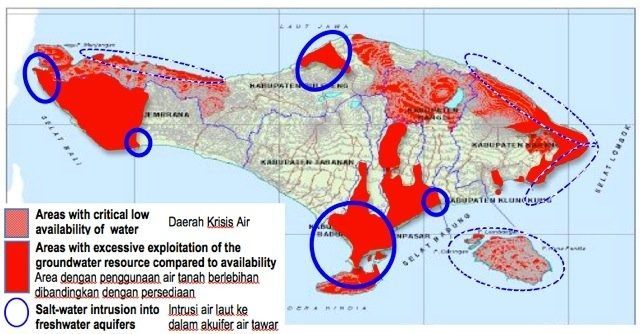
- Island-wide demand is projected to exceed sustainable supply around 2025. East Bali and nearby islands (Nusa, Gili) already face chronic shortages.
- Some communities rely on water tankers in the dry season, while tourist zones still keep pools full and gardens green.
- Groundwater extraction for hotels and villas is lowering the water table and allowing seawater intrusion into aquifers, especially along the coast.
Regional trade-offs for travelers
Detailed, up-to-date numbers by district are limited. Instead, we use qualitative patterns that show up again and again in government and NGO reports.
| Region | Water situation (qualitative) | Traveler upside | Traveler downside / risk |
| South Bali (Kuta, Seminyak, Canggu) | High demand, heavy groundwater use, stressed aquifers. | Most developed; usually stable services in mid–high-end properties. | High hidden impact; future restrictions or moratoriums more likely. |
| Ubud & Central Bali | Still pressured, but more linked to traditional irrigation systems. | More properties experimenting with conservation; cultural landscapes. | Risk of conflict between tourism and rice irrigation in dry periods. |
| East Bali & Nusa/Gili islands | Most acute scarcity; tanker dependence in some areas. | Scenic, less urbanized; strong incentive for some eco-initiatives. | Higher risk of rationing, low pressure, or service interruptions. |
How to decide your base
No region is “water neutral.” Your choice is about what kind of risk and impact you accept:
- If reliability is your top priority (families with small children, short trips): choose areas with more established infrastructure (parts of South Bali, central Ubud). Then reduce your impact by picking places with clear water policies (see Decision 2).
- If minimizing impact is your top priority: look at smaller-scale places in Ubud or central areas that clearly support local water initiatives and subak systems. Avoid water-heavy extras like private pools.
- If you want remote islands or East Bali: arrive with realistic expectations. You may face low pressure, occasional rationing, or limited hot water. Treat this as part of the trade-off for staying in a more fragile environment.
The key is to match your expectations to regional limits. A remote villa on a dry hillside cannot offer city-level water reliability without tanker deliveries or aggressive groundwater pumping.
Decision 2: Hotel, Villa, or Guesthouse – Which Uses Water More Responsibly?
Your choice of accommodation type is one of the strongest levers you have. Tourism infrastructure, especially starred hotels, uses a large share of Bali’s water and often far more per guest than local households.
What is known about consumption patterns
- Local studies suggest tourism facilities can use over half of the water in some areas, even though they serve only a minority of people.
- High-end hotels and villas with multiple pools, fountains, and big gardens use many times more water per room than typical domestic use per person.
- Many properties skip the piped network and drill private wells, because groundwater is cheaper and rules are weakly enforced.
Exact liters-per-guest numbers differ by property and are rarely reported. So this section focuses on structural patterns that are well documented, rather than pretending to know precise figures for each place.
Trade-offs by accommodation type
- Large resorts (especially with multiple pools and landscaped grounds)
- Upside: Often better internal infrastructure (storage tanks, treatment systems), so you may see fewer obvious disruptions.
- Downside: Very high total water use; more likely to rely on private wells; pools and gardens lock in high demand even in dry years.
- Private villas with pools
- Upside: Privacy and comfort; some promote themselves as eco-friendly.
- Downside: One small group can use water volumes similar to many households. Many villas sit outside main networks and depend on wells or tankers.
- Small guesthouses / homestays
- Upside: Usually fewer water-intensive features; often share infrastructure with local communities, which can encourage more careful use.
- Downside: More exposed to local shortages. You may feel disruptions more directly through low pressure or scheduled outages.
How to evaluate a specific property
There is no universal water label for Bali hotels. You need to read between the lines and look for specific, checkable signals instead of vague “eco” claims:
- Water source transparency: Does the property say if it uses the public network, wells, or tankers? A clear explanation is a good sign, even if the setup is not perfect.
- On-site treatment and reuse: Mentions of greywater reuse for gardens, rainwater harvesting, or on-site treatment plants show long-term investment.
- Operational policies: Opt-in linen changes, low-flow fixtures, and clear guest guidelines show active efforts to cut demand.
- Engagement with local systems: Partnerships with local water user groups or subak associations suggest the property understands shared limits.
Practical decision rules
- Short stay, high comfort: If you pick a resort, choose one that publishes its water initiatives. Avoid places that boast about many large pools and wide lawns.
- Long stay, moderate comfort: A well-run guesthouse or small hotel with clear conservation policies often balances reliability with lower impact.
- Private villa: Treat a private pool as a high-impact luxury. If you still choose it, offset by cutting other water-heavy habits (see Decision 3) and by staying longer in one place instead of hopping between several villas.
The basic rule is simple: the more built water features and irrigated land a property maintains, the more structurally water-hungry it is, no matter how careful you are in the shower.
Decision 3: How to Use Water Day-to-Day Without Making Things Worse
Once you arrive in Bali, your daily habits decide how much you add to or ease the pressure described above. One traveler will not fix the crisis, but many travelers together do shape demand. Your choices also affect how well your stay holds up if disruptions occur.
Drinking water: safety vs plastic vs cost
Bali’s tap water is widely seen as unsafe to drink. Contamination comes from poor sanitation, farm runoff, and untreated waste. This creates a three-way trade-off:
- Health: Do not drink tap water directly. This is a non-negotiable safety rule.
- Plastic waste: Single-use bottles add to plastic problems, especially where waste systems are weak.
- Cost and convenience: Filter systems require investment from properties. Bottled water is cheap per bottle but costly for the environment when used at scale.
Given this, a robust approach for travelers is:
- Choose places that offer refill stations or large dispensers of filtered or treated water.
- Bring a reusable bottle and refill it instead of buying many small bottles.
- Use bottled or filtered water for brushing your teeth if you have a sensitive stomach. Accept this small extra volume as a health trade-off.
Showers, laundry, and pools: comfort vs volume
Most of your water footprint in Bali comes from showers, laundry, and pools, not from drinking. The question is how much comfort you are willing to trade for lower use.
- Showers:
- Shorter showers and turning off the water while soaping are easy ways to cut use with little discomfort.
- In areas with low pressure or rationing, showering early in the morning or late at night can ease strain on the system and improve your own experience.
- Linen and towels:
- Say no to daily sheet changes. Reuse towels for several days. This cuts both water and energy use.
- If the property does not offer an opt-out, you can ask directly for less frequent changes.
- Pools:
- Every pool needs filling and constant top-ups due to evaporation and splashing. The main impact comes from having the pool, not from each swim.
- Heavy use can increase the need for backwashing and cleaning, which uses more water. Avoid rough play that throws large amounts of water out of the pool.
Why these decisions matter
In a water-stressed destination, the system already runs close to its limits. Your personal cuts do not “solve” scarcity, but they:
- Lower peak demand, which can make rationing less likely at critical times.
- Show accommodation providers that guests accept and even expect conservation, which makes systemic changes easier to introduce.
- Reduce the need for emergency tanker deliveries, which are costly and often divert water from local communities.
The mindset shift is to see water as a shared, limited resource, not an endless hotel amenity included in your room rate.
Decision 4: Supporting or Undermining Bali’s Subak and Cultural Landscapes

Bali’s famous rice terraces are more than a view. They are part of the subak irrigation system, a UNESCO-recognized cultural landscape. Tourism’s water use increasingly competes with this system, especially when water is diverted to hotels and villas.
How tourism pressures subak
- Groundwater extraction and diversion of surface water for tourism can cut flows to subak networks.
- As water becomes less reliable, farmers may stop growing rice and sell or convert land into villas or resorts.
- This harms local livelihoods and also damages the very landscapes that attract visitors.
Traveler choices that influence this dynamic
- Where you stay: Properties built on former rice fields, especially with large pools and lawns, are more likely to have displaced or disrupted subak.
- What you pay for: Tours or experiences that clearly support subak maintenance (for example, guided walks with local farmers or community-based tourism) help keep the system financially viable.
- How you respond to dry fields: In dry seasons, some terraces may look less green. If you see this as “disappointing” and shift to ever-greener, heavily irrigated resorts, you reward unsustainable water use.
Decision framework: scenery vs system
When you choose a “rice field view” villa or resort, ask yourself:
- Is this property integrated with existing subak (for example, paying water fees and supporting maintenance), or has it replaced fields with private landscaping?
- Does the marketing focus on harmony with local agriculture, or only on the visual backdrop?
Choosing stays and activities that support the system, not just the scenery, helps keep water flowing to agriculture and reduces pressure to turn more fields into tourism infrastructure.
Decision 5: Timing Your Trip and Budgeting for Water-Related Disruptions
Bali is close to, or already in, a structural water deficit. Future conditions are uncertain. You cannot control policy or rainfall, but you can decide how much uncertainty you accept in your plans.
Seasonal and policy uncertainties
- Seasonality: The dry season increases pressure on groundwater and surface water. In some regions, tanker deliveries become more common and raise business costs.
- Policy responses: Authorities and NGOs push for moratoriums on new accommodation, stricter water licenses, and recharge wells. Implementation is uneven and politically contested.
- Infrastructure gaps: Underinvestment in piped systems means that even if new rules appear, real improvements may lag behind demand.
There is little solid forecasting on how these forces will hit specific neighborhoods or price levels. Treat them as scenario risks, not fixed outcomes.
What this means for your booking strategy
- Flexibility vs price: Non-refundable bookings in highly water-stressed areas carry more risk of discomfort, such as low pressure or pool closures, if conditions worsen. Paying a bit more for flexible terms can be a sensible hedge.
- Length of stay: Longer stays in fewer places reduce the total footprint of cleaning, laundry, and transfers. They also give you more time to adapt if minor disruptions occur.
- Backup expectations: Mentally allow for the chance that some amenities (lush gardens, always-full pools) may be scaled back as rules tighten or droughts deepen.
Cost implications
Public data on how water scarcity affects room rates or surcharges is limited. Still, you can expect that:
- Properties that invest in sustainable water infrastructure (treatment, reuse, rainwater harvesting) face higher upfront costs, which may show up as slightly higher rates.
- In severely stressed areas, tanker deliveries or emergency measures can raise operating costs, which may appear as higher prices or reduced service levels.
Choosing a slightly more expensive property that clearly invests in water resilience is not only an ethical choice. It can also lower your risk of service disruptions.
Risks, Uncertainties, and Edge Cases You Should Consider
No guide can fully predict how Bali’s water crisis will unfold. But several uncertainties and edge cases are useful for you to understand before you book.
Regulatory enforcement is uneven
- Water licenses and extraction rules exist, but enforcement varies by region and over time.
- Some properties may run wells without proper permits, which could expose them to future crackdowns or forced changes in supply.
- For you, this means a small risk that a property could face sudden constraints if authorities tighten enforcement.
Health incidents from water contamination
- Tap water contamination is well documented, but there is little systematic data on how often travelers get sick from water.
- Edge cases include properties with poorly maintained filters or storage tanks, where even “filtered” water may be unsafe.
- To lower risk, favor places that describe their treatment systems in detail and keep refill stations visibly clean.
Community-level impacts you may not see
- When hotels and villas draw heavily on groundwater, the first visible impact is often drying community wells, not empty pools.
- As seawater enters aquifers, water can turn brackish, harming agriculture and household use long before tourists notice.
- This means a “smooth” guest experience can exist alongside serious local hardship.
Edge cases: tanker-dependent properties
- Some accommodations, especially in dry or remote areas, rely partly or fully on tanker deliveries.
- In extreme conditions, tanker supply can be delayed or redirected, causing sudden rationing or temporary closures.
- Few properties advertise this dependence. If you book in a known dry region, consider asking directly how the property secures its water.
These uncertainties do not mean you should avoid Bali. They mean you should treat water as a central planning factor and accept that some parts of the situation will remain outside your control.
Putting It All Together: A Practical Decision Checklist
To turn this analysis into concrete steps, use this checklist when you plan your trip to Bali:
- Destination choice:
- Have you thought about the water stress level of the region (South Bali vs Ubud vs East Bali vs nearby islands)?
- Are you comfortable with the reliability–impact trade-off that comes with your choice?
- Accommodation selection:
- Does the property explain its water source and any conservation or treatment measures?
- Are you choosing a scale and set of amenities (pools, lawns) that match your impact tolerance?
- Daily behavior:
- Will you bring a reusable bottle and use refill stations when you can?
- Are you ready to take shorter showers and decline daily linen changes?
- Cultural landscape support:
- Are you choosing activities or stays that help maintain subak and farm livelihoods, rather than only enjoying the view?
- Risk management:
- Have you allowed for some uncertainty in your budget and expectations (possible low pressure, reduced amenities)?
- Do your booking terms give you flexibility if conditions change a lot?
Bali’s water crisis comes from structural forces: rapid tourism growth, weak regulation, and underinvestment in infrastructure. As a traveler, you cannot fix these alone. But you can make better-aligned decisions that reduce harm, support more resilient businesses, and help keep the island’s communities and landscapes viable for future visits.