How to Think About “Best Baggage Value” in the New Fee Era
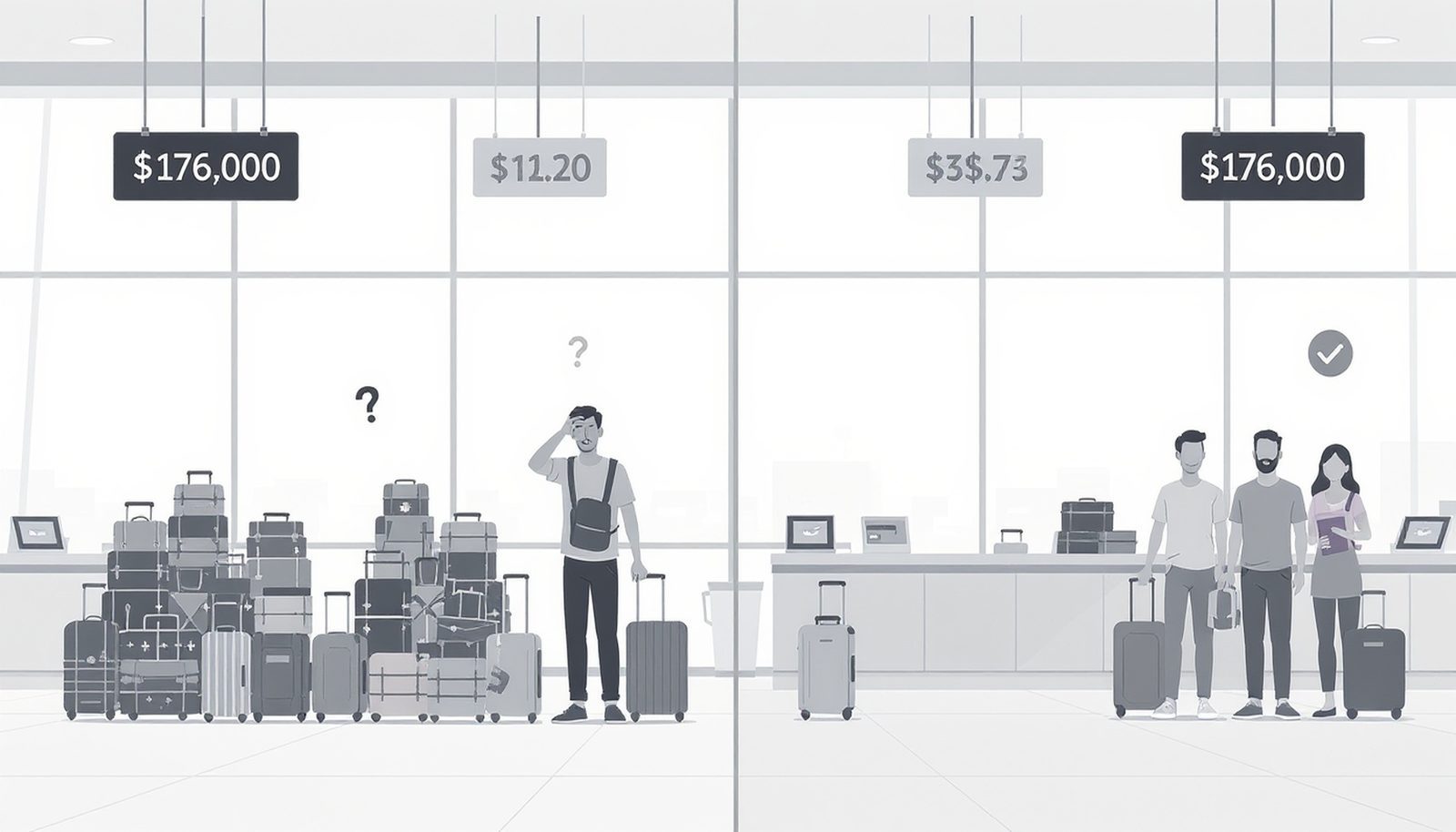
“Best airline for baggage value” no longer means “who gives you free bags.” Under the new U.S. checked-bag pricing rules, nearly every major carrier charges for checked luggage in standard economy, and even the last big holdout, Southwest, is moving toward charging in some contexts. To find real value, you have to look at how baggage fees interact with fare type, timing, and your own travel pattern.
At a high level, U.S. airlines now fall into two structural models:
- Legacy carriers (American, Delta, United, Alaska, JetBlue, and increasingly Southwest): relatively stable first-bag fees (about $35–$40), with baggage rights heavily tied to fare class, elite status, and co-branded credit cards.
- Ultra–low-cost carriers (ULCCs) (Frontier, Spirit, Allegiant, etc.): highly variable, route- and date-based pricing for both checked and carry-on bags, with strong penalties for buying late.
“Value” here is not just the lowest possible fee. It’s the combination of:
- Predictability: how early you can know your total trip cost.
- Flexibility: how costly it is if your baggage needs change.
- Transparency: how easy it is to see the true all-in price when comparing airlines.
- Leverage: how much you can reduce or offset fees via status, cards, or fare bundles.
Because the same airline can be a great value for one traveler and a poor value for another, the core decision is not “Which airline is best?” but “Which baggage model best matches my specific trip and profile?”
Legacy vs. ULCC Baggage Models: Where the Real Trade-Offs Are
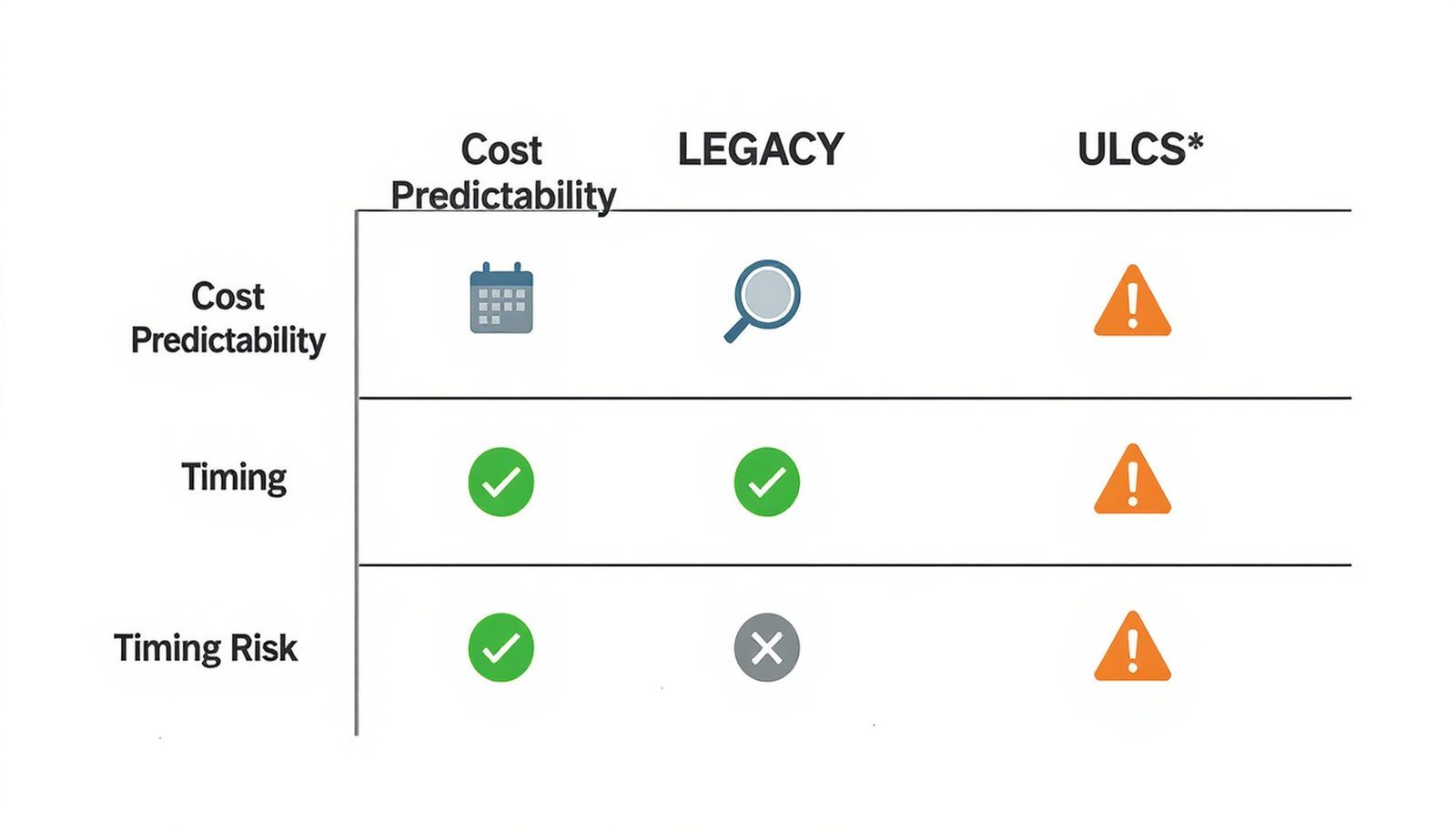
Legacy and ULCC baggage systems are built on different economic logics. Understanding those mechanics is the key to choosing the best baggage value for your situation.
Legacy carriers: stable prices, complex rules
On the major U.S. airlines, the first checked bag in standard economy has converged around roughly $35–$40 on domestic routes. That apparent similarity hides three important structural features:
- Fare segmentation: Basic economy often removes baggage rights (sometimes even the free carry-on), while standard economy and above restore them. Baggage is used as a lever to push you up to a higher fare.
- Loyalty and card integration: Co-branded credit cards and elite status reintroduce “free” bags, but only under specific conditions (for example, ticket purchased with that card, limited number of companions).
- Operational spillover: Because checked bags cost money, more passengers try to carry on, overloading overhead bins. When bins fill, airlines often gate-check bags for free, but not always for the most restricted fares.
In practice, this means legacy carriers monetize baggage in two ways:
- Directly, via published bag fees.
- Indirectly, by making baggage a reason to buy higher fares, hold a card, or chase status.
For travelers who fly often enough to justify a card or earn status, this system can deliver strong baggage value: predictable fees that can be largely offset. For infrequent travelers without loyalty ties, the same system can feel punitive and confusing.
ULCCs: low base fares, high timing risk
ULCCs flip the script. They advertise very low base fares, then charge separately for almost everything, including both checked and carry-on bags. The key mechanisms are:
- Dynamic pricing: Bag fees vary by route, date, and even time of purchase. The same bag on the same flight can cost much more if you wait until check-in or the airport.
- Carry-on vs. checked inversion: It’s common for a checked bag to be cheaper than a carry-on in the overhead bin, especially if purchased early.
- Compressed decision window: Because late purchase is heavily penalized, you must accurately predict your baggage needs at booking to avoid large surcharges.
This model is designed to segment travelers by planning ability and risk tolerance. Those who plan early and pack consistently can achieve low all-in costs. Those who misjudge or change plans late pay disproportionately more.
Comparing the models on baggage value
The table below compares legacy carriers and ULCCs on the main dimensions that matter for baggage value. Values are qualitative, based on the structural features described above rather than specific dollar amounts.
| Dimension | Legacy carriers | ULCCs |
| Base fare level | Moderate to high | Very low headline fares |
| First checked-bag price pattern | Clustered around $35–$40, relatively stable | Dynamic, route- and timing-based; can vary widely |
| Carry-on policy | Usually free in standard economy; restricted in basic economy on some airlines | Often charged separately; sometimes more expensive than checked bags |
| Predictability of total trip cost | High once fare type and status/card are known | Low until baggage is fully configured at booking |
| Timing risk (penalty for late bag purchase) | Low to moderate | High; steep escalations at check-in/airport |
| Leverage via status/credit cards | High; multiple ways to get “free” bags | Limited; fewer robust loyalty-based bag waivers |
| Complexity of rules | High; many exceptions by fare, route, and status | High; many price points by timing and channel |
| Best baggage value for… | Frequent travelers, families with status/card, those who dislike surprises | Ultra price-sensitive travelers who can plan bags precisely and early |
From a baggage-value perspective, legacy carriers tend to reward stability and loyalty, while ULCCs reward precision and early planning. The “best” model depends on which of those you can reliably provide.
How Fare Type, Weight Limits, and Loyalty Mechanisms Shape Real Costs
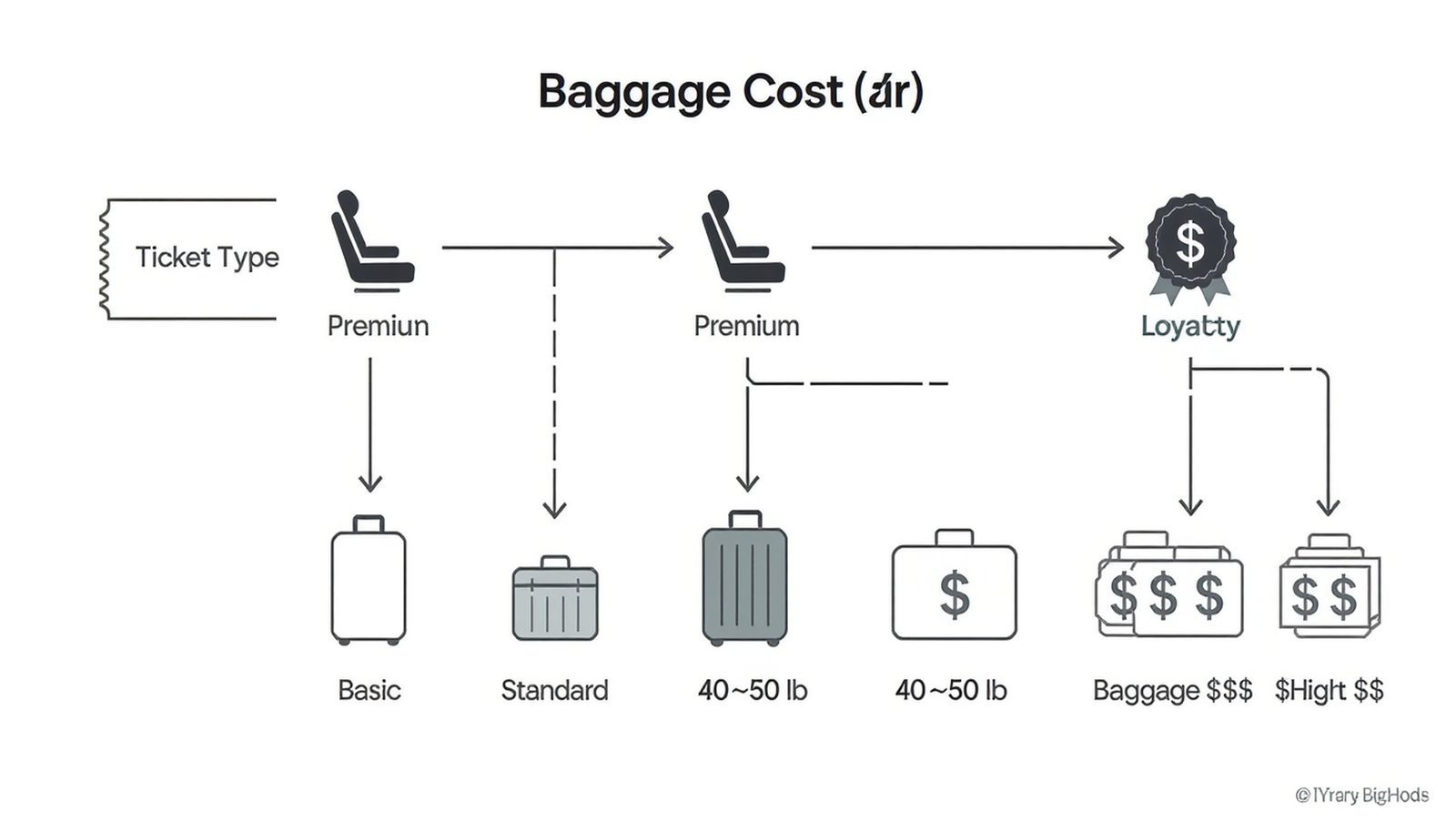
Even within a single airline, baggage value can swing dramatically based on three structural levers: fare type, weight/dimensions, and loyalty instruments (status and cards). Understanding how these interact explains why two passengers on the same flight can pay radically different amounts for similar bags.
Fare type as a baggage gatekeeper
Airlines use fare segmentation to control baggage rights:
- Basic economy: Often removes free checked bags and may restrict carry-ons (for example, some carriers allow only a personal item). Violations can trigger high gate-handling fees.
- Standard/main cabin economy: Typically allows a free carry-on and charges the standard first-bag fee.
- Premium cabins and bundled fares: Include one or more checked bags in the fare, effectively prepaying baggage at a discount compared to buying bags à la carte.
The mechanism is straightforward: baggage rights are used to make the cheapest fare feel risky and the next fare up feel safer. The price difference between basic and standard economy often mirrors the cost of a checked bag plus some margin. If you know you will check a bag, the airline nudges you toward the higher fare, which also locks in more revenue for them.
Weight and size: from operational limit to revenue lever
Historically, a “standard” checked bag meant up to 50 lbs and 62 linear inches. Some airlines are tightening this to 40 lbs for certain fare types or routes. That shift has two effects:
- Higher overweight risk: Typical family suitcases packed for a week can easily exceed 40 lbs, especially with shoes, toiletries, and children’s gear.
- Overweight surcharges as hidden price discrimination: Travelers who pack heavily or imprecisely pay more, while light packers pay only the base fee.
Because enforcement can vary by airport and agent, the risk is probabilistic: you might get waved through one trip and charged the next. That uncertainty makes it harder to compare airlines purely on published fees, because the expected cost includes the chance of overweight charges.
Loyalty and co-branded cards: baggage as a financial product
Co-branded credit cards and elite status convert baggage from a simple operational service into a loyalty and financial-product incentive. The mechanisms include:
- Conditional free bags: Many cards offer a free first checked bag for the cardholder and sometimes companions, but only if the ticket is purchased with that card.
- Companion variability: Some airlines extend the benefit to multiple companions on the same reservation; others limit it more tightly.
- Status tiers: Higher elite levels often include more free bags and higher weight limits, reducing overweight risk.
From a baggage-value perspective, these instruments can dramatically lower your effective cost per trip, but only if:
- You fly the same airline or alliance frequently enough.
- You remember to use the correct card at purchase.
- Your typical travel party fits within the companion rules.
For infrequent travelers, the annual fee of a card may outweigh the baggage savings. For frequent flyers or families loyal to one airline, the same card can turn a high-fee carrier into the best baggage-value option.
Scenario-Based Comparison: Which Airline Model Wins for You?
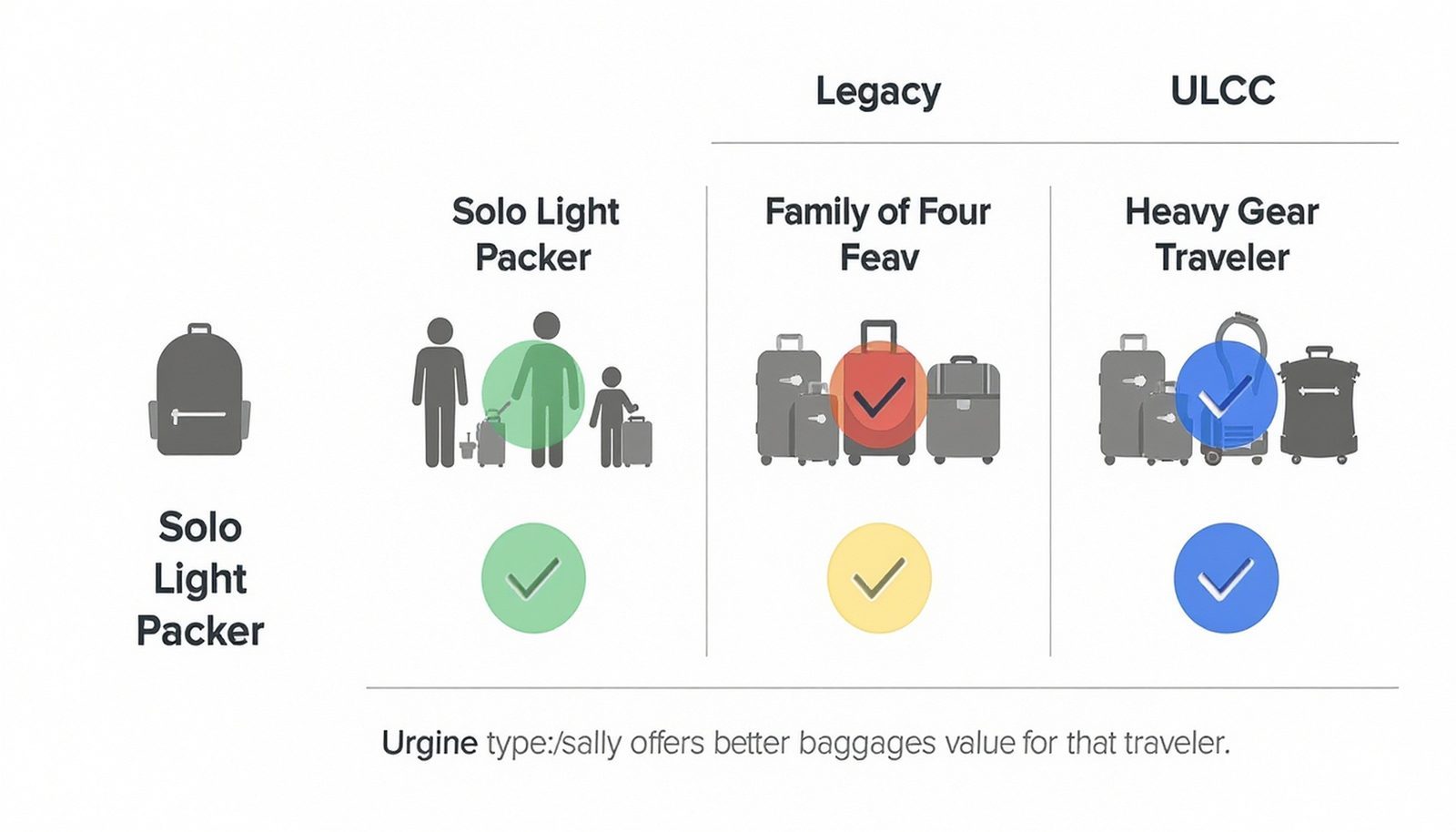
Because we don’t have precise, current dollar figures for each airline, we can’t compute exact totals. But we can compare relative baggage value across common scenarios using the structural features already described.
Scenario 1: Solo light packer, flexible on airline
This traveler usually carries only a backpack or small roller and can avoid checked bags entirely.
- Legacy carriers: In standard economy, a free carry-on is usually included, so baggage cost is effectively zero. Basic economy can be risky if carry-ons are restricted or gate-checked with fees.
- ULCCs: If even a small roller is charged as a carry-on, the traveler must either pay or downsize to a personal item. The base fare may be low, but a single carry-on fee can erase the advantage.
Best baggage value model: Legacy carriers in standard economy, or ULCCs only if the traveler can reliably travel with a personal item that meets strict size rules.
Scenario 2: Family of four, one checked bag per person
This is where baggage policies become economically decisive. Four checked bags at $35–$40 each quickly add up.
- Legacy carriers without status/card: Total baggage cost is roughly four times the first-bag fee. The family benefits from predictable pricing but pays a substantial amount.
- Legacy carriers with a co-branded card or status: If the card covers the primary traveler and companions, or status includes multiple bags, the effective per-bag cost can drop sharply, sometimes to zero for the first bag per person.
- ULCCs: If the family can pre-purchase bags at booking, checked bags may be cheaper than legacy first-bag fees. But any miscalculation (adding a bag later, overweight, or needing a carry-on) can trigger steep surcharges.
Best baggage value model:
- For families with a relevant card or status: legacy carriers often win on both cost and predictability.
- For card-free, price-sensitive families who can plan precisely and pack light: ULCCs can be cheaper, but the risk of surprise fees is higher.
Scenario 3: Occasional traveler checking heavy or bulky items
Think sports equipment, musical instruments, or long trips requiring heavy luggage.
- Legacy carriers: Published overweight and oversize fees apply, and some categories (like certain sports gear) have special rules. The main risk is hitting a 40-lb cap where you expected 50 lbs.
- ULCCs: Heavy items can become very expensive once both base bag fees and overweight surcharges are applied, especially if purchased late.
Best baggage value model: Legacy carriers, because their policies for special items and overweight bags are more standardized and easier to research in advance.
Scenario 4: Frequent domestic traveler on one primary airline
This traveler flies often enough to consider a co-branded card or to earn status.
- Legacy carriers: The combination of status and a co-branded card can eliminate most baggage fees and increase weight allowances, turning baggage from a cost into a perk.
- ULCCs: Loyalty programs exist but are generally less focused on baggage waivers and more on fare discounts or bundles.
Best baggage value model: Legacy carriers, because the loyalty ecosystem is explicitly designed to offset baggage fees for frequent flyers.
Risks, Uncertainties, and Where Travelers Get Caught Out
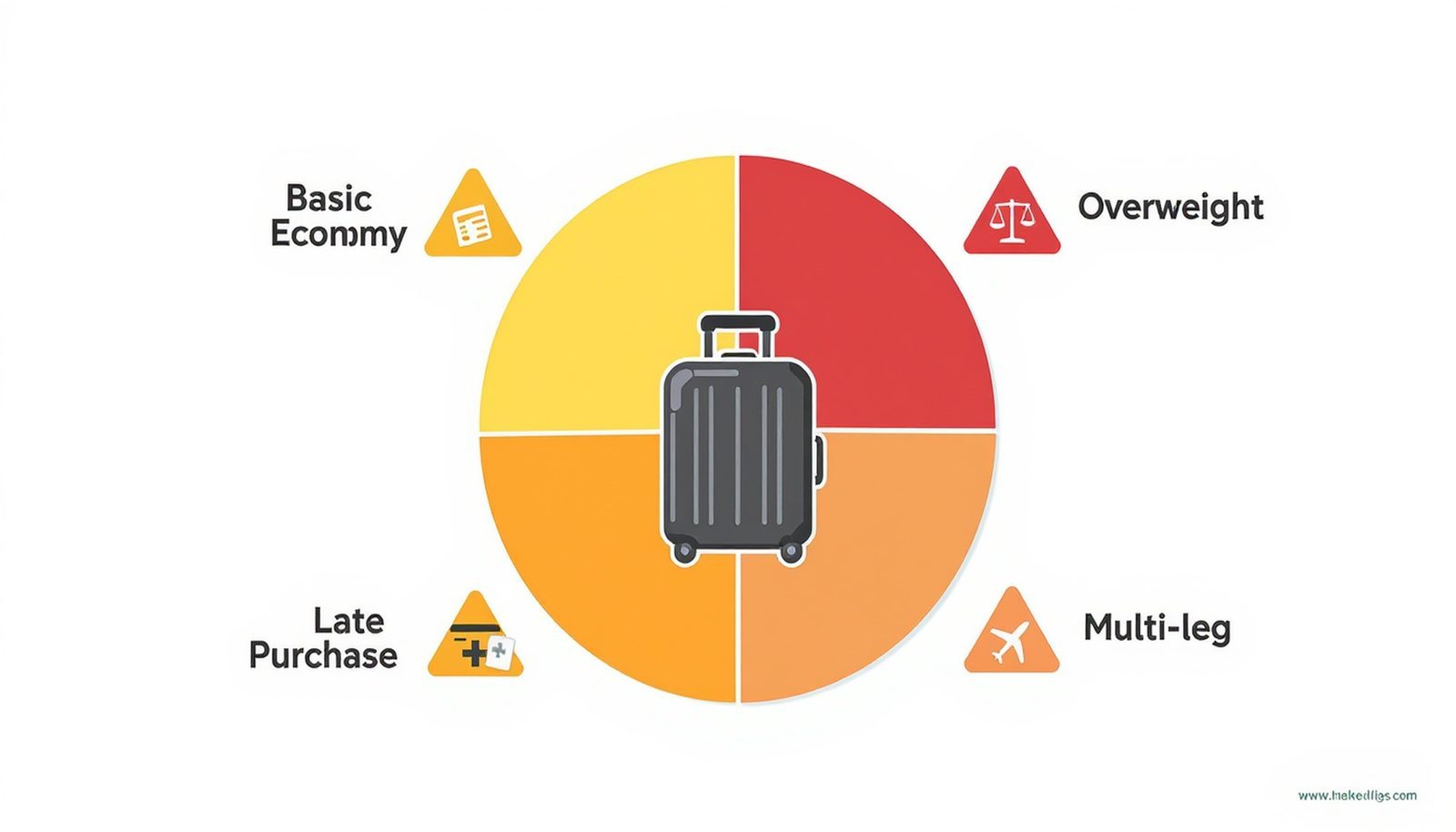
The current baggage landscape is full of traps that can turn a seemingly good deal into a bad one. While we can’t quantify exact dollar risks without airline-specific data, we can map the main categories of uncertainty.
Basic economy fine print
Basic economy fares often look like the best deal, but their baggage rules can be the most punitive:
- Carry-on restrictions: Some airlines allow only a personal item; a standard roller may be denied or charged at the gate.
- Gate-handling surcharges: If you show up with a bag that doesn’t qualify, you may pay both a checked-bag fee and an additional handling fee.
Uncertainty arises because many travelers assume “economy is economy” and don’t realize they’ve bought a more restricted product.
Weight enforcement variability
While published limits (40 or 50 lbs) are clear, enforcement is not. Some check-in agents strictly weigh every bag; others are more lenient. This creates a hidden risk:
- Travelers may mentally budget for only the base bag fee, underestimating the chance of overweight charges.
- Families with multiple bags may face uneven outcomes (some bags charged, others not), making it hard to predict total cost.
Because enforcement practices are not transparent, comparing airlines on this dimension is difficult.
Timing risk on ULCCs
ULCCs explicitly penalize late baggage decisions:
- Buying a bag at booking is cheapest.
- Buying at online check-in is more expensive.
- Buying at the airport is often the most expensive.
The uncertainty lies in how your plans might change. If you’re not sure whether you’ll need a second bag, you face a trade-off between prepaying for something you might not use and risking a much higher fee later.
Multi-leg and international itinerary complications
On itineraries involving multiple airlines or international segments, baggage rules can change mid-trip:
- One segment may include a free bag; another may not.
- Weight limits can differ between domestic and international legs.
- Interline agreements can affect whether bags are checked through or rechecked with new fees.
Without a clear, itinerary-level baggage summary, travelers may underestimate total costs, especially when mixing a legacy carrier with a ULCC on separate tickets.
So Which Airline Is Best for Baggage Value?
There is no single airline that dominates on baggage value for every traveler. Instead, there are best-fit models based on your behavior and constraints.
- If you fly often on one airline and can use a co-branded card or earn status, a major legacy carrier usually offers the best baggage value. The combination of predictable fees, potential free bags, and higher weight allowances outweighs slightly higher base fares.
- If you are extremely price-sensitive, flexible on airline, and can plan baggage precisely at booking, ULCCs can deliver the lowest all-in cost, especially for simple trips with one checked bag or a single paid carry-on.
- If you travel infrequently, with a family, and without loyalty ties, legacy carriers in standard economy often provide better value than ULCCs once you factor in the risk of dynamic bag pricing and late-purchase penalties.
- If you carry heavy or special items, legacy carriers are generally safer because their overweight and special-item policies are more standardized and easier to research.
The underlying mechanism across all these cases is the same: airlines use baggage as a price-discrimination tool. They charge more to travelers who value flexibility, who book late, or who don’t invest in loyalty instruments, and they reward those who commit early, pack predictably, or concentrate their business with one carrier.
To choose the best baggage value for your next trip, focus less on the headline fare and more on how each airline’s baggage model interacts with your own habits: how early you book, how much you pack, how often you fly, and whether you’re willing to align with a single carrier’s ecosystem. The closer that match, the more likely you are to turn today’s complex baggage rules from a cost into a strategic advantage.