
I don’t care how pretty the destination is. If you’re doing mental math before every coffee, the trip doesn’t feel like a vacation.
This guide is about building a daily travel budget that actually survives real life – flight delays, overpriced airport sandwiches, random museum tickets, and that bar you didn’t plan on but absolutely end up in.
We’ll walk through the decisions that matter, the things most people forget, and how to give yourself enough structure to feel safe without killing the fun. Think of it as practical, realistic daily travel cost planning, not a spreadsheet fantasy.
1. Start With One Honest Number (Not a Vibe)
Most people start with, Paris is like $150 a day, right?
and then wonder why their card statement looks like a crime scene.
Flip it. Start from your real life, not from the destination.
The first decision is simple and uncomfortable: How much money can you truly put toward this trip without wrecking the rest of your life?
Do this before you even peek at flight prices:
- List your fixed monthly costs: rent, food, bills, debt, subscriptions.
- See what’s left after those and a small buffer for home emergencies.
- Multiply that leftover amount by the number of months until your trip.
That total is your realistic trip budget ceiling. Not the fantasy number in your head. Not what a blog said a daily travel budget for backpackers should be. Yours.
Now sanity-check it:
- Is this a weekend city break, a 10-day international trip, or a month-long slow travel experiment?
- Are you a hostel-and-street-food person, or a hotel-and-wine person?
Trip length and style matter more than the city name. Two people can be in the same place and one spends $60/day while the other spends $260/day. Same skyline, very different expectations.
Once you have that total number, you can start shaping it into a daily travel budget that actually works.

2. Turn Your Total Into a Daily Number (Then Stress-Test It)
Now we turn that big number into something you can actually use on the ground.
Take your total trip budget and divide it by the number of days you’ll be away. That’s your raw daily budget.
Example:
- Total budget: $2,400
- Trip length: 10 days
- Raw daily budget: $240/day
Looks generous, right? Except that number is lying to you.
Why? Because big one-time costs (flights, long-distance trains, visas, travel insurance) are not daily expenses. If you treat them like they are, you’ll feel broke on day 2.
So split the budget into two buckets:
- Fixed / one-time costs: flights, long trains/buses, visas, insurance, major gear.
- True daily costs: accommodation, food, local transport, activities, small stuff.
Here’s how to make that daily travel budget breakdown more honest:
- Estimate your fixed costs first and subtract them from the total.
- Whatever is left is your daily-spend pool.
- Now divide that by your number of days.
Same example, but realistic:
- Total budget: $2,400
- Flights + insurance + visa: $900
- Left for daily spending: $1,500
- Trip length: 10 days → $150/day real daily budget
Now ask yourself: Does $150/day feel tight, comfortable, or indulgent for how I like to travel in this destination?
If it feels impossible, you have three levers:
- Shorten the trip.
- Change destination or travel style.
- Increase the total budget (more months to save, or cut something at home).
This is where long term travel daily budget planning really lives: in the trade-offs. Better to adjust now than to be rationing museum tickets later.
3. Pick Your Daily Comfort Tier (Not the Internet’s)
Generic City X costs $Y/day
numbers are almost useless. They don’t know if you’re happy with street food or if you need a glass of wine and a real mattress to function.
Instead of chasing one magic number for how much to budget per day for travel
, pick a comfort tier that matches how you actually move through a day.
Tier 1 – Survival Mode
- Hostels or the cheapest rooms you can tolerate.
- Mostly self-catered or street food.
- Walking and public transit only.
- Free or very cheap activities.
Tier 2 – Realistic Comfort (my default)
- Decent hotel/guesthouse or private hostel room.
- Mix of cheap eats, groceries, and some sit-down meals.
- Public transit plus the occasional taxi/rideshare.
- Paid activities that actually matter to you.
Tier 3 – Indulgent Ease
- Nice hotels or boutique stays.
- Frequent restaurant meals, drinks, coffee stops.
- Convenient transport: taxis, rideshares, transfers.
- Premium tours, experiences, and
why not
decisions.
Here’s the trick: you don’t have to pick one tier for the whole trip.
What actually works in real life:
- Use Tier 3 on arrival day and big experience days.
- Use Tier 2 as your normal baseline.
- Drop to Tier 1 for a day or two if you overspend or just want a quiet reset.
So instead of saying, My budget is $120/day, full stop,
you say something like:
- 3 days at Tier 3 (~$180/day)
- 5 days at Tier 2 (~$120/day)
- 2 days at Tier 1 (~$70/day)
Average that out and see if it fits your daily-spend pool. This is how you make room for the good stuff without pretending you’re a different person. It also gives you a more realistic mid range travel daily cost estimate than any generic blog post.
4. Build a Line-Item Daily Budget (Including the Stuff Everyone Forgets)
This is where most budgets quietly die. Not on flights. On small, boring, daily costs that nobody writes down.
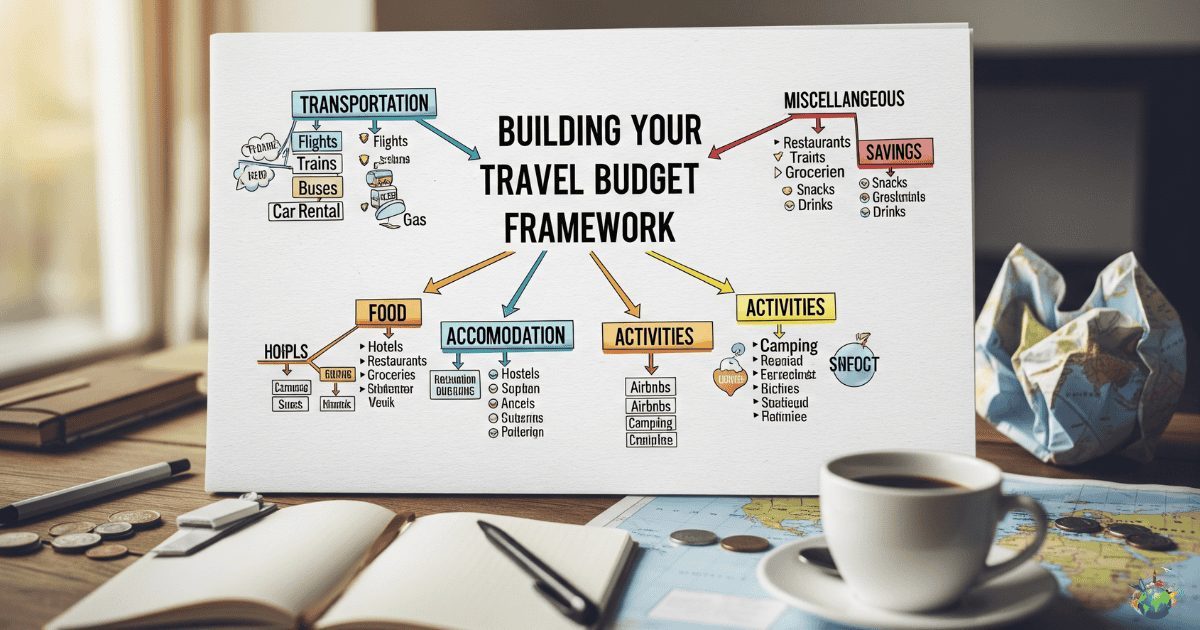
When I build a daily travel budget, I always include at least these categories:
- Accommodation – true nightly rate including taxes, resort fees, cleaning fees.
- Food & drinks – all meals, snacks, coffee, water, alcohol.
- Local transport – metro, buses, trams, taxis, rideshares, scooters, parking, fuel.
- Activities & entrance fees – museums, tours, day trips, rentals, national parks.
- On-the-ground extras – SIM cards, laundry, toiletries, tips, small shopping.
Then I add the silent budget killers that people routinely forget. These are the hidden travel expenses to include if you want your numbers to match reality:
- Arrival day costs: airport transfers, first meal when you’re too tired to hunt for cheap options, extra snacks, maybe a higher taxi fare.
- Tipping: in some countries it’s basically mandatory and adds 15–20% to restaurant bills.
- Card & currency fees: ATM fees, bad exchange rates, foreign transaction fees.
- Airline add-ons: baggage, seat selection, airport parking, in-flight Wi-Fi, airport food.
- Price creep from location: that cheaper hotel far from the center that forces you into taxis twice a day.
Be honest about your habits. If you always end up grabbing a coffee and a snack mid-afternoon, put it in the budget. If you always buy a local SIM, put it in. If you always say yes to one or two paid experiences, put them in.
The goal isn’t to restrict you. It’s to make sure your yes
doesn’t turn into how did I spend $600 more than I thought?
This is how you avoid the classic travel budget mistakes that blow up a trip.

5. Add a Buffer on Purpose (So You Don’t Panic Later)
A budget without a buffer is a fantasy. Prices change. Weather changes. You change your mind.
I use two kinds of buffers as part of my practical travel budgeting tips:
1. Daily micro-buffer
If I think I’ll spend $80/day, I’ll actually plan for $90–$95/day. That extra $10–$15 covers:
- Random snacks and drinks.
- Small price differences from what I researched.
- Minor
oh whatever, let’s just do it
moments.
2. Trip-level emergency buffer
This is separate money I hope not to touch. It’s for:
- Missed connections or last-minute hotels.
- Medical issues or pharmacy runs.
- Big unexpected opportunities (a last-minute show, a special tour).
How much?
- Short trips (3–5 days): at least one full day’s budget as a buffer.
- Longer trips (7–14 days): 1.5–2 days’ budget.
- Big trips (1+ month): 10–15% of the total trip budget.
And here’s the key: decide in advance what counts as a buffer-worthy expense. If you treat the buffer like extra spending money, it will evaporate by day 3.
6. Plan for Your Real Daily Rhythm (Not a Perfect Itinerary)
Most people budget as if every day will be a perfectly balanced sightseeing montage. That’s not how real trips work.
Real trips have:
- Heavy sightseeing days with lots of tickets and transport.
- Slow days where you mostly wander and sit in cafés.
- Bad weather days where you spend more on indoor food and less on activities.
- Travel days where you bleed money on transfers and convenience food.
So instead of one flat daily number, think in day types when you plan your travel cost per day:
- Arrival / departure days: higher transport, higher food, low activities.
- Sightseeing days: higher activities and local transport, normal food.
- Chill days: lower activities, maybe slightly higher food and coffee.
- Adventure / big experience days: high activities, high food, maybe higher transport.
Then roughly assign a budget to each type. For example:
- Arrival day: $160
- Sightseeing day: $130
- Chill day: $100
- Big experience day: $180
When you map these across your actual itinerary, you get a much more realistic total than $120/day x 10
. And you stop beating yourself up for spending more on days that are naturally more expensive.
This kind of planning works whether you’re building a daily travel budget for backpackers or a mid-range city break with a few splurges.
7. Track Lightly, Adjust Quickly, and Stop Obsessing
A budget is not a contract. It’s a decision-making tool. The point is not to hit the number perfectly; it’s to know what you’re trading off.
Here’s what actually works on the road:
- Track once a day, not after every purchase. Do it at night in a notes app or simple spreadsheet.
- Track by category (food, transport, activities, other), not by every line item.
- Watch the 3 usual suspects: food, local transport, and spontaneous activities. These are where most people overshoot by 20–35%.
If you notice you’re trending high and your realistic daily travel costs are creeping up:
- Drop to a Tier 1 day: cheap food, free activities, walk more.
- Swap a paid tour for a self-guided version.
- Use public transit instead of taxis for a couple of days.
The goal is to course-correct early, not to punish yourself at the end of the trip.
And if you’re under budget? Great. You can either:
- Upgrade a hotel night or a meal.
- Add a special experience.
- Or just come home with money left over (wild concept, I know).
That’s what adjusting your daily travel budget looks like in real life: small tweaks, not drama.
8. Put It All Together: A Simple Daily Budget Blueprint
If you want a quick template you can adapt, here’s a simple structure for how to make a travel budget that works:
- Set your total trip ceiling based on your real finances, not wishful thinking.
- Subtract fixed costs (flights, visas, insurance, big transport).
- Divide what’s left by your number of days to get a starting daily pool.
- Choose your mix of tiers (Survival / Comfort / Indulgent) across the trip.
- Build a line-item daily budget with accommodation, food, local transport, activities, extras.
- Add buffers: a daily micro-buffer and a trip-level emergency buffer.
- Map by day type: arrival, sightseeing, chill, big experience.
- Track lightly and adjust every couple of days instead of panicking at the end.
If you want to go deeper into calculators and multipliers, tools like the travel budget calculator on Funify Tools or frameworks from sites like TripMint Lab can help you plug in your own numbers and see how style, weather, and schedule change your daily costs.
But even without any fancy tools, if you:
- Start from your real money,
- Include the boring daily stuff (and the unexpected costs in your travel budget),
- Give yourself buffers on purpose,
- And adjust instead of ignoring the numbers,
you’ll end up with something most people never have on their trips: financial peace of mind. And that’s what actually makes the beach, the city, or the mountain view feel as good as it looks in the photos.