Destination: Honest Capacity – Why mAh Misleads Travelers
When you travel, a power bank is not just a gadget. It is a backup you depend on. But the main number on the box – milliamp-hours (mAh) – often misleads you when you try to guess how many real charges you will get or what it costs to keep the bank charged.
Manufacturers measure mAh at the internal battery voltage, usually around 3.6–3.7 V for lithium-ion cells. Your phone, tablet, or laptop charges at higher USB voltages like 5 V, 9 V, 12 V, or more. Each step that converts energy from the cell to USB output wastes some energy as heat and electronics overhead. So a “10,000 mAh” bank almost never behaves like 10,000 mAh at 5 V in real use.
To compare cheap and premium power banks honestly, you need to think in watt-hours (Wh) and then apply realistic efficiency. That is where the gap between marketing and reality shows up clearly.
From mAh to Wh: The Only Metric That Travels Well
Watt-hours measure energy directly: Wh = (mAh ÷ 1000) × voltage. For a typical 10,000 mAh bank with 3.7 V cells, the theoretical energy is about 37 Wh. This is your starting point before any losses.
Cheap and premium banks may show the same mAh, but their usable Wh differ once you include:
- Conversion efficiency: How much energy the electronics lose when they boost cell voltage up to USB voltage.
- Fast-charge overhead: Higher voltages and currents waste more energy as heat.
- Cable and connector losses: Thin or long cables lose more energy.
- Temperature: Very hot or cold conditions reduce how much capacity you can actually use.
Premium banks usually use better conversion electronics and better thermal design. Their efficiency often sits around 85–90% under moderate loads. Cheaper units are often closer to 75–80%, and they tend to drop further when you use fast charging or plug in several devices.
Why Airline Rules Quietly Favor Wh Over mAh
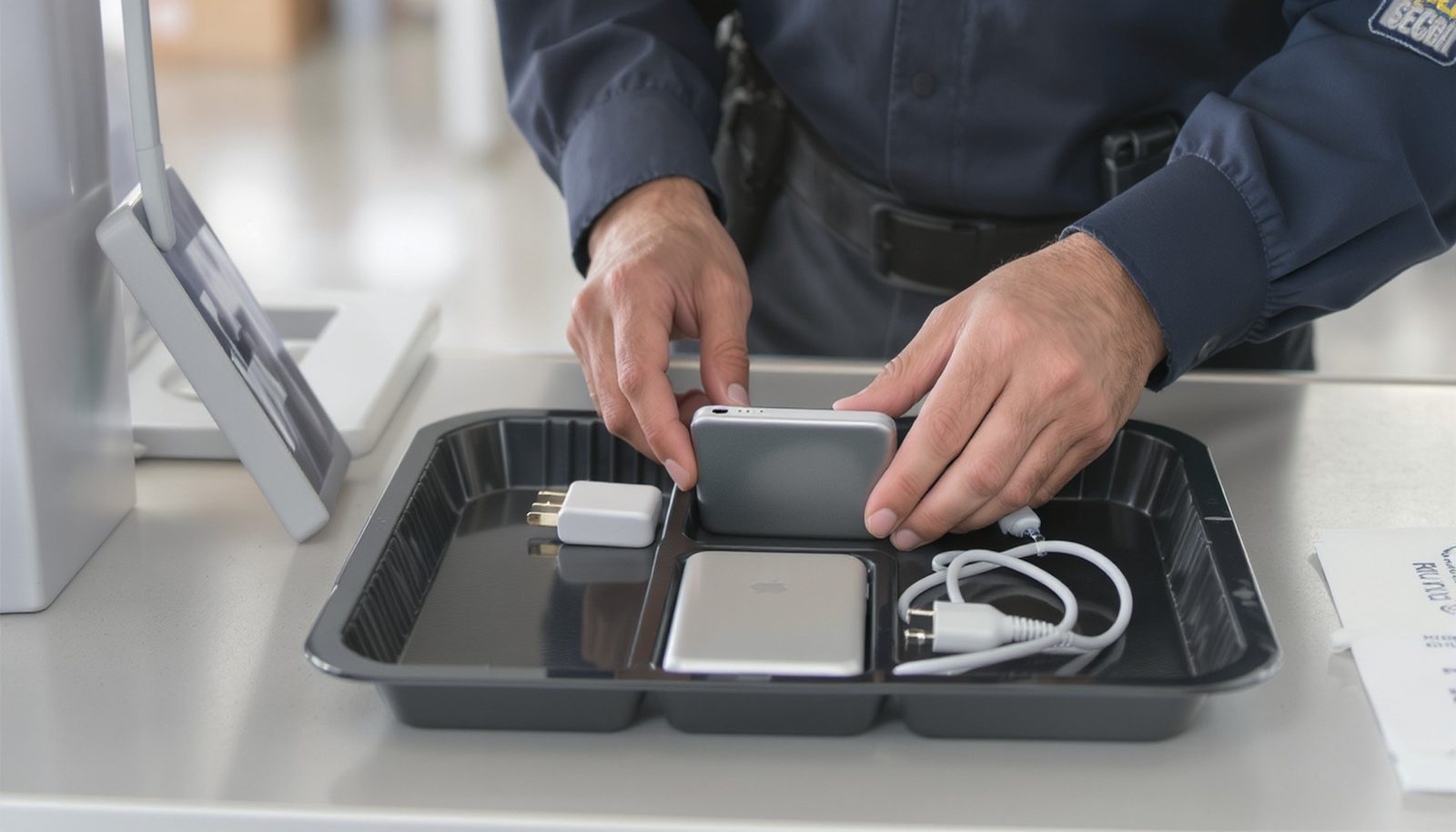
Airline and aviation safety rules use Wh, not mAh. Most airlines cap carry-on lithium batteries at 100 Wh without special approval. That means:
- A 10,000 mAh bank at 3.7 V (~37 Wh) is well below the limit.
- A 26,800 mAh bank at 3.7 V (~99 Wh) sits just under the common 100 Wh threshold.
Two banks can both say “20,000 mAh” on the box. But if one uses slightly higher cell voltage or has more cells inside, its Wh rating may sit closer to the airline limit. Premium brands usually print Wh clearly on the label. Some cheaper brands hide it or round it, so you are left guessing if it is allowed.
For travel choices, Wh is the only metric that tells you both:
- How much energy you can realistically use (after efficiency losses).
- Whether the bank is likely to pass airline and security checks without extra questions.
Decision 1: Cheap vs Premium – Cost per Usable Wh, Not per mAh
The real money question is not “How many mAh can I buy for my budget?” but “How much usable energy (Wh) do I get for my money, and how reliable is it?” Once you compare usable Wh instead of headline mAh, cheap and premium banks look very different.
Step 1: Estimate Usable Wh for Any Power Bank
To compare options, use a simple two-step method:
- Convert to theoretical Wh: Wh_theoretical = (mAh ÷ 1000) × 3.7 (assuming typical cell voltage).
- Apply efficiency: Wh_usable = Wh_theoretical × efficiency_factor.
Efficiency is where cheap and premium banks separate. You can think in ranges:
- Premium banks: Often around 85–90% efficiency under moderate loads.
- Cheap banks: Often around 75–80%, and more sensitive to fast charging and heat.
Even if both products claim the same mAh, the premium unit may give you clearly more usable Wh over a full discharge. This gap grows when you use fast-charge protocols or charge several devices one after another.
Step 2: Translate Usable Wh into Real Phone Charges
As a traveler, you usually care about “How many full phone charges do I get?” not raw Wh. To estimate this, you need:
- Your phone’s battery capacity in Wh (or mAh at its nominal voltage).
- An efficiency factor for the phone’s own charging circuit and cable.
Every step – power bank electronics, cable, and phone charging circuit – eats into the original Wh. Premium banks tend to keep higher efficiency across more types of loads, so the gap between advertised and real charge counts is smaller. Cheap banks may look similar on paper but disappoint when you rely on them during a long travel day.
Step 3: Compare Cost per Usable Wh
Once you estimate usable Wh, compare cost per usable Wh instead of cost per advertised mAh. This changes how the choice looks:
- A cheap bank with low efficiency may have a low price tag but a high cost per usable Wh.
- A premium bank with higher efficiency and better lifespan may cost more at first but give you more usable Wh over its life.
We are not using specific prices here, so focus on the structure: the more you travel and the more you depend on a power bank, the more cost per usable Wh matters. Occasional users can live with inefficiency. Heavy travelers gain from paying for better electronics and honest labels.
Decision Trade-off: Upfront Savings vs Long-Term Value
Choosing between cheap and premium banks means balancing upfront savings against long-term value:
- Cheap bank advantages: Lower purchase price, easy to replace, fine for light or backup use.
- Cheap bank drawbacks: Lower efficiency, higher self-discharge risk, bigger gap between advertised and real capacity, and often weaker safety margins.
- Premium bank advantages: Higher efficiency, more honest Wh labeling, better thermal management, and more predictable performance with fast charging and multiple devices.
- Premium bank drawbacks: Higher upfront cost and sometimes heavier or more feature-rich than minimalists want.
If you depend on a power bank every day – as a digital nomad, photographer, or someone on long transit days – a premium bank usually wins on cost per usable Wh and reliability. For short city trips with easy access to outlets, a cheap bank can be enough if you accept the performance gap.
Decision 2: How Many Real Charges Do You Need on a Trip?
Before you pick cheap or premium, decide how much real energy you need. Many travelers overestimate what a given mAh rating can do and underestimate how their own habits reduce usable capacity.
Step 1: Estimate Daily Energy Demand
Start by guessing how many full or partial charges you need per day:
- Phone-heavy travelers (navigation, photos, messaging) may need 1–2 full phone charges per day.
- Tablet or e-reader use adds another partial charge.
- Laptop charging from a power bank increases energy demand a lot.
Each device has its own battery capacity in Wh. Add them up to get a rough daily Wh need. Compare this to the power bank’s usable Wh, not its advertised mAh.
Step 2: Account for Efficiency Losses and Fast Charging
Fast charging is tempting when you have short layovers or tight schedules, but it increases losses:
- Higher voltage and current create more heat in the power bank and cable.
- Cheap banks may lose efficiency much faster under fast-charge loads.
- Premium banks are usually built to handle these conditions with less loss.
If you plan to rely heavily on fast charging, the gap between cheap and premium banks grows. A cheap bank that looks fine on paper may give you fewer real charges than you expect once fast-charge losses kick in.
Step 3: Consider Multi-Device and Sequential Charging
Charging several devices in sequence – phone, then tablet, then earbuds – adds up losses. Each plug-in and unplug cycle has conversion overhead. Premium banks often handle this better and keep higher efficiency across partial discharges and mixed loads.
Cheap banks may lose more effective capacity when you:
- Charge several devices back-to-back.
- Use long or low-quality cables.
- Use them in hot environments where thermal protection or throttling starts.
Step 4: Align Bank Size with Trip Pattern
Once you know your daily Wh demand and likely losses, choose between:
- Smaller, lighter bank: Good for city trips with many outlets; premium efficiency helps stretch limited capacity.
- Larger, near-100 Wh bank: Good for long-haul travel, remote areas, or multi-day trips without reliable power; premium build helps you stay within airline limits while maximizing usable Wh.
Cheap large banks may look like a bargain, but if their efficiency is low and their labels are optimistic, you may carry extra weight without getting the charges you expect. A premium mid-sized bank can sometimes match or beat a cheap high-capacity unit in real use.
Decision 3: Trip Readiness – Shipping Charge, Self-Discharge, and Storage
Another hidden difference between cheap and premium banks is whether the bank is actually ready when you need it. Marketing rarely talks about shipping charge levels, self-discharge, or storage behavior, but these decide if your bank works on day one of a trip.
Shipping Charge: Why New Banks Are Not Full
New power banks usually ship at 30–50% charge. This is a safety and lifespan choice, not a defect:
- Lower charge reduces risk during transport and storage.
- Cells age more slowly when stored partially charged.
For you, this means one simple thing: a new bank is not ready for a trip straight from the box. You must fully charge it before you leave. Premium brands often say this clearly in their manuals. Cheaper brands may not, which can lead to false confidence and a half-charged bank on travel day.
Self-Discharge: How Long Can a Bank Sit in a Drawer?
Lithium-ion cells slowly lose charge even when idle. Typical ranges are:
- Quality units: Around 3–5% per month at moderate temperatures.
- Cheaper units: Up to around 10% per month, especially with less efficient electronics or lower cell quality.
If you store a power bank for months between trips, this matters. A premium bank is more likely to keep a useful amount of charge after long storage. A cheap bank may be much more drained, especially if you leave it in a hot place like a car or a warm room.
Storage Conditions: Heat, Cold, and Degradation
Temperature affects both short-term capacity and long-term health:
- Heat speeds up chemical aging and increases self-discharge.
- Cold temporarily reduces available capacity and can trigger protection circuits.
Premium banks often have better thermal management and protection. This reduces the chance of sudden shutdowns or fast degradation. Cheap banks may lose capacity faster after repeated heat exposure, such as being left in a parked car or near a sunny window.
Trip-Readiness Checklist: Cheap vs Premium Behavior
Before a trip, the steps are the same no matter what you bought:
- Fully charge the bank, especially if it is new or has been unused for months.
- Test it with your main devices and cables to check that it behaves as you expect.
- Avoid storing it fully charged for long periods; instead, top it up shortly before travel.
The difference is how forgiving the bank is if you forget. Premium units, with lower self-discharge and better cells, are more likely to still hold useful charge after neglect. Cheap units are more likely to let you down if you assume “it was full last time I used it” and do not check.
Decision 4: Airline Limits, Shared Power Banks, and Ownership vs Rental
As a traveler, you also choose between owning a power bank and using shared rental stations in airports, cafes, and venues. Both options are shaped by energy, cost, and policy rules that marketing often hides.
Airline and Border Constraints: Why Wh Matters More Than Ever
Most airlines use a 100 Wh limit for carry-on lithium batteries without special approval. Above that, you may face extra rules or bans. This leads to a few points:
- High-capacity banks near 100 Wh are great for long trips but sit close to regulatory limits.
- Premium brands usually show Wh clearly, so you can prove compliance at security.
- Some cheaper brands do not show Wh clearly, which can cause confusion or delays at screening.
Regional rules and airline-specific policies can add more friction. Some airlines limit how many spare batteries you can carry or look more closely at large banks. Owning a premium bank with clear labeling and documentation reduces uncertainty at checkpoints.
Shared Power Bank Stations: Low Energy Cost, Hidden Assumptions
Shared power bank stations in airports and venues have their own energy and cost pattern. A simple model suggests:
- A baseline standby load of around 5 W per station.
- Extra consumption when the station is actively charging several banks.
- A yearly energy use that you can approximate as: 45 kWh + 2.7 kWh × average daily rentals.
This shows that electricity cost is usually small compared to hardware and operations. But this model hides assumptions about:
- Local electricity prices.
- How busy the stations are (busy airports vs quiet cafes).
- What happens when you scale from a few stations to a big network.
For you, the key point is that rental fees mostly pay for hardware, logistics, and business overhead, not for electricity. You pay for convenience and access, not for the raw energy.
Ownership vs Rental: When Does Each Make Sense?
Choosing between owning a power bank and renting shared units depends on your trip type and habits:
- Own a premium bank if you travel often, need predictable performance, and want clear Wh labeling that fits airline rules.
- Own a cheap bank if you travel rarely, stay mostly in cities, and can accept lower efficiency and more variable performance.
- Rely on rentals if you do not want to carry extra weight, travel where station networks are dense, and are fine with paying per use.
Because electricity is cheap, rental prices reflect convenience and infrastructure, not energy. For frequent travelers, owning a reliable bank usually beats repeated rentals on cost. For very occasional travelers, rentals can make sense, especially if you do not want to think about airline rules or storage.
Risk, Uncertainty, and Edge Cases: Where Cheap vs Premium Really Diverge
Real trips are shaped by edge cases: cold mornings, long delays, aging batteries, or doubtful capacity claims. This is where the difference between cheap and premium banks becomes most obvious.
Degradation Over Time
All lithium-ion batteries lose capacity with age and use. The rate depends on:
- Cell quality and manufacturing consistency.
- Operating temperature and storage habits.
- How deeply you discharge and how you charge.
Premium banks usually use higher-grade cells and better battery management systems. These slow degradation and give more accurate state-of-charge readings. Cheap banks may lose capacity faster and show less reliable indicators, so it becomes harder to know how much energy you really have during a trip.
Counterfeit or Overstated Capacity Claims
Some low-cost products exaggerate mAh ratings or use cells that do not match the label. We are not assigning specific failure rates, but the structural risk is clear: the cheaper and less reputable the source, the higher the chance that advertised capacity does not match reality.
For you, this risk can mean:
- Shorter runtime than expected on important travel days.
- Possible safety issues if protection circuits are weak.
- Trouble proving airline compliance if Wh labeling is inconsistent.
Temperature Extremes and Fast-Charge Stress
Cold weather can temporarily cut capacity. Heat can permanently damage cells. Fast charging makes both effects worse by creating more heat. Premium banks are more likely to offer:
- Better thermal design to move heat away.
- Smarter control of fast-charge protocols to balance speed and battery health.
Cheap banks may run hotter under long fast charging, which raises the risk of throttling, shutdowns, or faster aging. On trips with outdoor use in hot climates or heavy fast charging in transit, this risk becomes significant.
Itinerary and Financial Consequences
When a power bank underperforms, the impact is not just technical:
- You may miss navigation prompts or boarding updates if your phone dies.
- You may lose photo chances or access to digital tickets.
- You may spend extra on emergency charging, rentals, or replacement banks at airport prices.
Premium banks lower the chance of these problems by giving more predictable performance and clearer labels. Cheap banks increase variance: many work fine, but the risk of failure or underperformance is higher.
Summary Table: Cheap vs Premium Power Banks for Travelers
The table below sums up how cheap and premium power banks differ on key travel points, focusing on usable energy, cost, and risk rather than marketing claims.
| Dimension | Cheap Power Bank | Premium Power Bank |
| Advertised metric | mAh emphasized; Wh often unclear or missing | mAh plus clear Wh labeling, aligned with airline rules |
| Conversion efficiency | Lower, more variable; drops more under fast charging | Higher, more stable across loads and temperatures |
| Cost per usable Wh | Looks low on paper, higher once losses are included | Higher upfront, often lower per usable Wh over time |
| Self-discharge | Higher; more likely to be depleted after long storage | Lower; more likely to retain useful charge between trips |
| Degradation over years | Faster capacity loss, less accurate indicators | Slower degradation, more reliable state-of-charge readings |
| Fast-charge behavior | More heat, larger efficiency drop, potential throttling | Better thermal management, more controlled fast charging |
| Regulatory clarity | Labeling may be vague; harder to prove Wh at security | Clear Wh marking; easier airline and border compliance |
| Best use case | Occasional trips, backup use, low-stakes scenarios | Frequent travel, long itineraries, critical device reliance |
Practical Framework: Choosing the Right Power Bank for Your Travel Style
You can choose between cheap and premium power banks more calmly if you use a simple framework that matches your travel style and risk tolerance.
1. Define Your Energy Budget in Wh
- Estimate daily device use and approximate Wh needed.
- Multiply by the number of days you expect to be away from reliable outlets.
- Add a buffer for inefficiency, temperature, and unexpected use.
This gives you a target usable Wh, not just a target mAh.
2. Map That Budget to Bank Size and Airline Limits
- If your target usable Wh is modest, a smaller premium bank may be enough and will sit well below airline limits.
- If you need close to 100 Wh, pick a bank with clear Wh labeling and proven efficiency so you get the most usable energy within airline caps.
3. Decide Where You Sit on the Cheap–Premium Spectrum
- If you travel rarely, stay in cities, and can accept occasional underperformance, a cheap bank can be a reasonable choice, especially as a backup.
- If you travel often, rely on your phone for tickets and navigation, or work on the road, a premium bank’s higher efficiency, clearer labeling, and better lifespan usually justify the cost.
4. Plan for Trip Readiness and Storage
- Always fully charge your bank before departure, especially if it is new or has been stored for months.
- Store it partially charged between trips and avoid extreme temperatures.
- Test it with your real devices and cables to see how it behaves under realistic loads.
When you think in usable Wh, efficiency, and risk instead of headline mAh, you can pick a power bank – cheap or premium – that fits your travel style, respects airline rules, and reduces nasty surprises. The real cost to fully charge any power bank is not just the electricity on your bill. It is the mix of energy losses, battery aging, and the chance of itinerary disruption when marketing numbers do not match reality.