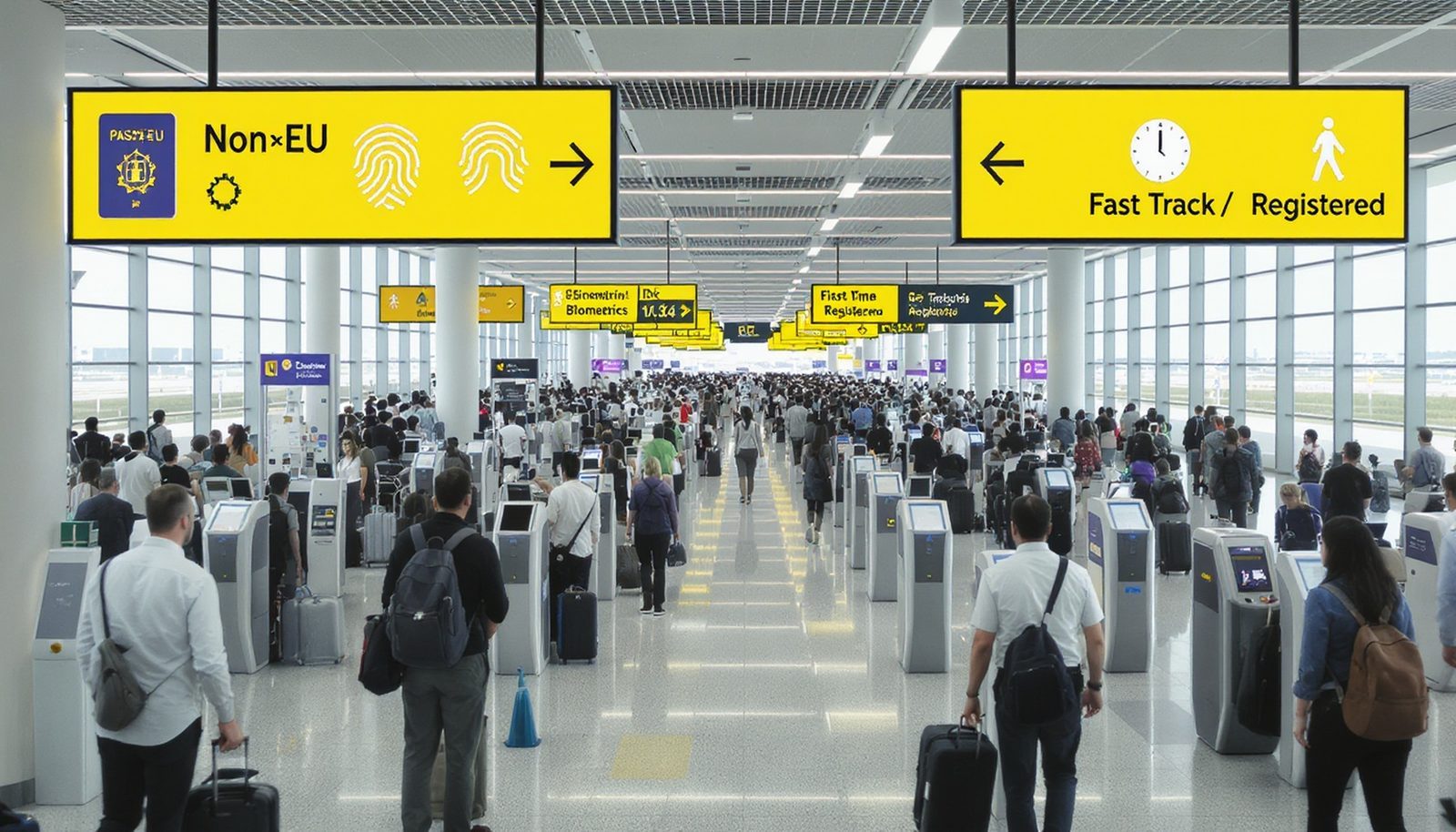
Why EES Turns Airport Capacity Into a Core Travel Variable
The Entry/Exit System (EES) is not just another device at the border. It is a structural change in how Schengen states process nonEU travelers. Instead of a quick passport stamp, firsttime EES entries require biometric enrollment and digital record creation. That extra step turns what used to be a mostly manual, officerdriven interaction into a datacapture workflow that competes directly with airport capacity.
Capacity here is not only the number of border officers. It is the combination of:
- Physical infrastructure: How many EES kiosks, counters, and lanes exist at each external border point.
- Process design: How passengers are routed between kiosks, manned booths, and secondary checks.
- System stability: Whether biometric devices and databases function at peak times without frequent resets or slowdowns.
- Traffic mix: The proportion of firsttime EES users (slower) versus repeat users (potentially faster).
Because EES enrollment is mandatory for shortstay nonEU visitors, the first wave of trips after rollout will push a large share of travelers through the slowest version of the process. A flight that previously cleared border control in 2030 minutes can suddenly face much longer queues, even if the number of officers has not changed.
From a traveler's perspective, this alters the underlying risk model. Previously, delays were driven mainly by flight disruptions, adhoc checks, or seasonal surges. With EES, the baseline processing time for first entry is structurally higher, and queue length becomes more sensitive to how well each airport has scaled and organized its EES infrastructure.
Two Biometric Systems, Two Bottlenecks: VIS vs EES
Schengen's move toward biometrics is unfolding along two parallel tracks that affect different parts of the journey:
- VIS (Visa Information System): Handles fingerprints and data for Schengen visa applications.
- EES (Entry/Exit System): Handles biometric and entry/exit records at the border for shortstay nonEU visitors, whether they need a visa or not.
Understanding how these systems interact is key to seeing where bottlenecks emerge and where they are reduced.
VIS and the 59month biometric reuse rule
Under the Schengen Visa Code and VIS regulations, fingerprints collected for a Schengen visa can be reused for up to 59 months. In practice, this works as follows:
- When you apply for a Schengen visa for the first time, your fingerprints are captured and stored in VIS.
- For subsequent visa applications within 59 months, consulates may reuse those fingerprints instead of requiring you to appear again for biometric capture.
- You still need an appointment and a full application; only the biometric capture step can be skipped.
- Member states retain discretion to demand fresh biometrics, even within the 59month window.
The intended effect is to reduce friction for repeat, compliant travelers. The actual effect is more nuanced. The rule lowers the frequency of inperson visits to Visa Application Centers (VACs), but it does not remove the need to secure timebound appointments or to navigate countryspecific documentation rules. In some states, additional identity checks (such as live photos or inperson verification) reintroduce physical presence requirements, partially offsetting the efficiency gain.
EES and biometric enrollment at the border
EES operates at a different stage of the journey. It replaces manual passport stamping with a digital record that includes biometric data and entry/exit timestamps. The core mechanism is:
- On your first EEScovered entry, your biometric data (typically fingerprints and/or facial image) are captured at the border.
- An EES record is created, linking your identity to your travel document and your permitted shortstay period.
- On subsequent entries, border checks can reuse this data, in principle reducing processing time, though authorities can still recollect biometrics if needed.
Unlike VIS, which only applies to visarequired travelers, EES covers both visarequired and visaexempt shortstay visitors. Travelers who never interact with consulates are now also part of a biometric system at the border.
How the two systems interact in practice
For a repeat Schengen visitor who needs a visa, the journey now passes through two biometric checkpoints at different times:
- Before travel: VIS fingerprints may be reused for up to 59 months, reducing the need for new biometric appointments.
- At first EES entry: New biometric enrollment is required at the border, regardless of VIS history.
This dual structure creates a clear tradeoff:
- Consular friction can decrease over time for compliant travelers, thanks to VIS reuse.
- Border friction increases at least once, at the first EES enrollment, and may spike again if data mismatches or technical issues arise.
Airport capacity becomes the visible constraint where these systems meet. Even if consular processes become smoother, any gains can be overshadowed by congestion at the first Schengen entry point, especially during the early EES rollout phase.
First Entry vs Repeat Entry Under EES: How Airport Capacity Shapes Outcomes
EES is being phased in between October 2025 and April 10, 2026, with manual passport stamping fully replaced after that date. During this period, airports and other border points will operate under mixed conditions: some travelers will still be processed under the old system, while others are enrolled into EES. This transitional complexity amplifies the impact of airport capacity on traveler experience.
Why first entries are structurally slower
On a first EES entry, the border process adds several steps compared with the preEES regime:
- Biometric capture at a kiosk or counter.
- Data verification and record creation in the EES database.
- Potential troubleshooting if fingerprints or facial images are difficult to capture.
Each of these steps consumes time and equipment. If an airport has limited kiosks or if many passengers are unfamiliar with the process, queues can grow quickly. The bottleneck is not just the number of officers but the throughput of the entire biometric capture chain.
Because the first wave of EES implementation will coincide with a large cohort of firsttime enrollments, the system is frontloaded with slower transactions. This is particularly acute at major hubs that serve as first Schengen entry points for longhaul flights, where a single arrival can bring hundreds of EESeligible passengers at once.
Why repeat entries can be fasterbut only conditionally
Once a traveler is enrolled in EES, subsequent entries can, in principle, be faster:
- Biometric data can be reused, reducing the need for full recapture.
- Automated gates or streamlined checks can rely on existing records.
- Overstay history is immediately visible, allowing quicker decisions for compliant travelers.
However, this speed gain is conditional on several factors:
- System reliability: If EES is slow or offline, officers may revert to manual checks, eroding the advantage.
- Policy discretion: Authorities can still require fresh biometrics, especially if there are doubts about identity or data quality.
- Airport design: If repeat travelers are not separated into dedicated lanes, they may still be stuck behind firsttime enrollees.
EES therefore creates the potential for faster repeat processing, but whether that potential is realized depends heavily on how each airport configures its infrastructure and staffing.
Timing risk for tight connections
The most immediate consequence for travelers is increased timing risk at the first Schengen entry point. This risk is particularly relevant for:
- Sameday connections where a nonEU traveler lands in a Schengen hub and has a short layover before a connecting flight.
- Mixeditinerary trips that combine Schengen and nonSchengen segments on the same day.
- Peakseason arrivals when many flights converge and a high proportion of passengers are firsttime EES users.
Under the old stamping system, travelers could often rely on historical experience to estimate bordercontrol times. With EES, especially during rollout, that historical intuition becomes less reliable. Queue length is now more sensitive to the proportion of firsttime enrollees and to the stability of biometric equipment, variables that are hard for travelers to observe in advance.
How MemberState Discretion and Airport Choices Create Uneven Experiences
Although EES is an EUlevel system, member states retain significant leeway in how they implement both consular biometrics (VIS) and border procedures. This discretion introduces structural inconsistency that travelers experience as unpredictability.
Consular side: biometric reuse with local addons
On the consular side, the 59month biometric reuse rule is common, but its application varies:
- Some states lean into reuse, allowing representatives to submit applications and minimizing inperson requirements for repeat travelers.
- Others add extra identity checks, such as mandatory live photos or inperson verification, even when fingerprints are technically reusable.
The mechanism behind this divergence is risk tolerance. States that perceive higher fraud or identitytheft risk may use their discretion to require more frequent physical presence, even at the cost of higher friction for legitimate travelers. Two travelers with similar histories can therefore face different appointment burdens depending on which consulate they must use.
Border side: EES infrastructure and staffing choices
At the border, similar discretion appears in how airports and land crossings configure EES:
- Number and placement of kiosks: Some airports may invest heavily in selfservice kiosks near arrival gates; others may rely more on manned counters.
- Segregation of flows: Airports can choose whether to separate firsttime EES users from repeat users, or to mix them in the same queues.
- Use of automated gates: The extent to which automated gates are deployed for certain nationalities or traveler categories can vary.
These choices directly affect how quickly queues move. For example, an airport that dedicates specific lanes to firsttime EES enrollment can isolate the slowest transactions, allowing repeat travelers to move faster. Another airport that mixes all travelers in a single line may see overall throughput drop, even if the total number of officers is similar.
Interaction with airport capacity constraints
Airport capacity is not infinitely elastic. Physical space for new kiosks, budget for additional staff, and time for training are all limited. During the EES rollout, airports must reallocate resources from other functions (such as manual document checks) to support biometric enrollment. This reallocation can create temporary bottlenecks in other parts of the passenger journey, such as longer walks, more complex wayfinding, or reduced flexibility in opening extra lanes at short notice.
For travelers, the result is a patchwork of experiences. Two flights arriving at different Schengen airports on the same day can face very different bordercontrol times, not because the rules differ, but because the local implementation and capacity constraints do.
Decision Tradeoffs for Different Traveler Profiles
Although this article focuses on mechanisms rather than advice, it is useful to map how EES and VIS changes alter the tradeoffs faced by different types of travelers. The key dimension is how much each traveler relies on tight timing and flexible planning.
Repeat Schengen visa holders
For travelers who need a Schengen visa and visit regularly, the 59month VIS reuse rule and EES enrollment interact in a specific way:
- Consular friction tends to decrease over time, as long as consulates accept biometric reuse and do not frequently demand fresh fingerprints.
- Border friction spikes once, at the first EES enrollment, and then may stabilize or decrease for subsequent entries.
- Overall timing risk shifts from the pretrip phase (appointments, VAC visits) toward the border phase (first EES entry).
For these travelers, the main tradeoff is between investing effort earlier (securing appointments, possibly using representatives) and accepting higher uncertainty at the first EEScovered arrival, especially if they plan tight connections.
Visaexempt frequent visitors
Travelers who do not need a Schengen visa but visit often face a different pattern:
- They bypass VIS entirely, so there is no consular biometric reuse to offset border friction.
- They still undergo EES enrollment at first entry, with the same potential for delays.
- Repeat entries may become smoother if airports effectively leverage EES data and automated gates.
For this group, the main structural change is the introduction of a biometric checkpoint where none existed before. Their planning horizon shifts from show up with a valid passport to account for possible biometric enrollment delays at first entry.
Occasional or oneoff visitors
Travelers who visit the Schengen area infrequently, whether visarequired or visaexempt, experience the costs of EES without fully benefiting from its potential efficiencies:
- They must undergo biometric enrollment at first entry.
- They may not return often enough to benefit from faster repeat processing.
- They still face consular complexity if they require a visa and cannot fully exploit the 59month reuse window.
For these travelers, the system's design favors enforcement and data completeness over individual convenience. The tradeoff is skewed toward higher onetime friction in exchange for systemic benefits such as automated overstay detection.
Comparing PreEES and PostEES Airport Dynamics
To clarify how EES changes the structure of airport bottlenecks, it is useful to compare the preEES and postEES regimes along key dimensions. The table below focuses on the first Schengen entry for a nonEU traveler.
| Dimension | PreEES (manual stamping) | PostEES (biometric entry/exit) |
| Primary identity check | Visual inspection of passport; manual stamp | Biometric capture and database verification plus document check |
| Data recording | Stamp in passport; limited digital records | Centralized digital record with biometrics and timestamps |
| Firstentry processing time | Relatively short, driven by officer speed | Structurally longer due to biometric enrollment |
| Repeatentry processing | Similar to first entry; no systematic reuse of prior data | Potentially faster if biometrics reused and systems stable |
| Overstay detection | Manual, fragmented, dependent on stamps | Automated, centralized, based on entry/exit records |
| Impact of airport capacity | Important but moderated by simpler procedures | Critical, as biometric throughput depends on kiosks, lanes, and staffing |
This comparison highlights the core tradeoff: EES strengthens enforcement and standardization but makes airport capacity and system reliability central determinants of traveler experience.
Risk, Uncertainty, and Systemic Blind Spots
The transition to EES introduces several layers of risk and uncertainty that are not yet fully quantifiable. These arise from gaps in available data, from the phased rollout, and from the interaction between VIS and EES.
Unknown queue dynamics and processing times
There is currently no robust, public quantitative data on how much longer firstentry processing will take under EES, or how queue lengths will evolve during rollout. Without such metrics, timing risk can only be described qualitatively:
- First entries are expected to be slower due to biometric enrollment.
- Queue volatility is likely to be higher at peak times and at major hubs.
- Repeat entries may be faster, but only if systems and infrastructure perform as intended.
This lack of hard numbers makes it difficult for travelers and airlines to calibrate connection times or to model worstcase scenarios.
Data mismatches and errorcorrection mechanisms
Another uncertainty lies in how VIS and EES data interact when there are discrepancies. For example:
- A traveler's identity details may be recorded slightly differently in VIS and EES.
- Biometric capture may fail or produce lowquality data at either stage.
- Updates to personal data (such as name changes) may propagate unevenly.
The mechanisms for detecting and correcting such mismatches at the border are not fully transparent. In practice, this means that some travelers may face unexpected secondary checks or delays if their records do not align cleanly, even when they have complied with all formal requirements.
Public confusion between EES and ETIAS
Public communication about EES has often been intertwined with messaging about ETIAS, a separate future pretravel authorization system. This conflation creates several risks:
- Travelers may purchase unnecessary services or products, believing they are required for EES.
- Some may focus on ETIAS and overlook the practical impact of EES on airport timing.
- Misinformation can spread quickly, especially when timelines shift or are not clearly communicated.
The result is a perception gap: travelers may either underestimate the impact of EES on their airport experience or overestimate the complexity of compliance, leading to suboptimal planning in both directions.
Enforcement pressure and overstay detection
EES is designed to automate overstay detection by linking entry and exit records. However, there is no public quantification yet of how much this will increase refusalofentry rates or enforcement actions. The structural effect is clearoverstays become more visiblebut the magnitude remains uncertain.
For travelers who previously relied on the ambiguity of manual stamps or on the difficulty of reconstructing their travel history, this represents a significant shift in risk. For compliant travelers, the main impact is indirect: border officers may spend more time scrutinizing cases that appear risky in the system, potentially slowing down queues for everyone else.
Balanced Outlook: Toward a More Predictable but Less Forgiving System
The rollout of EES, combined with the existing VIS biometric reuse framework, is pushing Schengen border management toward a more datadriven, standardized model. The core mechanisms are clear:
- VIS reduces repeat consular friction for many visarequired travelers through the 59month fingerprint reuse rule, while preserving state discretion and procedural complexity.
- EES replaces manual passport stamping with biometric entry/exit records, lengthening firstentry processing and making airport capacity a central constraint.
- Memberstate implementation choices and airport infrastructure decisions create uneven experiences across different border points.
From a systemic perspective, the benefits include more reliable overstay detection, better data quality, and the potential for faster processing of compliant repeat travelers once the initial enrollment wave passes. The costs are concentrated in the transition period and in the firstentry experience, where biometric enrollment and capacity constraints combine to raise timing risk.
For travelers, the environment becomes more predictable in terms of rules but less forgiving of tight schedules and lastminute planning. The key structural shift is that the first Schengen entryespecially during the EES rollout window between October 2025 and April 10, 2026becomes a critical bottleneck that can dominate the overall reliability of an itinerary.
As data on actual queue lengths, processing times, and system performance emerges, both travelers and operators will be able to refine their expectations. Until then, a reasonable working assumption is that airport capacity and EES implementation quality will be decisive factors in how smoothly nonEU travelers move through Europe's external borders.