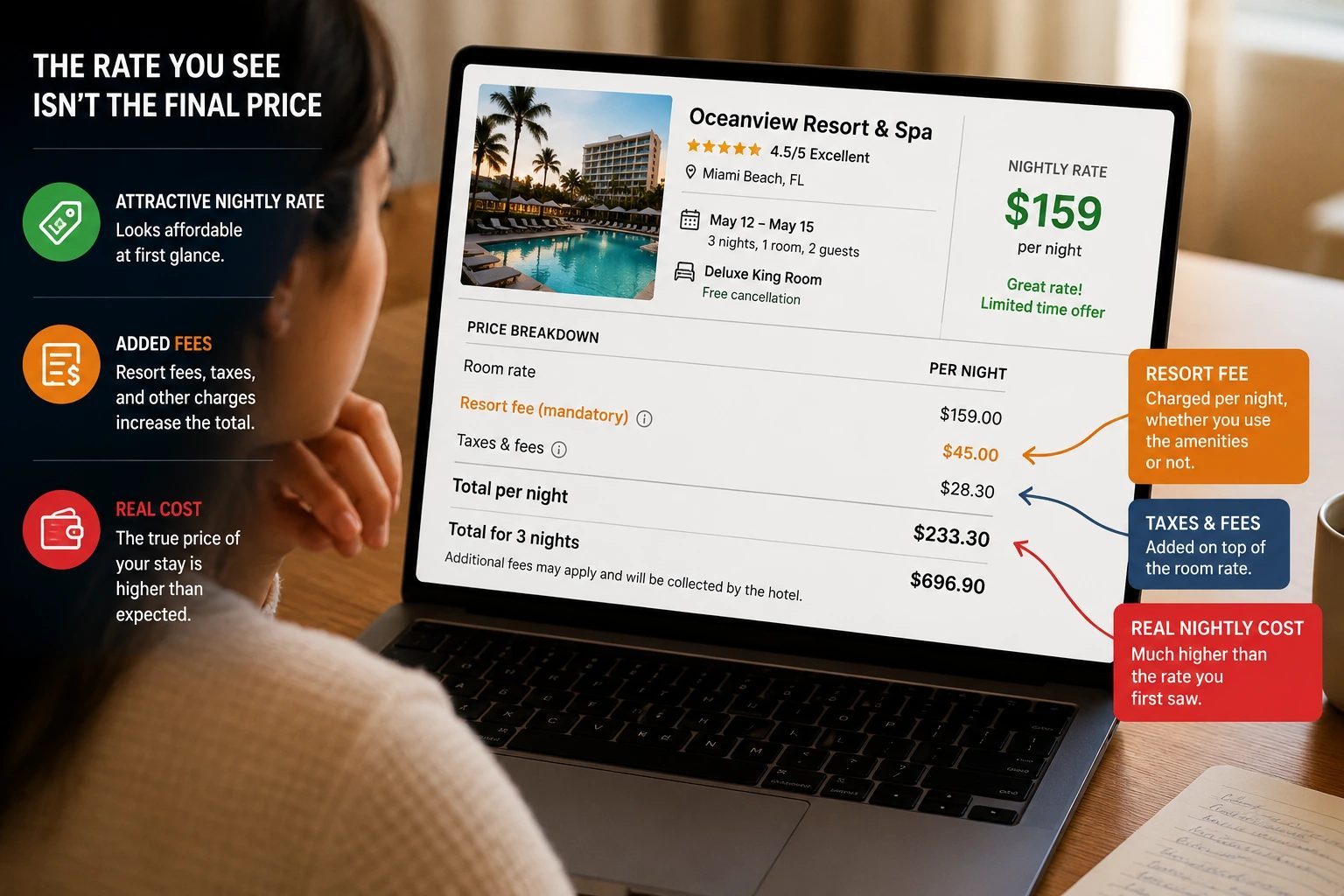
I’ve lost count of how many times I’ve watched a “$129” room quietly turn into $220 a night once resort fees and taxes show up at checkout. That complimentary
welcome drink, the Wi‑Fi, the pool – none of it feels free when there’s a $45 destination fee
tacked on every night.
But here’s the twist: sometimes those free hotel perks really can save you money. Other times, they’re just a dressed-up price hike.
This guide walks through how to tell the difference – and how to decide, before you book, whether a resort fee is a rip-off or a smart trade. If you’ve ever wondered are free hotel perks worth it, this is where to start.
1. First, Know What You’re Really Paying For
Before you can judge if a resort fee is worth it, you need to know what it actually covers. Most hotels don’t make this easy. That’s not an accident.
Resort (or destination, amenity, facility) fees are mandatory nightly charges added on top of the room rate. They’re not tips. They’re not optional. If you want the room, you pay the fee.
Typical inclusions:
- Wi‑Fi (in-room and public areas)
- Pool, hot tub, and basic spa facilities (sauna, steam room)
- Fitness center access
- Beach chairs and towels, or basic water sports gear
- Local calls, sometimes a local shuttle
- Small welcome items (bottled water, coffee, snacks)
Typical exclusions (you still pay extra):
- Room service and minibar
- Paid spa treatments and massages
- Parking (yes, often separate)
- Premium activities like golf, excursions, or tours
- Gratuities for staff
The question I always come back to: If I stripped away the marketing language, would I still pay this much for what’s included?

In many resort destinations – Las Vegas, Miami, Orlando, Hawaii, New York – these fees can run $30–$50+ per night and are often hidden until late in the booking process. That’s why I always click through to the final price screen and read the hotel resort fee cost breakdown before I get attached to a “deal.”
2. When a Resort Fee Actually Saves You Money
Let’s talk about the rare but real scenarios where a resort fee can be a net win.
Some hotels bundle genuinely valuable perks into their daily fee. Think of it as a forced package: if you’d pay for those things anyway, the fee can be cheaper than buying everything à la carte. This is where resort amenities can actually save money instead of quietly draining your budget.
Here’s how I evaluate it:
- List what you’d realistically use. Not what sounds nice. What you’ll actually do.
- Assign a rough value to each perk based on local prices.
- Compare that total to the nightly fee.
For example, some properties highlighted in this breakdown offer:
- Guided kayak or stand-up paddleboard tours
- Cultural classes (hula, ukulele, coconut husking)
- Daily fitness classes and local gym passes
- Bar credits, spa credits, or laundry credits that reset each night
- Access to a
gear garage
with bikes, scooters, and games
Now imagine a $40 nightly fee that includes:
- $35 bar credit
- $40 laundry credit
- Gym access you’d otherwise pay $15/day for
If you’re going to use those credits every night, you’re effectively getting more than $40 in value for $40 in fees. That’s not junk; that’s a discount disguised as a fee. In a hotel amenities value comparison, that kind of package can beat a cheaper-looking hotel with no perks at all.
On the other hand, if you don’t drink, travel with carry-on only, and prefer running outside to the gym, that same fee is just a mandatory donation to the hotel’s profit margin.
My rule of thumb: If I can reasonably recoup about 1.5x the fee in value, I stop fighting it and treat it like a package rate.
3. When Resort Fees Are Pure Junk (and How to Spot Them Fast)
Most resort fees don’t come with guided kayak tours or nightly bar credits. They come with… Wi‑Fi and a bottle of water.
Here’s when I mentally label a fee as junk:
- The inclusions are basic utilities – Wi‑Fi, gym, local calls – that many hotels include in the room rate.
- The fee is high relative to the room price. A $45 fee on a $120 room is a red flag.
- The fee is vague. Phrases like
enhanced guest experience
orhotel services fee
with no clear list of benefits. - The fee is per person or percentage-based. Some properties sneak in per-person or percentage-of-room-rate fees that balloon your bill.
Resort fees can range from under $10 to over $100 per night. In many big tourist markets, $35–$50 is common. That can easily add hundreds of dollars to a week-long stay and turn those so-called free hotel perks into a very real bill.
To spot junk fees quickly, I do this:
- On the booking page, look for a line item labeled
resort fee
,destination fee
, oramenity fee
. - Click the small info icon or
details
link – that’s where the inclusions hide. - If there’s no clear list, I assume the worst and either call the hotel or move on.
If the fee is mandatory and the inclusions are things I don’t care about, I treat it as part of the room rate and compare hotels on total nightly cost, not the headline price. That alone can flip which hotel looks like the better deal and helps you avoid the hidden cost of free hotel perks.
4. The Award Stay Trap: When “Free Nights” Aren’t Free
Resort fees get especially sneaky when you’re using points. You think you’re booking a free stay, and then a $50/night destination fee
shows up at checkout. Suddenly your free
five-night vacation costs $250 in cash.
Different hotel programs handle this very differently, as outlined in this deep dive:
- Hyatt: Waives resort fees on all free night awards (points or certificates). Globalist elites also get resort fees waived on eligible paid stays.
- Wyndham: Go Free awards (100% points) explicitly waive resort fees.
- Hilton: Waives resort fees only on 100% points bookings or free night certificates. Use Points & Money and you’ll usually pay the full fee.
- Marriott & IHG: Often still charge resort or facility fees on award nights, with only narrow elite exceptions.

Here’s how I decide if an award stay with a resort fee is worth it:
- Calculate the cash value of the stay (room rate + taxes + resort fees).
- Subtract the resort fees you’ll still pay out of pocket.
- Divide the remaining value by the points you’re spending to get your cents-per-point.
If the resort fees eat up a big chunk of the value, I either:
- Switch to a chain that waives fees on awards (Hyatt, Wyndham, sometimes Hilton), or
- Save my points for a different property and pay cash somewhere with no resort fee.
One more subtle trap: mixed cash-and-points bookings. With some programs, the moment you add cash, you lose the fee waiver. I avoid those unless the math still works after adding the full resort fee back in.
5. How to Compare Hotels on Total Cost (Not Just the Headline Rate)
Hotels separate resort fees from the base rate to look cheaper in search results. If you only compare the big bold number, you’re playing their game.
Here’s the comparison method I use when I’m doing a quick resort fee vs no resort fee check:
- Pick your dates and length of stay. Resort fees are per night, so a small nightly fee can add up fast.
- Click through to the final booking screen for each hotel you’re considering.
- Write down:
- Base room rate per night
- Resort/destination/amenity fee per night
- Taxes and any other mandatory charges
- Add them up to get the true nightly cost.
Now compare hotels using that total number, not just the base rate.
Example:
- Hotel A: $150 room + $40 resort fee = $190/night before tax
- Hotel B: $185 room, no resort fee = $185/night before tax
On a search page, Hotel A looks cheaper at $150. In reality, Hotel B is the better deal – and you’re not forced into paying for perks you may not use.
Also pay attention to how the fee is disclosed. Some chains bury it in small print or only show it at the last step. Others (especially after recent FTC and legal pressure) are starting to show total prices earlier. I reward the transparent ones with my business.
6. When to Pay the Fee, When to Walk Away
So how do you decide, in practice, whether to book a hotel with a resort fee?
I run through this quick decision tree whenever I’m trying to avoid common mistakes with hotel perks and fee traps:
- Is the fee mandatory? If yes (almost always), treat it as part of the rate.
- Will I use the included perks daily?
- If yes, estimate the value. If it’s clearly higher than the fee, I’m open to it.
- If no, I assume the fee is a pure surcharge.
- Is there a comparable hotel nearby without a fee?
- If yes, I compare total nightly cost and choose based on value, not marketing.
- If no (common in Vegas or resort-heavy areas), I look for the
least bad
fee – the one with perks I’ll actually use.
- Can I avoid the fee via points or status?
- If I can book an award that waives fees, that often tips the scales.

There are also a few edge cases where I’ll pay a bad-feeling fee anyway:
- Location is everything. If the hotel is exactly where I need to be (conference, wedding, early flight), I factor the fee into the cost of convenience.
- Trip purpose matters. On a once-in-a-decade honeymoon, I’m less fee-sensitive than on a quick work trip.
- Last-minute bookings. When options are limited, I accept the fee but remember that property for future avoidance.
The important part is that you’re making a conscious choice, not getting ambushed at checkout.
7. Practical Ways to Minimize or Avoid Resort Fees
You can’t always dodge resort fees, but you can often shrink them or sidestep them entirely. This is where budget travel and resort amenities strategy really pays off.
Here’s what I actually do when planning trips:
- Filter for hotels without resort fees. Some booking sites now let you see total prices or filter out properties with extra fees.
- Use points strategically. Favor programs like Hyatt and Wyndham that waive resort fees on full award stays. With Hilton, stick to 100% points or free night certificates when you want the waiver.
- Check packages and corporate rates. Some deals quietly include or offset resort fees. Always read the rate description.
- Book direct when it helps. Occasionally, direct bookings or loyalty rates have clearer fee disclosure or better inclusions than third-party sites.
- Consider non-resort alternatives. Smaller hotels, guesthouses, and some vacation rentals may skip resort-style fees (though watch for cleaning or
service
fees on platforms like Airbnb).
What I don’t do: argue at the front desk. Resort fees are usually baked into the hotel’s pricing structure. Front desk staff rarely have the authority to remove them unless something went seriously wrong with your stay.
Instead, I vote with my wallet. If a property’s fees feel abusive or opaque, I simply don’t go back – and I make sure my future self remembers that when planning the next trip.
8. The Bottom Line: Make the Fee Work for You (or Walk)
Resort fees aren’t going away anytime soon. New rules and lawsuits are pushing hotels to be more transparent, but they’re not banning the fees themselves.
So the real question isn’t Are resort fees bad?
It’s:
- Does this specific fee give me more value than it costs?
- Am I choosing this hotel with eyes open, or am I being nudged by a fake-cheap headline rate?
When the perks line up with how you actually travel – daily activities, meaningful credits, waived fees on award stays – resort fees can genuinely save you money compared to paying for everything separately. In those cases, the answer to are free hotel perks worth it can be a cautious yes.
When they don’t, they’re just a tax on not reading the fine print. That’s the hidden cost of free hotel perks that catches a lot of travelers off guard.
Next time you see free
perks bundled into a nightly fee, pause and ask yourself: Would I still book this hotel if the fee were part of the room rate? If the answer is no, you’ve just saved yourself from an expensive surprise – and probably found a better deal down the street.