Why this is a Destination issue, not just a ticketing tweak
For the 2026 World Cup in the U.S., Canada, and Mexico, FIFA has effectively turned ticketing into a live test of how a mega-event manages demand. Instead of relying mainly on traditional price bands and partial caps, it is leaning heavily on dynamic pricing: an algorithm adjusts prices in real time as demand, inventory, and match profile change.
This is not a minor operational detail. It reshapes how travelers decide whether to go, which matches to target, and how to structure an entire trip across three countries. In destination terms, dynamic pricing is competing with a more familiar tool for managing pressure on host cities: overtourism caps, where authorities limit numbers through quotas, lotteries, or fixed price ceilings.
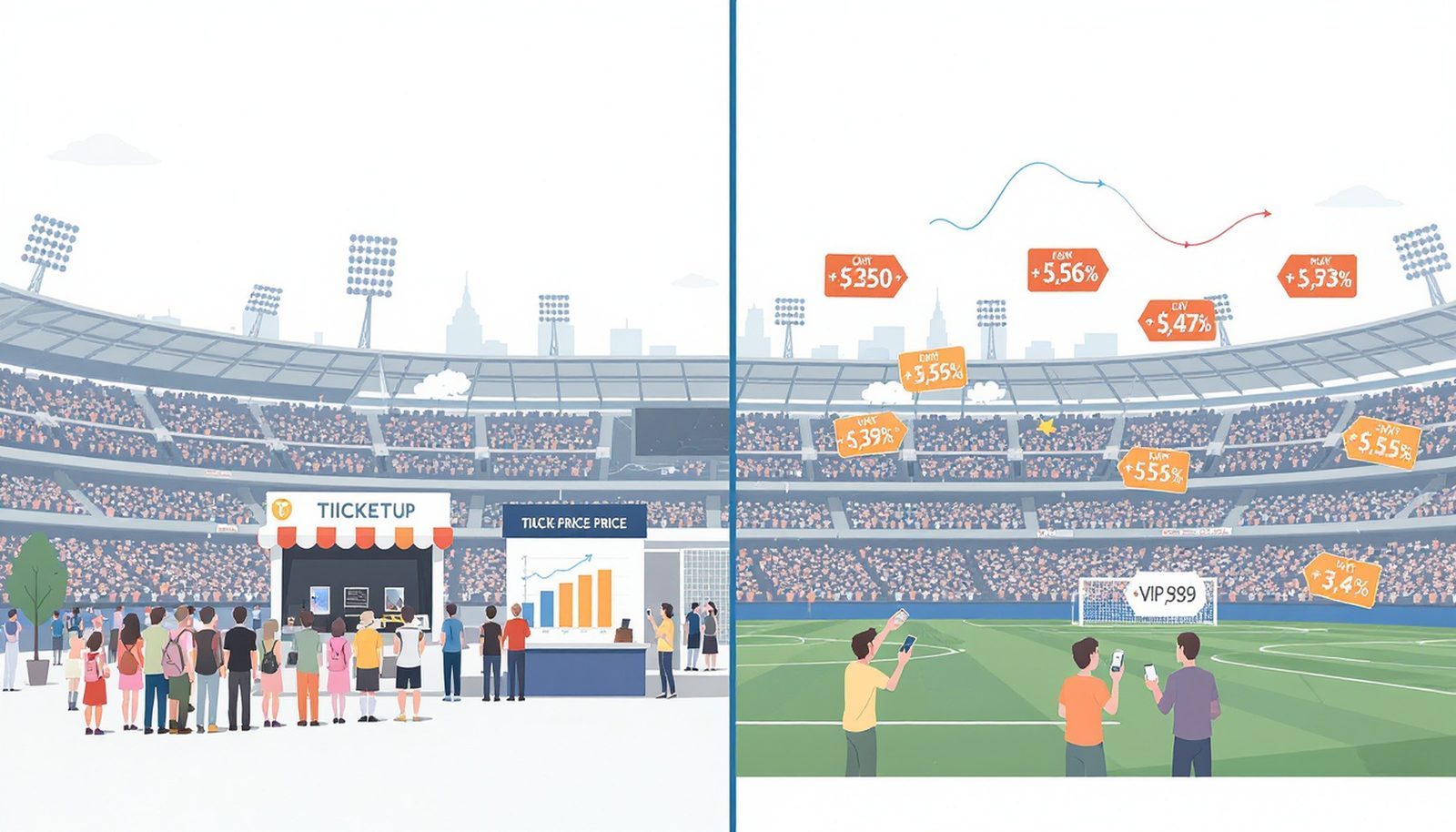
Understanding the trade-off between overtourism caps and dynamic pricing is now central to planning a World Cup trip. One model rations access by quantity (how many people can attend); the other rations by willingness and ability to pay (how much people can afford). Both aim to manage extreme demand, but they distribute risk and opportunity very differently for fans, host cities, and FIFA.
Two demand-management models: caps versus algorithms
Overtourism caps and dynamic pricing are both responses to the same structural problem: demand for World Cup matches is far higher than stadium capacity, especially for knockout games and marquee teams. The core question is how to allocate scarce seats and manage the spillover into host cities.
How overtourism caps work in mega-events
Overtourism caps are essentially quantity controls. Authorities or organizers set hard limits on how many people can access a venue, zone, or experience, and often pair this with fixed or banded pricing. Mechanically, this can take several forms:
- Ticket quotas and lotteries: A fixed number of tickets per match, sometimes with reserved allocations for host-country residents or specific fan groups. Prices are pre-announced and stable.
- Capacity limits on fan zones and festivals: Cities cap attendance at public viewing areas or require free-but-ticketed entry to avoid overcrowding.
- Price ceilings: Even when prices vary by category (e.g., group stage vs final), there is a clear maximum price per seat type, often published well in advance.
The mechanism is transparent: fans know the price bands and the odds of success in a lottery or first-come-first-served sale. The main uncertainty is whether they get a ticket, not what it will cost.
How dynamic pricing works for FIFA 2026
Dynamic pricing is a price-control mechanism rather than a quantity-control one. The number of seats is fixed by stadium capacity, but the price of each seat can move up or down as the algorithm responds to demand signals. For FIFA 2026, the decision intelligence points to several structural features:
- Real-time price adjustments: Ticket prices change as inventory shrinks, demand spikes, or match importance becomes clearer.
- Opaque algorithm: There is no public methodology, no disclosed caps, and no independent oversight. Fans cannot see the rules that govern price movements.
- Extreme segmentation: Premium and hospitality tickets can reach into the thousands of dollars and even tens of thousands, while a small number of $60 upper-tier seats act as a symbolic low-price tier.
Here, the main uncertainty is not whether a seat exists, but what price the algorithm will assign at the moment a fan tries to buy. The system is designed to extract as much revenue as possible from those with the highest willingness to pay, especially corporate and high-income buyers.
Comparing the mechanisms
From a traveler’s perspective, the two models create different planning environments. The table below contrasts their core mechanics and implications.
| Dimension | Overtourism caps & fixed bands | Dynamic pricing (FIFA 2026) |
| Primary control | Quantity (how many can attend) | Price (how much each pays) |
| Price visibility | Published bands, stable over time | Real-time, opaque, can change quickly |
| Main risk for fans | Not getting a ticket at all | Paying far more than expected |
| Planning horizon | Long; budgets can be set months in advance | Compressed; pressure to act without clarity |
| Equity effect | Some protection for lower-income fans via cheaper bands and resident quotas | Access increasingly sorted by income and corporate budgets |
| Political visibility | Trade-offs are explicit and debatable | Trade-offs are hidden inside an algorithm |
Both systems ration scarcity, but they do so through different levers. Caps make scarcity visible; dynamic pricing monetizes it.
Dynamic pricing as a destination shaper: mechanisms and knock-on effects
Dynamic pricing does more than change ticket costs; it reshapes how and when people travel to host cities, and which parts of the tournament they prioritize. The decision intelligence highlights several mechanisms that matter for trip planning.
1. Budget volatility and compressed decision windows
Under fixed bands, a fan could roughly estimate the total cost of a World Cup trip: ticket price range, flights, accommodation, and local transport. With dynamic pricing, one of the largest cost components becomes unstable.
The mechanism is straightforward:
- Fans see prices moving and fear further increases.
- They feel pressure to buy earlier than planned, even if flights and hotels are not yet secured.
- Alternatively, they gamble on later drops, risking that prices spike instead.
This creates a planning trap. Either you lock in tickets at potentially inflated prices and then discover that flights and hotels are also expensive, or you wait and risk being priced out entirely. The volatility effectively shifts planning risk from FIFA to the traveler.
2. Income-based sorting of who travels where
Because dynamic pricing raises prices most aggressively where demand is strongest, it tends to concentrate high-income and corporate travelers in the most attractive matches and cities. Mechanically:
- High-demand matches (knockouts, host nation games, global stars) see rapid price escalation.
- Corporate buyers and wealthy fans absorb these increases, as tickets are a small share of their total budget.
- Lower-income fans are pushed toward cheaper group-stage matches, less central venues, or fan zones instead of stadiums.
For host cities, this means that the composition of visitors shifts. Some cities may see more “premium” visitors with higher per-capita spending, while others become secondary destinations for price-sensitive fans. The destination map of the tournament is being redrawn by an algorithm that optimizes revenue, not geographic balance or fan diversity.
3. Distorted resale markets and planning uncertainty
Dynamic pricing also destabilizes the concept of “face value” in the official resale market. When primary prices are moving targets, several things happen:
- Fans cannot easily tell whether a resale listing is fair or exploitative.
- Anti-scalping rules become harder to enforce, because the baseline price is not fixed.
- Some fans may hold tickets speculatively, hoping that algorithm-driven increases will justify high resale prices.
For travelers, this means that resale—traditionally a safety valve for last-minute changes—becomes another source of uncertainty. It is harder to rely on resale as a backup plan if you cannot predict whether prices will be reasonable or extreme.
4. Host city planning and fan festival economics
Host cities are not just passive backdrops; they must plan security, transport, and public viewing events. The intelligence indicates that some cities are already reconsidering or scaling back fan festivals because high and unpredictable ticket prices make attendance patterns harder to forecast.
The mechanism here is indirect but important:
- If tickets are too expensive, more fans may choose to watch in fan zones instead of stadiums.
- But if dynamic pricing keeps stadiums full of high-paying visitors, fan zones may attract fewer people than expected.
- Cities face difficulty justifying large, free public events when they cannot predict whether they will be packed or half-empty.
This uncertainty can push cities toward privatized or ticketed fan zones, further shifting the World Cup experience away from open, communal spaces and toward controlled, monetized environments.
Overtourism caps: what they would change for FIFA 2026 travelers
Overtourism caps are not a panacea, but they offer a different balance of risks. If FIFA and host authorities leaned more on caps and less on dynamic pricing, the traveler experience would change in several structural ways.
1. Predictable price bands, uncertain access
With caps, the key trade-off is clear: prices are more predictable, but not everyone who wants a ticket can get one. Mechanically, this would look like:
- Published price bands for each match category, with clear maximums.
- Lotteries or phased sales where demand exceeds supply.
- Transparent quotas for host-country residents, international fans, and specific supporter groups.
For travelers, this shifts the planning problem. Instead of asking “How much will this ticket cost if I wait?”, the question becomes “What is the probability I will get a ticket at all?” This is still a risk, but it is easier to integrate into a trip plan: you can budget around known price ranges and decide whether to travel even if you might end up watching from a fan zone.
2. More equitable access, less revenue maximization
Caps and fixed bands make it easier to embed equity goals into the ticketing system. For example:
- Lower-priced categories can be reserved for residents of host countries or lower-income regions.
- Price ceilings prevent extreme outliers, such as hospitality packages reaching tens of thousands of dollars.
- Public authorities can more easily justify subsidies or special allocations when prices are stable and transparent.
The trade-off is that FIFA cannot fully monetize the inelastic demand for top matches. Some of the surplus that dynamic pricing would capture as revenue is instead left with fans or redistributed through cheaper tickets. From a destination perspective, this can support a more diverse mix of visitors and a stronger sense of shared global event, rather than a premium corporate spectacle.
3. Clearer signals for host city planning
When ticket prices and allocations are known in advance, host cities can better estimate:
- How many visitors to expect for each match.
- What share of them are likely to be local, regional, or long-haul travelers.
- How much overflow demand will spill into fan zones and public spaces.
This reduces the risk of overbuilding or under-provisioning fan infrastructure. It also makes it easier to argue that public investments in fan festivals and transport upgrades will deliver broad benefits, not just serve a narrow, high-paying audience.
Dynamic pricing risks and uncertainties for FIFA 2026 travelers
The decision intelligence highlights several specific risks and uncertainties that travelers face under the current dynamic pricing model, especially in relation to the broader trip budget.
1. Ticket cost volatility relative to total trip cost
There is a clear gap in quantitative data: we do not have a detailed breakdown of ticket prices by match category, nor a precise mapping of how these interact with flights, accommodation, and intra–North America transport. However, the mechanism is still clear enough to outline the risk:
- For long-haul travelers, tickets are only one part of the budget, but they are highly salient and central to the trip.
- If ticket prices spike after flights and hotels are booked, the total trip cost can overshoot initial expectations by a large margin.
- Conversely, if fans delay booking flights and hotels while waiting for better ticket prices, they may face higher travel and lodging costs.
This creates a multi-variable risk: ticket, flight, and hotel prices can all move, but only tickets are being actively managed by an opaque algorithm. The lack of transparency makes it hard to model worst-case scenarios.
2. Algorithm opacity and regulatory uncertainty
Another major uncertainty is regulatory. Lawmakers in the U.S. have already accused FIFA of price gouging and called for interventions such as transparency requirements, price caps, or even a reversal of dynamic pricing in future tournaments. But the current legal landscape across the U.S., Canada, and Mexico is not clearly mapped in public sources.
This creates several layers of uncertainty for travelers:
- It is unclear whether any jurisdiction will impose real-time constraints on FIFA’s pricing algorithm before or during the tournament.
- Fans do not know whether consumer-protection rules (such as anti-gouging laws) will apply to cross-border ticket sales.
- If regulations change mid-cycle, pricing behavior could shift in ways that are hard to anticipate.
From a decision-making standpoint, this means that the rules of the game are not fully known, even to policymakers, let alone fans.
3. Political backlash and reputational risk
Political pressure is already visible: at least 69 U.S. lawmakers have publicly criticized FIFA’s pricing strategy, arguing that it diverges from the more modest assumptions in the original host bid book. They frame the issue as one of fairness and public trust, not just market dynamics.
For travelers, the direct impact of this backlash is uncertain, but there are plausible scenarios:
- FIFA could make limited concessions, such as releasing more low-priced tickets in poor-view sections, as it has already done with a small batch of $60 seats.
- Host cities might adjust their own policies, for example by expanding free public viewing options to offset perceived exclusion from stadiums.
- In a more extreme scenario, regulatory interventions could force changes to pricing behavior mid-tournament, creating winners and losers depending on when fans bought tickets.
None of these outcomes can be predicted with confidence, but they add another layer of uncertainty to trip planning.
4. Long-term shift in fan behavior
Finally, there is uncertainty about how fans will adapt over time. Past tournaments that experimented with dynamic pricing, such as the 2024 Copa America and 2025 Club World Cup, already showed patterns of confusion and frustration. Yet FIFA is scaling up the model without addressing transparency or consumer safeguards.
Possible behavioral responses include:
- More fans choosing to attend only group-stage matches, where prices may be relatively lower and more stable.
- Increased reliance on fan zones and public viewing events instead of stadium attendance.
- Some fans deciding not to travel at all, especially from lower-income countries facing multi-country travel costs.
These shifts would change the atmosphere in host cities and the overall character of the tournament as a global gathering.
Trade-offs for travelers: choosing between price risk and access risk
From a decision-intelligence perspective, the core tension between overtourism caps and dynamic pricing can be framed as a choice between two types of risk:
- Price risk: Under dynamic pricing, you may get a ticket, but the cost is uncertain and potentially extreme.
- Access risk: Under caps and fixed bands, prices are predictable, but you may not get a ticket at all.
For FIFA 2026, travelers do not get to choose the system; dynamic pricing is already in place. But understanding the trade-off helps clarify what is actually being optimized and who bears the risk.
Who benefits under each model?
Even without precise numbers, the distributional effects are clear:
- Dynamic pricing: Benefits FIFA (higher revenues) and high-income or corporate buyers (who can secure seats at almost any price). Costs are borne by price-sensitive fans and host cities dealing with planning uncertainty.
- Overtourism caps with fixed bands: Benefits fans who secure tickets at predictable prices and host cities that can plan around stable attendance patterns. Costs are borne by those who miss out on tickets and by FIFA, which forgoes some revenue.
In both cases, scarcity remains. The question is whether scarcity is managed through transparent rules and visible caps, or through an opaque algorithm that monetizes demand peaks.
Implications for trip frameworks
For travelers building a trip framework around FIFA 2026, the key analytical takeaway is that ticket prices are no longer a fixed input. They are a moving variable that interacts with flights, accommodation, and visas. Mechanistically, this suggests:
- Planning should be scenario-based rather than single-budget: best-case, mid-case, and worst-case ticket price scenarios.
- Flexibility in match selection (e.g., targeting less in-demand fixtures or venues) may be more important than in past tournaments.
- Non-stadium experiences (fan zones, host city events) will play a larger role in determining whether the trip feels worthwhile if ticket prices become prohibitive.
These are not recommendations, but structural implications of the pricing model that travelers need to factor into their own decisions.
Conclusion: a destination shaped by algorithms, not just stadiums
FIFA’s adoption of dynamic pricing for 2026 tickets marks a shift from a World Cup organized around transparent, if imperfect, caps and price bands to one organized around an opaque revenue-maximizing algorithm. For travelers, this transforms the World Cup from a high-cost but budgetable destination into a volatile, high-risk proposition where one of the core trip components is unpredictable.
Overtourism caps and fixed bands are not inherently fair or efficient, but they make trade-offs visible: who gets tickets, at what price, and under what rules. Dynamic pricing hides those trade-offs inside a black box, shifting planning risk onto fans and complicating host city efforts to design inclusive public experiences.
The unresolved question is whether a quasi-public global event should be governed by private, opaque pricing logic, or whether public expectations of fairness and accessibility justify stronger caps and transparency. For FIFA 2026 travelers, the practical reality is that the algorithm is already in place. The destination they are considering is not just a set of cities and stadiums, but a moving price landscape shaped by decisions they cannot see.
Understanding that landscape—its mechanisms, trade-offs, and uncertainties—is now as important as understanding flight routes or visa rules. The World Cup remains a powerful travel draw, but the path to the stands is increasingly defined by code rather than queues.