
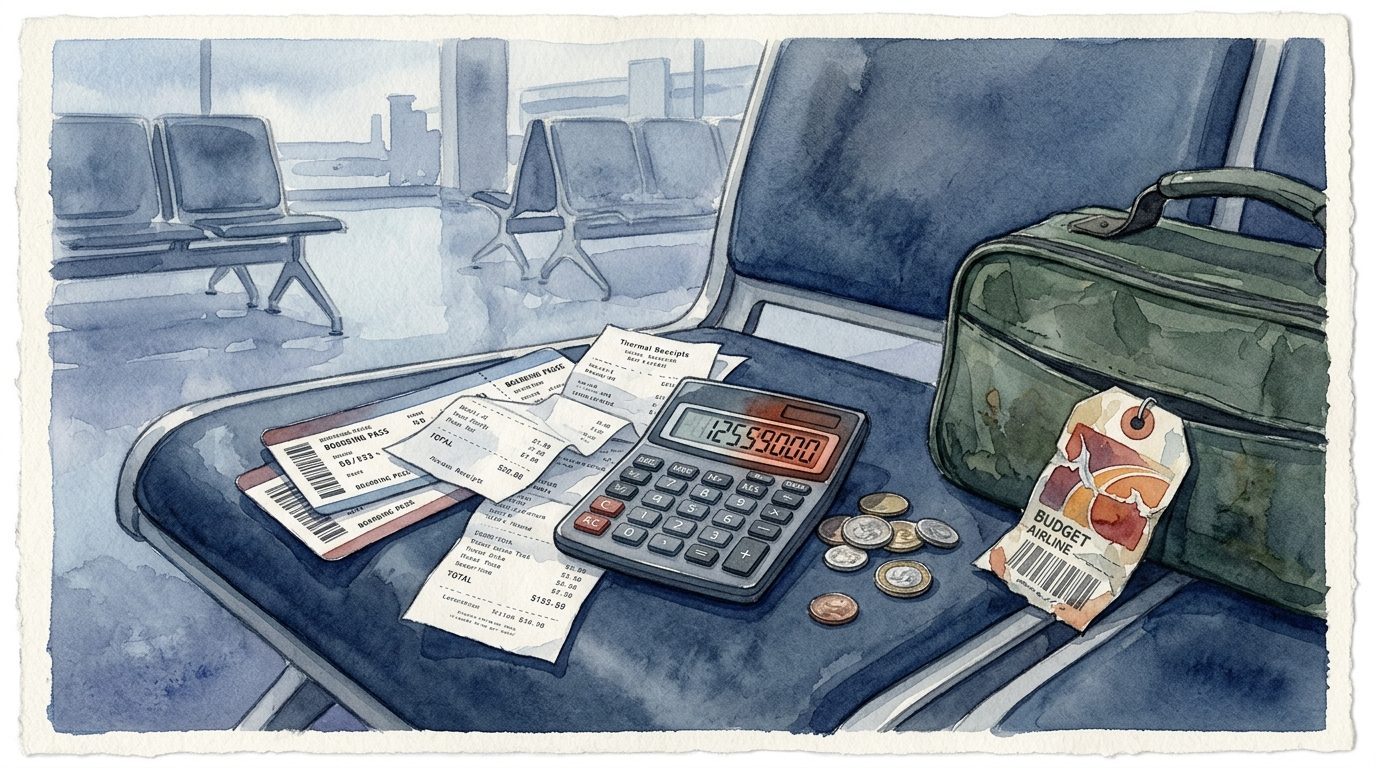
I love a good flight deal. I track prices, set alerts, and feel a little rush when a fare pops up that’s $150 cheaper than everything else. But after a few too many “bargains,” I’ve had to admit something:
That “cheap” flight can quietly turn into the most expensive part of your trip.
Airlines know exactly what they’re doing. Fees aren’t an afterthought anymore; they’re a business model. Ancillary charges – bags, seats, priority boarding, penalties – brought in an estimated $148.4 billion in 2024, about 15% of total airline revenue, and that slice keeps growing (source).
If you’re trying to understand the hidden costs of cheap flights, this is where it starts. Let’s walk through the choices that decide whether that $150 “saving” is real – or a trap that makes your whole trip more expensive.
1. The $39 Fare vs. the Real Price: Are You Comparing the Right Number?
When I see a rock-bottom fare now, I don’t ask, Is this cheap?
I ask, What will this cost me by the time I walk into my hotel?
Budget airlines (and more and more full-service ones) follow a simple playbook:
- Advertise a stripped-down base fare that looks unbeatable.
- Make up the difference with fees for almost everything: bags, seats, check-in, food, even payment methods.
- Reveal the true cost slowly, step by step, once you’re already invested in the booking.
Some carriers now earn more from fees than from tickets. Frontier, for example, reportedly gets around 62% of its revenue from ancillary charges alone. That eye-catching price is often just a hook.
Here’s the mental shift that completely changed how I book and how I compare the real cost of budget airlines vs full-service ones:
- Don’t compare fares. Compare total trip cost vs ticket price.
- Price out what you’ll actually use: carry-on, checked bag, seat choice, airport transfers, food, and any likely changes.
- Then compare that all-in number with a full-service airline or a direct flight.
Once you do that, you’ll often find the “expensive” airline is actually cheaper when you factor in extra airline fees for baggage and seats, plus your time and sanity.
2. Baggage: The Fee That Quietly Destroys Your Savings
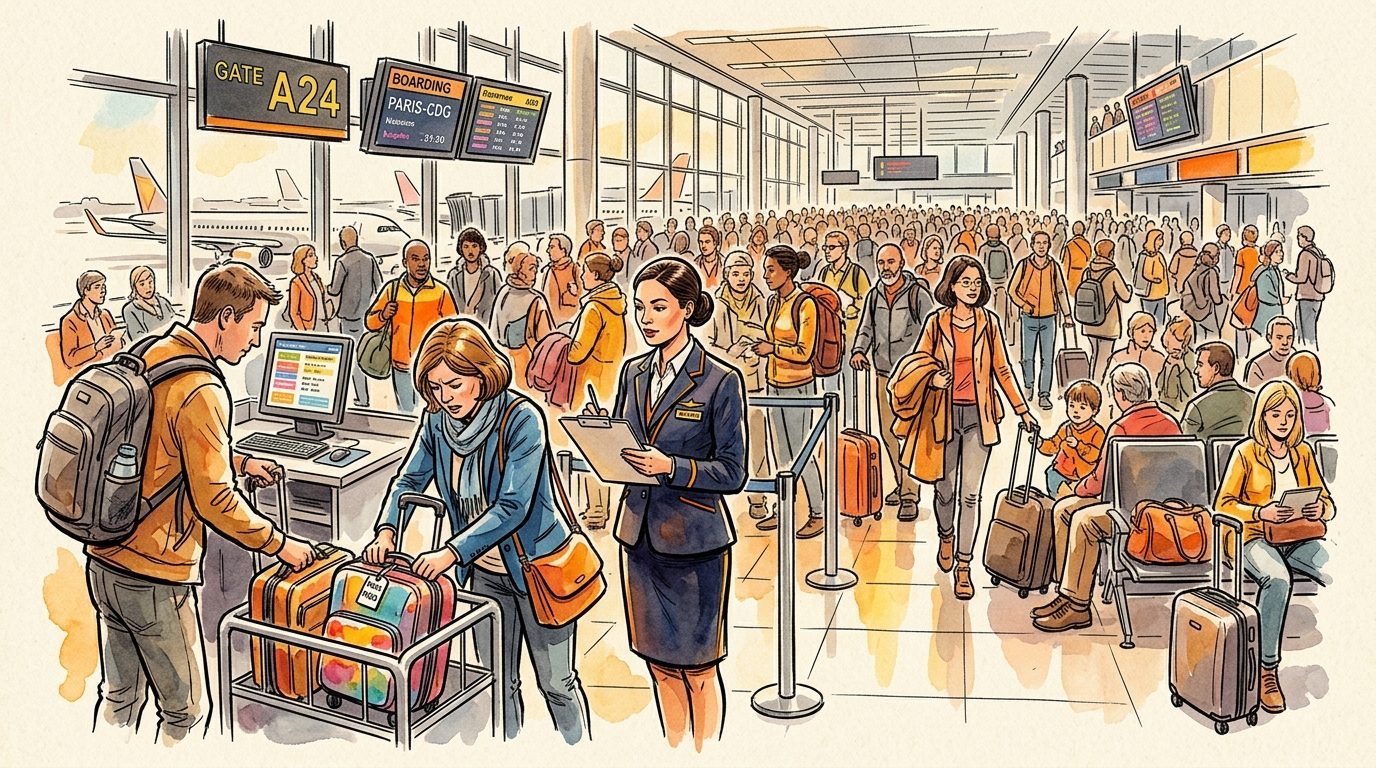
If there’s one place where your $150 saving goes to die, it’s baggage. This is where a lot of budget airline traps and fees live.
On many low-cost carriers, the base fare includes only a small personal item – basically a compact backpack that fits under the seat. A normal carry-on? Extra. A checked bag? Definitely extra.
Typical patterns:
- Carry-on bag: $20–$75 each way, often more if you pay at the airport.
- Checked bag: tiered pricing by route, season, and when you pay (online vs. airport).
- Overweight/oversize: painful penalties – $79–$125 or more for being just a kilo over.
And it doesn’t stop there:
- Fees are often per segment, not per trip. A round-trip with a connection can mean four separate baggage charges.
- Some airlines pay bonuses to gate staff for catching non-compliant bags, so enforcement can be… enthusiastic.
Here’s how that $150 “saving” disappears in seconds:
- You save $150 on the ticket.
- You pay $50 each way for a carry-on and $60 each way for a checked bag.
- Total extra: $220. Your “cheap” flight is now $70 more expensive than the regular airline that included a bag.
How I handle baggage now when I’m comparing the cheap flight vs direct flight cost or budget vs full-service:
- Step 1: Check the airline’s baggage page before I even click “select flight.”
- Step 2: Decide honestly: can I travel with just a personal item, or am I kidding myself?
- Step 3: If I need a bag, I add that cost immediately and compare with full-service carriers.
If the total with bags is within 10–15% of a regular airline, I usually book the regular one. The comfort, space, and flexibility are worth more than a tiny price gap.
3. Seat Selection & “Family Separation”: Are You Paying to Avoid Stress?
Seat selection fees are one of the quiet moneymakers of modern air travel. A US Senate report found major airlines collected $12.4 billion in seat fees between 2018–2023. United made more from seat fees in one year than from checked bags.
On budget airlines, this is where the psychology kicks in hard:
- Basic fares often don’t include seat selection.
- Random assignment tends to “randomly” give you middle seats or split your group.
- Families feel pressured to pay just to sit together.
Typical seat fees:
- Standard seat: $10–$30 per segment.
- Extra legroom / front of cabin: $30–$50+ per segment.
On a round-trip with connections, a family of four can easily drop $200–$300 just to avoid being scattered around the plane. That’s a big chunk of the total trip cost vs ticket price that doesn’t show up in the headline fare.
My rule of thumb now:
- If I’m solo and it’s a short flight, I usually skip seat selection and take my chances.
- If I’m traveling with kids or on a long-haul, I price seat selection in from the start and compare with full-service airlines that include it.
It’s worth asking yourself: Am I really saving money, or am I just paying to fix a problem the airline created?
4. Airports, Transfers & Time: The Hidden Costs You Don’t See on the Ticket
One of the most expensive invisible costs of cheap flights isn’t on your booking confirmation at all. It’s where you land and how much time the flight quietly steals from your trip.
Many low-cost carriers use secondary airports far from the city center. That’s how they keep their own costs down. For you, it can look like this:
- Extra 45–90 minutes of travel each way.
- Limited public transport, so you end up in taxis or rideshares.
- Higher transfer costs, especially late at night or early in the morning.
That $150 cheaper ticket can vanish quickly thanks to:
- $40–$80 round-trip in airport transfers.
- Half a day of sightseeing or work lost to transit.
- An extra hotel night because the only flight is at a terrible time.
Then there’s the time-risk factor that rarely shows up when you’re comparing the cheap flight vs direct flight cost on a search engine:
- Budget airlines often run tighter schedules with fewer backup planes.
- Delays and cancellations can mean long waits and limited rebooking options.
- Fewer staff can mean longer lines and more DIY problem-solving when things go wrong.
When I’m planning a short trip, I now ask:
- Is this cheap flight going to cost me an entire day of my vacation?
- If something goes wrong, do I have same-day backup options?
Sometimes the best deal isn’t the lowest fare. It’s the flight that gets you into the main airport, at a reasonable time, on an airline that can actually help you if things go sideways.
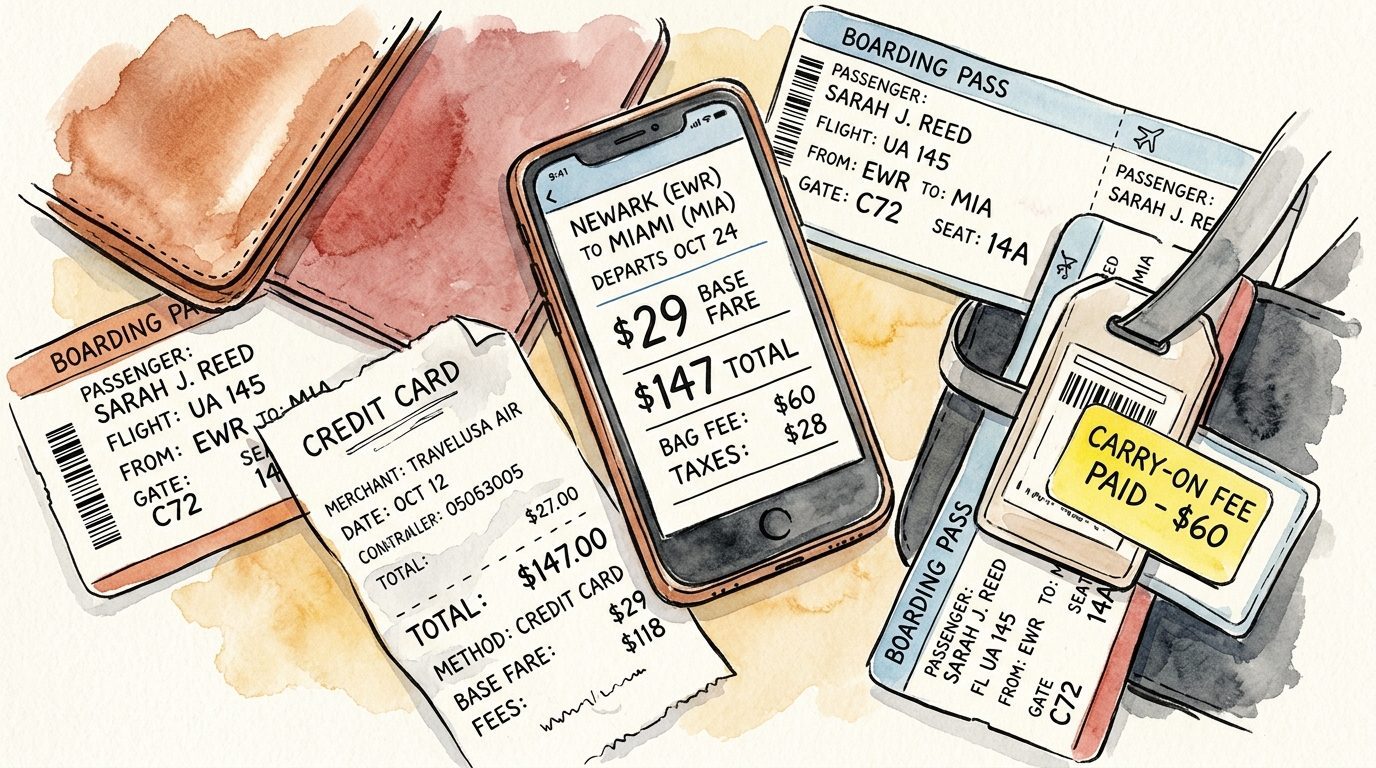
5. Check-In, Boarding Passes & Onboard Purchases: Death by a Thousand Small Fees
Some of the most annoying extra airline fees are the ones that feel like penalties for being human.
Common traps I see over and over:
1. Online check-in deadlines
- Online check-in may close earlier than you expect.
- Miss it, and you can be hit with a hefty airport check-in fee or even a reissue fee.
2. Boarding pass printing
- Some airlines charge $15–$25 just to print your boarding pass at the counter.
- It’s effectively a tax on anyone who isn’t app-obsessed or whose phone dies at the wrong moment.
3. Food and water
- Many budget airlines don’t include any free drinks or snacks.
- Water can be $3–$4, snacks $7–$10. On a long day of flying, that adds up fast.
4. Payment and “service” fees
- Some carriers add 2–3% for certain payment methods.
- Others tack on vague “service” or “administration” fees near the end of booking.
Individually, these don’t look huge. Together, they can easily eat $50–$100 of your “savings” and quietly change the airfare savings vs travel time cost equation.
How I avoid most of them now:
- Always check in as soon as the window opens and save the boarding pass offline.
- Carry a refillable water bottle and fill it after security.
- Bring simple snacks from home or a supermarket instead of relying on onboard food.
- Watch for payment method fees on the final screen and switch cards if needed.

6. Changes, Cancellations & Flexibility: The Most Expensive “What If”
This is the cost most people ignore when they’re chasing a cheap fare: what happens if your plans change?
On many ultra-low-cost carriers:
- Tickets are non-refundable.
- Change fees can be $50–$150 per person, per segment.
- Even a simple name correction can cost a shocking amount (think $140 to fix a letter).
Now imagine you saved $150 on a ticket, but then:
- Your work schedule shifts.
- Your kid gets sick.
- A storm hits and your flight is canceled.
On a full-service airline, you might pay a moderate change fee, use a credit, or get rebooked on another flight the same day. On a bare-bones budget carrier, you might be looking at:
- Buying a whole new ticket at last-minute prices.
- Paying for an extra hotel night because there’s no same-day alternative.
- Spending hours in line or on hold with limited support.
When I know my plans are rock-solid and it’s a short, simple trip, I’m more willing to gamble on a strict fare. But if there’s any uncertainty, I factor in the cost of flexibility as part of the true flight cost:
- Is there a slightly more expensive fare with free or low-cost changes?
- Would a full-service airline give me better rebooking options if things go wrong?
Sometimes paying $50 more upfront is the difference between a minor inconvenience and a very expensive disaster. That’s when cheap airfare is not worth it.
7. When a Cheap Flight Is Actually a Good Deal (and When It’s Not)
After all this, you might wonder if budget airlines are ever worth it. They can be. I still book them – but only when the numbers and the context make sense and the total trip cost vs ticket price still comes out in my favor.
When a cheap flight usually is a good deal:
- You’re traveling light – just a personal item or small backpack.
- It’s a short, direct flight where comfort matters less.
- You’re flexible with timing and can absorb delays.
- The airport is reasonably close to your destination.
- You’ve read the airline’s rules and are willing to play by them.
When that $150 saving is probably fake:
- You need a carry-on and a checked bag.
- You care about sitting with your partner, friends, or kids.
- The airline uses a far-flung secondary airport with expensive transfers.
- Your schedule is tight, or a missed connection would be a big problem.
- The all-in price is within 10–20% of a full-service airline.
In those cases, the “cheap” option often ends up costing more money, more time, and more stress. Those are the cheap flights that make trips more expensive once you add everything up.
So next time you see a flight that’s $150 cheaper, pause for a moment and ask yourself:
What will this really cost me once I add bags, seats, food, and transfers?
If something goes wrong, how expensive will it be to fix?
Is this saving worth the trade-offs in comfort, time, and flexibility?
When you start thinking in trip totals instead of ticket prices, you’ll see the real cost of budget airlines much more clearly. The best deal isn’t always the lowest fare – it’s the flight that lets you arrive with your budget, your time, and your sanity still intact.