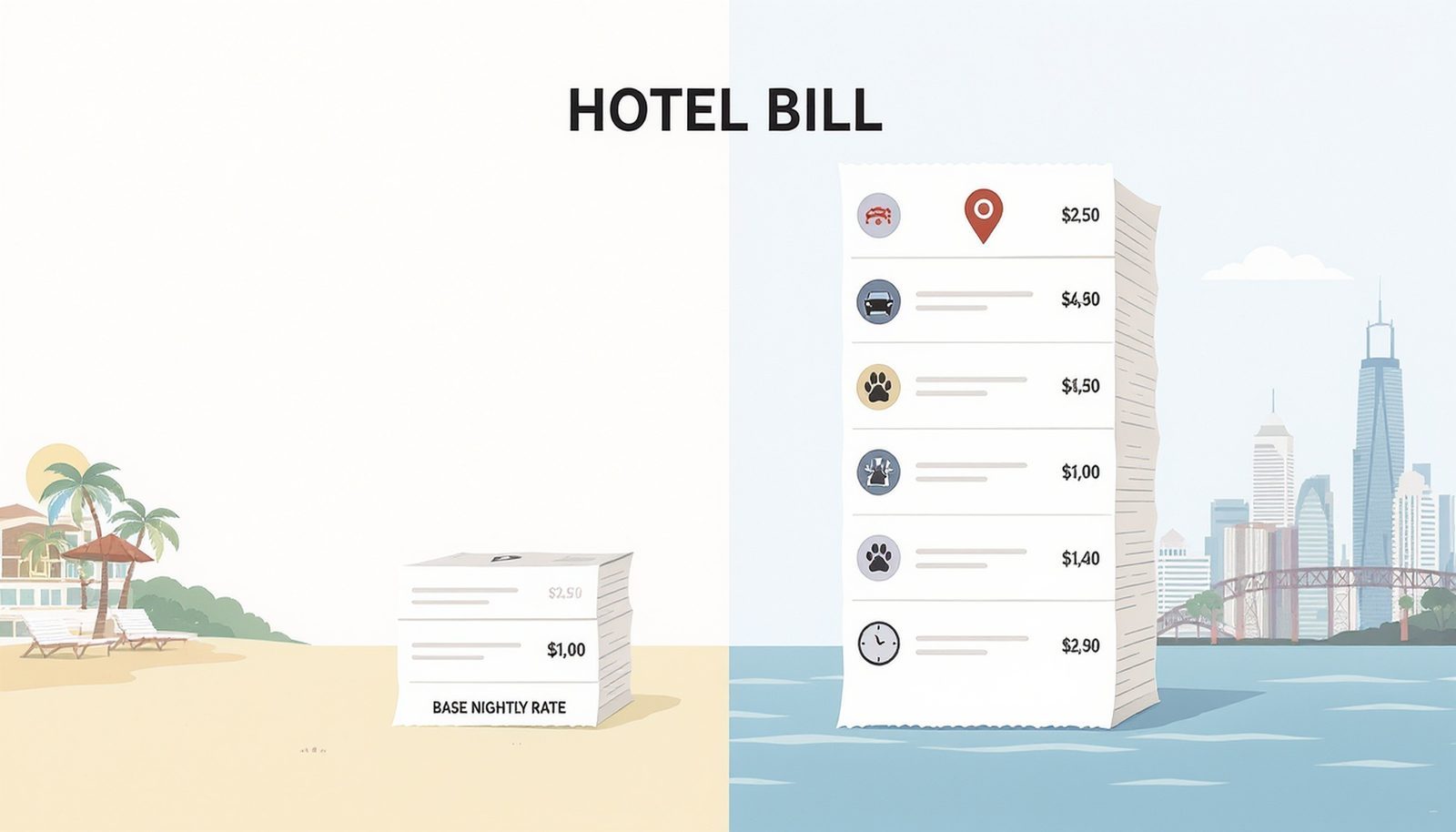
Why hidden resort fees belong in a cost guide, not the fine print
Hotel pricing now functions less like a straightforward nightly rate and more like a layered puzzle. Travelers search, compare, and book based on an appealing base price, only to discover at checkout—or at the front desk—that the actual cost is much higher. This is not incidental. It reflects a deliberate pricing structure built around resort fees, destination charges, parking, Wi‑Fi tiers, early check-in, late checkout, and a growing list of surcharges that can quietly push the nightly cost toward double the advertised rate.
This article sits in the Cost Guide category. It does not offer tactics for avoiding fees; it examines the mechanisms that cause hotel costs to escalate after you think you have finished comparing prices. The focus is on how these fees are designed, why they persist even under new regulation, and how different traveler profiles (drivers, families, pet owners, remote workers) end up facing very different effective nightly rates at the same property.
Understanding these mechanisms matters because the U.S. Federal Trade Commission’s Rule on Unfair or Deceptive Fees, effective May 12, 2025, will change how prices are displayed but will not remove the underlying incentives that drive fee proliferation. The interface will look different, but the economic logic underneath is largely unchanged.
The core mechanism: drip pricing and information asymmetry
At the center of hidden resort fee escalation is drip pricing: advertising a low base rate and revealing additional mandatory charges only after the traveler has invested time and attention in the booking process. The base rate becomes the psychological anchor; everything else is framed as a relatively small add-on, even when those add-ons collectively rival or exceed the base price.
Information asymmetry is what makes this work. Hotels and booking platforms know the full fee structure from the start. Travelers do not. Instead, they encounter fees in stages:
- Search results: Emphasis on the base nightly rate, often excluding resort or destination fees.
- Room selection: Some mention of “taxes and fees,” but often in a collapsed or secondary view.
- Checkout page: A more complete breakdown, sometimes with a line like “Resort fee due at property,” which still keeps the total cash outlay partially off-screen.
- Check-in: Final confirmation of mandatory fees, plus disclosure of authorization holds and optional upgrades.
Each stage nudges you forward. By the time the full cost is visible, you have already invested effort, chosen dates, and possibly passed on other options. Backing out feels costly, even if the price no longer matches your initial understanding.
Resort and destination fees are central to this system. They are framed as payment for amenities—pool access, gym, “complimentary” local calls, or daily food and beverage credits—but in practice they function as non-optional pay-to-stay charges. The amenities are often things travelers assumed were included or do not fully use, so the realized value of the fee is usually lower than its stated justification.
How resort, destination, and facility fees quietly double nightly costs
Resort, destination, and facility fees share the same structure: mandatory, per-night charges layered on top of the base rate. The labels differ, but the economic function is identical—shifting revenue from the visible base price into less visible categories.
Several features make these fees particularly effective at escalating costs:
- Per-night compounding: A fee that looks modest per night becomes substantial over a multi-night stay. A traveler may mentally discount a $35 nightly resort fee when thinking about a single night, but over five nights that is $175 before tax.
- Amenity bundling: The fee is justified by a bundle of amenities—Wi‑Fi, gym access, “daily” credits—that sound generous but are hard to fully use. A daily $20 food credit, for example, may be limited to specific outlets or hours, or may not roll over, reducing its practical value.
- Non-optional framing: The fee is charged whether or not the traveler uses the pool, gym, or local discounts. This disconnect between usage and payment makes the fee functionally similar to a disguised room rate increase.
- Terminology rotation: As scrutiny grows around “resort fees,” some properties rebrand them as “destination,” “facility,” or “urban” fees. The label changes, but the cost structure does not.
From a cost-guide perspective, the key point is that these fees are not optional in the way that room service or spa treatments are. They are structurally close to the base rate but presented as something else. This is why travelers often feel that the nightly cost has doubled: the base rate is only one of two major mandatory components.
Parking, early check-in, and late checkout: monetizing operational constraints
Beyond resort-style fees, hotels increasingly monetize operational constraints—parking capacity, housekeeping schedules, and room turnover—through separate charges. These fees are tied to real constraints, but the way they are priced and disclosed can sharply increase the effective nightly cost.
Parking fees are a straightforward example. In dense urban or resort areas, parking is limited and valuable. Hotels respond by:
- Charging nightly parking fees that are not included in the base rate.
- Distinguishing between self-parking and valet, with different price points.
- Listing parking as “available” without clearly stating the total cost until late in the booking flow.
For travelers who must drive—families, road-trippers, or those in destinations with weak transit—parking is effectively a mandatory add-on. Over several nights, parking can rival the resort fee in size, especially in cities or beach destinations where demand is high.
Early check-in and late checkout fees monetize housekeeping and occupancy constraints. On high-occupancy days, every hour of room turnover matters. Hotels can either absorb the operational strain or convert it into revenue:
- Early check-in is offered for a fee, which may vary by day based on occupancy.
- Late checkout is similarly priced, sometimes approaching the cost of an extra half-night.
- Missed checkout times can trigger penalties, including being charged for an additional night.
These fees are usually more visible than resort fees but still often excluded from travelers’ initial cost expectations. For travelers with early arrivals or late departures, the realistic cost of aligning hotel time with flight or train schedules can be material.
Wi‑Fi, extra guests, and pets: exploiting baseline expectations
Another layer of escalation comes from fees applied to what many travelers now view as baseline expectations: connectivity, family travel, and bringing pets. These charges create hidden cost tiers within the same property.
Wi‑Fi tiers show this clearly. A hotel may advertise “free Wi‑Fi,” but the free tier is slow or unstable, suitable only for light browsing. Functional connectivity for remote work or streaming sits behind a paid “premium” tier. The result is a two-level pricing structure:
- Base rate + resort fee + free Wi‑Fi (limited functionality).
- Base rate + resort fee + premium Wi‑Fi surcharge (functional connectivity).
From a cost-guide standpoint, the second tier is the realistic one for many modern travelers, but the first tier is what anchors expectations.
Extra-guest fees and pet surcharges follow a similar pattern. A room may be advertised at a rate that implicitly assumes one or two adults, but:
- Additional adults may incur per-night surcharges.
- Children may be free up to a certain age, then charged beyond that.
- Pets may trigger nightly fees, cleaning surcharges, or mandatory room-type upgrades.
These charges are often justified by higher wear-and-tear or cleaning costs, which is plausible. The key mechanism, however, is that they are not prominent in the initial price comparison. Families and pet owners, in particular, can see their effective nightly cost rise sharply once these surcharges are applied.
Authorization holds: shifting risk and cash-flow burden to travelers
Authorization holds at check-in are not fees in the strict sense, but they are part of the cost architecture because they affect how much usable credit or cash a traveler has during the stay. Hotels commonly place a hold on a credit or debit card to cover incidentals or potential damage. The amount can be substantial relative to the base rate, especially at higher-end properties.
The mechanism is risk transfer. Instead of the hotel bearing the risk of unpaid incidentals, the traveler’s available credit is reduced in advance. For travelers with constrained credit limits, this can have several knock-on effects:
- Reduced ability to charge other travel expenses (meals, transportation) to the same card.
- Increased risk of card declines if the hold plus actual charges approach the limit.
- Potential overdraft or fees if a debit card is used and the hold interacts with other withdrawals.
While the hold is usually released after checkout, the timing can be uncertain, and the temporary constraint can shape the traveler’s experience. In a cost guide, this matters because the “cost” of a stay is not only what is ultimately charged, but also how much liquidity is tied up during the trip.
How the FTC’s 2025 rule changes the display—but not the logic—of fees
The FTC’s Rule on Unfair or Deceptive Fees, effective May 12, 2025, is a structural change in how hotel prices must be presented in the United States. For short-term lodging, the rule requires that the total price—including all calculable mandatory fees—be displayed more prominently than any partial price. This targets drip pricing directly.
In practice, this means that:
- Resort, destination, and facility fees that are mandatory must be included in the upfront total price shown to consumers.
- Third-party booking platforms, not just hotels, must adjust their interfaces so that search results and room listings emphasize the total price rather than the base rate alone.
- Taxes and government-imposed charges can still be listed separately, as the rule explicitly allows this.
The rule improves comparability: two hotels with similar total prices but different mixes of base rate and resort fee will be easier to compare at a glance. The underlying economic incentives, however, remain intact. Hotels can still:
- Maintain or increase resort-style fees, as long as they are included in the total price.
- Repackage charges into categories that may be treated differently under the rule, such as optional add-ons.
- Experiment with new fee types that are framed as optional but are practically necessary for many travelers (for example, premium Wi‑Fi for remote work).
Enforcement details—such as how non-compliance will be detected, what penalties will be applied, and how platforms will be monitored—are not yet fully clear in public discussion. This uncertainty suggests that the transition period around May 2025 is likely to be uneven, with different platforms and chains implementing the rule in slightly different ways.
Comparing fee structures: where costs escalate for different traveler profiles
Because the same property can produce very different effective nightly costs for different travelers, it is useful to think in terms of profiles. The table below illustrates how fee structures interact with traveler characteristics. The numbers are illustrative in structure only; the focus is on which fees matter most for each profile, not on specific amounts.
| Traveler profile | Key cost escalators | Mechanism | When nightly cost can effectively double |
| Solo traveler without car | Resort/destination fee, premium Wi‑Fi | Mandatory amenity fee plus functional connectivity tier | When resort fee is large relative to a discounted base rate |
| Family with car | Resort fee, parking, extra-guest charges | Per-night compounding of resort and parking, per-person surcharges | On multi-night stays in cities or resorts with high parking fees |
| Remote worker | Resort fee, premium Wi‑Fi, late checkout | Need for reliable connectivity and extended room use on departure day | When late checkout is priced near a half-night and Wi‑Fi is tiered |
| Pet owner | Resort fee, pet surcharge, cleaning fee | Per-night pet fees plus one-time cleaning or deposit | On longer stays where per-night pet fees accumulate |
| Group of adults | Resort fee, extra-guest charges, parking (multiple cars) | Per-person surcharges and multiple vehicle fees | When extra-guest and parking fees stack across several nights |
The pattern is consistent: the more a traveler’s needs intersect with monetized constraints (parking, occupancy, pets, connectivity, timing), the more likely it is that the effective nightly cost will approach or exceed double the advertised base rate.
Risks, uncertainties, and where travelers remain exposed
Even with the FTC rule approaching, several areas of risk and uncertainty remain for travelers trying to understand the true cost of a hotel stay.
1. Underestimation of total trip cost
Mandatory fees that are technically disclosed but not salient still lead to underestimation. Travelers may see a total price at booking but mentally anchor on the base rate, especially if they are used to thinking in terms of “room rate plus tax.” The shift to “total price including mandatory fees” requires a change in mental models that will not happen immediately.
2. Penalties tied to timing and policy breaches
Early check-in and late checkout fees, as well as penalties for missed checkout times, remain a significant source of risk. The same applies to undeclared extra guests or pets. These charges are not hidden in the same way as resort fees, but they are often not fully incorporated into budgets. A single late checkout penalty or extra-guest charge can erase the savings from choosing a lower base rate.
3. Degraded service without premium options
When baseline Wi‑Fi is weak or when certain amenities are effectively paywalled behind resort fees or premium tiers, travelers face a choice between degraded service and higher costs. This is particularly relevant for remote workers or anyone who relies on stable connectivity. The risk is not only financial; it can affect work commitments or time-sensitive tasks during the trip.
4. Liquidity constraints from authorization holds
For travelers with limited credit or those using debit cards, large authorization holds can create liquidity stress. The concern is not that the hotel will ultimately overcharge, but that the temporary reduction in available funds will collide with other expenses. There is little quantitative analysis of how often holds lead to declines or overdrafts, but the mechanism is straightforward.
5. Regulatory implementation uncertainty
The FTC rule’s effectiveness depends on how rigorously it is enforced and how platforms and hotels interpret its requirements. Open questions include:
- How quickly all major booking channels will adopt compliant total-price displays.
- What happens when a hotel misclassifies a fee as optional or fails to include it in the total.
- How cross-border bookings will be handled when the property is outside the U.S. but the booking platform is subject to U.S. rules.
Until these details are clarified through enforcement actions and industry adaptation, travelers will operate in a transitional environment where some listings are more transparent than others.
What this escalation means for future hotel pricing
Hidden resort fee escalation is not a temporary quirk; it is a structural response to competitive pressure and regulatory constraints. Hotels face intense competition on visible nightly rates, especially in search results where small differences can shift bookings, while also facing rising costs and expectations for revenue growth.
The result is a persistent incentive to keep the base rate as low as possible while shifting revenue into less visible categories. Resort and destination fees, parking charges, Wi‑Fi tiers, and timing-based fees all reflect this logic. The FTC’s 2025 rule will change how prices appear on screens, but it does not change the underlying economics.
Looking ahead, several trends are plausible:
- More sophisticated fee packaging: Hotels may bundle multiple charges into “experience” or “access” packages that are technically optional but practically necessary for many travelers.
- Dynamic pricing of add-ons: Early check-in, late checkout, and even premium Wi‑Fi may become more dynamically priced based on occupancy and demand, making costs less predictable.
- Greater divergence across traveler types: As fee structures become more granular, the gap between what a solo traveler without a car pays and what a family with a car and a pet pays at the same property will widen.
For cost-conscious travelers, the main implication is that the “nightly rate” is no longer a single number but a layered structure. Understanding how those layers interact with your specific travel profile is essential to anticipating the real cost of a stay.
Conclusion: a more transparent display, but the same underlying game
Hidden hotel resort fee escalation is best understood as a system, not a set of isolated charges. The system relies on drip pricing, information asymmetry, and the monetization of operational constraints. Resort and destination fees, parking, Wi‑Fi tiers, early check-in, late checkout, extra-guest and pet surcharges, and authorization holds all play specific roles in shifting revenue away from the visible base rate.
The FTC’s Rule on Unfair or Deceptive Fees will make the total price more visible at the point of booking, which is a meaningful improvement for comparison shopping. It does not, however, remove the incentives that drive fee proliferation or fully address risks tied to timing penalties, degraded baseline services, or liquidity constraints from authorization holds.
From a cost-guide perspective, the central point is that the true cost of a hotel stay is the sum of the base rate, all mandatory per-night fees, and the add-ons that are functionally necessary for your specific travel pattern. As long as hotels compete primarily on the visible base rate, the pressure to shift revenue into less visible categories will remain. Travelers will see clearer totals on screens, but the underlying construction of those totals is likely to keep evolving beneath the surface.