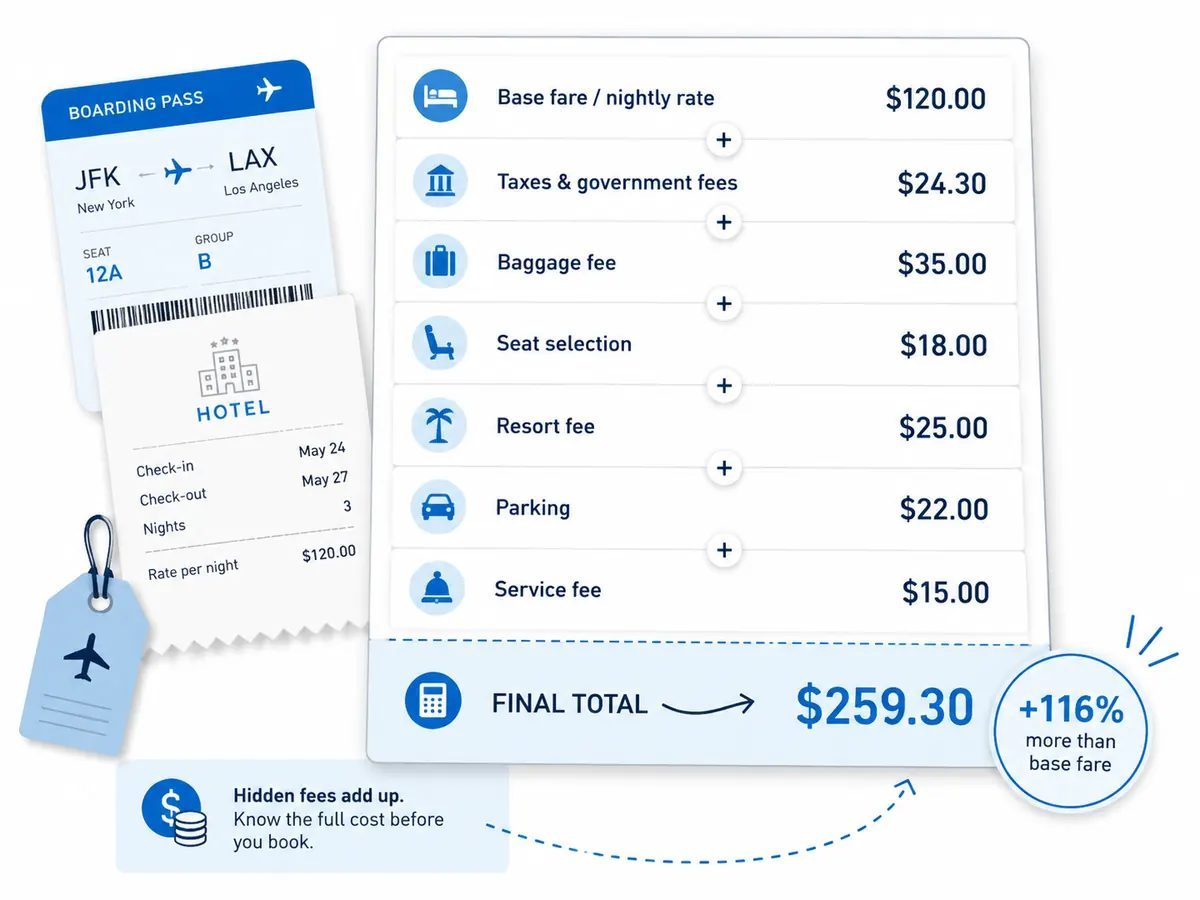
I used to think that once I’d paid for my flight, the “big” expense was done. Then I started checking my credit card statements after trips. The airfare was just the opening act. The real damage came from everything that happened after I landed.
If you’ve ever come home from a “cheap” trip wondering where your money went, this guide is for you. Let’s walk through the extra travel costs not in your airfare that quietly blow up a post-airfare travel budget – and how to plan for them before you even leave home.
1. The Airport-to-Hotel Trap: Transfers, Tolls, and Parking
The moment you step off the plane, the meter starts running. Most people budget for flights and hotels, then vaguely assume they’ll “grab an Uber” or “take the train.” That vagueness is expensive.
Here’s what often gets missed and turns into hidden costs after the flight:
- Airport transfers: Taxis, rideshares, hotel shuttles that aren’t actually free, or premium express trains.
- Tolls and surcharges: Airport pickup fees, bridge tolls, late-night surcharges that don’t show in the base estimate.
- Parking at your home airport: Weekly rates, confusing “from $X/day” pricing, and extra days if your flight is delayed.
Ask yourself: If I had to get from the airport to my hotel and back three times, what would it cost?
That little thought experiment forces you to look up real numbers instead of guessing.
How I budget it:
- Check the airport’s official site for train/bus fares and compare with rideshare estimates.
- Look at round-trip costs, not just one-way.
- If I’m driving to my home airport, I price out all parking options (on-site, off-site, rideshare both ways) and pick the cheapest realistic one.
- Add a 20–30% buffer for tolls, surge pricing, or delays.
The goal isn’t perfection. It’s to stop pretending these ground transportation costs after flying don’t exist.
2. Hotel Sticker Shock: Resort Fees, Parking, and “Little” Charges
Hotels are masters of the half-truth. The nightly rate looks fine. The final bill does not.
Common budget killers and hidden airport and baggage-style fees on the ground:
- Resort or destination fees: Daily charges for “amenities” you may not use – pool access, “free” local calls, gym, Wi‑Fi.
- Parking: Especially in cities and resorts. Sometimes parking costs more than the rental car.
- Early check-in / late checkout: Increasingly monetized, especially in busy destinations.
- Minibar and in-room snacks: Easy to ignore until someone in your group raids them.
- Paid Wi‑Fi or “premium” Wi‑Fi: Basic may be free, usable Wi‑Fi is not.
The nightly rate is just the cover charge.
The real cost is the nightly rate plus everything the property quietly adds on.
How I budget it:
- When comparing hotels, I calculate a “true nightly rate”: (room rate + resort fee + average parking per night).
- I read the fine print or FAQ for resort fees, Wi‑Fi, parking, and any mandatory service charges.
- I assume at least one early check-in or late checkout fee on trips with awkward flight times, unless the hotel confirms it’s free.
- I mentally add $5–$10 per night for “miscellaneous” (water, snacks, tips) unless I’m very disciplined.
Once you start comparing hotels by total cost instead of headline rate, a lot of “cheap” properties stop looking cheap. This is where many travel budget mistakes after airfare begin.
3. Local Transport Creep: Daily Movement Adds Up Fast
Most of us plan how to arrive in a city, not how we’ll move around once we’re there. That’s how you end up spending more on Ubers than on your flight.

Hidden local transport costs include:
- Rideshares and taxis: Short hops that don’t feel expensive individually.
- Public transit passes: Great value, but still a line item you need to plan for.
- Parking and tolls: If you rent a car or drive into the city.
- Tour pickups: Some tours charge extra if you’re not at a central meeting point.
The problem isn’t one ride. It’s the pattern. A $12 ride, twice a day, for 5 days is $120. Do that in a couple of cities per year and you’ve quietly spent the cost of another trip.
How I budget it:
- Before booking accommodation, I drop the address into a map and check walking times to the places I care about.
- If I’ll use transit, I look up the cost of a day pass or weekly pass and assume I’ll buy it.
- If I’m likely to use rideshares, I estimate 2–3 rides per day at local prices and multiply by trip length.
- For road trips, I add a rough line for tolls + parking (often $10–$30/day in cities).
Sometimes a slightly more expensive, central hotel is actually cheaper once you factor in what you’d spend getting around. That’s the kind of post-flight cost breakdown that keeps your budget honest.
4. Money Leaks: Currency, Cards, and “Convenient” Exchange
International trips add a whole extra layer of hidden costs. Not from what you buy, but how you pay for it.

Here’s where people quietly lose 5–10% of their budget without noticing:
- Foreign transaction fees: Often 2–3% on every purchase with some cards.
- Dynamic currency conversion: When a terminal asks,
Pay in your home currency?
and you say yes. The rate is usually terrible. - Airport exchange kiosks: High fees and bad rates wrapped in bright signage.
- Frequent ATM withdrawals: Flat fees + foreign bank fees + poor rates.
Individually, these look small. Over a week or two, they can equal a nice dinner or even a hotel night. Another classic example of unexpected expenses after landing.
How I budget it:
- Use at least one no-foreign-transaction-fee credit card for most purchases.
- Always choose to pay in local currency on card terminals and ATMs.
- Plan cash needs and make fewer, larger ATM withdrawals instead of many small ones.
- Assume a small “friction cost” (1–2%) on the total trip spend if I can’t avoid some fees.
The point isn’t to chase the perfect exchange rate. It’s to avoid the worst ones and keep those surprise travel fees to budget for under control.
5. Food, Water, and “I’m Tired, Let’s Just Eat Here”
Food is where budgets go to die, especially on long travel days. You’re tired, hungry, and not in the mood to hunt for value. That’s exactly when you overpay.
Common culprits:
- Airport meals: Marked up heavily. Same for coffee and bottled water.
- Hotel breakfasts: Convenient, but often $20–$40 per person in big cities.
- Room service: Menu prices + service fees + delivery charges + tips.
- Tourist-zone restaurants: You pay for the location, not the food.
Ask yourself: How many times per trip do I say, ‘I don’t care, I just want to eat’?
Those are the moments that need a plan.
How I budget it:
- For travel days, I assume airport pricing for at least one meal and snacks.
- I check if my hotel room has a fridge or kettle so I can do simple breakfasts (yogurt, fruit, instant oats).
- I plan for one “lazy” meal per day (nearby, maybe overpriced) and one more intentional, better-value meal.
- I add a small daily line for coffee, snacks, and bottled water unless I know I’ll be disciplined.
Food doesn’t have to be cheap. It just needs to be chosen, not defaulted. That mindset alone can reshape how much to budget beyond airfare.
6. Rental Cars, Insurance, and Fuel: The Landmine Category
Rental cars look straightforward until you’re at the counter being asked about insurance, upgrades, and fuel options. This is where a lot of people panic-spend.
Hidden or underestimated costs include:
- Insurance and excess coverage: Collision damage waivers, liability coverage, and extra protection that may duplicate what your card or personal policy already covers.
- Fuel policies: Prepaid fuel (convenient but rarely good value) vs. returning full.
- One-way fees: Dropping off in a different city or country.
- Young driver or additional driver fees: Per day, not per rental.
- Refueling penalties: Per-liter or per-gallon rates far above local prices if you return the car less than full.
Most of these are not truly hidden. They’re just poorly understood until it’s too late to shop around.
How I budget it:
- Before booking, I check what my credit card and personal auto insurance actually cover abroad.
- I price the rental as: base rate + mandatory insurance + estimated fuel + parking + tolls.
- I assume I’ll pay for at least one extra driver if I know we’ll share driving.
- I avoid prepaid fuel unless I’m sure I’ll return the car nearly empty.
Sometimes, once you add everything up, a mix of trains, buses, and occasional rideshares is cheaper and less stressful than renting at all. Another reason to do a full post-flight cost breakdown before you book.
7. Tips, Souvenirs, and the “Oh Well, I’m on Vacation” Fund
Not every cost is a fee. Some are just the natural side effects of being somewhere new and wanting to enjoy it. But they still need a line in your budget.

Things people routinely forget to plan for:
- Tipping: Hotel staff, guides, drivers, restaurant servers, porters.
- Souvenirs and gifts: For yourself and for people back home.
- Small daily treats: Gelato, street snacks, coffee, local desserts.
- Pet or house sitting back home: Daily rates add up quickly.
These aren’t “bad” expenses. They’re part of the experience. The problem is when they’re treated as exceptions instead of expectations.
How I budget it:
- Set a daily “fun money” amount for snacks, treats, and small impulse buys.
- Estimate tips based on destination norms (some countries tip heavily, others barely at all).
- Decide in advance how much I’m willing to spend on souvenirs and stick to it.
- Include pet/house sitting in the trip budget, not as a separate “life expense.”
When you give yourself permission to spend within a clear limit, you enjoy it more and regret it less. It also keeps those overlooked travel expenses on arrival from sneaking up on you.
8. Build a Realistic Buffer: Your Anti-Stress Safety Net
Even with careful planning, travel is messy. Flights get delayed. Weather changes plans. You discover something amazing you didn’t know existed and want to say yes.
That’s why I always add a 10–20% buffer on top of my total estimated trip cost. Not as “extra spending money,” but as a things will go wrong or right
fund.
Here’s how to use it wisely:
- Calculate your full trip cost: flights + accommodation + transport + food + activities + all the hidden categories above.
- Multiply that number by 1.1 or 1.2 and treat the difference as your buffer.
- Only tap the buffer for genuine surprises or opportunities, not for every impulse.
- If you come home under budget, that buffer becomes seed money for the next trip.
The real win isn’t just saving money. It’s coming home without that sinking feeling when you open your banking app.
If you take one thing from this: stop judging trips by airfare alone. The flight is just the ticket to the game. The real cost is everything that happens after you land. Once you start budgeting for that, and you’re honest about the hidden costs after the flight, travel gets a lot more manageable – and a lot less stressful.