
I used to feel proud of myself for being organized. Same vacation week every year. Fly out Friday after work. Come back Sunday night. Done.
Then I started tracking prices.
What I found was uncomfortable: those fixed dates were quietly adding $200–$600 per trip compared to almost identical itineraries just a day or two earlier or later. And it wasn’t only flights. Hotels, rental cars, even tours got pricier the moment I insisted on specific dates.
If you’ve ever said, Those are the only days that work,
this is for you. Let’s look at how inflexible travel dates cost you money, where the biggest hidden charges show up, and how to use timing to your advantage without turning trip planning into a second job.
1. The Invisible Surcharge of “Those Are the Only Days I Can Go”
Here’s the basic problem: airlines and hotels don’t price based on what’s fair. They price based on demand.
When you lock yourself into specific dates, you’re basically telling the pricing algorithm, Charge me whatever you want, I’m still coming.
It sounds dramatic, but that’s how dynamic pricing works:
- Airlines constantly adjust fares based on demand, seat inventory, and seasonality (explained well here).
- Hotels do the same with occupancy forecasts, local events, and holidays.
- Weekends, school breaks, and big events create automatic price spikes.
So when you say, I have to fly out Friday after work and back Sunday night,
you’re often choosing the most expensive days on the calendar by default. On many routes, midweek flights (especially Tuesday and Wednesday) and shoulder-season dates are significantly cheaper.
Fare-tracking tools like Google Flights, Skyscanner, and Kayak regularly show 30–50% lower prices on less popular days. That’s not a small difference. That’s the difference between one trip a year and two.
It took me a while to admit it, but here’s what I eventually realized: my rigid schedule, not the airline, was the main reason I was overpaying.

The moment you loosen your grip on exact dates, you stop paying that invisible inflexibility tax.
2. How One Rigid Day Can Add $300+ to Your Flight
Let’s put some numbers to this. It’s easier to see the cost of inflexible travel dates when you look at a real route.
Take a typical round-trip: New York to Los Angeles.
- Search Friday–Sunday on a busy spring weekend and you might see fares around $450–$550.
- Shift to Wednesday–Saturday or Tuesday–Friday and suddenly you’re seeing $250–$320 on the same airlines, same airports.
The plane didn’t change. The route didn’t change. Only the dates did.
Tools that show flexible vs fixed travel dates make this painfully obvious:
- Google Flights Date Grid / Price Graph shows a matrix of departure vs. return dates with prices. A one-day shift can drop the fare by $100+ each way.
- Skyscanner’s month view highlights the cheapest days in green and the most expensive in red.
- Kayak’s color-coded calendar does something similar, so pricey weekends jump out immediately.
According to multiple guides (EasyDealsFinder, SkyGoFly, FlyFono):
- Shifting your trip by just 1–3 days can save hundreds of dollars on many routes.
- Midweek flights (especially Tuesday/Wednesday) are often much cheaper than Friday/Sunday.
- Early morning and late-night flights usually undercut prime-time departures.
So when you insist on, We have to leave Friday after work,
you’re not just choosing a day. You’re choosing a price tier. That’s how timing affects flight prices more than most people realize.
3. The Hotel Trap: Why Your Check-In Date Matters More Than You Think
Flights get all the attention, but hotels quietly punish rigid timing too. The hidden cost of rigid travel dates shows up clearly when you start playing with check-in and check-out days.
Here’s what I see over and over when I test different date ranges on hotel sites and OTAs like Priceline:
- Check in on a Friday in a popular city? Rates jump because of weekend leisure demand.
- Check in on a Tuesday or Wednesday? Same room, same hotel, often 20–40% cheaper.
- Shift your stay just outside a major event or holiday? Nightly rates can drop dramatically.
Platforms like Priceline (especially with their Express Deals) reward date flexibility for cheaper hotels even more:
- If you’re open on exact dates and even the exact hotel, opaque deals can be significantly cheaper.
- If you’re locked into a specific weekend, you’re stuck paying whatever the market will bear.
- Non-refundable, prepaid rates are cheaper, but they’re brutal if your rigid dates end up changing.
Then there’s the seasonality trap—a big one in any flight and hotel cost breakdown by date:
- Travel in peak season (school holidays, summer in Europe, Christmas in warm destinations) and you pay a premium on both flights and hotels.
- Shift to shoulder season (late spring, early fall) and you often see 40–50% lower prices, fewer crowds, and better service.
Your check-in date isn’t just a calendar choice. It’s a pricing signal. Weekend vs weekday travel prices, peak vs shoulder season, event vs non-event week—those details quietly decide whether your hotel bill feels reasonable or painful.
4. The “One Airport Only” Mindset That Shrinks Your Options
Another way inflexibility costs you: insisting on a single airport when there are cheaper, practical alternatives nearby.
Most of us do this without thinking:
I’m flying to San Francisco, so I’ll search SFO only.
I live near JFK, so I’ll only look at JFK.
But once you start using flexible-date tools and multi-airport searches, a different picture appears:
- Bay Area: OAK or SJC can be much cheaper than SFO.
- Los Angeles: Burbank or Long Beach sometimes undercut LAX by a lot.
- New York: EWR or LGA can beat JFK, depending on the route.
Guides from SkyGoFly and EasyDealsFinder both point out that being flexible with airports often unlocks lower fares, even after you factor in an extra train, bus, or rideshare.
Now I ask myself a simple question: Is my time and convenience worth the extra $150–$300? Sometimes the answer is yes. Sometimes it’s a hard no. The key is that it becomes a conscious trade-off instead of an automatic, expensive habit.
5. The Myth of “I Don’t Have Flexibility” (You Often Have More Than You Think)
This is usually where people push back: That’s nice in theory, but I don’t have flexible dates.
Sometimes that’s true. Weddings, fixed conferences, school schedules—they are what they are. But in practice, most travelers have more wiggle room than they first admit. The trick is to define flexibility realistically, not ideally.
Ask yourself:
- Can I leave one day earlier or later if it saves $200–$400?
- Can I fly early morning or late night instead of peak midday?
- Can I shift the trip by a week to avoid a major holiday or event?
- Can I fly into a nearby airport and take a train or bus?
- Can I move a meeting by a few hours to catch a cheaper flight?
Even business travelers sometimes have more control than they think. One guide on trip timing mistakes that cost money pointed out that simply adjusting meeting times can unlock cheaper flights without changing the actual work being done.
And if your dates truly are fixed? You still have a few levers to pull:
- Use price alerts (Google Flights, Skyscanner, Hopper) as soon as you know your dates.
- Avoid ultra-restrictive basic economy if you might want to rebook when prices drop.
- Take advantage of airlines’ more flexible change policies on standard economy to rebook if fares fall.
You may not be able to move the whole trip. But a different flight time, a nearby airport, or booking at the right moment can still shave real money off the total.
6. Simple Tools That Turn Flexibility Into Actual Savings
Knowing that flexible vs fixed travel dates matter is one thing. Turning that into actual savings is another. Here’s how I do it without spending hours a day hunting deals.
1. Start with flexible-date search, not fixed dates.
- On Google Flights, use the Date Grid and Price Graph instead of typing exact dates and hitting search once.
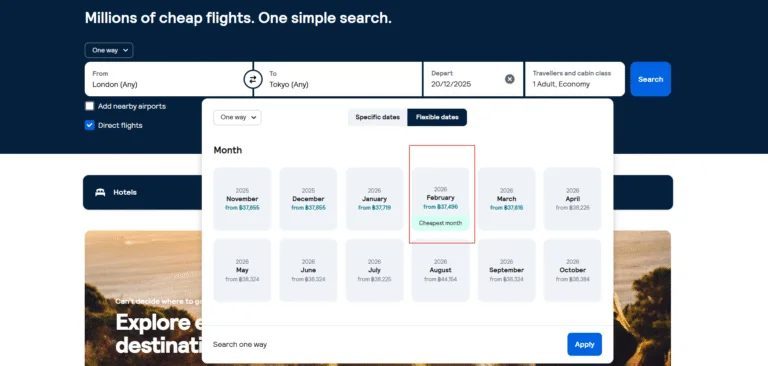
- On Skyscanner, search by whole month or even
cheapest month
to see travel pricing by season and day. - On Kayak, use the color-coded calendar to spot cheaper days at a glance.
2. Use “Everywhere” or Explore tools when you’re open on destination.
- Skyscanner’s
Everywhere
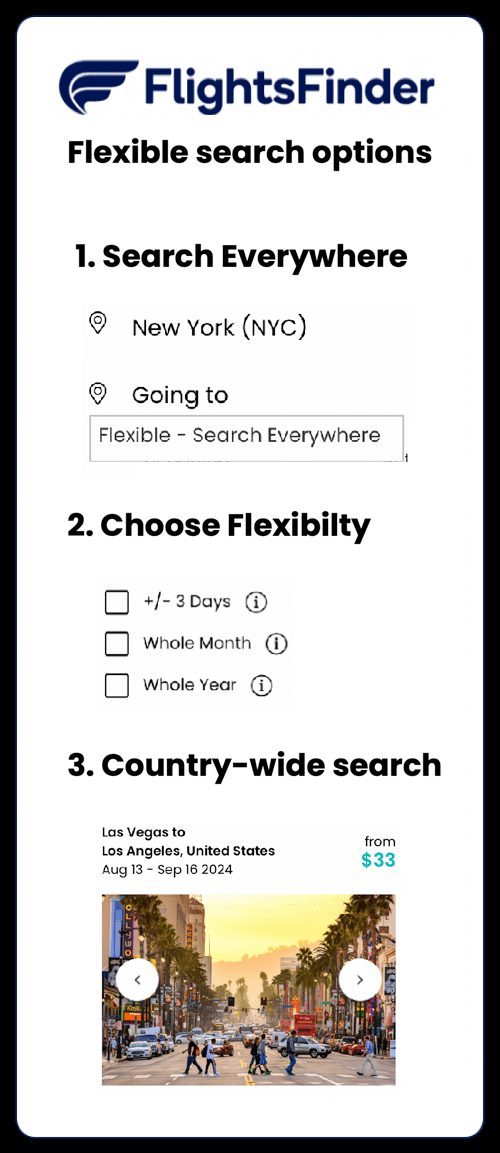
search shows the cheapest destinations from your home airport. - Google Flights’ Explore map reveals surprisingly cheap routes you might not have considered.
3. Set price alerts early.
- As soon as you have a rough window, set alerts on Google Flights, Skyscanner, or Hopper.
- Let the tools watch for drops instead of manually checking every day.
4. For hotels, search ranges, not just exact dates.
- On OTAs (Priceline, Booking, etc.), play with check-in/check-out by a day or two.
- Check if arriving Sunday instead of Friday cuts your nightly rate.
- Compare non-opaque vs. opaque deals (like Priceline Express Deals) if you’re flexible on the exact property.
5. Combine flexibility with points and miles.
- When you’re flexible, award availability opens up dramatically.
- Being able to move your trip by a day or two can be the difference between a terrible redemption and an amazing one.
The pattern is simple: search wide first, then narrow down. Most people do the opposite and end up paying more than they need to.
7. A Practical Playbook: How to Plan Your Next Trip Without the Inflexibility Tax
Let’s turn this into a simple plan you can actually follow for your next trip. Think of it as a quick guide to travel date flexibility savings.
Step 1: Define your real flexibility.
- What’s the earliest you could leave? The latest you could return?
- Could you shift by 1–3 days on either side if the savings are big enough?
- Are nearby airports acceptable if they save $150+?
Step 2: Scan the month, not just the weekend.
- Use Google Flights / Skyscanner / Kayak to view a full month of prices.
- Mark the cheapest clusters of dates that still work for you.
Step 3: Check hotels for those same clusters.
- Search your top 2–3 date ranges on hotel sites or OTAs.
- Compare total trip cost (flight + hotel), not just the flight alone. The cheapest days to fly and stay aren’t always obvious until you add everything up.
Step 4: Set alerts and give yourself a short decision window.
- Once you’ve picked your top dates, set price alerts.
- Give yourself a defined window (say, 5–10 days) to watch for drops and then commit.
Step 5: Book with a change-friendly fare when possible.
- Avoid basic economy if you might rebook later.
- Use airlines’ more flexible change policies to your advantage if prices fall.
By the time you’re done, you’re not just booking the only weekend that works.
You’re booking one of the cheapest reasonable options within your real-life constraints—and avoiding the worst trip timing mistakes that cost money.
8. The Bottom Line: Your Calendar Is a Pricing Tool
Most people treat their calendar as fixed and prices as something they just have to accept. I’ve flipped that.
Now I assume:
- My dates are negotiable (at least a little).
- Prices are highly sensitive to small shifts in timing.
- Tools exist to show me exactly where the sweet spots are.
When you start planning this way, you stop paying the hidden cost of inflexible travel dates. You don’t have to become a full-time travel hacker. You just have to stop telling airlines and hotels, Charge me whatever you want, I’m coming anyway.
Next time you plan a trip, try a quick experiment: before you lock in dates, spend 10 minutes with a flexible-date calendar. Look at how far in advance to book flights for your route, scan a full month, and see what happens when you nudge your dates around.
If you don’t see at least a $150–$300 swing somewhere in that month, I’d be surprised.
Your calendar is more powerful than it looks. Use it like a pricing tool, and your trips get cheaper, calmer, and often better.