How Japan’s new travel economy works: from “cheap yen” to premium, high-friction trips
Japan’s travel landscape in 2026 is no longer defined by the simple idea that a weak yen makes everything feel cheap. Instead, a layered policy mix is pushing the country toward a more premium, higher-friction model for visitors. To understand what this means for your budget, it helps to separate three interacting forces:
- Fiscal extraction from tourists: new and higher taxes, fees, and dual pricing.
- Monetary normalization: a gradual move away from ultra-low interest rates that previously kept the yen weak.
- Overtourism management: capacity controls and reservation systems that change how you can access popular sites.
These forces are tightly linked. Japan’s high public debt and expansionary fiscal stance create pressure to treat inbound tourism as a revenue source. At the same time, the Bank of Japan’s expected rate hikes toward roughly 1–1.5% reduce the likelihood that a very weak yen will continue to offset rising local prices. Meanwhile, projected visitor volumes of 42–44 million people push authorities to ration access to fragile or overcrowded sites, often via systems that add planning friction and sometimes cost.
The result is a structural shift: realistic daily spend for mid- to high-end travelers now sits around $300–$500+ per person, and a growing share of that spend is shaped by policy rather than pure market pricing. Understanding the mechanisms behind each policy change is the key to designing a trip that fits both your budget and your tolerance for uncertainty.
Stacked tourism levies: how taxes and dual pricing quietly raise your daily spend
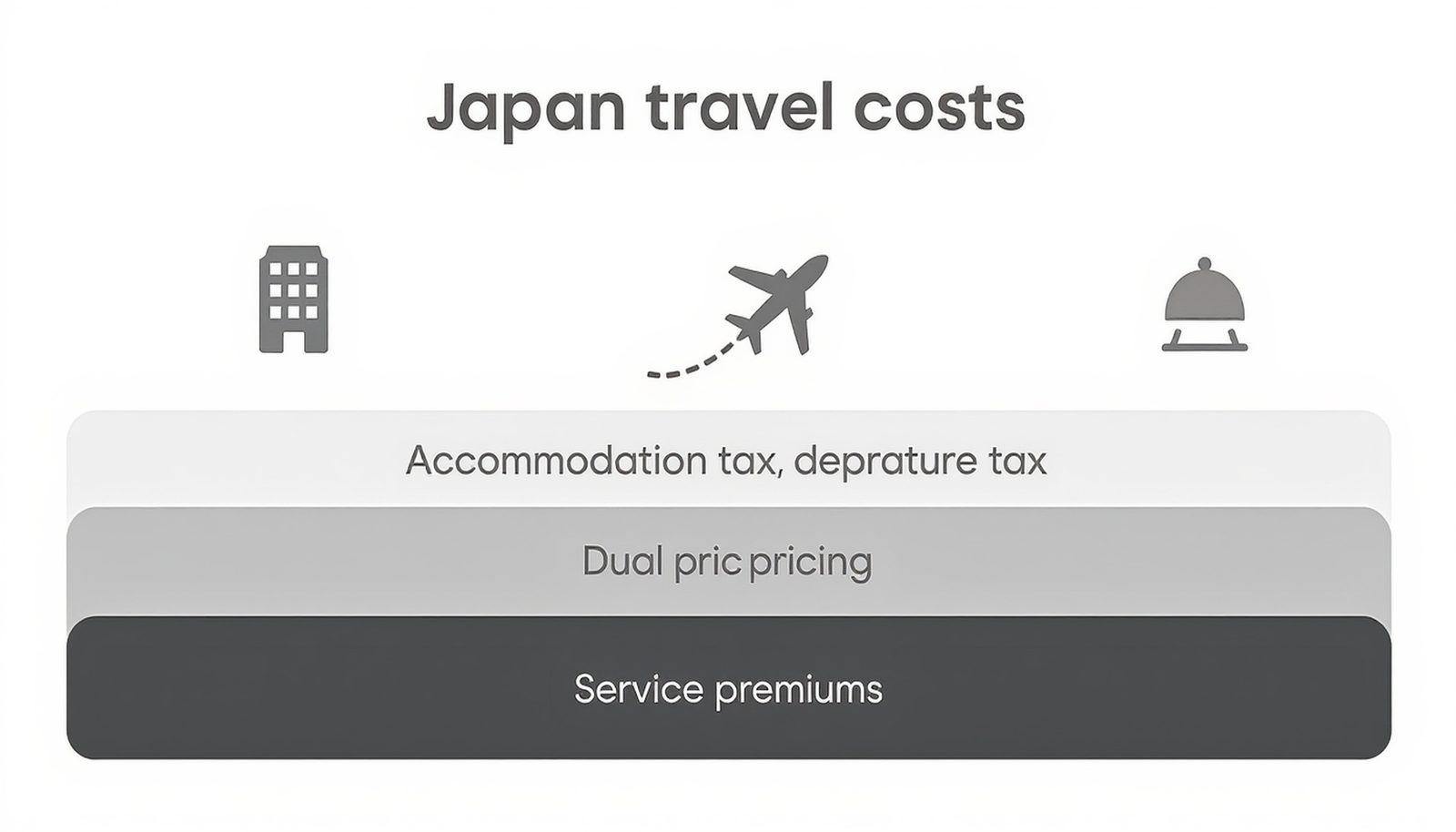
Japan’s new cost structure for visitors is built from multiple layers of charges that interact with each other. None of them alone is decisive, but together they shift the baseline cost of a trip upward.
Accommodation taxes: why Kyoto is becoming a cost outlier
Kyoto’s tiered accommodation tax is a clear example of how local policy can reshape trip economics. The mechanism is simple: the higher the nightly room rate, the higher the per-person, per-night tax. For a couple staying in a high-end ryokan, the cumulative tax can reach around $130 per night in local taxes alone.
Two features make this particularly impactful:
- Tax is often excluded from upfront booking prices: many booking platforms show base room rates and only reveal local taxes at a later stage, or at check-in. This delays full price discovery and can cause travelers to underestimate total accommodation costs when comparing cities.
- Tax is tied to price, not value: the tax does not guarantee better service or infrastructure; it is primarily a revenue tool. From a traveler’s perspective, it behaves like a surcharge on choosing central, traditional, or luxury stays in Kyoto.
Because the tax is location-specific, it creates a structural cost gap between Kyoto and nearby alternatives (for example, staying in Osaka or satellite cities and commuting in). The trade-off is clear: pay more for immersive, central Kyoto stays, or accept longer daily transit in exchange for a lower tax burden.
Departure tax and the rise of “invisible” fees
Japan’s international tourist departure tax is set to triple from ¥1,000, and it is automatically bundled into airfares. Mechanically, this works like a small, unavoidable exit toll:
- You do not see it as a separate payment at the airport.
- It is embedded in ticket prices, so it is easy to overlook when comparing Japan to other destinations.
On its own, this tax is modest. But it signals a policy direction: using air tickets as a collection point for tourism-related levies. As more such charges are layered into fares, the apparent cost of flights to Japan will increasingly reflect fiscal policy choices rather than just airline competition or fuel prices.
Dual pricing and “service premiums” for foreigners
Dual pricing at major sites (such as Himeji Castle) and 10–20% “service premiums” at foreigner-oriented venues formalize a higher price level for international visitors. The mechanism is straightforward:
- Dual pricing: different ticket prices for residents and non-residents, often justified by the idea that locals already contribute via taxes.
- Service premiums: explicit surcharges on bills at restaurants, bars, or experiences that target foreign visitors, sometimes framed as language or service fees.
Because there is no standardized national framework yet, implementation is uneven and sometimes opaque. This creates three effects:
- Budget uncertainty: travelers cannot reliably predict where premiums will apply or how high they will be.
- Behavioral steering: price-sensitive visitors may shift toward less touristy neighborhoods or venues that do not apply premiums, indirectly dispersing tourism.
- Perception risk: if surcharges feel arbitrary, they can erode the perception of Japan as transparent and fair on pricing.
From a cost-structure perspective, dual pricing and service premiums act like a targeted tax on foreign demand, especially in high-traffic areas. They raise the effective price of “must-see” experiences relative to everyday local consumption.
How these levies combine in a typical day
For a mid- to high-end traveler, a single day in 2026 might include:
- Accommodation tax (higher in Kyoto, moderate elsewhere).
- Dual-priced entry to one or two major attractions.
- A 10–20% service premium on a dinner in a tourist-heavy district.
Individually, each charge may look small. Collectively, they can push a day that would have cost $250–$300 a few years ago into the $300–$500+ range, especially once you factor in the macro forces discussed later.
Tax-free shopping overhaul: why the 10% consumption tax is now a liquidity and risk problem
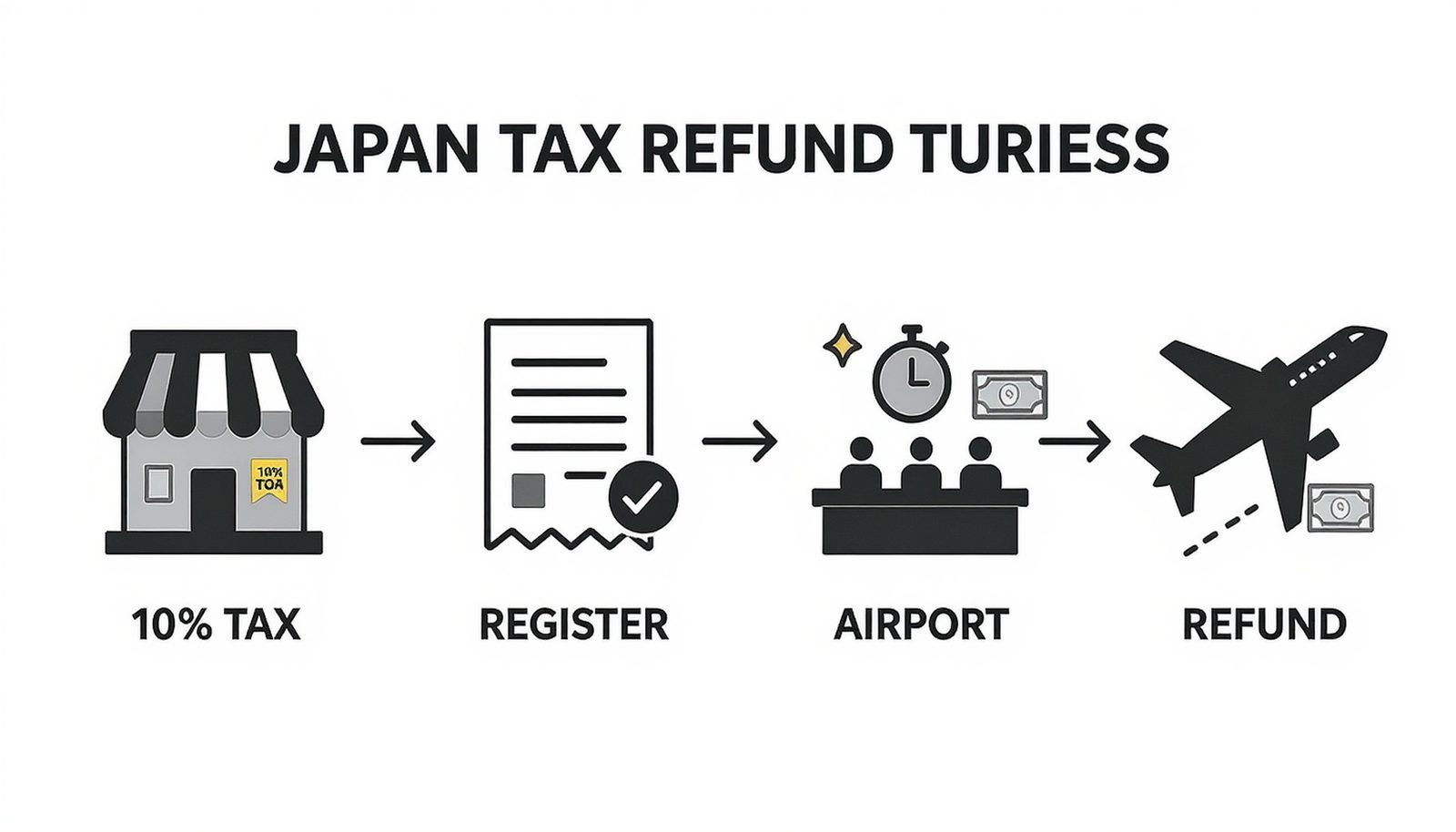
Japan’s shift away from instant tax-free shopping in November 2026 is one of the most consequential changes for visitors who plan to shop. Previously, eligible foreign tourists could have the 10% consumption tax removed at the point of sale. The new system reverses the cash flow.
From instant discount to delayed refund
Under the new model, the mechanism works as follows:
- You pay full price in-store, including the 10% consumption tax.
- Your purchases and receipts are registered into a system that tracks eligibility.
- You claim the tax back at airport refund counters when departing Japan.
This change has two major implications:
- Liquidity strain: you must front the 10% tax during your trip, which ties up cash or credit limit.
- Execution risk: if you miss the refund window, face long queues, or encounter documentation issues, the 10% effectively becomes a permanent cost.
How the 10% risk scales with your shopping profile
The impact of this change depends heavily on how much you plan to spend on goods:
- Light shoppers (souvenirs, small electronics): the absolute amount at risk is modest, but the time cost of airport queues may outweigh the refund value.
- Heavy shoppers (luxury goods, cameras, watches): the 10% tax can represent hundreds of dollars. For these travelers, the refund process becomes a critical part of trip planning.
Because there is no published, reliable data yet on average airport refund wait times or denial rates, the true probability of losing the refund is unknown. This uncertainty is itself a cost: travelers must either budget as if they will not receive the refund (treating prices as 10% higher) or accept the risk that their effective trip cost could jump if the refund fails.
Airport capacity as a hidden constraint
The new system’s success depends on the capacity of airport refund counters to handle high volumes, especially with 42–44 million international visitors projected. If processing capacity does not scale with demand, several outcomes are possible:
- Long queues that force travelers to choose between catching flights and securing refunds.
- Informal triage, where staff prioritize certain passengers or transaction sizes.
- Behavioral adaptation, with some travelers reducing shopping or shifting to online purchases shipped abroad to avoid the process.
Because these dynamics are not yet observable at full scale, they represent a significant uncertainty in 2026–2027 trip planning. A cautious approach is to treat the 10% as a potential sunk cost and view any successful refund as upside rather than a guarantee.
Visas, JESTA, and entry friction: how fixed costs reshape per-day economics
Japan’s entry policies are tightening in two main ways: higher visa fees for those who already need visas, and the phased introduction of a JESTA-style electronic authorization for currently visa-exempt travelers. These changes matter not just because they add cost, but because they alter the fixed-cost structure of a trip.
Higher short-term visa fees: moving to “Western standards”
Short-term visa fees for nationals who already require visas are being raised toward roughly ¥15,000, aligning more closely with Western visa pricing. The mechanism is straightforward: the fee is paid upfront, usually before any other major trip expenses are committed.
This has two key effects:
- Higher sunk cost: once the visa is paid for and approved, travelers are more likely to follow through with the trip, even if other costs rise.
- Per-day cost sensitivity: for short trips, the visa fee represents a large share of total cost; for longer trips, it is diluted over more days.
JESTA-style authorization: small fee, universal friction
For currently visa-exempt travelers, a JESTA-style electronic authorization is being piloted and is expected to be fully implemented from 2028. While details are still evolving, the structure is likely to resemble systems used in other regions:
- An online application with basic personal and travel information.
- A modest fee, applied per authorization (often valid for multiple trips over a set period).
- Automated checks against security and immigration databases.
Even if the fee is small, the authorization introduces a universal layer of friction: travelers must remember to apply, manage validity periods, and handle potential denials or delays. This shifts Japan away from a purely visa-free experience toward a managed-entry model.
How fixed entry costs change per-day economics
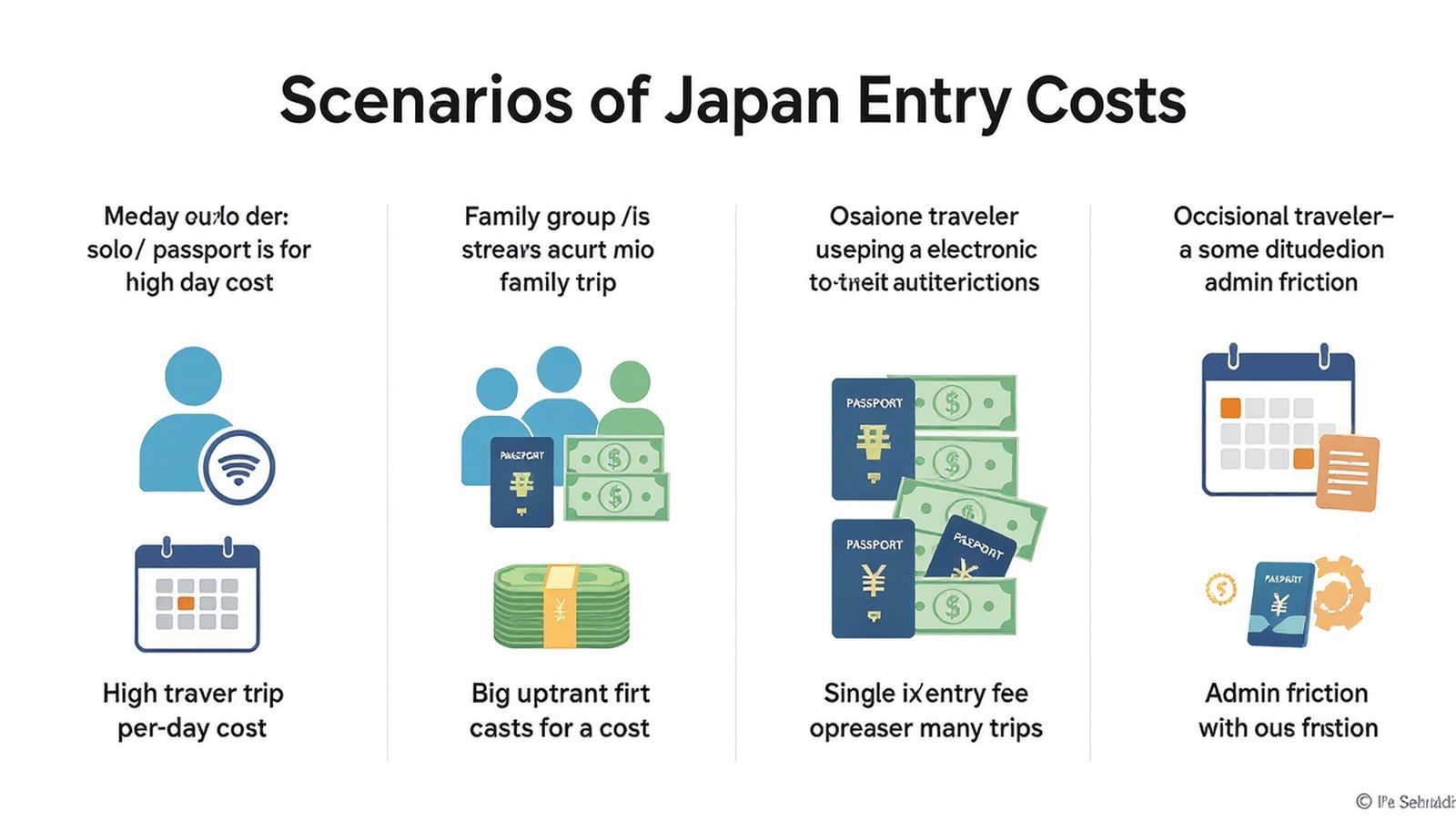
The combination of higher visa fees and future JESTA charges affects different traveler profiles in distinct ways. The table below illustrates the mechanism qualitatively, without assigning specific numerical values beyond the indicative ¥15,000 visa fee.
| Traveler type | Entry regime | Trip pattern | Cost effect per day |
| Solo, 5-day first-time visitor needing visa | Higher short-term visa fee (~¥15,000) | Single short trip | Visa fee is spread over few days, sharply raising per-day cost; entry cost is a significant share of total budget. |
| Family of four, 10-day trip needing visas | Four visas at higher fee | One longer trip | Large upfront outlay; per-day cost impact is moderate but total trip cost jumps substantially due to multiplication across family members. |
| Frequent business traveler, multiple short trips, visa-exempt | Future JESTA-style authorization | Several trips over validity period | Authorization fee is diluted over many days and trips; friction is more about administration than cost. |
| Occasional leisure traveler, 7-day trip, visa-exempt | Future JESTA-style authorization | Infrequent trips | Small fee adds modest per-day cost; main impact is the need to plan and apply in advance. |
In all cases, these entry costs are non-refundable sunk costs once paid. They do not directly improve the travel experience but are necessary to access it. As they rise, they push travelers to either extend trip length (to dilute the cost) or to compare Japan more critically against destinations with lower entry friction.
Overtourism controls: how reservations and quotas change what “expensive” means
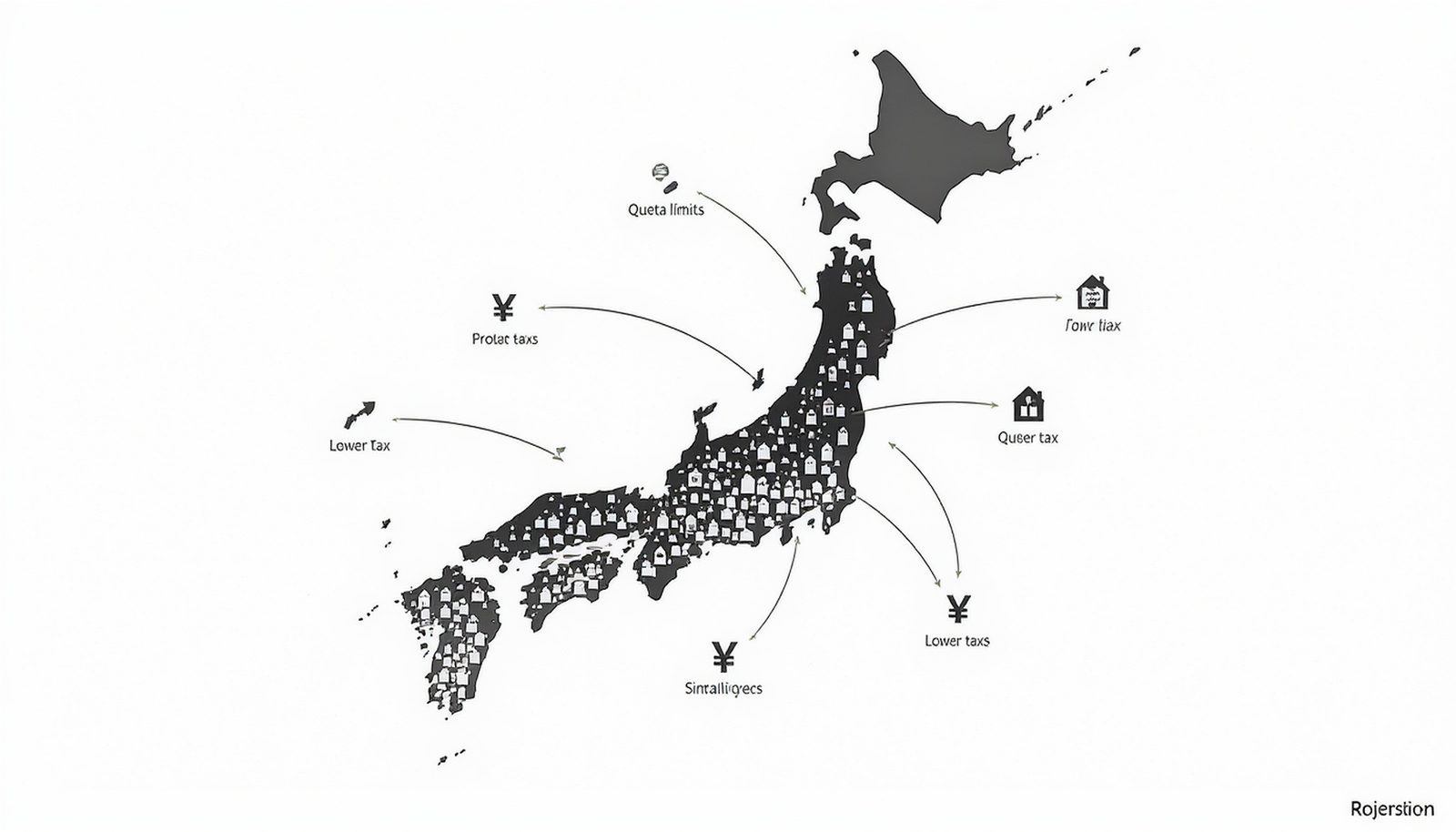
Japan’s projected 42–44 million international visitors are forcing a shift from open-access tourism to a managed-capacity model. This is not primarily about raising prices; it is about rationing access. But the way rationing is implemented has cost implications.
Timed entry, quotas, and AI crowd monitoring
At high-demand sites such as Mount Fuji and certain Kyoto temples, authorities are deploying:
- Timed-entry systems: visitors must book specific time slots in advance.
- Quotas: daily caps on visitor numbers, especially during peak seasons.
- AI-based crowd monitoring: real-time data to redirect flows or temporarily restrict access.
These tools change the nature of scarcity. Instead of scarcity being expressed mainly through higher prices (for example, surge pricing), it is expressed through limited availability and the need for early planning. The cost to travelers is measured in flexibility and time rather than just money.
Geographic dispersion and the rise of satellite cities
To relieve pressure on core hubs, Japan is encouraging geographic dispersion of tourists. This often means promoting “satellite cities” that are:
- Less crowded and more accessible on short notice.
- Less exposed to the highest accommodation taxes and service premiums.
- More reliant on regional infrastructure that benefits from additional visitor spending.
From a cost perspective, this creates a new trade-off:
- Core hubs (Kyoto, central Tokyo, Fuji access points): higher taxes, more quotas, more reservation requirements, but maximum concentration of iconic sights.
- Satellite cities and secondary regions: lower direct costs and fewer access constraints, but more time spent on intercity transport and potentially fewer “headline” attractions.
Travelers who prioritize flexibility and lower costs may increasingly design itineraries that use satellite cities as bases, dipping into core hubs for pre-booked, high-value experiences.
Seasonality and shifting cherry blossom patterns
Climate-driven shifts in cherry blossom timing—especially earlier blooms in Tokyo and Nagoya—are compressing demand into narrower windows that do not always align with traditional travel calendars. Combined with domestic holidays like Golden Week, Obon, and Silver Week, this creates:
- Shorter, more intense peaks where both prices and access constraints spike.
- Longer shoulder periods where costs and crowding are lower but weather and bloom timing are less predictable.
In this environment, “expensive” is no longer just about the sticker price of a hotel or rail pass. It also reflects the opportunity cost of inflexible dates, the risk of missing key experiences due to quotas, and the value of time spent navigating reservation systems.
Macro backdrop: how stimulus, wages, and a stronger yen interact with travel budgets
Behind these tourism-specific policies sits a broader macroeconomic story. Japan’s high public debt and expansionary fiscal stance create ongoing pressure to raise revenue, including from inbound tourism. At the same time, the Bank of Japan is expected to accelerate rate hikes toward a 1–1.5% policy rate, moving away from the ultra-low rates that kept the yen weak for years.
Rising wages and service prices
Japan is experiencing gradual wage increases, particularly in service sectors. The mechanism is straightforward: higher wages raise operating costs for hotels, restaurants, and attractions, which then pass through to higher prices. This is especially visible in labor-intensive services such as:
- Traditional ryokan stays with elaborate meals and personalized service.
- Guided tours and experiences that require multilingual staff.
- Hospitality in high-rent urban districts.
These price increases are structural rather than cyclical; they reflect a deliberate policy push to escape deflation and support household incomes. For travelers, this means that even without new taxes or fees, the underlying price level of services is drifting upward.
From weak yen discount to potential yen appreciation
For several years, a weak yen made Japan feel like a bargain for visitors paying in stronger currencies. As the Bank of Japan normalizes policy, that discount is at risk. While the exact path of the exchange rate is uncertain, the mechanism is clear:
- Higher Japanese interest rates reduce the incentive to borrow in yen and invest elsewhere.
- This can support the yen’s value relative to other major currencies.
- As the yen strengthens, prices in foreign-currency terms rise even if local yen prices stay constant.
When you combine this with rising local wages and tourism-specific levies, the total cost of a trip in your home currency becomes more volatile. A trip budgeted at $300 per day could easily drift toward $400+ if the yen appreciates and you are heavily exposed to taxed or dual-priced services.
Why daily spend estimates are shifting upward
Putting these elements together, it is reasonable to think of 2026 Japan trips in terms of new daily spend bands for mid- to high-end travelers:
- Lower band (~$300 per day): more use of satellite cities, mid-range accommodation, limited shopping, and careful avoidance of the highest tax tiers and service premiums.
- Upper band ($500+ per day): central stays in high-tax cities like Kyoto, frequent dining in tourist-heavy districts, significant shopping with uncertain tax refunds, and exposure to dual pricing at major attractions.
The key point is not the exact numbers, which will vary by currency and timing, but the direction: structural forces are pushing the distribution of daily spend upward, and policy-driven components (taxes, fees, and exchange-rate-sensitive costs) are taking a larger share.
Risks, uncertainties, and what they mean for planning
Several critical elements of Japan’s new travel regime remain uncertain or only partially defined. These uncertainties are not just abstract; they directly affect how you should interpret prices and plan budgets.
Unquantified airport refund performance
The new tax-refund system’s real-world performance is unknown at scale. Key gaps include:
- No reliable data on average wait times at refund counters during peak seasons.
- No published statistics on refund denial rates or common reasons for rejection.
- Limited visibility into how quickly capacity will be expanded if queues become problematic.
This means that the effective cost of the 10% consumption tax is uncertain. Travelers must choose between assuming a successful refund (and risking a budget overshoot) or treating the tax as a likely cost (and potentially over-budgeting).
Fluid rules around dual pricing and service premiums
Dual pricing and service premiums are emerging faster than standardized regulation. Open questions include:
- How prices will be set and whether there will be caps on foreigner surcharges.
- What transparency requirements will apply (for example, clear menu or ticket disclosures).
- Whether consumer-protection agencies will monitor and enforce against abusive practices.
Until these questions are resolved, travelers face a risk of encountering unexpected surcharges, especially in heavily touristed areas. This uncertainty complicates price comparisons between venues and between Japan and alternative destinations.
Future tourism taxes and evolving JESTA rules
Policy signals suggest that additional tourism-related levies are under discussion, and the detailed design of the JESTA-style authorization is still evolving. Potential developments include:
- New city-level or regional taxes earmarked for infrastructure or preservation.
- Adjustments to JESTA fees, validity periods, or eligibility criteria.
- Changes in how data from JESTA and AI crowd monitoring are used to manage flows.
Because these measures are not yet defined, they represent policy risk for trips planned far in advance. Travelers booking long-lead itineraries may find that the regulatory environment at the time of travel differs from what existed at the time of booking.
Trade-offs under uncertainty
In this environment, planning becomes an exercise in managing trade-offs rather than eliminating risk:
- Book early vs. wait: early booking can lock in prices in your home currency but exposes you to policy changes; waiting preserves flexibility but risks higher prices and reduced availability.
- Concentrate vs. diversify: concentrating your trip in high-demand hubs maximizes iconic experiences but increases exposure to taxes, quotas, and surcharges; diversifying across regions reduces some costs but adds transport complexity.
- Assume refunds vs. budget conservatively: assuming successful tax refunds keeps headline budgets lower but risks overruns; budgeting as if refunds fail creates a buffer but may lead to over-saving or under-spending.
There is no single optimal strategy; the right balance depends on your risk tolerance, flexibility, and the relative importance you place on specific experiences versus overall cost control.
Conclusion: Japan is still worth it—but the value equation has changed
Japan in 2026 is not the same destination that many travelers remember from the era of ultra-cheap yen and low-friction entry. Coordinated fiscal, monetary, and tourism-management changes are pushing the country toward a model where:
- Taxes, fees, and dual pricing play a larger role in shaping total trip cost.
- Access to iconic sites is increasingly rationed through reservations and quotas rather than just price.
- Macroeconomic shifts—rising wages and potential yen appreciation—erode the currency-driven discount that once offset local price increases.
For mid- to high-end travelers, realistic daily spend estimates have moved into the $300–$500+ range, with significant variation depending on city choice, accommodation tier, shopping intensity, and exposure to new fee structures. The biggest change is not simply that Japan is more expensive; it is that a larger share of your budget is now determined by policy mechanisms that can change over time and are not always transparent.
Yet the underlying value proposition remains strong. Japan still offers dense cultural experiences, high service quality, and efficient infrastructure. The shift toward a premium, managed model can even enhance the experience if it reduces overcrowding and funds preservation. The practical challenge is to recognize that the old mental model of “cheap, easy Japan” no longer applies and to design trips that explicitly account for taxes, entry friction, and macro uncertainty.
In practical terms, this means treating policy-driven costs as a core part of your planning, not an afterthought. The more clearly you understand how accommodation taxes, tax refunds, visas, JESTA, and crowd controls interact, the more effectively you can shape an itinerary that delivers high value—even in a Japan that is structurally more expensive and more complex than before.