I’ve wasted more money than I’d like to admit on bad exchange rates, hidden card fees, and those “helpful” payment screens that quietly overcharge you. If you travel internationally, chances are you’ve done the same.
The upside? Once you understand how exchange rates, foreign card fees, and dynamic pricing really work, you can stop leaking money and keep more of your travel budget for the fun stuff.
Think of this guide as your defense plan against three big budget killers:
- Currency swings and exchange-rate risk
- Foreign card and ATM fees
- Dynamic pricing and dynamic currency conversion
As you read, keep one question in mind: Where am I currently losing money without noticing?
Fixing just one or two habits can easily save you hundreds on a single trip.
1. Decide: Are You Letting Exchange Rates Control Your Trip?
Exchange rates move every day. Sometimes it’s a tiny shift. Sometimes it’s enough to make your whole trip noticeably more expensive.
If you ignore them completely, you’re basically saying, I’ll pay whatever it costs.
That’s one way to travel. It’s just not the cheapest way.
Here’s the reality behind those numbers you see online:
- The rate you see on Google is the interbank rate – the best possible rate banks use with each other, not with you.
- The rate you get as a traveler usually includes a markup plus possible fees from your bank or card network.
- Airport kiosks and tourist-zone booths often give you the worst combination of poor rates and high fees.
So how do you protect your travel budget from currency swings without obsessing over every tick of the market?
- Check the real rate a few weeks before your trip using a currency app or site. Watch how much it moves. This gives you a feel for volatility and helps you plan your travel budget around realistic numbers.
- Order a small amount of foreign cash from your bank before you go if the rate and fees are reasonable. It’s usually better than airport exchange counters and covers taxis, snacks, or tips when you land.
- Use ATMs at reputable banks once you arrive for most of your cash needs. Bank ATMs usually track closer to the market rate than street exchanges or hotel desks.
- Avoid “too good to be true” exchange booths in tourist areas. Some use confusing fee structures, bad math, or even slip in counterfeit notes. If you have to use one, count your cash slowly in front of the teller.
You don’t need to time the market. The goal is simpler: avoid the obvious traps and stop donating money to the worst exchange providers.
2. Decide: How Much Currency Risk Can Your Budget Handle?
Exchange rates don’t just change what you pay at the counter. They can quietly rewrite your entire travel budget.
If your home currency weakens, your fixed budget suddenly buys less: hotels, food, transport – everything. If it strengthens, you get a surprise discount on your whole trip. That’s the core of travel budgeting for currency fluctuations.
I treat currency swings like weather: I can’t control them, but I can pack for them.
Here’s how to build a budget that survives bad exchange-rate days:
- Add a buffer – Add 10–20% on top of your expected daily costs. If the local currency strengthens, you’re covered. If it doesn’t, you just come home with extra money.
- Stay flexible – If rates move against you mid-trip, adjust. Swap one fancy dinner for street food, or one paid tour for a free walking route. A flexible mindset beats a rigid spreadsheet every time.
- Keep a small emergency fund in local currency once you arrive. This keeps you from having to convert money at terrible rates in a rush if something goes wrong.
- Use apps to track rates before and during your trip. If you see a favorable move, it might be a good time to top up a multi-currency account, prepay a hotel, or make a larger ATM withdrawal to effectively lock in a better exchange rate.
Ask yourself: If the exchange rate got 10% worse tomorrow, what would I cut first?
Knowing that in advance makes it much easier to adapt calmly if the numbers turn against you.
3. Decide: Are Your Cards Working For You or Against You?
Most people don’t blow their budget with one huge mistake. They lose money through tiny percentage fees that hit every single transaction.
Common culprits that quietly increase your travel costs:
- Foreign transaction fees – often 1–3% on every purchase in a foreign currency. Over time, those credit card foreign fees turn into real money.
- ATM withdrawal fees – a fixed fee per withdrawal, sometimes plus a percentage, and occasionally a worse exchange rate on top.
Over a two-week trip, that can easily add up to the cost of a nice hotel night or a domestic flight.
Here’s a simple setup that helps reduce international payment fees on vacation:
- One primary credit card with no foreign transaction fees – for hotels, restaurants, tickets, and other big purchases. This is your main workhorse.
- One backup credit card – in case the first is lost, blocked, or not accepted.
- One debit card with low ATM fees – used only for planned, less frequent cash withdrawals.
Before you travel, do a quick audit of your cards:
- Check if your current cards charge foreign transaction fees. If they do, consider applying for a no-foreign-fee card well before your trip so you can avoid those hidden costs of foreign card fees.
- Ask your bank about partner banks abroad. Using their ATMs can reduce or eliminate extra charges.
- Confirm your cards are chip-enabled (and ideally contactless). Some places simply won’t accept magstripe-only cards anymore.
- Set up fraud alerts and mobile banking so you can lock a card quickly if something looks off.
One habit that saves real money: fewer, larger ATM withdrawals. If you pay a fixed fee every time, withdrawing the equivalent of $300 once is usually cheaper than $50 six times – as long as you’re comfortable carrying that amount safely.
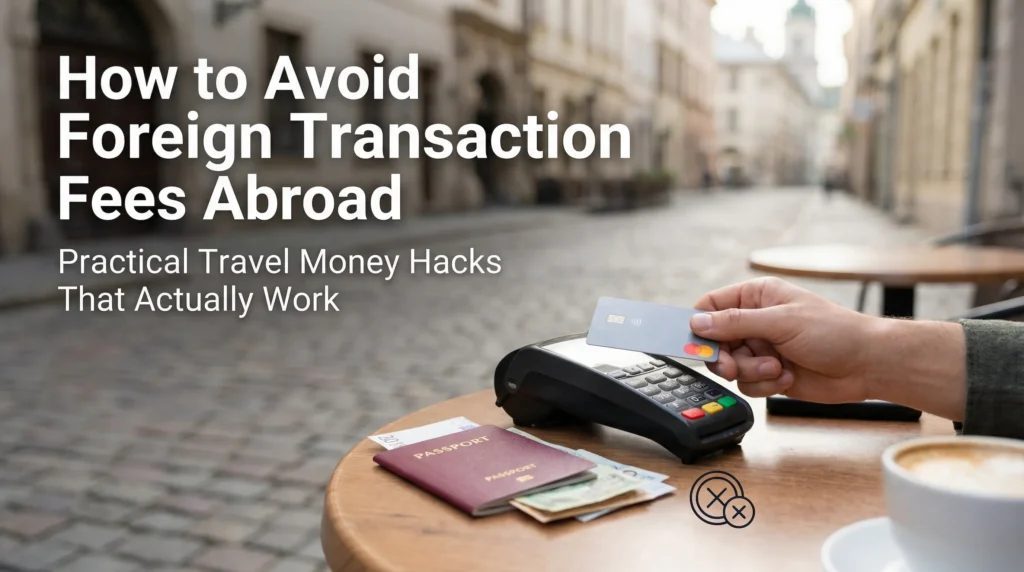
4. Decide: Will You Fall for Dynamic Currency Conversion?
This is one of the sneakiest ways travelers get overcharged, and it often looks like the merchant is doing you a favor.
You’re at a restaurant or ATM abroad. The screen asks:
Pay in your home currency or in local currency?
Paying in your home currency feels safer. You see the exact amount in dollars, euros, or whatever you use at home. But here’s the catch: that “service” is called Dynamic Currency Conversion (DCC), and it almost always uses a worse exchange rate plus extra markup.
In other words, you’re paying extra just to see a familiar number.
My rule is simple and non-negotiable: Always choose to pay in the local currency.
That way:
- Your card network (Visa, Mastercard, etc.) handles the conversion, usually at a much better rate.
- You avoid the merchant’s or ATM operator’s inflated rate and the classic DCC trap.
If a cashier tries to rush you or pre-selects your home currency, I politely insist they switch it back to local. If they “can’t,” I seriously consider walking away or using cash.
Once you start noticing DCC, you’ll see it everywhere – hotels, shops, ATMs. And once you know what it costs you, it becomes very easy to say no.
5. Decide: How Will You Balance Cash, Cards, and Apps?
Going all-cash is risky and inconvenient. Going card-only can leave you stuck at markets, small guesthouses, or in rural areas where cash is still king.
The sweet spot is a deliberate mix that fits how you actually travel.
Here’s a practical setup that works in most countries and keeps your cash vs card abroad cost comparison under control:
- Cards for big and mid-sized expenses – hotels, flights, train tickets, chain restaurants, online bookings.
- Cash for small, frequent purchases – street food, local buses, markets, tips, small cafes.
- Digital wallets and QR apps where they’re common – especially in places like China or parts of Southeast Asia where QR codes dominate daily payments.
To keep this from turning into chaos, I do three things:
- Set a daily budget in local currency based on real prices, not guesses. I look up typical costs for coffee, a basic meal, metro rides, and a mid-range dinner. Then I add a buffer for surprises.
- Use an expense-tracking app that supports multiple currencies. It doesn’t have to be fancy – just something that lets you see, in real time, how your spending compares to your plan.
- Plan ATM withdrawals around that daily budget. If I’m spending the equivalent of $60 a day and I want to withdraw once a week, I’ll take out around $450–500 in local currency, depending on my buffer and how safe it feels to carry.
This approach keeps you from constantly hunting for ATMs, over-withdrawing, or losing track of what you’re actually spending.

6. Decide: Will You Let Dynamic Pricing Push You Around?
Dynamic pricing isn’t just for airline tickets anymore. Hotels, ride-hailing apps, and even some attractions adjust prices based on demand, timing, and sometimes your behavior.
That means two people can pay very different prices for the same thing, just because one of them clicked at the wrong time or from the wrong device. How dynamic pricing affects travel costs is one of those things you only notice after you’ve overpaid.
Here’s how I push back and avoid the worst of dynamic pricing on flights and hotels:
- For flights and hotels:
- Search in incognito/private mode or use a different browser to reduce the chance of price jumps based on your search history.
- Compare prices across a few platforms, then check the airline or hotel’s own site. Sometimes direct bookings are cheaper or come with better terms.
- Stay flexible with dates and times. Shifting your trip by a day or even a few hours can make a big difference.
- For ride-hailing and local transport:
- Check if there’s surge pricing. If it’s not urgent, waiting 10–15 minutes can drop the price.
- Compare the app price with a metered taxi or public transport. The “convenient” option is often the most expensive.
- For attractions and tours:
- Look at official websites and local agencies, not just the first big platform you find.
- Check if prices differ by booking time or channel. Sometimes booking on-site is cheaper; sometimes advance online tickets are.
Dynamic pricing isn’t going away. But you don’t have to be the person who always pays the highest version of the price.
7. Decide: Will You Travel on Autopilot or With a Money Strategy?
Most people spend hours comparing hotels and almost no time thinking about how they’ll pay for those hotels. That’s backwards.
If you want to protect your travel budget from currency swings, foreign fees, and dynamic pricing, a little planning goes a long way.
Here’s a simple pre-trip checklist you can run through:
- 1–2 months before departure:
- Check exchange rate trends for your destination and get a feel for the risk.
- Apply for a no-foreign-transaction-fee card if you don’t have one, so you can avoid foreign transaction fees when traveling.
- Ask your bank about international ATM fees and partner banks.
- Decide on your daily budget (with a buffer) based on real local prices.
- 1–2 weeks before departure:
- Order a small amount of foreign cash if it’s cost-effective. Compare bank vs airport exchange rates so you don’t overpay at the last minute.
- Set up mobile banking, alerts, and any travel notifications for your cards.
- Install a currency converter and an expense-tracking app – two simple international travel money saving tips that actually work.
- During the trip:
- Always pay in local currency, not via dynamic currency conversion. When in doubt, choose local currency over DCC.
- Use cards for larger purchases, cash for small ones.
- Make fewer, larger ATM withdrawals from reputable bank ATMs.
- Watch your daily spend against your budget and adjust early if needed.
You don’t need to obsess over every cent or try to perfectly lock in the exchange rate before your trip. But a few deliberate decisions about currency exchange, card fees, and pricing can turn your trip from more expensive than I expected
into actually, I came in under budget.
In the end, the choice is simple: travel on autopilot and pay whatever the system asks, or travel with a money strategy and keep that cash for the experiences you actually care about.