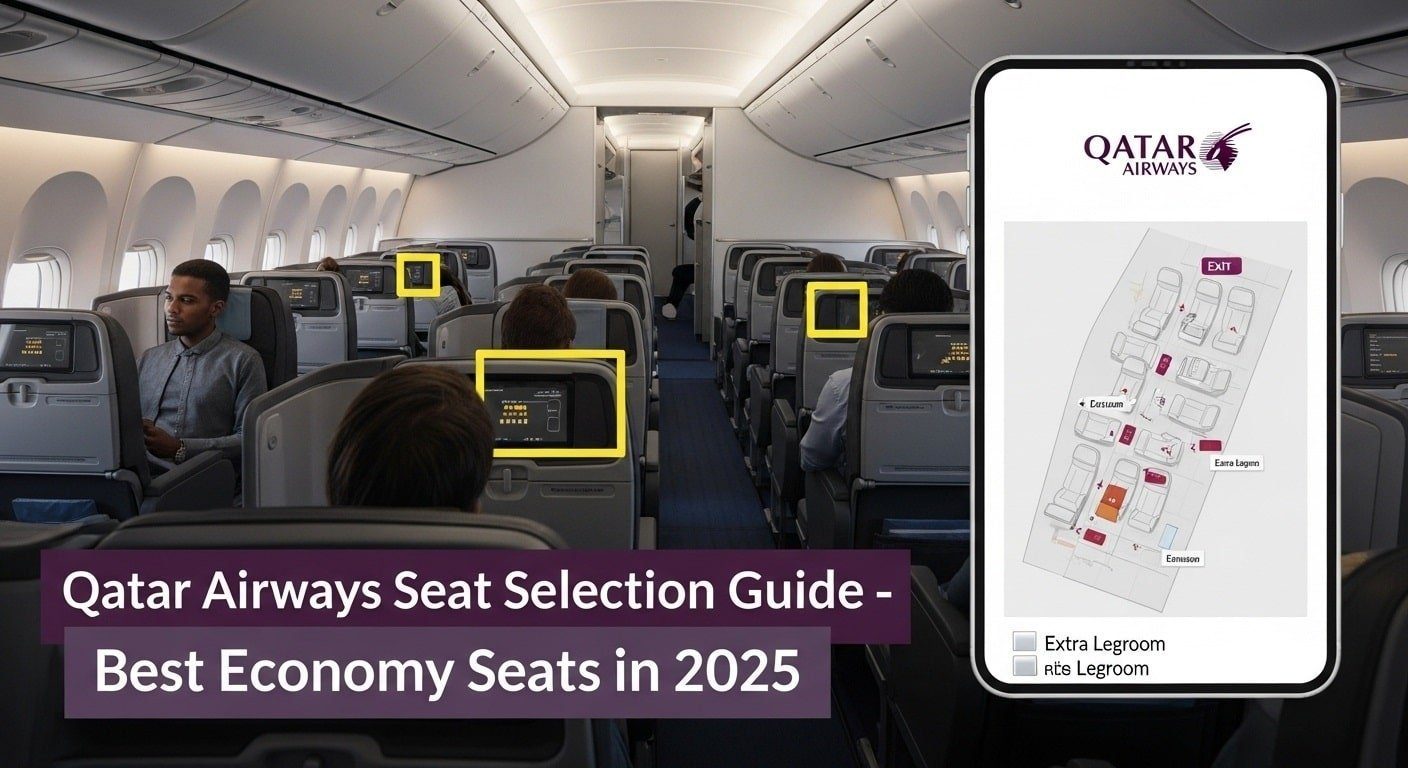
Choosing Your Framework: Base Fare vs. Seat Fees as an Economic Decision
For Qatar Airways economy passengers, seat selection is no longer just about comfort. It is now a pricing tool that decides how much risk and planning work you take on. The airline uses an unbundled model: the base fare buys transport, while comfort and predictability sit behind extra seat fees.
This article fits the Cost Guide category. I focus on how Qatar’s seat selection system works in practice, what trade-offs you face, and how to make decisions when prices are incomplete and not very transparent.
Qatar’s economy fares fall into families (often Lite, Classic, Convenience, Comfort). The cheaper the fare family, the more limits you face and the fewer free services you get. Seat selection is one of the clearest levers:
- Economy Lite: usually no free advance seat selection. You either pay per seat or wait until online check-in, when some standard seats may become free.
- Economy Classic / Convenience: some or full access to standard seats in advance. You still pay for preferred, extra-legroom, and other high-demand seats.
- Economy Comfort and premium cabins: wider or fully free seat selection, especially for standard and many preferred seats.
The economic problem is simple: Qatar does not publish clear, stable price ranges for each seat type. Fees change by route, aircraft, timing, and demand. You must decide under uncertainty and use a framework instead of exact numbers. The rest of this article turns that framework into concrete trade-offs.
Trade-Off 1: Cheapest Fare vs. Paying for Seats Later
Your first big choice is this: buy the lowest fare (often Economy Lite) and add seat fees later, or pay more upfront for a higher fare family that includes some seat benefits. This is a trade-off between visible savings now and hidden costs and risk later.
Because Qatar’s seat fees are dynamic and not transparent, you cannot find a precise break-even point in advance. Instead, treat the fare difference as a bundled seat package. Then compare that bundle to a few realistic seat fee scenarios.
| Decision Dimension | Economy Lite + Paid Seats | Higher Fare (Classic/Convenience) |
| Upfront ticket price | Lower | Higher |
| Advance standard seat selection | Usually paid | Often included or discounted |
| Flexibility (changes/refunds) | More restricted | More flexible |
| Risk of family separation | Higher if you wait for free seats | Lower; more seats available earlier |
| Complexity of decision-making | Higher; must monitor seat map and fees | Lower; more is pre-included |
In real trips, the Lite option tends to work best for:
- Solo travelers who do not mind where they sit.
- Short-haul flights where comfort matters less.
- Off-peak departures where the cabin is likely less full.
Higher fare families are usually safer when:
- You travel as a family or group and need to sit together.
- The flight is long-haul or overnight, so seat quality strongly affects comfort.
- You also care about flexibility for changes and cancellations, not just seats.
The key economic point: Qatar uses seat fees to make the cheapest fare look attractive while pushing uncertainty onto you. If you guess future seat costs too low, or assume too many free seats at check-in, the Lite fare can end up costing more overall than a higher fare that already included seat selection.
Trade-Off 2: Paying Early for Seats vs. Waiting for Free Check-In Assignment
After you pick a fare family, the next choice is timing. Do you pay for seats early, or wait until online check-in (usually 48 hours before departure) when some standard seats may become free? This is a trade-off between certainty and option value.
Qatar uses seat fees as a yield management tool. High-demand seats (front of cabin, exit rows, bulkhead, quiet zones) go on sale early. Standard seats may stay blocked for sale and then appear for free closer to departure if the cabin is not full. This creates three main scenarios:
- High-load flights (peak dates, popular routes): Many people pay for seats early. Free seats at check-in are few and often poor (back of cabin, middle seats).
- Moderate-load flights: Some standard seats remain unsold. At check-in you may see a decent range of free standard seats, but prime spots still cost money.
- Low-load flights (off-peak, midweek): More standard seats may be free at check-in. Paying early has less value.
Qatar does not share load factors or clear rules for when it releases seats. You cannot know your exact scenario. But you can read the context and estimate risk:
- Peak holidays, big events, and Friday/Sunday departures are more likely high-load.
- Midweek flights outside school holidays are more likely moderate or low-load.
- Ultra-long-haul and hub-to-hub routes tend to fill earlier than short regional legs.
Economically, paying early for seats is like buying insurance. You pay a fee to avoid bad outcomes: separation from your group, middle seats, or seats far from lavatories or bassinets.
For solo travelers on non-peak flights, waiting often has high option value. You may get a decent standard seat for free at check-in. For families, the downside of waiting is much bigger. Being split up is not just uncomfortable; it affects childcare and safety. In that case, paying early for at least one adult and one child to sit together is a practical choice, even if you do not know the exact fee pattern.
Trade-Off 3: Standard vs. Preferred vs. Extra-Legroom Seats
Qatar divides economy seats into groups: standard, preferred (front or more desirable spots), extra-legroom (exit rows), bulkhead, and bassinet positions. Each group has its own fee level and value. The question is not only whether a seat is better, but whether the extra comfort is worth the extra cost on your specific flight.
Because Qatar does not publish stable price ranges, you need to think in relative terms:
- Standard seats: The basic product. You may pay for advance selection depending on fare family and timing, but these seats often become free at check-in.
- Preferred seats: Usually closer to the front or in quieter areas. They cost more than standard seats because they offer faster exit and a sense of higher comfort.
- Extra-legroom / exit row: The highest fees in economy. These seats sell physical space and easier movement.
- Bulkhead / bassinet seats: Often controlled due to safety and infant rules. They may be sold or held for certain passengers.
This trade-off matters most on long-haul flights. On a short regional hop, extra legroom has limited value. On a 12-hour overnight flight, it can change how well you sleep and how you feel on arrival. But because fees are opaque, you cannot easily judge if Qatar’s premium for these seats is high or low compared with other airlines.
A simple way to decide is to label your flight as comfort-critical or comfort-neutral:
- Comfort-critical flights: overnight, ultra-long-haul, flights after a workday, or when you must function on arrival. Here, paying for extra-legroom or a preferred seat can make sense as a productivity or health cost.
- Comfort-neutral flights: short daytime legs or leisure trips with rest time at the end. Here, standard seats usually work fine. Paying for preferred seats is more about peace of mind than real need.
Qatar’s tiered system also links to loyalty status. Elite members often get free access to better seats. In that case, you pay with loyalty and repeat business instead of cash on each flight. If you fly Qatar often, building status can be another way to reach preferred seating without constant seat fees. But this only works if you commit to Qatar and its partners over the long term.
Trade-Off 4: Loyalty Status and Fare Families vs. One-Off Seat Purchases
Qatar’s seat selection economics sit inside a wider access ladder. Premium cabins and higher-status loyalty members get more free seat options. Non-elite economy passengers face more fees and more uncertainty. This leads to a bigger question: do you invest in loyalty and higher fare families, or treat each trip on its own and just pay seat fees when needed?
From an economic view, loyalty status is a kind of prepayment. You focus your flying on Qatar (or its alliance partners) and accept possibly higher fares or less choice. In return, you get future benefits, including better seat access. The value of this plan depends on:
- Frequency of travel: Occasional travelers rarely reach or keep status levels where seat perks matter.
- Route network fit: If Qatar’s network matches your usual routes, loyalty makes more sense. If not, you may overpay compared with other airlines.
- Alternative uses of flexibility: Committing to one airline can stop you from choosing cheaper or more convenient flights elsewhere.
For most infrequent travelers, the smart move is to treat each trip as its own puzzle. Pick the fare family and seat plan that gives the lowest total cost and risk for that one itinerary, instead of chasing status.
For frequent travelers, especially when an employer pays for tickets, loyalty status can be a cost-effective way to secure better seats. You avoid paying seat fees yourself, but you still get the comfort.
Third-party agents that offer seat management add another layer. They may include seat advice and booking in their service. But they can also add markups and push upsells. Economically, you outsource complexity and lose some transparency. You may not see the real seat fees or know if the agent’s advice matches your cost limits or their commission goals.
Risk and Uncertainty: What You Cannot See in Qatar’s Seat Fee System
Qatar’s seat selection model hides several key details, and these gaps affect your choices. You face price uncertainty and policy uncertainty at the same time.
1. Lack of transparent price bands
There is no stable public table of seat fees by route and seat type. Prices only appear inside a live booking. You cannot build a reliable cost model or compare Qatar’s seat pricing with other airlines in a clean way. You cannot easily answer questions like: “Is Qatar’s extra-legroom seat premium higher or lower than Emirates on this route?”
2. Dynamic pricing and load factors
Seat fees seem to react to demand and timing, but the rules stay hidden. You do not know when standard seats will become free, or how close to departure fees might rise or fall. This makes timing your purchase hard. Waiting might save money or leave you with bad seats. Paying early might lock in a higher price than you needed to pay.
3. Policy handling of disruptions
Public details are limited on how Qatar treats paid seats when schedules change, aircraft swap, or you get rebooked without choice. Key questions include:
- Do you get seat fees back automatically if your chosen seat disappears?
- Do they move you into an equivalent seat type without extra payment?
- How do they handle group seating after disruptions?
Without clear and consistent rules, you cannot fully judge the risk of losing both your seat and your fee when things go wrong.
4. Family and group separation risk
There is no hard data on how often families split up when they rely on free check-in seats. Airlines often say they try to seat families together, but this is not a firm promise. On busy flights, many seats are already sold to people who paid. For families, this uncertainty is a major reason to buy seats early, even when fees feel high.
5. Competitive comparison gaps
Without systematic comparisons to other full-service airlines, it is hard to know if Qatar’s seat fee structure is aggressive or moderate. The premium brand may make you expect more inclusive pricing than you actually get. In practice, the unbundled model brings Qatar closer to low-cost carrier behavior in economy, but without the same level of clear price display.
Because of these gaps, even a careful, informed traveler cannot fully optimize seat choices. Instead, you rely on simple rules: avoid the very cheapest fare when group seating is crucial, pay early on peak flights, and treat extra-legroom seats as a premium buy only on comfort-critical legs.
Practical Decision Framework: How to Minimize Total Cost Under Opaque Seat Fees
Given the lack of transparency and dynamic pricing, the best approach is to use a decision framework, not chase perfect numbers. Aim to minimize your total cost of travel (fare + seat fees + risk), not just the ticket price.
Step 1: Classify your trip type
- Solo, flexible, short-haul: focus on a low base fare. Consider waiting for free standard seats at check-in, unless you travel at peak times.
- Family or group, any distance: avoid the most restrictive fare if it blocks advance seat selection. Plan for at least some seat fees.
- Long-haul or overnight: treat seat comfort as part of the core product. Consider higher fare families or targeted purchase of preferred or extra-legroom seats.
Step 2: Estimate your risk tolerance
- Low risk tolerance (you want certainty and dislike surprises): pay for seats early or choose a fare that includes them. Treat the extra cost as insurance.
- High risk tolerance (you accept uncertainty): use Economy Lite on off-peak flights and rely on check-in for free standard seats. Accept the chance of less desirable seats.
Step 3: Use timing and context as proxies for load
- Assume high load on holidays, weekends, and big event dates. Pay earlier for seats if sitting together or avoiding middle seats matters to you.
- Assume lower load on midweek, off-peak flights. Waiting for check-in may work better here.
Step 4: Decide where to spend, not whether to spend
Under Qatar’s model, many economy passengers will pay something, either in money or in risk. The key is to spend where it helps most:
- For families: spend first to keep at least one adult with each child, rather than upgrading every seat to preferred.
- For long-haul solo travelers: spend on extra-legroom or a good window or aisle seat on the longest overnight leg, not on short connections.
- For frequent travelers: check if focusing flights on Qatar to build status could offset future seat fees, but only if the routes and fares still make sense.
Step 5: Reassess at check-in
Even if you skip seat fees at booking, check the seat map again at online check-in. Qatar may release more standard seats for free. You may also find that a small fee at this stage buys a much better seat than the automatic assignment. Treat check-in as a second decision point, not just a formality.
Conclusion: What Qatar’s Seat Fees Reveal About Airline Fee Transparency
Qatar Airways’ seat selection model shows how airlines use unbundled pricing to advertise low base fares while charging extra for comfort, predictability, and control. For the airline, this is economically logical. It pulls more revenue from passengers who will pay more and shifts planning work and risk to you.
For travelers, the main problem is not just that seat fees exist. The real issue is the lack of clear and predictable rules. Without stable price bands, clear disruption policies, or visibility into how seats open up by load, you cannot fully optimize your choices. You have to lean on simple, structured rules instead.
If you understand these economics, you still pay fees, but you choose them more deliberately. By looking at total trip cost and putting a clear value on certainty, comfort, and flexibility, you can move through Qatar’s seat selection system with fewer surprises and a better sense of what you pay for—and why.