I’ve lost count of how many “bargain” stays turned out to be anything but. A $120 hotel room that quietly becomes $170. An Airbnb that looks cheaper than a hotel until you see the cleaning fee, service fee, and taxes stacked on at checkout.
If you’ve ever stared at your final bill thinking, Wait, how did it get this high?
this guide is for you. Let’s walk through the real costs hiding behind cheap-looking prices, how new U.S. rules are changing (and not really changing) things, and the quick checks I now run before I book anything.
1. The Illusion of the Cheap Nightly Rate
When I compare hotels or Airbnbs, the first number I see is almost always a lie. It’s not illegal; it’s just incomplete.
In the U.S. especially, the headline nightly rate often excludes:
- Resort / destination / amenity fees
- Multiple layers of hotel or occupancy taxes
- Mandatory service fees (on platforms like Airbnb)
- Parking, which can be priced like a second room
On paper, a $150 hotel can look cheaper than a $170 one. But once you add a $35 resort fee, 17–19% tax, and $40 parking, that “cheaper” option can easily become the most expensive choice on your shortlist. This is where a proper hidden hotel fees breakdown matters more than the big bold price on the search page.
From my own trips and from data in guides like this breakdown of U.S. hotel fees, a simple rule of thumb has emerged:
In many major U.S. cities, mentally add 15–20% (or more) to any hotel’s base rate to get closer to the real cost.
For short-term rentals, I do something similar: I ignore the nightly rate and look only at the total before taxes
and then the total with taxes and fees
. That’s the only number that matters if you want the true cost of cheap accommodation, not just the marketing version.
2. Resort & Destination Fees: The Price of “Free” Amenities
Resort fees are one of the most frustrating travel inventions of the last decade. They’re mandatory, often poorly explained, and they rarely feel like a good deal.
These fees typically cover things like:
- “Premium” Wi‑Fi (which you assumed was included)
- Gym and pool access
- Beach towels, bike rentals, or “local discounts”
- Daily bottled water or coffee
Destinations like Las Vegas, Orlando, Hawaii, and many beach cities are notorious for this. You might see a room for $99, but the resort fee is $45 plus tax. Suddenly your “cheap” room is effectively $150+ before you even add regular taxes. That’s your resort fees cost per night quietly reshaping the bill.
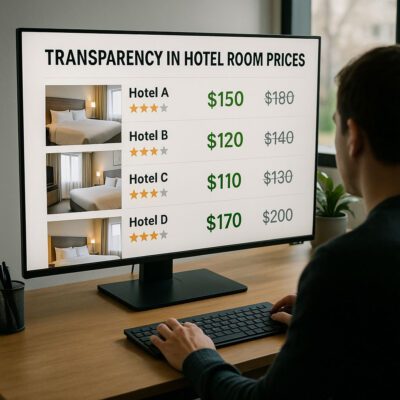
Recent U.S. rules are trying to fix the transparency problem. The FTC now requires hotels and short-term rentals to show all mandatory fees upfront in the advertised price, and the proposed Hotel Fees Transparency Act of 2025 aims to lock this into law nationwide.
But here’s the catch: the rules focus on disclosure, not elimination. The fees don’t go away; they just become harder to hide. So you still need to be vigilant if you’re trying to avoid resort fees and other surprise charges on your hotel bill.
How I handle resort/destination fees now:
- Filter them out: On many booking sites, you can sort by “total price” instead of nightly rate. I always do this.
- Check the fee list: Before I book, I scroll to the fee breakdown and look specifically for “resort,” “destination,” or “amenity” fees.
- Ask myself:
Would I pay this much for these amenities if it were optional?
If the answer is no, I keep looking.
3. Taxes, Parking & City-Specific Gotchas (Example: Austin)
Taxes and parking are the quiet killers of a hotel budget. They’re not sexy, but they add up fast.
Take Austin, Texas as a concrete example. The city has one of the highest hotel tax stacks in the state. According to this detailed Austin hotel fee guide, you’re often looking at:
- 6% state hotel occupancy tax
- 9% City of Austin hotel tax
- 2% venue project tax
- + 2% TPID fee at larger hotels (100+ rooms)
That’s 17–19% on top of the base rate. So a $250/night downtown room for three nights:
- Room: $250 × 3 = $750
- Tax (19%): about $142.50
- Total before any fees or parking: $892.50
Now add:
- Resort/amenity fee: say $30/night × 3 = $90
- Parking: $45/night × 3 = $135
Your $750 stay is suddenly over $1,100. Same room, same dates, completely different reality. This is the kind of cheap hotel price vs final cost gap that catches people off guard.

My personal rules for cities with high taxes and parking fees:
- Always calculate tax on the full room rate before you get attached to a property.
- Check parking: is it free, self-park, valet only, or “nearby public parking” (which usually means expensive)?
- Consider smaller hotels or neighborhoods just outside the core; they often have slightly lower tax rates and free or cheaper parking.
This isn’t just Austin. New York City, many California cities, and major convention hubs all have their own tax stacks and parking traps. I now assume that city-center hotels will cost significantly more than their base rate suggests and budget accordingly. If you’re building your own accommodation hidden fees guide, city taxes and parking deserve their own line.
4. Security Deposits & Card Holds: The Invisible Budget Trap
One cost that doesn’t always show up in the “total price” is the security deposit or card hold. It’s not a fee (you usually get it back), but it can quietly wreck your cash flow on a trip.
Here’s how it typically works:
- The hotel or host places a hold on your card at check-in (say $100–$300 per stay, sometimes more).
- The money isn’t charged, but your available credit limit drops.
- The hold can take several days to release after checkout.
If you’re traveling with a low-limit card, a prepaid forex card, or multiple overlapping stays, these holds can block a big chunk of your usable money. I’ve seen travelers arrive in a new city only to realize their card is “maxed” because of stacked holds, not actual spending.
What I do now:
- Check the deposit policy before booking. It’s usually buried in the “important information” or “house rules” section.
- Use a higher-limit credit card for hotels and car rentals, and keep a separate card for daily spending.
- If I’m using a forex card, I overfund it or keep a backup card in case holds are higher than expected.
It’s not just about avoiding unexpected charges; it’s about making sure you don’t get stranded with a card that suddenly stops working when you need it most.
5. Airbnb Cleaning Fees: What You’re Really Paying For
Let’s talk about the most controversial line item in the short-term rental world: the cleaning fee.
On Airbnb and similar platforms, the cleaning fee is:
- Charged once per stay (not per night)
- Shown as a separate line item from the nightly rate
- Included in the “total price” you see in search results (prorated per night)
Hosts are supposed to set this fee based on real turnover costs: cleaner wages, supplies, laundry, trash removal, and the time it takes to reset the property between guests. Guides for hosts, like this breakdown of cleaning cost basics and this deep dive on cleaning fees, all say the same thing: Price it to cover your actual costs.
From a guest’s perspective, though, cleaning fees can feel unfair when:
- The fee is very high relative to the nightly rate (e.g., $80 cleaning on a $90/night stay).
- You’re staying only one night, so the fee isn’t spread over multiple nights.
- The host still expects you to do a long list of chores at checkout.
So when people ask for Airbnb cleaning fees explained, this is usually what they mean: why am I paying so much, and what do I actually get?
How I evaluate cleaning fees now:
- Look at the total for your exact dates. A $60 cleaning fee on a 5‑night stay is $12/night. On a 1‑night stay, it’s brutal.
- Compare similar listings. If one place has a $150 cleaning fee and others in the same area are around $60–$80, I ask why.
- Read the house rules. If I’m paying a high cleaning fee and still expected to strip beds, start laundry, mow the lawn (kidding, but sometimes it feels like it), I move on.
One more nuance: in some markets, hosts are advised to fold cleaning costs into the nightly rate instead of charging a separate fee, especially if competitors don’t use cleaning fees. So a place with “no cleaning fee” might just have a higher nightly rate. Again, the only number that matters is the total.
6. Airbnb Service Fees, Host Fees & Platform Cuts
Even when you think you’ve understood the nightly rate and cleaning fee, there’s another layer: platform fees.
Airbnb uses two main models:
- Split-fee model: Host pays ~3%, guest pays ~14–16.5% service fee.
- Host-only model: Host pays ~15.5% (often when using a Property Management System, or PMS).
In the split-fee model, you as the guest see a higher total price because of the guest service fee. In the host-only model, the host pays more, but they may adjust their nightly rate upward to compensate. Either way, the platform is taking a significant cut of the booking.
From a host’s perspective (as explained in this 2026 fee breakdown), these fees can eat nearly 19% of gross booking value once you add PMS charges. That pressure often flows straight into higher prices for guests.
What this means for you when you book:
- Don’t obsess over the nightly rate; compare the final total between similar listings.
- Be aware that stricter cancellation policies can sometimes add extra platform fees, which may be baked into the price.
- If you’re staying longer or booking multiple units, consider whether a direct booking with a reputable property manager (if available) offers a better total price and clearer fee structure.
When you add up service fees, cleaning charges, and taxes, you start to see the real cost of budget travel stays on platforms like Airbnb, not just the cute nightly rate in the search results.
7. How to Compare “Cheap” Options Like a Pro
So how do you actually compare a “cheap” hotel with a “cheap” Airbnb without getting burned? I use a simple, repeatable process that turns a messy hotel vs Airbnb total price comparison into something you can judge in a minute or two.
Step 1: Ignore the headline price.
I scroll straight to the total price
for my dates, including taxes and fees. If a site doesn’t show this until the last step, I go that far before I decide.
Step 2: List the hidden extras.
- Hotel: resort/destination fee, parking, Wi‑Fi (if not included), breakfast, late checkout.
- Airbnb: cleaning fee, service fee, extra guest fees, pet fees, parking, local taxes.
Step 3: Adjust for your actual behavior.
- If you won’t use the gym, pool, or “resort activities,” a high resort fee is pure waste.
- If you’re driving, expensive parking can kill a good deal.
- If you’re staying one night, a big cleaning fee hurts more than on a week-long stay.
Step 4: Factor in deposits and card holds.
I check how much will be held on my card and for how long. If I’m traveling with tight credit limits, this can be the deciding factor.
Step 5: Decide based on total value, not just total price.
Sometimes the slightly more expensive option is actually better value: no resort fee, free parking, breakfast included, flexible cancellation, or a host with stellar reviews and clear house rules.
When I follow this process, the “cheapest” option on the search page is rarely the one I end up booking. And that’s the point. It’s how you avoid those unexpected charges in vacation rentals and budget hotel hidden costs that show up after you’ve already mentally committed.
8. The Bottom Line: Don’t Let Junk Fees Plan Your Trip
Hidden fees aren’t going away overnight. New rules in the U.S. are forcing hotels and platforms to be more honest about pricing, but they’re not banning resort fees, cleaning fees, or service charges. The responsibility to see through the marketing still sits with us.
If you remember nothing else, remember this:
- Always compare total price, not nightly rate.
- Watch for resort/destination fees, cleaning fees, and parking.
- Check deposit and hold policies before you swipe your card.
- Ask yourself if the extras match how you actually travel.
The real cost of “cheap” accommodation is rarely obvious at first glance. But once you know where the traps are—resort fees, city taxes, parking, Airbnb service and cleaning charges, and all the other extras—you can turn that skepticism into savings and spend your money on the parts of travel that actually matter to you.