
I don’t care how seasoned a traveler you are – a “$89/night” hotel can still turn into a $160/night gut punch at checkout. I’ve watched it happen to smart people who thought they were getting a steal. The problem isn’t just resort fees. It’s cleaning charges, parking, breakfast, taxes, and one big mistake: picking the wrong location because the map looked close enough.
These days, when I’m hunting for an affordable hotel, I look at the total cost of a hotel stay, not the headline price. I care about what I’ll actually pay once all the hidden hotel fees and charges show up. In this guide, I’ll walk you through how I evaluate “cheap” hotels now, how I avoid the worst cheap hotel traps for travelers, and when a higher sticker price is secretly the better deal.
1. The $89 Room That Becomes $160: Why Base Rates Are a Trap
When I compare hotels now, I ignore the big bold price for as long as possible. That number is marketing, not math.
Here’s what usually happens with a cheap
room:
- Advertised nightly rate: $89
- Hotel tax (say 15% in a big city): +$13.35
- Resort/destination fee: +$35
- Parking (urban hotel, self-park): +$30
- Breakfast for 2 at the hotel: +$40
Suddenly your $89 room
is flirting with $207.35 per night before you’ve even opened the minibar. That’s more than double the headline rate.
Articles and calculators like the Hotel Cost Estimator and simple hotel cost calculators all point to the same reality: once you add taxes, resort fees, parking, and meals, your bill often jumps 30–50% above the base rate – sometimes more in big cities.
The mental shift is simple: the base rate is just one line item. If you want a real budget hotel cost breakdown, you have to look at the all-in nightly cost for how you actually travel, not how the hotel wants you to think you’ll travel.
2. Resort Fees: The Mandatory Charge You Didn’t Ask For
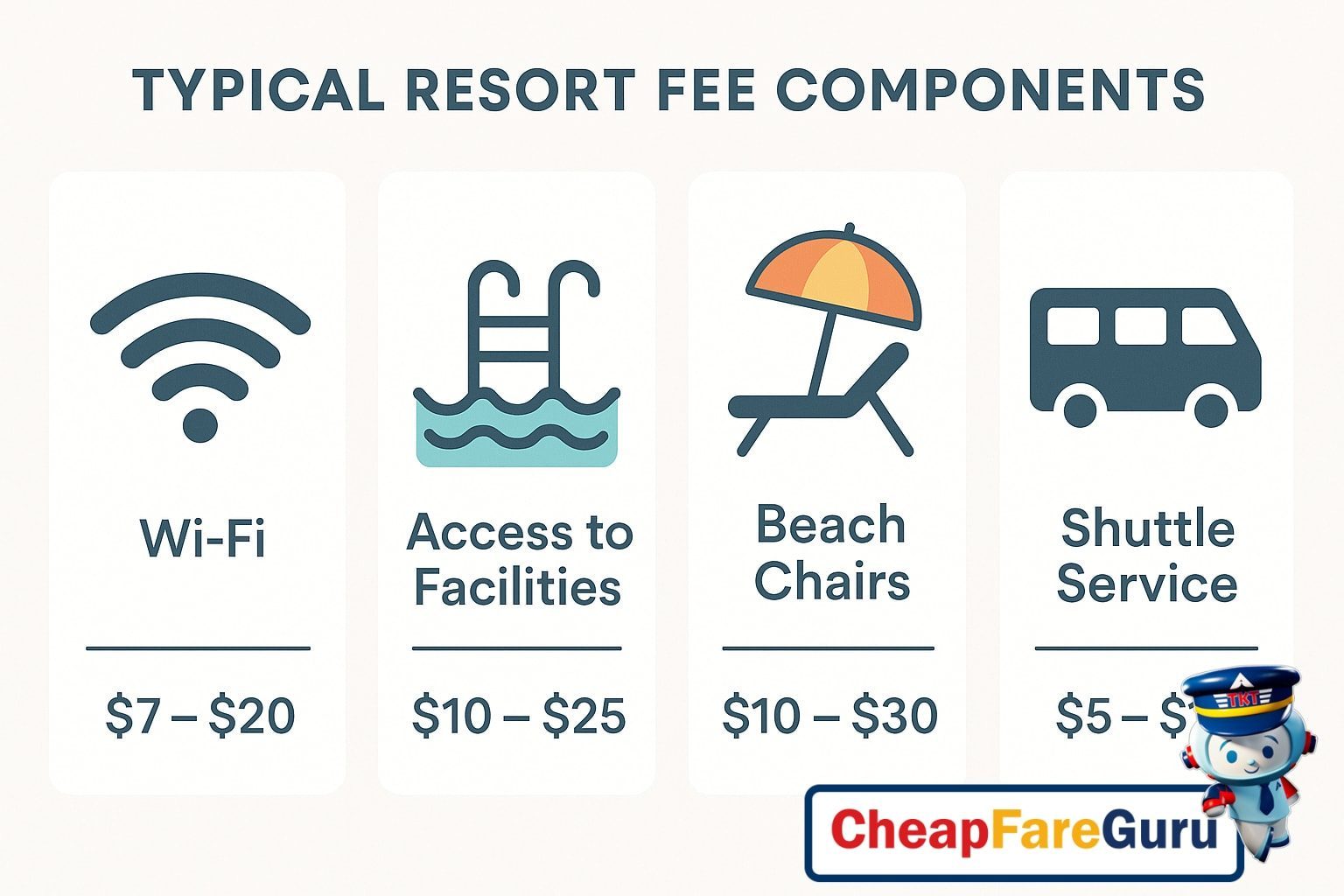
Resort fees are the most infuriating part of modern hotel pricing. They’re mandatory, nightly, and often buried until the last booking step. You’ll see them called resort fee
, destination fee
, facility fee
, or some other creative label.

Here’s what matters, not the marketing spin:
- They’re mandatory. You pay them whether or not you use the pool, gym, or Wi‑Fi.
- They’re nightly. A $35 fee over 5 nights is $175 – that’s a whole extra night somewhere else.
- They’re not taxes. They go straight to the hotel and are not standardized.
- They’re often hidden late. Many chains only show them clearly at the final booking step.
According to coverage like Travel + Leisure’s breakdown of resort fees, the average fee among hotels that charge them is around $33 per night. Other analyses show ranges from under $10 to over $100 per night in places like Las Vegas or Miami.
My rule now is blunt: if a hotel charges a resort/destination fee, I add it straight into the nightly rate in my head. A $120 room with a $35 fee is a $155 room. Period. That’s the real cost of a cheap hotel. Then I compare that $155 to other hotels that might look more expensive at first glance but don’t play the fee game.
Can you ever avoid them? Sometimes:
- Top-tier loyalty status at some chains
- Specific award stays (Hyatt and Hilton are often good about waiving fees on points bookings, as noted by Upgraded Points)
- Occasional waivers when amenities are unavailable and you politely push back
But these are exceptions, not a strategy. When I’m planning, I assume I’ll pay the full fee every night. If it gets waived, great. If not, I’m not shocked at checkout.
3. Cleaning Fees, Parking, and Breakfast: The Silent Budget Killers
Resort fees get all the attention, but the small
extras are what quietly wreck your budget over a week-long trip.
Here’s how I think about the big three when I’m trying to avoid extra hotel charges at checkout:
Parking
- Urban hotels: $25–$60 per night is common, valet often at the top end.
- Resorts: parking may be separate from the resort fee.
- Suburbs/airport areas: often free, which can save hundreds over a week.
On a 5-night stay, a $40 parking fee is $200. That alone can make a cheaper
downtown hotel more expensive than a slightly pricier property with free parking a few miles away. Those unexpected hotel parking fees add up fast.
Breakfast
- Mid-range hotels: $15–$30 per person per day.
- Family of four: you’re easily at $60–$100 per day.
- Extended-stay or select-service hotels with free breakfast can save you hundreds.
Over 4 days, a $25 breakfast for two is another $200. That’s not a side cost; that’s a flight. When I compare a cheap hotel vs a central hotel, I always factor in whether breakfast is included or not.
Cleaning & service fees (especially rentals)
Vacation rentals and some aparthotels love big one-time cleaning fees. A $120 cleaning fee on a 2-night stay is effectively $60 per night. On a 7-night stay, it’s under $20 per night. Same fee, totally different impact.
So I always normalize these fees to a per-night cost before comparing anything. That’s exactly what simple hotel calculators do: they take the nightly rate, multiply by nights and rooms, then add taxes and all extra fees into one total. The formula is boring but powerful:
Total cost = (Nightly Rate × Nights × Rooms) + Taxes + All Additional Fees
Once you see everything in per-night terms – including the hotel cleaning fee cost, parking, and breakfast – the cheap
options often stop looking cheap.
4. The Location Trap: When “Near the Center” Costs You Hours and Cash
Even if you nail the math on fees, you can still lose badly on location. I’ve done it. The hotel looked central on the map, the price was great, and then I spent half my trip on buses and rideshares.

Here’s the trap: you see a hotel that’s only
20–30 minutes from the main sights, and you think, That’s fine.
But you don’t multiply.
Let’s say:
- Hotel A (central): $180/night, walkable to most things.
- Hotel B (cheaper): $120/night, 30 minutes away by transit or rideshare.
On a 4-night stay, Hotel B saves you $60/night × 4 = $240 on paper. Looks great. But now add:
- Two round-trip rideshares per day at $15 each: $30/day × 4 = $120
- Extra transit tickets, time lost, and the
we’re too tired to go back out
effect
Suddenly the real savings are closer to $120, and you’ve traded hours of your trip for it. If you value your time at even $10/hour, that deal evaporates fast. This is the classic cheap hotel location mistake.
When I evaluate location now, I ask:
- What will I actually do each day? Work, sightseeing, nightlife, family activities?
- How many trips in and out will I realistically make?
- What’s the real cost of those trips? Not just money, but energy and time.
Sometimes the best move in a city center vs outskirts hotel cost comparison is a slightly more expensive hotel in a less trendy but well-connected neighborhood. Tools like Expedia’s filters let you search by neighborhood and transit access, not just price. I use those filters to find the boring but efficient
areas that save me both cash and time.
5. How to Run the Numbers Like a Pro (Without a Spreadsheet)
You don’t need to be a data nerd to beat hotel pricing games. You just need a simple, repeatable process. I borrow the mindset from tools like the Hotel Resort Fee Impact Calculator: define the decision, list the inputs, and sanity-check the output.
Here’s the 5-minute method I use before I book anything:
Step 1: Define the decision in one sentence
Which hotel gives me the lowest total cost for 4 nights in X city, including all fees and realistic transport, without making my days miserable?
Step 2: Gather the key inputs for each hotel
- Nightly base rate
- Number of nights and rooms
- Local tax rate (or the tax line shown at checkout)
- Resort/destination/facility fee (per night)
- Parking (per night)
- Breakfast cost (per person per day) – or note if it’s free
- Estimated daily transport costs based on location
Step 3: Normalize everything to a per-night total
For each hotel, I quickly calculate:
- Room + taxes per night
- Resort fee per night
- Parking per night
- Breakfast per night (for everyone traveling)
- Transport per night (average)
Then I add them up. That’s my real nightly cost – the honest budget hotel cost breakdown I care about.
Step 4: Sanity-check the result
I ask myself:
- Does this total feel plausible for this city and season?
- What if I’m underestimating breakfast or transport by 20–30%?
- What if I end up using valet instead of self-park?
Good calculators always recommend scenario testing – change one input at a time and see how sensitive the total is. I do the same mentally: if a hotel only looks good under perfect
assumptions, I drop it.
Step 5: Compare ranges, not fake precision
Instead of saying, This hotel will cost exactly $742.18,
I think in ranges:
- Hotel A: $160–$190 per night all-in
- Hotel B: $140–$150 per night all-in
If the ranges overlap heavily, I look at comfort, reviews, and location. If one hotel is clearly cheaper even in a worst case
scenario, that’s the winner.
6. When a “More Expensive” Hotel Is Actually the Bargain
One of the most counterintuitive lessons in all this: the hotel with the higher nightly rate is often the cheapest once you factor everything in.
Here’s a real-style comparison I’ve seen more than once:
Hotel X
- $130 base rate
- $35 resort fee
- $40 parking
- $25 breakfast per person (2 people)
- 15% tax on base rate
Hotel Y
- $180 base rate
- No resort fee
- Free parking
- Free breakfast
- Same 15% tax
Per night, Hotel X looks $50 cheaper at first glance. But once you add:
- Resort fee: +$35
- Parking: +$40
- Breakfast for 2: +$50
- Tax on $130: +$19.50
Hotel X is now at $274.50 per night.
Hotel Y?
- Base: $180
- Tax: +$27
- No other mandatory fees
Total: $207 per night.
The expensive
hotel is actually $67.50 cheaper per night. Over 4 nights, that’s a $270 swing. This is why I don’t even start comparing hotels until I’ve built a rough all-in nightly number for each one and looked at the total cost of a hotel stay, not just the base rate.
Sometimes an all-inclusive resort or an extended-stay hotel with a kitchen wins for the same reason: more is baked into the base price, fewer surprises later. If you’re trying to find an affordable hotel without resort fees, these can be surprisingly good value.
7. Practical Booking Tactics to Keep Your Budget Intact
Once you understand the traps, you can start using booking tools and timing to your advantage instead of theirs.

Here’s what I actually do now when I want to avoid hotel hidden fees and keep my travel budget from getting wrecked at checkout:
1. Use big platforms, but don’t trust the first price
- Sites like Expedia are great for scanning options, filters, and reviews.
- I always click through to the final booking step to see the full breakdown of taxes and fees.
- Then I compare that to the hotel’s own website – sometimes direct booking includes breakfast or waives certain fees.
2. Exploit flexibility and timing
- Leisure destinations: often cheaper midweek.
- Business cities: often cheaper on weekends.
- Prices can drop closer to check-in, especially around 2–3 weeks out, but I only gamble on this if I have backup options.
3. Use loyalty programs strategically
- Join the free loyalty program for any chain you’re considering.
- Look for deals where resort fees are waived on award stays (Hyatt, Hilton, and sometimes Wyndham).
- Check if booking direct gets you free breakfast, parking, or late checkout – those perks have real dollar value.
4. Avoid properties that hide the ball
- If a hotel makes it hard to find the resort fee, I assume they’re not done surprising me.
- If the fee is high and the included amenities are things I don’t care about (newspaper,
local calls
,complimentary
water), I move on.
5. Always do a quick what if I’m wrong?
check
I ask myself:
- What if I end up taking more taxis than I planned?
- What if I’m too tired to hunt for cheap breakfast every morning?
- What if parking is valet-only when I arrive?
If a hotel only works financially when everything goes perfectly, I treat that as a red flag. That’s how travel budgets get destroyed by hotel fees.
8. The Mindset Shift: From Chasing Deals to Buying the Trip You Actually Want
In the end, this isn’t really about hating resort fees (though I do). It’s about buying the trip you actually want, not the one the marketing page nudged you into.
When you stop chasing the lowest base rate and start asking, What will this really cost me – in money, time, and energy?
you make different choices:
- You pick the hotel that lets you walk more and commute less.
- You choose the place with free breakfast because you know you’re not a morning logistics person.
- You skip the
deal
with the $45 destination fee and the $50 valet because you’ve done the math.
The next time you see a cheap
hotel, don’t ask, Can I afford this rate?
Ask, Can I afford the reality behind this rate?
Then run the numbers, even roughly. Your future self – the one checking out without a nasty surprise – will be very glad you did.