I don’t really trust “cheap” trips anymore. I trust math.
Airlines, booking sites, even road-trip planners love to flash one shiny number at you: a base fare, a nightly rate, a “from $29” teaser. But the real cost of cheap trips starts the moment you close your front door and ends when you walk back through it at home.
So instead of chasing low numbers, I build a door-to-door travel cost before I book anything. Not just money, but also time and energy. Once you see the full picture, a lot of “bargains” stop looking like bargains.
1. Start With the Only Number That Matters: Door-to-Door
When I compare options, I don’t ask, How much is the ticket?
I ask, What will this cost me from my front door to my destination door, and back?
That means I always look at three layers of total trip cost:
- Money – every realistic expense, not just the headline price.
- Time – hours from home to destination, including transfers and waiting around.
- Energy – how wrecked I’ll feel when I arrive, and when I get home and have to function like a normal human.
Most people only look at the first one. That’s how they get trapped by “cheap” flights and “budget” trips that aren’t actually cheap.
Here’s the mental model I use for a vacation cost door to door:
- Door-to-door money cost = transport + bags + seats + food + transfers + parking + tolls + hotels + anything I will almost certainly pay.
- Door-to-door time cost = time to airport/station + check-in + security + layovers + flight/train/bus time + likely delays + transfers at destination.
- Door-to-door fatigue cost = early alarms + red-eyes + cramped seats + long layovers + stressful connections.
Once you start thinking in full door to door travel cost, the “real cost of cheap trips” becomes a lot clearer.
2. Driving vs Flying: Build a Full Road-Trip Price First
Before I even open a flight search, I price the drive properly. Not just gas. A real total trip cost calculator for driving includes everything.
Tools like the Trip Cost Calculator and other road trip calculators let you combine fuel, tolls, parking, lodging, and extras into one number. You can break the route into segments, choose one-way or round trip, and even see cost per person. That’s exactly the level of detail you want for honest budget trip cost planning.
Here’s how I build a realistic driving cost:
- Fuel
I estimate fuel like this:- Total distance (miles or km) ÷ vehicle fuel economy (MPG, L/100km, or km/L) = fuel needed.
- Fuel needed × current fuel price (per gallon or liter) = fuel cost.
- Tolls & parking
I add tolls from maps or local toll calculators, then estimate parking per day at my destination. City trips can almost double in cost once you add parking, so skipping this step is one of the classic travel cost mistakes to avoid. - Overnights
If the driving time is more than I’m willing to do in a day, I assume at least one hotel night each way. That’s often the point where driving stops being cheaper than flying. - Extras
Food on the road, attraction tickets, and a small buffer for surprises. Many calculators let you add these as custom line items, which makes your hidden travel costs breakdown more honest.
Then I divide by the number of travelers to get a per-person cost. That’s the number I compare to flights.
One more thing: I always estimate driving time using a slightly lower average speed than the speed limit. Real life includes traffic, bathroom breaks, and slow sections. Tools like Travelmath and others can help you see both cost and time so you can decide if an overnight stop is needed or if flying makes more sense.
3. The Flight Price Trap: Base Fare vs Real Fare
Now for flights. This is where the “true cost of budget travel” really shows up.
Airlines have turned ancillary fees into a business model. In 2024, airlines made an estimated $148.4 billion from extras like baggage, seat selection, and boarding fees alone, about 15% of total airline revenue. Some carriers now earn more from fees than from tickets themselves. That tells you a lot about how honest base fares are.
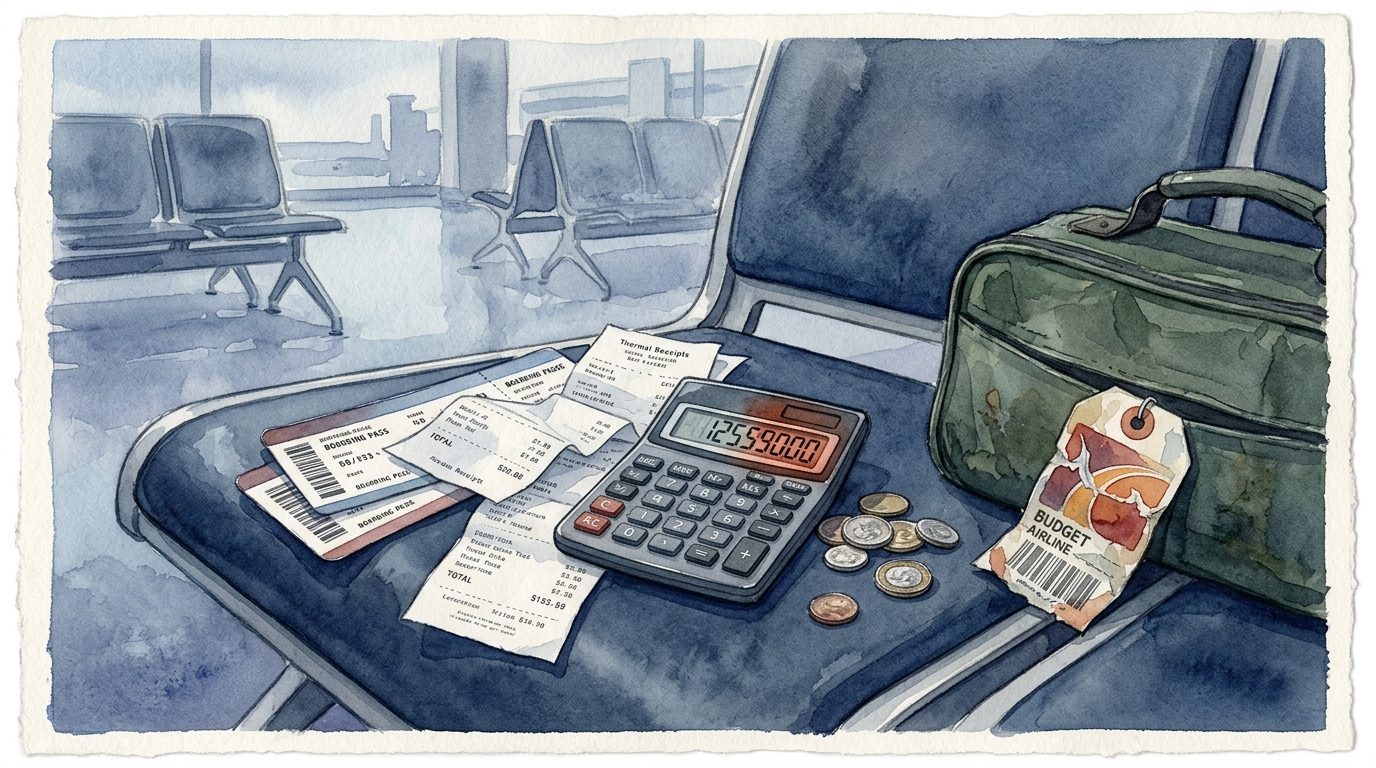
When I see a cheap fare, I immediately ask:
- What does this fare not include that I will realistically need?
- What are the airline’s baggage and seat rules for this specific fare type?
Here’s how I build a realistic flight cost so I can compare flight prices with fees instead of just base fares:
- Start with the base fare
That’s the number you see on the search page. Then I assume it’s incomplete. Because it usually is. - Add baggage
Checked bags are rarely free anymore. Typical fees:- Legacy carriers: about $35–$50 for the first checked bag.
- Budget airlines: often $55–$99+, especially if you pay at the airport or at the gate.
- Add seat selection (if I care)
Seat fees have exploded. Rough averages:- Preferred seats: around $33.
- Exit rows: around $48.
- Extra legroom on some long-haul routes: up to $160 or more.
- Add onboard food & drink
Budget airlines often charge for everything, including water. Two people on a medium-length flight can easily spend $30–$50 if they buy onboard. Full-service airlines usually include basic drinks and snacks, which is part of the real value when you compare a low cost airline vs full service cost. - Add payment and other fees
Some carriers add booking fees, payment surcharges, or “service” fees at the end. I always click through to the final payment page (without paying) to see the true total.
Only after I’ve added all of that do I compare one airline to another. Often, the “cheap” ultra-low-cost carrier ends up the same price—or more—than a standard airline once I price the full journey.
4. The Airport Problem: Transfers, Timing, and Layovers
Even if the ticket price is fair, the airport choices can quietly wreck your budget and your energy. This is where a lot of the hidden travel costs breakdown lives.
Here’s what I look at before I call any flight “cheap”:
Transfers to and from the airport
Secondary airports used by budget airlines often mean:
- Longer, more expensive transfers (buses, trains, rideshares).
- Fewer departure times and more risk if something goes wrong.
I always calculate:
- Home → airport transfer cost and time.
- Destination airport → accommodation transfer cost and time.
Sometimes the “expensive” main airport is actually cheaper door-to-door once you add transfers. That’s why a proper travel cost comparison guide has to include ground transport, not just airfare.
Layovers and weird timings
Long layovers can turn a small saving into a net loss. Why?
- You’ll probably buy airport food, Wi‑Fi, or lounge access.
- You’ll arrive exhausted and waste your first day.
- You increase the risk of missed connections and extra hotel nights.
Early-morning and red-eye flights are another trap. They’re often only slightly cheaper now, but the hidden cost is a wrecked first day and a higher chance you’ll spend more on taxis (because public transport isn’t running) or extra coffee and food to stay awake.
So I ask myself:
If this flight saves me $40 but costs me 6 extra hours and a ruined first day, is that actually a saving?
Would I pay $40 to avoid that schedule?
Often, the honest answer is yes—I’d pay to avoid it. That’s when I stop calling the cheaper option “cheap.”
5. Cost Per Trip: The Metric That Changes How You Travel
One concept I like from cost-per-trip calculators is CPT (Cost Per Trip). It’s simple:
CPT = total cost ÷ number of trips
Most people only think about this for commuting or business travel, but it’s powerful for leisure trips too, especially if you travel often and want to see your full trip budget before booking.
Here’s how I use it:
- I add all related expenses: fuel, tolls, parking, maintenance, bags, seats, transfers, food, hotels.
- I divide by the number of trips or travel days to see what each day or trip is really costing me.
Why this matters:
- It exposes how much “small” fees add up over a year.
- It makes carpooling, public transport, or off-peak travel look more attractive because you see the impact on your average cost.
- It helps you decide whether to take fewer, better trips instead of many low-quality “cheap” ones.
Even small monthly savings—like sharing rides, packing lighter, or choosing a closer airport—can meaningfully lower your CPT. Over time, that changes how you price a trip properly.
6. A Simple Door-to-Door Checklist (Use This Before You Book)
To keep myself honest, I use a quick checklist before I hit “pay.” You can adapt this to your own style and use it as your personal total trip cost calculator.

For any flight, I write down:
- Base fare (round trip, including taxes).
- Bags I will realistically bring (carry-on, checked) × airline’s actual fees.
- Seat selection cost (if I care about sitting together or extra legroom).
- Onboard food & drink I’ll likely buy (or cost of bringing my own).
- Home → airport transfer cost and time.
- Destination airport → accommodation transfer cost and time.
- Layover costs (meals, lounge, Wi‑Fi) if applicable.
- Potential hotel if a long layover or missed connection is likely.
For any road trip, I write down:
- Total distance and realistic average speed (not the speed limit).
- Fuel cost (using my car’s real-world MPG or L/100km, not the brochure).
- Tolls and parking (both en route and at destination).
- Overnight stays if the drive is long.
- Food on the road (not just snacks, but real meals).
- Maintenance and wear (I usually add a small per-mile amount).
- Number of travelers to split the cost.
Then I compare:
- Total money (door-to-door) for each option.
- Total time (door-to-door) for each option.
- Fatigue level I expect for each option (subjective, but honest).
Only after that do I decide whether the “cheap” option is actually worth it.
7. How to Use This on Your Next Trip
Here’s how I’d apply all of this in practice, step by step, so you can avoid the usual travel cost mistakes and see the real cost of cheap trips before you commit.
- Pick your dates and flexibility
Decide what you care about more: saving money, saving time, or protecting your energy. Be honest with yourself. - Price the drive properly
Use a trip cost calculator to get a full driving cost: fuel, tolls, parking, hotels, food. Note the total and per-person cost. - Price flights honestly
For each promising flight, add bags, seats, food, transfers, and layover costs. Don’t compare base fares; compare final totals. - Compare door-to-door time
Include transfers, check-in, security, layovers, and realistic delays. Compare that to driving time (with breaks and overnights). - Factor in fatigue
Red-eyes, 5 a.m. departures, and 8-hour layovers have a cost. If you’ll lose a full day to exhaustion, treat that as part of the price. - Decide on value, not just price
Ask yourself:If these two options cost the same, which would I choose?
If the “cheap” one still feels worse, it’s not really cheap.
Once you start thinking door-to-door, you book fewer bad trips. You stop chasing fake deals. And you start paying for what you actually value—time, comfort, and experiences—rather than for marketing tricks.
The next time a site flashes a “from $29” fare at you, pause and ask: What’s the real door-to-door price?
Then do the math. Your future self, standing at the gate with no surprise fees and a sane itinerary, will be very glad you did.