I’ve lost count of how many times I’ve clicked on a “great” hotel deal, only to watch the price quietly double by the time I reach the payment screen. If you’ve ever wondered how a $149 room turns into $230 a night, you’re not imagining things.
This guide breaks down the real cost of “free” hotel perks — resort fees, parking, and breakfast — and how to see the true cost of a hotel stay before you hand over your card.
1. The Resort Fee Problem: The Second Room Rate You Didn’t Agree To
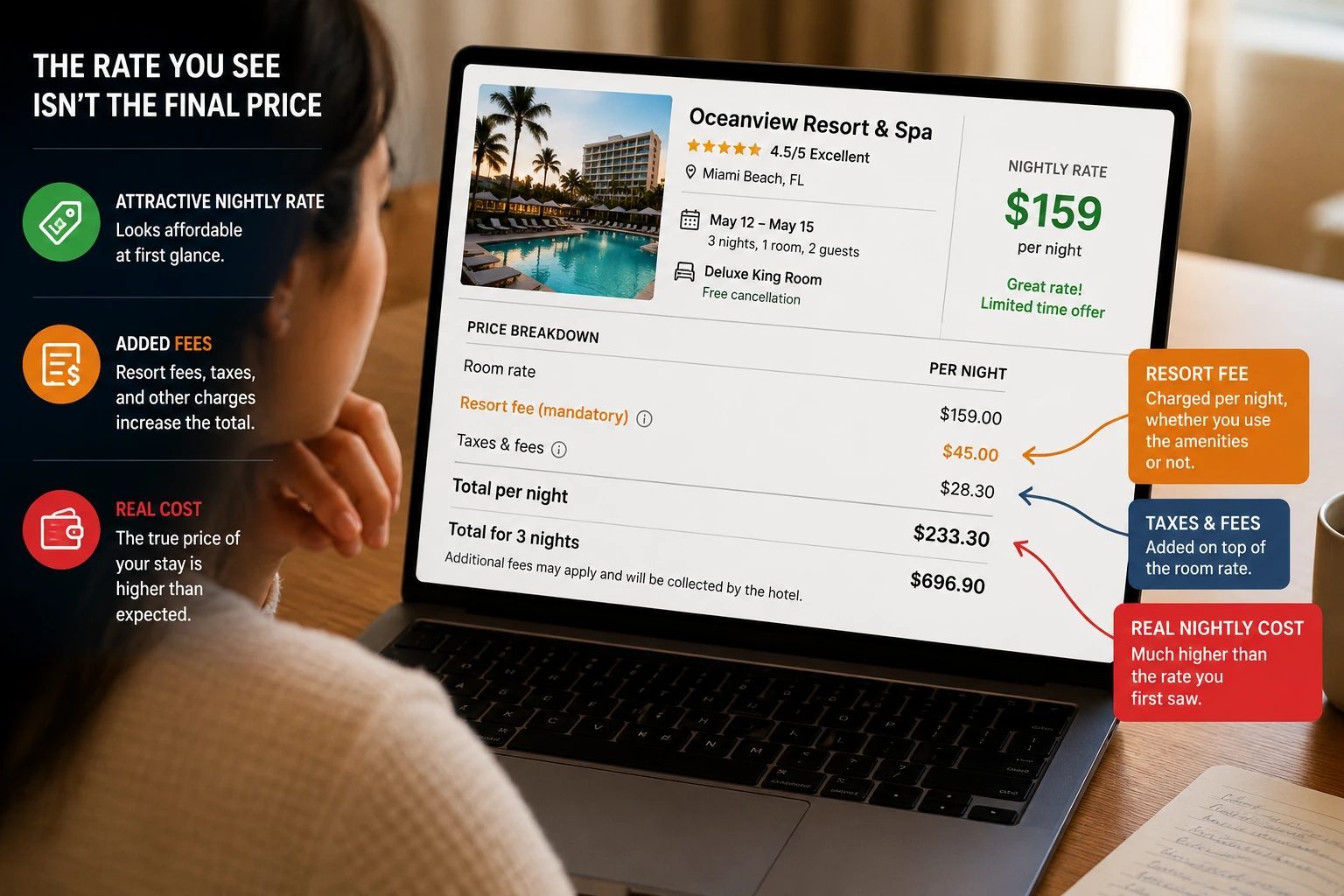
Let’s start with the big one: resort fees (also called destination, facility, amenity, or urban fees). These are mandatory per-night charges added on top of the room rate. You pay them whether you use the amenities or not.
Typical marketing line: Includes Wi‑Fi, pool access, fitness center, local calls, and in-room coffee.
Sounds generous, right? But here’s the truth: you’re not getting those things for free. You’re just paying for them in a different line item.
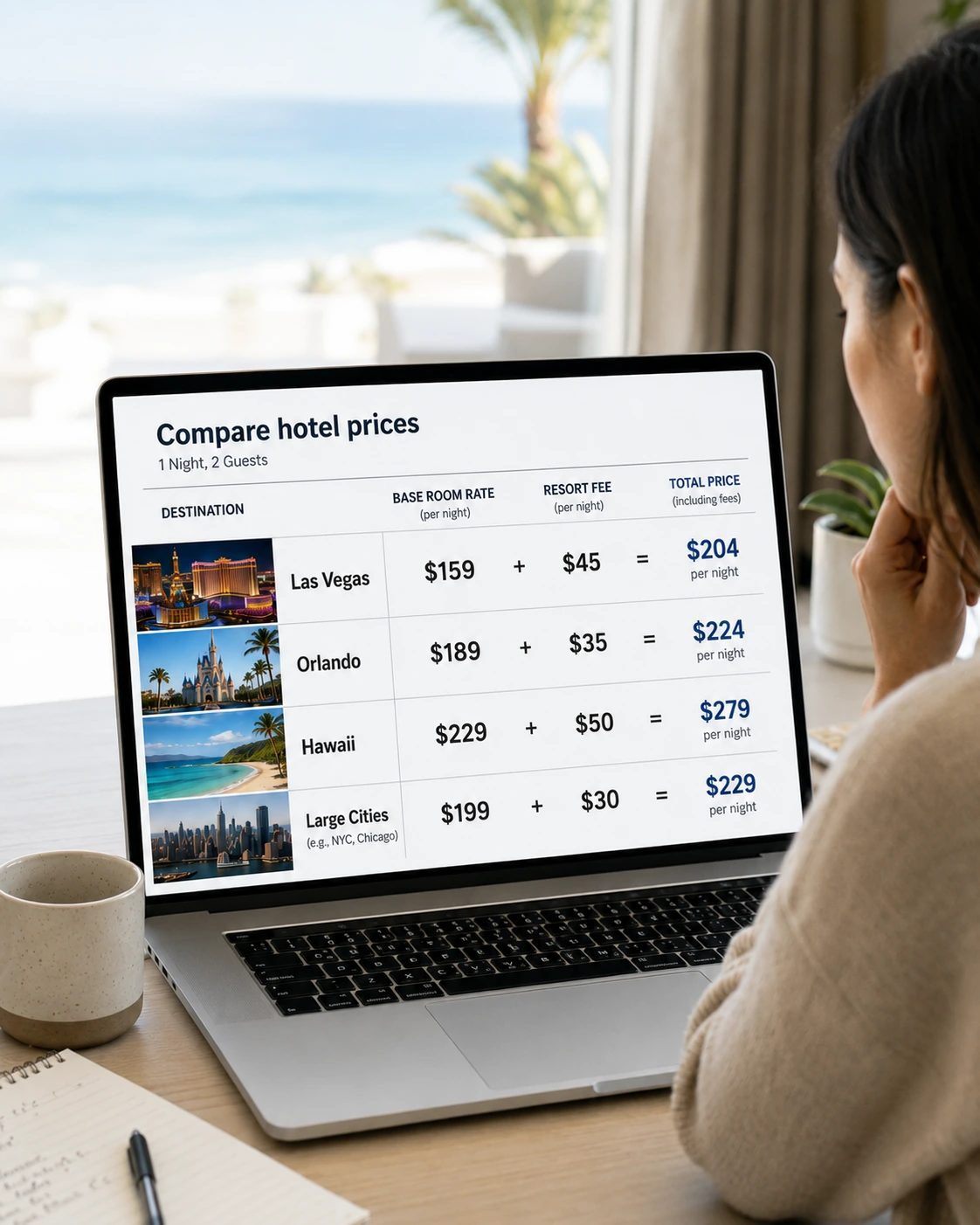
Across various analyses, average resort fees hover around $30–$40 per night. In some destinations — Las Vegas, Hawaii, New York, parts of Florida and the Caribbean — they regularly hit $50–$60+. At luxury properties, they can blow past $100 per night. Over a week-long stay, that’s hundreds of dollars travelers often forget to budget.
Why do hotels love them?
- They make the room look cheaper in search results. The base rate looks low; the real price is buried until later.
- They avoid commissions. Resort fees often aren’t commissionable to travel agents or online travel agencies, so more money stays with the hotel.
- They’re flexible and loosely regulated. There’s no standard cap, and the inclusions can be vague or padded with fluff.
In practice, a resort fee is often a second room rate wearing a friendly name tag. If you’re comparing resort fee vs no resort fee properties, that second rate can completely change which hotel is actually cheaper.
My rule of thumb: I never judge a hotel by the nightly rate alone. I always ask: What’s the total per night, including all mandatory fees and taxes?
That’s the number that matters.
2. How to Spot Resort Fees Before They Ambush Your Budget
Resort fees are finally getting more scrutiny. The U.S. Federal Trade Commission has called them out as harmful, and a new junk fees
rule (effective May 2025) will require hotels and short-term rentals to show all mandatory fees upfront. That’s a big win for transparency.
But here’s the catch: the rule doesn’t make the fees disappear. It just makes them harder to hide. You still need to pay attention if you want to avoid hidden hotel fees and charges.
Until transparency fully catches up, here’s how I check for resort fees before I book:
- Click through to the final price screen. Don’t trust the first number you see on a search site. Go all the way to the
review and pay
page and look for a line labeledresort fee
,destination fee
,facility fee
, oramenity fee
. - Read the rate details, not just the headline. Some chains bury the fee in small print or expandable sections. If you’re trying to avoid unexpected hotel charges at checkout, this is where they usually hide.
- Check if it’s per room or per person. A few properties charge per person per night, which can quietly double the fee for couples or families.
- Call or email the hotel directly. I’ll ask:
What mandatory fees will be added to my stay, per night, including taxes?
andWhat exactly do they cover?
- Watch for multiple fees. In rare cases, a property might stack a
resort fee
and adestination amenity fee
. Absurd? Yes. Real? Also yes.
Once you know the full nightly cost, you can compare hotels honestly. A place with a higher base rate but no resort fee may actually be cheaper — and more transparent — than the “deal” with a low rate and a big daily surcharge.
3. When Resort Fees Might Actually Be Worth It (And When They’re a Rip-Off)
Not all resort fees are equal. Some are pure junk. Others at least give you something close to the value you’re paying for. The key is to ask: Is this fee buying me something I’d actually pay for anyway?
Here’s how I size them up when I’m doing a quick hotel resort fee breakdown:
- High-value inclusions. If the fee genuinely covers expensive items — like parking, airport shuttle, reliable high-speed Wi‑Fi, beach chairs, or a decent breakfast — it might be worth it, especially in cities where those things are pricey on their own.
- Low-value fluff. If the list is mostly
daily newspaper
,local calls
,two bottles of water
,access to the fitness center
, anddiscounts at the gift shop
, I mentally label it a junk fee. - How much will I actually use? If I’m arriving late, leaving early, and spending most of my time off-property, paying $40+ per night for amenities I’ll barely touch is a hard no.
- Length of stay. A flat $40 fee on a one-night stay stings. On a seven-night stay, it’s brutal. I always multiply the fee by the number of nights before I commit.
Sometimes I’ll still book a property with a resort fee — but only if the total cost (room + fees + taxes) beats my other options and the inclusions match how I actually travel.
Practical move: When I’m comparing hotels in resort-heavy areas (Las Vegas, Hawaii, Orlando, Cancun, Punta Cana), I make a quick note or mini spreadsheet with:
- Base rate per night
- Resort fee per night
- Parking cost per night
- Breakfast situation (included, paid, or not offered)
It takes five minutes and often flips my decision completely. That’s where the real cost of “free” hotel perks shows up.
4. Parking: The Quiet Fee That Can Wreck a “Cheap” Stay
Parking is the other big trap that doesn’t get as much attention as resort fees, but it should. In many cities, parking can add $20–$60 per night to your bill. Combine that with a resort or destination fee and your budget
hotel suddenly looks like a splurge.
Here’s how I think about hotel parking fees when I’m doing a quick cost check:
- City vs. resort vs. suburb. Downtown and resort areas are where parking fees explode. Suburban or highway hotels are more likely to offer free parking.
- Self-parking vs. valet. Valet can be dramatically more expensive and often comes with mandatory service charges. I always check if there’s cheaper self-parking nearby.
- Is parking bundled into the resort fee? Sometimes the resort fee includes parking. If it does, I factor that into my value calculation. If it doesn’t, I treat parking as a separate line item in my hotel cost comparison with fees.
- Do I actually need a car? In some cities, ditching the rental car and using public transit or rideshares is cheaper than paying for parking every night.
Before I book, I usually:
- Search the hotel name plus
parking fee
. - Check the hotel’s own website for parking details (and whether it’s per night, per entry, or per day).
- Look at nearby public garages on Google Maps to see if I can park for less and walk a block or two.
Decision test: If the parking + resort fee together are more than 30–40% of the room rate, I seriously consider a different hotel or even a different neighborhood. Those are the hotel fees travelers forget to budget that quietly blow up a trip.
5. “Free” Breakfast: When It Saves You Money — and When It’s Just Marketing
Breakfast is one of the most emotionally loaded hotel perks. It feels comforting. It feels generous. But it’s not always the money-saver it appears to be. Sometimes the “free hotel breakfast” trap is just another way to dress up a higher rate.
Here’s how I break it down:
- Truly included vs. bundled into a higher rate. Many hotels offer two prices: room-only and
bed and breakfast
. If the breakfast rate is $25 more per night and the buffet is mediocre, I’d rather grab a coffee and pastry nearby for half that. - Quality matters. A full hot buffet with good options can easily be worth $15–$25 per person in an expensive city. A sad continental spread of stale pastries and instant coffee is not.
- Family math. For a family of four, a genuinely included breakfast can be a huge win. But if the
breakfast included
rate is $60 more per night and the kids barely eat, it may not pencil out. - Resort fee “includes breakfast.” Some properties justify a high resort fee by throwing in a basic breakfast. I still ask:
If I stripped out the fee and paid for breakfast separately, would I come out ahead?
What I usually do:
- Check the room-only rate vs. the breakfast-included rate.
- Look up the menu price for breakfast on the hotel’s website or in recent reviews.
- Search
cafes near [hotel name]
to see if there are cheaper, better options within a short walk.
If the numbers don’t clearly favor the hotel breakfast, I skip it and keep my mornings flexible. That simple habit avoids one of the most common hotel fee mistakes people make.
6. Smart Ways to Avoid or Reduce Resort Fees (Without Arguing at the Front Desk)
Can you just refuse to pay a resort fee at check-in? In most cases, no. It’s baked into the hotel’s pricing structure, and front desk staff usually don’t have the authority to remove it just because you don’t like it.
The real leverage point is how you book, not how loudly you complain at checkout. If you want to know how to avoid hotel resort fees or at least soften the blow, start there.
Here are strategies I actually use:
- Choose hotels that don’t charge resort fees. Many perfectly good properties still avoid them. In Europe, they’re relatively rare; in the U.S., they’re concentrated in certain destinations. I actively filter for hotels with no additional mandatory fees when I can.
- Use points for award stays. Some major chains (notably Hyatt and Hilton, and often Wyndham) waive resort fees on award bookings. That can save you $30–$60+ per night.
- Look for packages that include or offset the fee. Corporate, group, or promotional rates sometimes bundle the resort fee into the price or offer credits that effectively cancel it out. Always get this in writing.
- Book direct when it helps. Occasionally, booking directly with the hotel (or through a corporate rate) can reduce or waive certain fees, especially for elite loyalty members.
- Use loyalty status strategically. Elite members sometimes get perks (like breakfast, parking, or resort credits) that make the fee less painful, even if it’s not waived.
What I don’t rely on: I’ll just argue at check-in and they’ll remove it.
That might work once in a while, but it’s not a strategy. I’d rather pick a place where the pricing is fair from the start and the hotel pricing hidden charges are minimal.

7. How to Compare Hotels Without Getting Tricked by “Junk Fees”
When I’m choosing between hotels, I don’t ask, Which one has the lowest nightly rate?
I ask, Which one has the best total value for the way I actually travel?
If you want to avoid being surprised by parking and breakfast hotel surcharges and other add-ons, use a simple comparison framework:
- List your top 3–5 hotel options.
- For each, write down:
- Base room rate per night
- Resort/destination/amenity fee per night
- Parking cost per night
- Breakfast situation (included, extra, or not offered)
- Any other mandatory fees (service charges, cleaning fees for rentals, etc.)
- Calculate the real nightly cost: (Room + all mandatory fees + taxes) ÷ number of nights.
- Overlay your actual behavior: Will you use the pool? Need parking? Eat breakfast at the hotel? If not, don’t give those perks much weight.
Often, the hotel that looked cheapest at first glance ends up being the most expensive once you factor in everything. And sometimes a slightly higher base rate with no resort fee, free parking, and included breakfast is the clear winner in a true hotel cost comparison with fees.
One more thing: this isn’t just a hotel problem. Some vacation rentals and even certain Airbnb hosts now tack on resort-style fees and cleaning charges. I treat them the same way: ignore the headline price, focus on the all-in cost.
8. The Mindset Shift That Saves You the Most Money
Resort fees, parking charges, and breakfast traps all rely on the same psychological trick: partitioned pricing. Break the cost into pieces, and people focus on the part that looks small — the nightly rate — instead of the total.
If you remember nothing else from this article, remember this:
Never fall in love with a room rate. Fall in love with the total value.
Before you book your next stay, ask yourself:
What’s the real per-night cost once I add resort fees, parking, and taxes?
Am I actually going to use the perks I’m paying for?
Is there a nearby hotel with fewer junk fees and a more honest price?
Once you start thinking this way, you’ll notice something: the deals
that used to tempt you don’t look so tempting anymore. And the hotels that are transparent and fairly priced become much easier to spot.
That’s how you turn the game around — and make sure the only surprises on your trip are the good kind.