

How Status Matches Reshape the Value of Airline Loyalty in 2025
Airline loyalty programs are often presented as straightforward: fly enough, earn status, enjoy benefits. In 2025, status matches and status challenges complicate that picture. These offers let you bypass normal qualification thresholds, but they also compress timelines, increase policy uncertainty, and change the economic logic of which airline delivers the best value for you.
This article fits the Compare category: it contrasts the structural value of airline loyalty when you earn status through organic flying versus through a status match or challenge, and examines how that value shifts across different program designs. The goal is not to catalog every current offer, but to explain the mechanisms that drive value, risk, and trade-offs.
We will use “status match” as shorthand for both pure matches (instant status with no flying requirement) and challenges (temporary status that must be “earned in” within a short window). The core decision is simple but consequential: should you concentrate your travel to earn status gradually and predictably, or should you rely on short-term matches and challenges that can change or disappear at any time?
Mechanics: How Status Matches Change the Cost of Elite Benefits
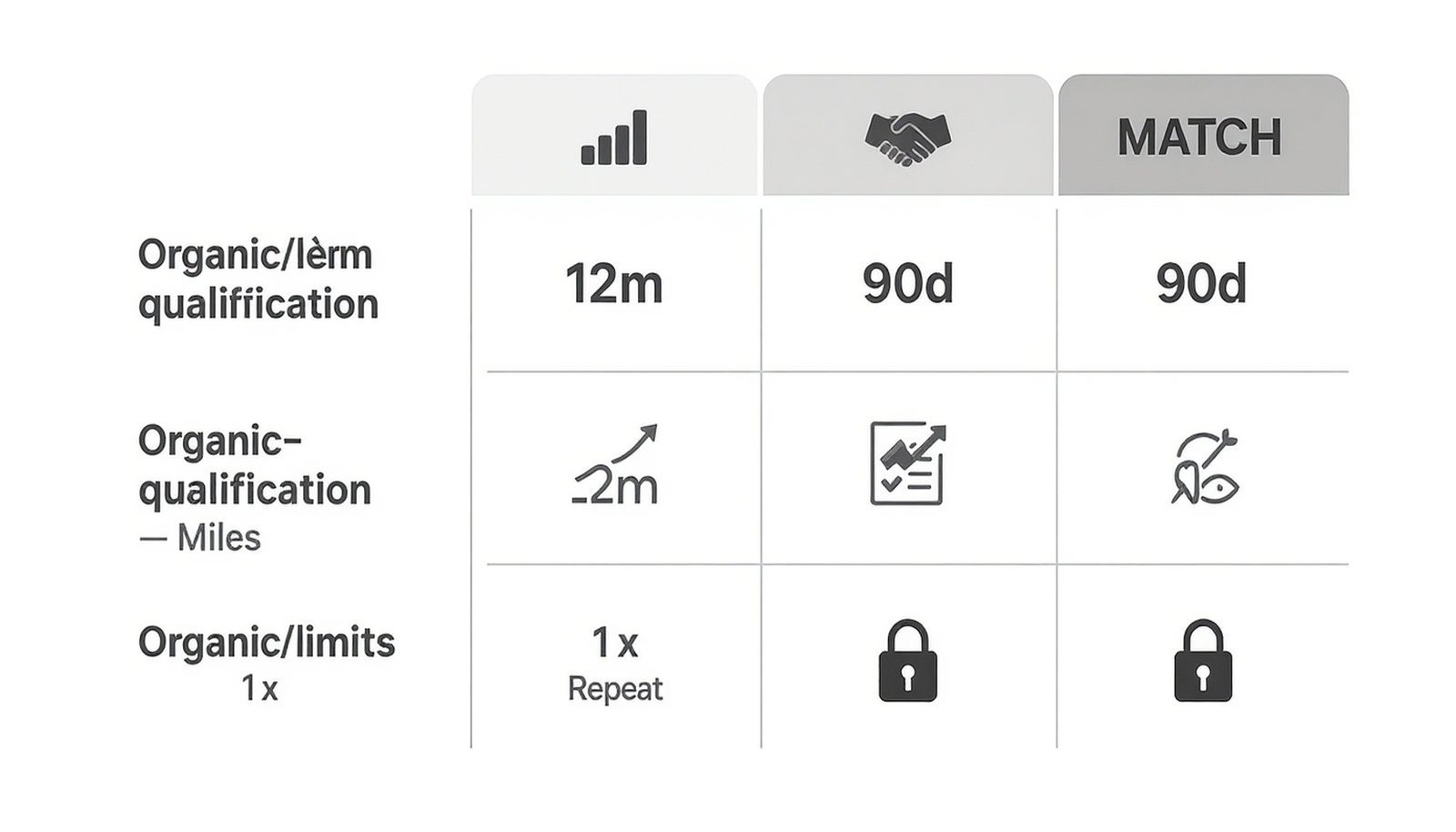
To understand value, it helps to unpack the mechanics that distinguish a status match from traditional elite qualification. The same lounge access or priority boarding can have very different effective “cost” depending on how you obtain it.
Compressed qualification windows and timing risk
Traditional elite status is usually earned over a full program year. Status matches and challenges compress this into short trial windows, often around 90 days, sometimes 180 days or up to 12 months. This shifts the problem from slow accumulation to a tight deadline:
- Standard earning: You spread flights across 12 months and can adjust as your travel needs change.
- Status challenge: You must hit a specific mileage, segment, or points target within a fixed 90–180 day window.
The same total flying can therefore produce very different outcomes. If your heavy travel happens to fall inside a challenge window, the match can be highly efficient. If your travel is uneven or disrupted, the compressed window raises the chance that you miss the target and lose the temporary benefits you planned around.
Different qualification currencies: miles, segments, and “Loyalty Points”
Airlines now use different “currencies” to measure your value:
- Miles or segments flown: Traditional model; value is tied directly to flight activity.
- Base points or revenue: Focus on how much you spend rather than how far you fly.
- Broad points systems (e.g., Loyalty Points): Non-flying activity such as credit card spend, shopping portals, or partner transactions also count.
In a status challenge, these mechanics change the effective cost of elite benefits:
- A traveler who can generate large credit card or partner activity may find a Loyalty Points-style system cheaper than flying.
- A traveler who mostly flies on discounted fares may find revenue-based thresholds harder to reach than distance-based ones.
Because each airline defines its qualification currency differently, the same traveler profile can face very different effort to secure equivalent status across carriers. “Best airline loyalty program” is therefore not universal; it depends on how you can generate qualifying activity.
Temporary vs. durable status: trial periods and earn-in thresholds
Most status matches and challenges grant only temporary status at first. Typical patterns include:
- Trial status: You receive elite benefits immediately for 90–180 days.
- Earn-in requirement: You must hit a defined threshold during that trial to keep status for the rest of the year or a full 12 months.
This structure creates a two-stage value profile:
- Stage 1 – Guaranteed short-term value: You enjoy benefits during the trial regardless of whether you later qualify.
- Stage 2 – Conditional long-term value: The long-term payoff depends entirely on meeting the earn-in threshold.
From a decision perspective, the key question is not “Is this status level good?” but “How much of my travel will fall inside the trial window, and what is the probability I will hit the earn-in target?”
One-time-only and restricted matches: why timing your first match matters
Some airlines restrict status matches to one-time-only per account or limit them to specific groups (for example, employees of a particular university or elites from a specific alliance). This creates a strategic timing problem:
- If you match too early, during a period of low travel, you may waste your one chance.
- If you wait too long, the offer may be paused or withdrawn before you can use it.
Because these restrictions are structural, they discourage experimentation. You cannot easily “test” a program with a match and then repeat it later when your travel intensifies. The timing of your first match becomes a critical decision variable rather than a casual choice.
Comparing Value: Organic Earning vs. Status Match or Challenge
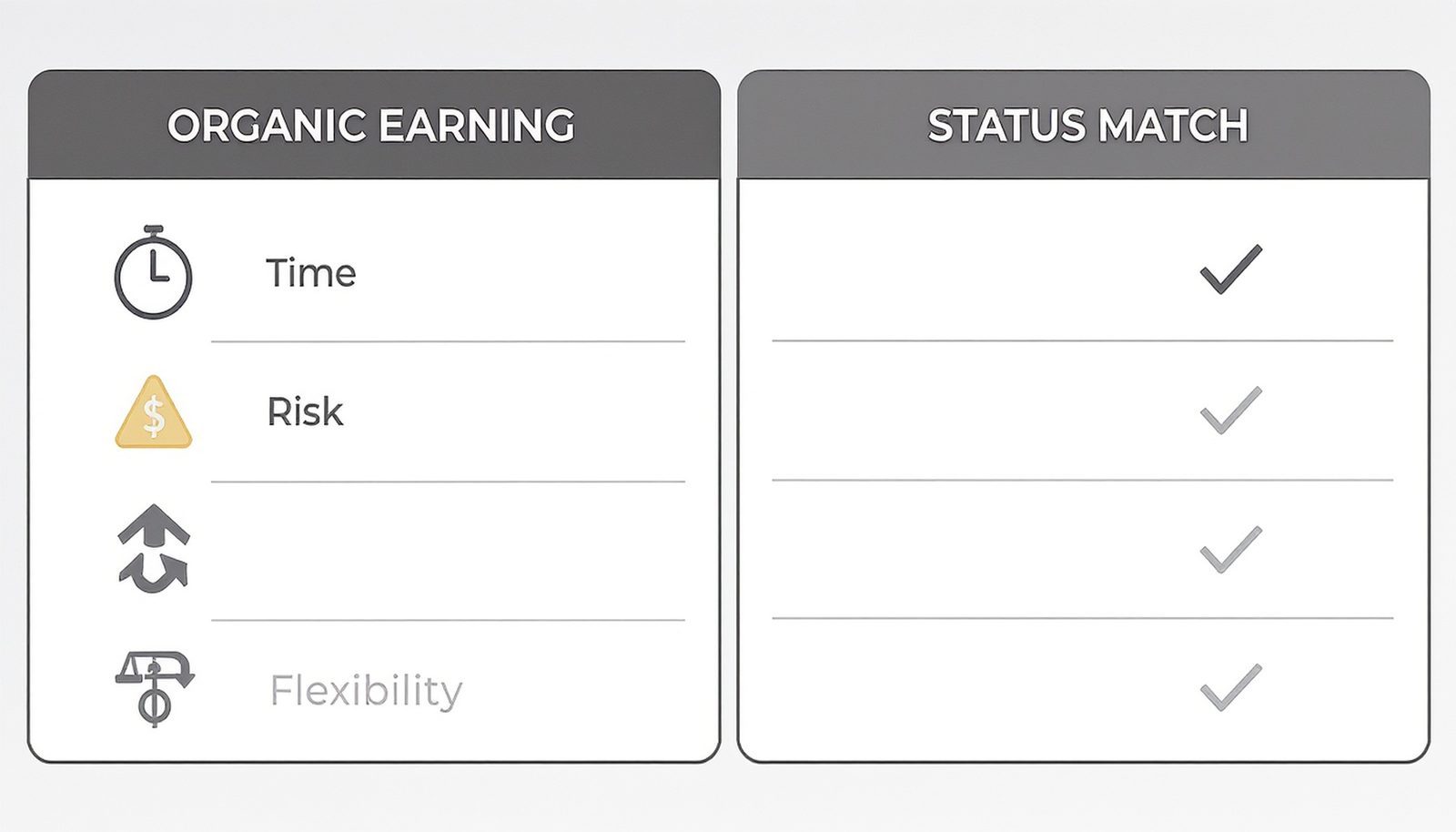
To compare value, you need to look beyond headline benefits and examine how each path allocates risk, timing pressure, and flexibility between you and the airline.
Structural trade-offs between the two paths
| Dimension | Organic Earning (Fly-to-Status) | Status Match / Challenge |
| Time horizon | Full program year to qualify | Compressed 90–180 day window (sometimes up to 12 months) |
| Policy stability | Relatively stable; changes usually announced in advance | High volatility; offers can launch, pause, or end without notice |
| Upfront certainty | Clear thresholds; progress accumulates gradually | Trial status is immediate, but long-term status is conditional |
| Flexibility of airline choice | Can spread flights across carriers, but dilutes progress | Strong incentive to concentrate flights with one carrier during challenge |
| Economic risk | Lower; you earn benefits in proportion to actual travel | Higher; you may pay more or accept worse routings to chase thresholds |
| Opportunity cost | Moderate; you can adjust mid-year if plans change | High; missed threshold means sunk costs and lost benefits |
| Access constraints | Open to anyone who flies enough | Often limited by one-time rules, eligible competitor lists, or employer/partner ties |
Asymmetric incentives: why airlines love matches more than you do
Status matches are designed as acquisition tools. Airlines target travelers who already have proven high activity with competitors. The economics are asymmetric:
- For the airline: Granting temporary status costs little. Seats, lounge access, and priority lanes often have spare capacity. If you fail the challenge, the airline still captures your flights during the trial.
- For you: Concentrating flights with a new airline may mean higher fares, less convenient schedules, or weaker network coverage. If you miss the threshold, those extra costs are not refunded.
This asymmetry means the default outcome tends to favor the airline. A match is only genuinely attractive if you can align your existing travel with the challenge window and thresholds, rather than creating new, artificial travel just to qualify.
When a match can outperform organic earning
Despite the risks, there are situations where a status match or challenge can deliver better value than organic earning:
- Front-loaded travel: If you have a cluster of flights in a short period (for example, a project requiring multiple trips), a 90-day challenge can convert that burst into a full year of status.
- Switching alliances: If you are moving from one alliance to another (e.g., job relocation changing your primary routes), a match can avoid a “reset to zero” and preserve your comfort level.
- High non-flying activity: In programs where non-flight activity counts, heavy credit card or partner spend can make a challenge cheaper than flying your way up from scratch.
The common mechanism in all these cases is alignment: the more your natural behavior already matches the challenge requirements, the higher the value and the lower the risk.
Program Design Differences: Why the Same Traveler Sees Different Value
Airline loyalty programs are not interchangeable. Differences in qualification rules, partner networks, and match policies mean that the same traveler can face very different cost and risk profiles across carriers.
Qualification mechanics and traveler profiles
Consider three simplified traveler profiles:
- Heavy flyer, low card spend: Flies frequently on work trips, but uses a corporate card with limited personal rewards.
- Moderate flyer, high card spend: Flies a few times a year but channels large personal or business expenses through a rewards card.
- Infrequent flyer, opportunistic deals: Flies rarely, chasing the cheapest fares regardless of airline.
In a mileage-based program, the heavy flyer has a clear advantage. In a broad points system that counts non-flying activity, the high card spender may reach status more easily. For the opportunistic deal-seeker, both paths are difficult; status matches may provide short bursts of comfort but are hard to sustain.
Because airlines choose different qualification mechanics, each program implicitly favors a different mix of these profiles. A “best” program for one profile may be inefficient for another.
One-time matches and selective access
Some airlines limit status matches to a single use per account or restrict them to specific groups such as employees of certain institutions or elites from particular alliances. This creates a hierarchy of access:
- Insiders: Travelers with the right employer, alliance status, or partner relationship can access extended fast tracks or more generous matches.
- General public: Others may only see generic, shorter challenges or no match at all.
Mechanically, this shifts value toward travelers who can leverage institutional or alliance ties. It also makes the timing of your one-time match more consequential if you are in the insider group; you may have access to unusually favorable terms, but only once.
Partnerships and indirect status pathways
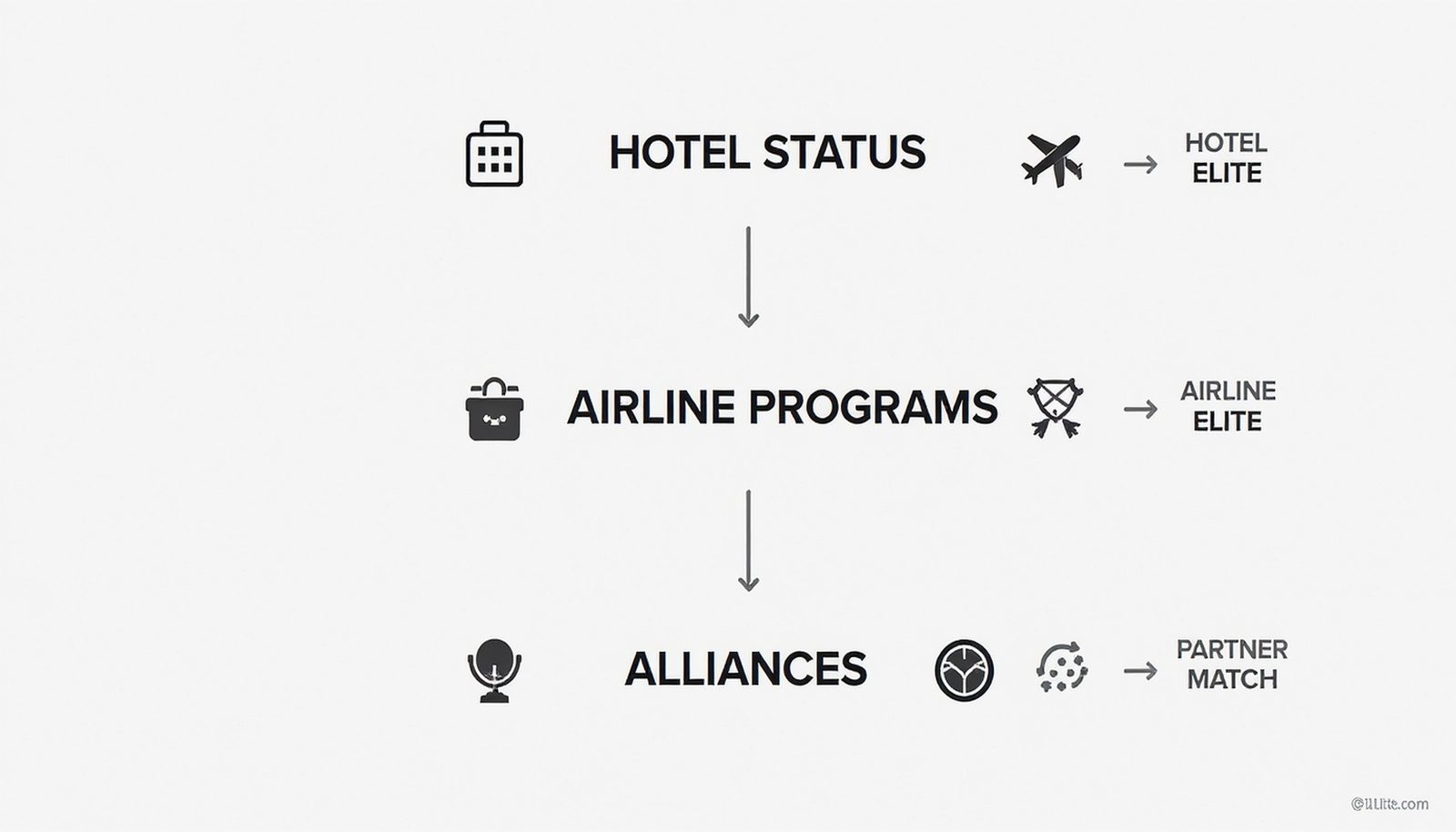
Airline–hotel partnerships and alliance structures create indirect pathways to airline status. Examples include:
- Reciprocal benefits between an airline and a hotel chain, where hotel status can be used to request an airline match.
- Alliance-based matches where status in one member airline can be leveraged to obtain status in another.
These structures shift power toward travelers who can maintain status in multiple ecosystems. If you hold high hotel status, you may be able to “ladder” into airline status even when direct matches are limited. Conversely, travelers who only interact with a single airline program have fewer options and are more exposed to that program’s policy changes.
Why some airlines avoid or limit matches
Not all airlines actively participate in status matching. While specific internal reasons are rarely disclosed, the structural logic is straightforward:
- Airlines with strong local dominance or captive demand have less incentive to poach competitors’ elites.
- Carriers with high premium cabin load factors may see little spare capacity to offer as trial benefits.
- Programs that already rely heavily on credit card partnerships may prefer to drive status via spend rather than matches.
For travelers, this means that the availability of matches is not random; it reflects each airline’s competitive position and revenue strategy. A “no match” policy can signal confidence in a strong home market or a deliberate focus on long-term, spend-based loyalty.
Risk, Uncertainty, and Policy Volatility in 2025
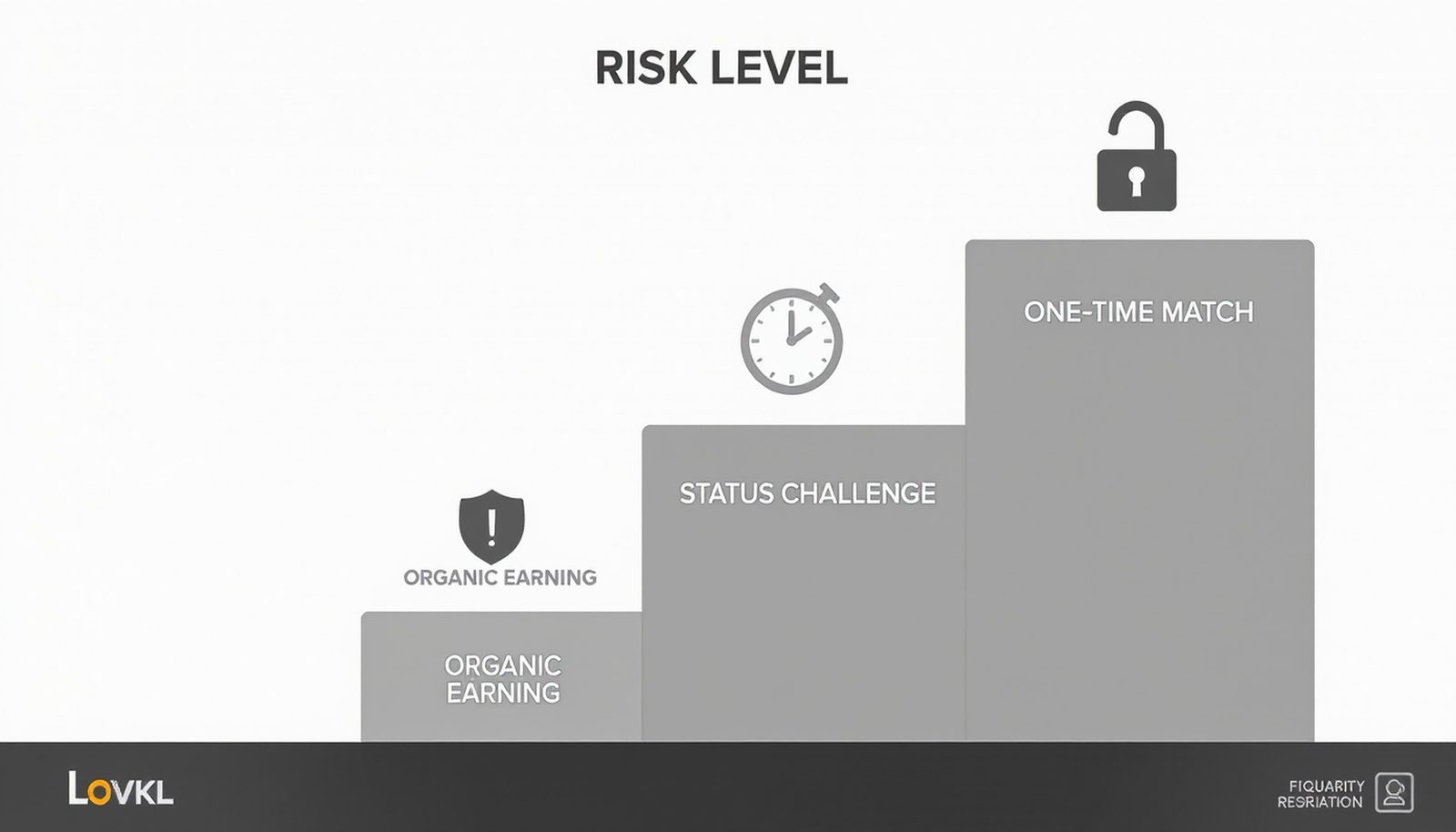
Status matches and challenges introduce several layers of risk that typical loyalty guides often underplay. Understanding these risks is essential to evaluating the true value of a match.
Policy volatility: offers can vanish without notice
Airlines can launch, pause, or withdraw status match and challenge offers at any time. Some carriers explicitly state that they are not offering matches, while others pause challenges with little warning. This volatility has two implications:
- Planning risk: You cannot reliably build a multi-year strategy around a specific match offer.
- Execution risk: Even within a year, an offer you saw earlier may be gone by the time you are ready to use it.
Travelers increasingly rely on third-party “master lists” and monthly updates to track these changes. These aggregators reduce search costs but rarely provide data on rejection rates or long-term stability, so they do not remove uncertainty.
Operational risk: disruptions inside a compressed window
Because challenge windows are short, disruptions have outsized impact. Flight cancellations, schedule changes, or personal events can cause you to miss the threshold even if your original plan was sufficient:
- In a 12-month earning period, a few disrupted trips can often be replaced later.
- In a 90-day challenge, there may be no time to rebook equivalent qualifying activity.
This makes status challenges particularly sensitive to operational reliability and personal schedule stability. The more uncertain your travel calendar, the higher the risk that a challenge will fail despite reasonable planning.
Information gaps: opaque approval criteria and rejection risk
Many programs reserve the right to decline status match applications without explaining why. Public information rarely includes:
- Rejection rates for different source programs or tiers.
- How strictly documentation is verified.
- Whether prior unsuccessful applications affect future eligibility.
This opacity means that even before you start flying, there is uncertainty about whether you will receive the trial status at all. For travelers considering non-refundable bookings or higher fares based on an expected match, this is a meaningful risk.
One-time-only constraints and irreversibility
One-time-only match rules introduce a form of irreversibility. Once you use your match, you cannot repeat it, even if your first attempt coincides with an unexpectedly low travel period or major disruption. This creates a timing dilemma:
- Waiting increases the chance of aligning with a high-travel period but also increases the chance that the offer disappears.
- Acting early secures the offer but may waste it if your travel does not materialize.
Because this trade-off cannot be fully resolved with available information, some degree of risk is unavoidable. The key is to treat a one-time match as a scarce resource, not a routine perk.
Trend Signals: How Status Match Value Is Evolving
Several trends are reshaping the value of airline loyalty and status matches in 2025.
From ad hoc promotions to codified, trackable offers
Status matches and challenges are increasingly documented in centralized lists and updated monthly. This codification has two effects:
- Lower search costs: Travelers can quickly see which airlines are currently matching which competitors or hotel programs.
- Higher competitive pressure: When one airline launches a generous match, others can see and respond more quickly.
However, the underlying rules remain fragmented. Codification improves visibility but does not standardize eligibility, durations, or thresholds. The landscape is easier to observe but not necessarily easier to navigate.
Growing importance of multi-program arbitrage
As partnerships deepen, travelers who can maintain status in multiple ecosystems gain leverage. For example:
- Hotel status can be used to request airline matches where direct airline-to-airline matches are limited.
- Alliance status can be used to access preferential matches within the same alliance or across partner networks.
This trend shifts value toward travelers who treat loyalty as a portfolio rather than a single-program commitment. The ability to move status across ecosystems becomes a form of decision intelligence: you can respond to policy changes by re-routing your status rather than starting from zero.
Shift toward spend-based and non-flying qualification
Programs that count non-flying activity (such as credit card spend or shopping portals) are structurally different from pure mileage-based schemes. For status matches and challenges, this means:
- Travelers with high spend but moderate flying can qualify more easily.
- Airlines can tie status more closely to profitable financial products and partners.
From a value perspective, this can make a match more attractive if you can generate qualifying spend quickly. But it also increases dependence on specific financial products and partner ecosystems, which may not be equally accessible in all markets.
Balanced Conclusion: When Does a Status Match Truly Add Value?
Status matches and challenges are powerful tools, but their value is highly conditional. They compress qualification into short windows, introduce policy volatility, and often come with one-time-only constraints. At the same time, they can convert a burst of travel or high non-flying activity into a full year of elite benefits.
From a decision-intelligence perspective, the key mechanisms to evaluate are:
- Alignment: How closely does your existing travel and spend pattern match the challenge requirements and timing?
- Risk allocation: How much operational and policy risk are you assuming relative to the airline, especially given compressed windows and opaque approval criteria?
- Irreversibility: Are you using a one-time-only opportunity, and if so, is this period of your life likely to be one of your highest travel phases?
- Alternative paths: Could you achieve similar benefits through organic earning, partner status, or another program with more stable rules?
For travelers whose natural behavior already fits a challenge’s structure, a status match can be a high-value shortcut that accelerates comfort and convenience. For those who must significantly alter their travel patterns or spending to qualify, the hidden costs and risks can outweigh the benefits.
In 2025, the “best” airline loyalty program is not simply the one with the most generous published benefits. It is the program whose qualification mechanics, match policies, and partnership network most closely align with your real-world travel and spending patterns, while exposing you to an acceptable level of timing and policy risk. Understanding these mechanisms is the basis for making airline loyalty work for you, rather than the other way around.