
If your dates are fuzzy, your costs can quietly explode. Change fees, fare jumps, nonrefundable rooms, wasted credits – they all feed on one thing: uncertainty.
I plan a lot of trips where the dates aren’t locked in. Over time, I’ve learned that the goal isn’t to guess the cheapest day
– it’s to buy the right kind of flexibility at the right time, so you don’t pay twice for the same trip.
Let’s walk through the key decisions: when to book, when to wait, and when to pay extra for flexibility on flights, hotels, and trains when you’ve got uncertain travel dates.
1. The Real Cost of Uncertain Dates: What Are You Actually Risking?
Before you book anything, ask yourself one blunt question: what’s the worst realistic thing that could happen to your dates?
- Could the trip move by a day or two?
- Could it shift by a week or more?
- Could it be canceled entirely?
Your answers decide whether you should lock things in early, pay for flexibility, or wait. That’s the core booking strategy for uncertain travel plans.
Here’s how I think about the hidden costs of uncertainty:
- Fare jumps: Airlines often hike prices inside 21 days of departure, and especially in the last week. If you wait too long, you’re paying a premium for indecision.
- Change fees + fare difference: Many fares have
no change fee
, but you still pay any fare difference. If prices rise, that can be brutal. - Nonrefundable rooms: Cheap hotel rates often lock you in. One date change can mean losing the entire first night.
- Wasted credits: Airline and hotel credits usually expire. If your plans are shaky, unused credits are just money that quietly evaporates.
So the real game is this: spend a bit more now on the right flexibility, or risk spending a lot more later on changes and higher prices. That’s the trade-off behind most flight, hotel, and train date change fees.
2. Flights: Should You Book Now or Wait?
Flight pricing is messy. It behaves more like a stock market than a supermarket shelf. There’s no magic book on Tuesday at 3 p.m.
trick – airlines use dynamic pricing that shifts with demand, season, and availability.
But there are patterns you can use, especially when your dates aren’t fixed and you’re wondering when to book flights if plans aren’t fixed.

Use the Goldilocks window, not a magic weekday
Instead of chasing a specific day of the week, focus on how far out you’re booking. Data from multiple sources (like CNBC Select) suggests rough Goldilocks windows
where prices are often more reasonable:
- Domestic, off-peak: about 1–3 months before departure.
- International, off-peak: about 2–8 months before departure.
- Peak seasons (summer, Christmas, New Year’s):
- Domestic: roughly 3–7 months ahead.
- International: roughly 4–10 months ahead.
- Absolute minimum: try to book at least 21 days before departure to avoid the sharp last-minute price hikes many airlines apply.
If your dates are uncertain but you know the month, aim to book inside these windows and then buy flexibility (more on that below), rather than waiting until the last minute and swallowing a huge cost of changing flight dates.
When you should book early even if dates are fuzzy
There are situations where waiting is almost always more expensive:
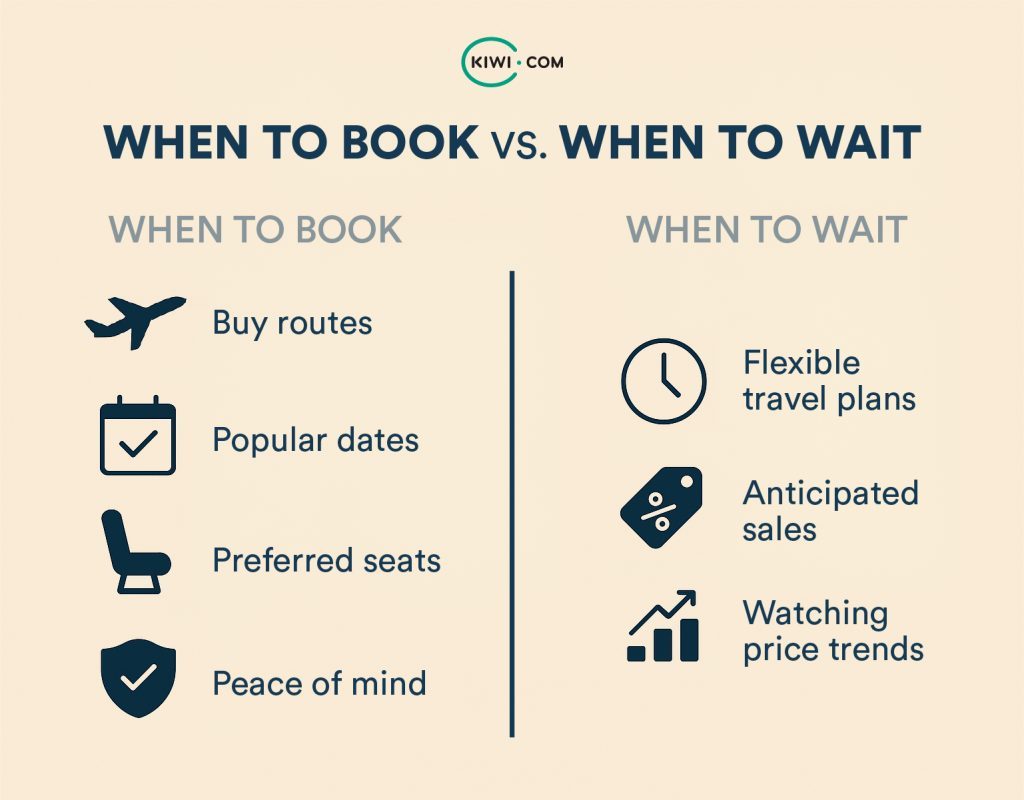
- Busy routes & peak dates: Think Christmas, Thanksgiving, major events, or always-busy city pairs. As Kiwi.com points out, these flights rarely get cheaper as you wait; they just sell out or climb.
- Strict seat preferences: If you care about specific rows, extra legroom, or sitting together, the best seats disappear first, even if prices later drop.
- Non-flexible commitments: Conferences, weddings, exams. If the event date is fixed but your surrounding travel days are fuzzy, I still book the core flights early and adjust around them.
In these cases, I’d rather:
- Book early within the Goldilocks window.
- Choose a fare that allows changes for a reasonable cost.
- Accept that I might pay a small fare difference later, instead of a huge last-minute price.
That small premium for a flexible flight ticket cost is often cheaper than gambling on last-minute availability.
When waiting can actually make sense
On the other hand, waiting can be rational if:
- You’re very flexible on dates, times, and even airports.
- You’re traveling off-peak on a route that often has sales.
- You’re okay with less-than-ideal flight times or longer layovers.
In that case, set up price alerts on tools like Google Flights, Skyscanner, or Hopper, and watch how fares move for a week or two. If prices dip into a range you’re happy with, you book. If they start climbing steadily, that’s your signal to lock something in.
Use predictors and alerts, but don’t worship them
AI tools like AirTrackBot analyze historical and real-time data to tell you whether to buy now
or wait
, often with a confidence score. I treat these as advisors, not oracles.
My rule: if a predictor says wait
but I’m inside 21 days of departure or traveling for something important, I usually book anyway. Peace of mind is worth more than squeezing out a theoretical 5–10% savings.
3. Flexible, Refundable, and Open Tickets: When Paying More Upfront Saves You Later
When your dates are uncertain, the type of ticket you buy matters as much as the price. This is where people quietly lose hundreds of dollars in hidden costs of flexible travel.
Know what you’re actually buying
Airlines love confusing language. Here’s how I simplify it:
- Basic economy: Cheapest, but usually terrible for uncertain plans. Changes may be impossible or very expensive, and you often can’t get a credit if you cancel.
- Flexible/changeable tickets: You can change dates/times (sometimes routes) with no or reduced change fees, but if you cancel, you usually get a travel credit, not cash.
- Refundable tickets: You can cancel and get cash back to your original payment method. These are pricier but powerful if there’s a real chance you won’t travel at all.
As Otto the Agent and AIRebooker both emphasize, no change fee
does not mean free changes
. You still pay any fare difference. That’s the part that hurts when you change dates close to departure.
When a flexible ticket is worth the extra cost
I’m willing to pay more for a flexible or refundable fare when:
- My dates could move by more than a day or two.
- The trip might be canceled entirely (e.g., client work, visa issues, health).
- I’m booking far in advance for a peak period and expect prices to rise.
Think of it this way: if a flexible fare costs $80 more, but a single change could cost you $200 in fare difference plus fees, that flexibility is actually cheap insurance. That’s the real comparison behind change fees vs flexible ticket prices.
Open tickets: niche but useful for truly uncertain returns
Open tickets – where you lock in an outbound flight and choose your return date later – are rarer now, but they still exist on some routes and airlines. They’re most useful if:
- You’re traveling long-term (backpacking, remote work, extended family visits).
- You genuinely don’t know when you’ll come back, but you know the general window.
Trade-offs, as Kayak notes:
- They often cost more than regular round-trips.
- They have a validity window (e.g., 3–12 months).
- They don’t guarantee a seat on your ideal return date.
For most travelers, a flexible or refundable round-trip is simpler and often cheaper than hunting for a true open ticket.
4. Hotels: Lock in a Room or Wait for a Deal?
Hotels are usually more forgiving than flights, but they can still punish uncertain dates if you pick the wrong rate type. The way you handle a hotel booking with flexible dates can save – or cost – a lot.
Nonrefundable vs. flexible rates
Most hotels offer at least two flavors of rates:
- Nonrefundable / advance purchase: Cheaper, but you pay in full and lose your money if you cancel or change too late.
- Flexible / free cancellation: Slightly more expensive, but you can cancel or change up to a certain date (often 24–72 hours before check-in).
With uncertain dates, I almost always start with a flexible rate. Why?
- It lets you lock in a room in popular destinations or during events.
- You can re-shop the rate later. If prices drop, you cancel and rebook at the lower price.
- You avoid the worst-case scenario: paying for a room you never use.
When to book hotels if your dates might move
Here’s how I usually handle hotels when my dates are still moving around:
- As soon as I know the city and rough dates, I book a fully cancellable room. This protects me from big price spikes or sold-out properties.
- Every few weeks (or when flights are finally locked), I check prices again. If they’re lower, I rebook.
- Once my flights are fixed, I decide whether to switch to a cheaper nonrefundable rate for the exact nights I know I’ll stay.
This way, uncertainty doesn’t stop me from booking – it just changes which rate I choose and when I commit.
Watch out for these hotel traps
- Different cancellation deadlines: Some properties require cancellation 7–14 days in advance, especially resorts. Don’t assume it’s always 24 hours.
- Prepaid taxes and fees: Even on flexible rates, some fees may be nonrefundable or tricky to recover.
- Third-party bookings: OTAs (online travel agencies) sometimes have stricter rules than booking direct. If your plans are shaky, I prefer booking directly with the hotel for easier changes.
5. Trains: The Overlooked Middle Ground for Flexible Travel
Trains sit in a sweet spot between flights and hotels. They’re often more flexible than planes, but the rules vary wildly by country and operator. The choice between train tickets flexible vs advance fares can really shape your day.

Understand the fare tiers
Many rail systems use a structure similar to airlines:
- Advance / saver fares: Cheaper, limited changes, sometimes train-specific.
- Standard / flexible fares: More expensive, but allow changes or even open travel on a route within a day or time window.
If your dates or times are uncertain, ask yourself:
- Is this a busy route or time (Friday evenings, holiday weekends)?
- How painful would it be if I had to buy a new ticket last minute?
On popular routes, I often book an advance fare for the day I’m 80–90% sure I’ll travel, but I’ll pay a bit more for a fare that allows same-day changes or refunds with a modest fee.
When to book trains with uncertain dates
General patterns:
- High-speed / long-distance trains: Book earlier, especially in Europe and Asia. The cheapest buckets sell out first, just like flights.
- Regional / commuter trains: Often have fixed prices or minimal savings for advance purchase. If your dates are uncertain, it can be fine to wait.
Because train tickets are usually less volatile than flights, I’m more comfortable waiting until my flights and hotels are set before locking in long-distance train segments – as long as I’ve checked that there’s still decent availability.
6. How to Combine Flights, Hotels, and Trains Without Overcommitting
The hardest part isn’t booking each piece. It’s making sure they all fit together without locking yourself into a schedule you’ll regret – and without racking up a pile of flight, hotel, and train date change fees.

Start with the least flexible piece
When my dates are uncertain, I usually plan in this order:
- Flights: They’re the most volatile and often the most expensive to change. I lock these first, with some flexibility built in (changeable fare, good time of day).
- Hotels: I book flexible rates that match the flight window, then refine later.
- Trains / local transport: I add these once the first two are stable, choosing fares that allow minor time shifts if needed.
This way, I’m not stuck with a nonrefundable hotel that doesn’t match my eventual flight times, or a train ticket that leaves 30 minutes after my plane lands.
Use flexibility strategically, not everywhere
You don’t need maximum flexibility on every single piece. That’s overkill and expensive. Instead, I ask:
- Where is a change most likely? (e.g., the first leg of a trip, a work-related segment)
- Where would a change be most expensive? (usually long-haul flights)
Then I buy flexibility only where those two overlap.
For example:
- Long-haul flight: flexible or at least changeable fare.
- Short regional hop: cheaper, less flexible fare if the risk is low.
- First hotel night after a long flight: flexible rate, in case of delays or rebooking.
- Later hotel nights: nonrefundable if I’m confident I’ll be there.
This kind of targeted flexibility keeps your travel cost guide for uncertain dates under control without paying for premium options you don’t really need.
Track your credits and deadlines
If you’re changing plans often, you’ll accumulate airline and hotel credits. These are easy to forget – and that’s exactly how you lose money.
I keep a simple note with:
- Airline / hotel name
- Credit amount
- Booking and travel deadlines
- Confirmation or voucher numbers
Many credits expire in about 12 months, and rules vary by airline. If you’re juggling uncertain travel dates, this little habit can save you hundreds over time.
7. A Simple Playbook for Uncertain Travel Dates
If you remember nothing else, use this as your quick checklist for how to avoid extra travel change fees:
- 1. Define your risk: Could your trip move by a day, a week, or be canceled entirely? Your answer decides how much flexibility you need.
- 2. Time your flights: Aim for the Goldilocks window (1–3 months domestic, 2–8 months international off-peak; earlier for peak). Avoid booking inside 21 days if you can.
- 3. Buy the right fare type: Avoid basic economy if dates are shaky. Use flexible or refundable tickets where changes would hurt most.
- 4. Start hotels flexible: Book cancellable rates early to hold space, then re-shop and switch to cheaper nonrefundable rates once flights are firm.
- 5. Add trains last: Lock in long-distance trains after flights and hotels, choosing fares that allow minor time shifts.
- 6. Use tools, not superstition: Price alerts and AI predictors are helpful, but don’t let them override common sense about peak dates and your own risk tolerance.
- 7. Track credits and deadlines: Treat credits like cash with an expiration date. Because that’s exactly what they are.
Uncertain dates don’t have to mean uncertain costs. If you’re deliberate about when you book and what kind of flexibility you buy, you can keep your options open without lighting money on fire every time your plans shift.