1. Category and Core Tension: This Is a Visa & Entry Timing Problem
This article belongs in the Visa & Entry category. The core tension is straightforward but unforgiving: the U.S. Visa Bulletin looks like a calendar, but it actually functions as a control panel for managing scarcity. That gap creates a recurring mismatch between what the bulletin appears to promise ("your date is current") and what people experience (months or years of additional waiting).
Understanding that mismatch is not about tricks or shortcuts. It requires seeing the underlying mechanisms that drive the backlog: annual caps, per-country limits, two different charts, and downstream processing bottlenecks. Once those mechanisms are clear, the Visa Bulletin’s behavior—sudden jumps, freezes, and retrogressions—stops looking random and starts to look like a predictable response to pressure in the system.
2. How the Visa Bulletin Really Works as a Rationing Device
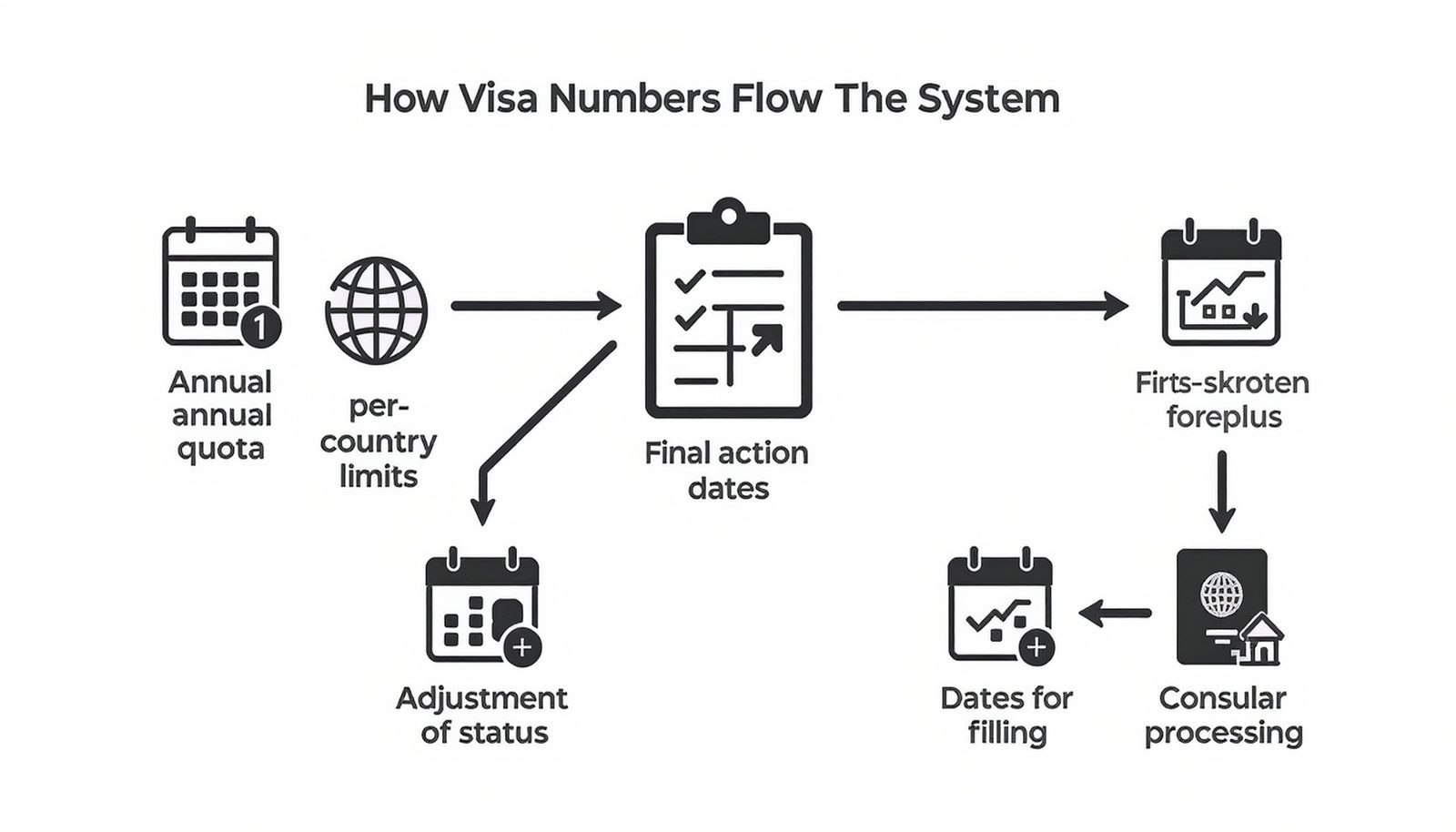
On the surface, the Visa Bulletin looks like a monthly newsletter with dates. In practice, it is the public output of a rationing algorithm that has to fit very high demand into a fixed annual quota.
2.1 Annual caps and per-country ceilings: the structural bottleneck
The U.S. immigration system is constrained by two main rules:
- Annual numerical caps for each immigrant category (family-based, employment-based, etc.).
- A 7% per-country limit, which prevents any single country from using more than a small share of the total in a given year.
When demand from a particular country and category exceeds its share, the system cannot simply issue more visas. Instead, it creates a queue. Your place in that queue is your priority date (usually the date your petition was filed).
The Visa Bulletin’s role is to decide how far down that queue the government can go each month without breaking the caps. The published cutoff dates are the visible result of that calculation.
2.2 Priority dates as tickets in a segmented line
Functionally, the system operates as multiple parallel lines:
- Each category (e.g., EB-2, F2A) is a separate line.
- Each country of chargeability (e.g., India, China, Mexico, Philippines, "All Chargeability Areas") is a separate sub-line.
- Your priority date is the timestamp on your ticket in that sub-line.
The Visa Bulletin’s cutoff date for a given category and country is essentially: “We are now serving tickets dated on or before X.” Because the number of tickets and the annual quota are misaligned, some lines move quickly while others barely move at all.
2.3 Two charts, two different questions
The bulletin publishes two main charts for immigrant categories:
- Final Action Dates (FAD): When can the government actually approve and issue a green card?
- Dates for Filing (DFF): When can people start submitting their final paperwork (for example, adjustment of status or consular documents)?
Operationally, the DFF chart is a way to pre-load the pipeline. By allowing people to file earlier than the final action date, the government ensures that when a visa number becomes available, the case is already documentarily complete and can be approved quickly.
However, USCIS decides month by month whether applicants inside the U.S. can use the DFF chart or must use the stricter FAD chart for adjustment of status. That decision is based on internal assessments of demand and available numbers. This is one of the first points where the bulletin’s apparent timeline diverges from lived reality: a date that looks “open” on the DFF chart may not actually be usable for filing AOS in a given month.
3. Where the Mismatch Starts: Bulletin Dates vs Real Processing Time
The central confusion is this: people see their priority date become current and assume they are close to the finish line. In practice, they are often only entering the second half of the process.
3.1 The non-linear movement of cutoff dates
Visa Bulletin movement is not a smooth conveyor belt. It behaves more like a thermostat responding to spikes:
- When the State Department sees lower-than-expected demand in a category, it can advance cutoff dates aggressively to pull more cases into the pipeline.
- When demand overshoots—for example, because many people file as soon as their date becomes current—the system reacts by slowing or reversing the dates (retrogression) to avoid exceeding the annual cap.
This non-linearity means that a period of rapid advancement does not guarantee continued progress. It often signals that the system is trying to catch up, and a later slowdown or retrogression becomes structurally likely once the new demand is measured.
3.2 High-demand vs low-demand countries: same rules, different outcomes
The formal rules are the same for all countries, but the per-country cap interacts with demand very differently:
- For low-demand countries, the 7% ceiling rarely binds. Their lines move mostly according to the overall category cap.
- For high-demand countries (India, China, Mexico, Philippines), the 7% ceiling is constantly binding. Their lines stretch out for years or decades.
This is not discrimination in the decision to approve an individual case; it is a structural effect of the quota system. Two applicants with similar qualifications can face radically different wait times solely because they stand in different sub-lines.
3.3 “Current” is not the end: the 6–18 month processing tail
Even when your priority date is current on the Final Action chart, several stages remain:
- For adjustment of status (AOS) inside the U.S.: biometrics, background checks, possible interview, and local field office workload.
- For consular processing abroad: document collection, National Visa Center (NVC) review, medical exams, and consulate interview scheduling.
These steps are constrained by staffing, security checks, and local capacity, not by the Visa Bulletin itself. That is why the transition from “current” to final approval typically takes 6–18 months, and why two people with the same priority date can still finish at different times depending on where and how they process.
4. AOS vs Consular: How the Backlog Changes the Trade-offs
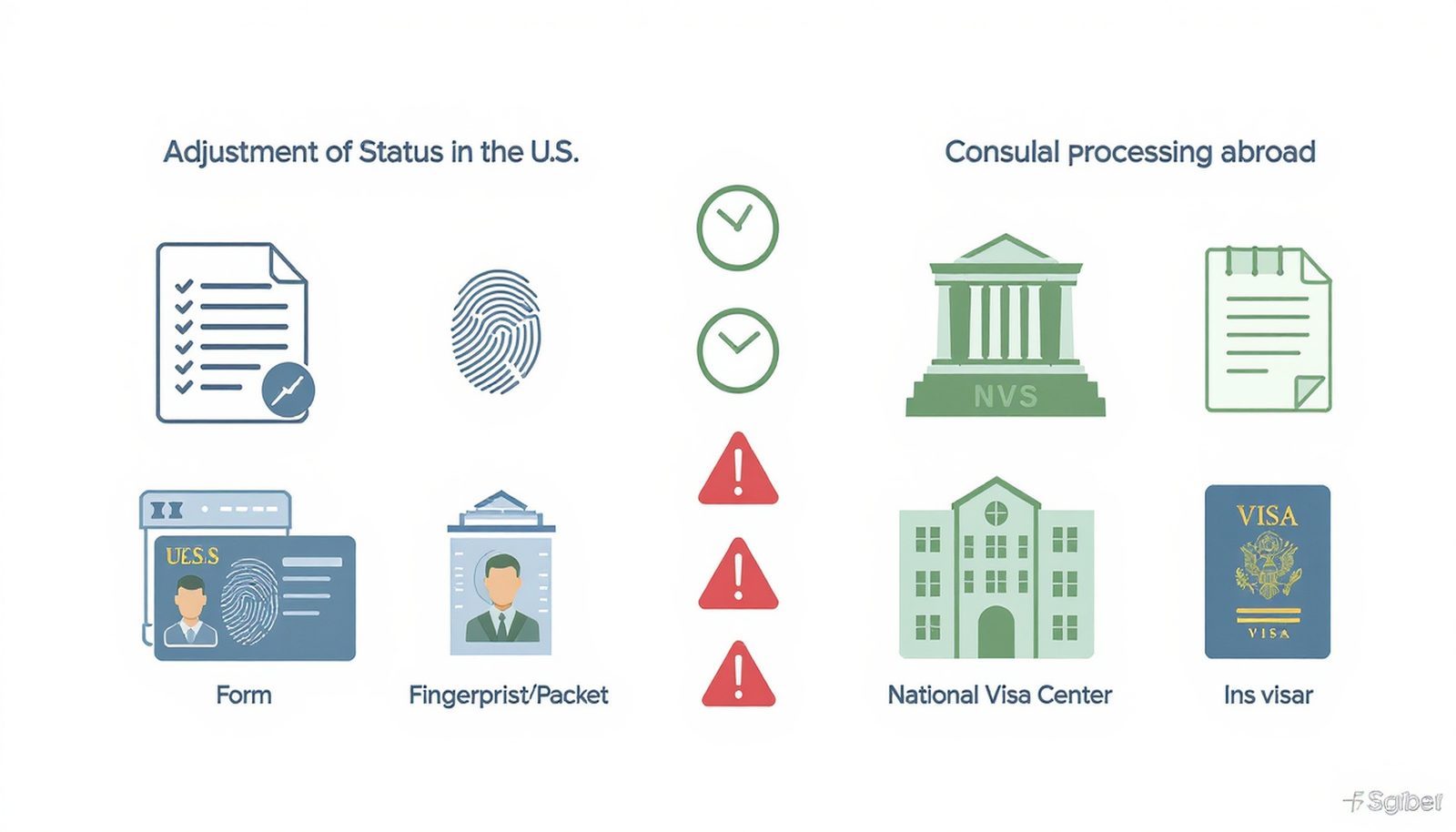
The Visa Bulletin does more than influence when you get a green card; it also changes the risk and timing profile of adjustment of status (AOS) versus consular processing. Because the underlying mechanisms differ, the same cutoff date can produce very different experiences.
4.1 Structural differences between AOS and consular processing
| Dimension | Adjustment of Status (AOS) | Consular Processing |
| Where it happens | Inside the U.S. with USCIS | At a U.S. consulate abroad |
| Key dependency | USCIS field office capacity and chart choice (FAD vs DFF) | NVC document queue and consulate interview slots |
| Use of DFF chart | Only if USCIS authorizes DFF for that month | State Department can use DFF to pre-collect documents |
| Work/travel during wait | Often possible via EAD/AP once filed | Depends on existing visas; no EAD/AP from immigrant case |
| Exposure to retrogression | High: if dates retrogress after filing, case may sit in limbo | High: interview scheduling can be delayed or paused |
Both paths are constrained by the same annual caps and per-country limits, but the timing of each stage and the points of vulnerability are different.
4.2 How chart selection reshapes AOS timing
For AOS, the monthly USCIS decision on whether to use the DFF or FAD chart is central:
- If DFF is allowed, many applicants can file earlier, gaining access to interim benefits (work and travel authorization) while they wait for a final action date.
- If only FAD is allowed, filing is delayed until the system is ready to approve, compressing the time between filing and final decision but extending the pre-filing wait.
USCIS is effectively trying to balance two pressures: keeping its pipeline full enough to use all available visas, but not so full that it creates an unmanageable inventory of pending AOS cases. The choice of chart is a lever to manage that inventory.
4.3 Consular processing: where the backlog shifts to NVC and consulates
For consular processing, the Visa Bulletin interacts with two additional bottlenecks:
- NVC document review: NVC must declare a case “documentarily qualified” before an interview can be scheduled.
- Consulate capacity: local staffing, security conditions, and post-specific backlogs determine how many interviews can be held each month.
Even when the bulletin shows a date as current, a consulate with limited capacity may not be able to schedule interviews quickly. The backlog effectively shifts from the bulletin to the consulate’s calendar.
4.4 Trade-off summary: timing vs stability
In backlog-heavy categories, the trade-off often looks like this:
- AOS tends to offer more stability of presence in the U.S. (through interim benefits) but more exposure to chart volatility and long pending times.
- Consular processing can sometimes move faster once a case is documentarily complete, but it exposes applicants to external shocks (local closures, security issues) and requires them to manage their status outside the U.S. while waiting.
The Visa Bulletin does not determine which path is “better”; it changes the risk profile of each path depending on how close a category is to its annual cap and how volatile its cutoff dates have been.
5. Retrogression and Missed Windows: How Timing Risk Actually Plays Out
Retrogression—when a cutoff date moves backward—is the most visible sign of the mismatch between the bulletin and real processing. The deeper issue is how retrogression interacts with document readiness and procedural timing.
5.1 Why retrogression happens
Retrogression is not a penalty; it is a mechanical response to oversubscription. The State Department estimates how many visas it can issue in a year and advances dates accordingly. If more people than expected file or become documentarily qualified, the system must slow down to stay within the cap.
In effect, retrogression is the system saying: “We opened the gate too far; we need to pull it back to avoid exceeding the annual limit.”
5.2 The cost of not being document-ready
Because the system can move backward, there is a structural cost to not being ready when your date becomes current:
- If you are document-ready (forms, fees, medicals, civil documents) when the date opens, you can file or be scheduled quickly, locking in your place.
- If you are not ready, you may miss the window. If retrogression hits before you complete your steps, you are pushed back into the queue with everyone else.
This is why the Visa Bulletin’s apparent generosity—advancing dates to allow more filings—can increase timing pressure. It creates short-lived windows that reward those who can respond quickly and penalize those who cannot.
5.3 Hidden cost impacts of prolonged waits
Long gaps between “current” and final approval also generate repeat costs, even though the bulletin itself does not mention them:
- Medical exams may expire and need to be redone if adjudication is delayed.
- Work and travel documents (for AOS applicants) may require multiple renewals.
- Police certificates or other time-sensitive documents may need updating for consular cases.
These are not incidental; they are structural consequences of a system where the visible queue (the bulletin) and the invisible queue (agency processing) are only loosely synchronized.
6. Risk and Uncertainty: What You Can and Cannot Predict
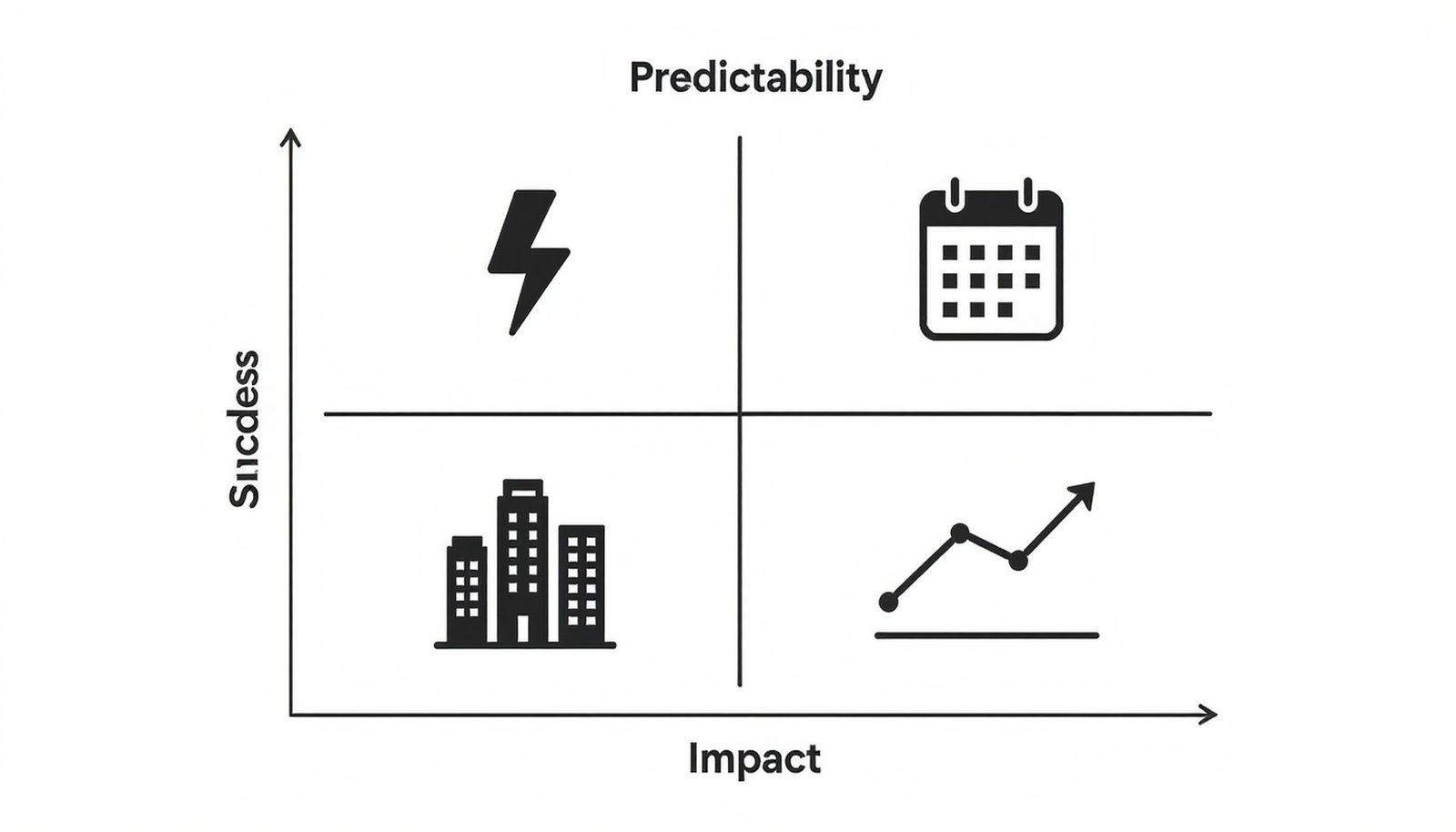
The Visa Bulletin backlog mismatch is fundamentally a problem of uncertainty. Some elements are predictable; others are not. Distinguishing between the two is essential for interpreting the system.
6.1 Predictable structural features
Certain aspects of the system are stable and can be treated as fixed:
- Annual caps and per-country limits are set by law and do not change month to month.
- Priority dates are fixed once assigned; your place in line does not move backward.
- Category and country segmentation (for example, separate lines for India EB-2 vs All Chargeability EB-2) is consistent.
These features explain why some categories and countries have chronically long waits. They are not random; they are built into the design.
6.2 Semi-predictable dynamics
Other elements show patterns but not precise schedules:
- Non-linear movement: periods of rapid advancement are often followed by slowdowns or retrogression once the system measures the new demand.
- Chart selection: USCIS tends to allow DFF when it needs more AOS filings and revert to FAD when the pipeline is full, but the exact months are not announced far in advance.
- Local capacity constraints: historically understaffed consulates or field offices are likely to remain slower, even if the bulletin moves.
These dynamics can be monitored by watching monthly bulletins and agency announcements, but they cannot be forecast with precision.
6.3 Hard-to-predict shocks
Some risks are inherently difficult to anticipate:
- Sudden policy shifts that change how demand is counted or how visas are allocated within a year.
- External disruptions (pandemics, security incidents, local political events) that shut down or slow consulates.
- Data anomalies where prior demand estimates turn out to be wrong, forcing abrupt retrogression.
These shocks explain why even well-prepared applicants can face unexpected delays. The system is not only complex; it is also exposed to events outside the immigration agencies’ direct control.
7. Why the System Feels So Confusing: Jargon as a Symptom of Design
The Visa Bulletin ecosystem is full of jargon—priority dates, chargeability, retrogression, DFF vs FAD. This is not just a language issue; it reflects the underlying complexity of the system’s design.
7.1 Multiple audiences, one document
The bulletin is written for several audiences at once:
- Consular officers and USCIS staff, who need precise instructions on which cases they can move.
- Immigration lawyers, who interpret the bulletin for clients.
- Applicants, who want a straightforward answer: “How long will I wait?”
Because the bulletin must serve the first two groups, it is optimized for operational clarity, not for user-friendliness. The gap between what it is designed to do and what applicants want from it is a major source of confusion.
7.2 The illusion of a timeline
Visually, the bulletin resembles a timeline: a table of dates that seem to move forward month by month. Functionally, it is a control knob that the government turns up or down based on demand.
When applicants treat it as a timeline, they naturally expect linear progress. When the control knob moves backward (retrogression) or stalls, it feels like a broken promise. In reality, the bulletin never offered a schedule; it only indicates how far the system can go this month given the caps.
7.3 Reliance on intermediaries
Because the bulletin is not designed as a consumer-facing timeline, applicants often rely on attorneys, forums, and third-party interpreters to translate it into expectations. This reliance is not only about legal complexity; it is a structural response to a system that exposes individuals to high-stakes timing risk without providing a simple, personalized forecast.
8. Balanced Conclusion: What the Backlog Mismatch Really Means
The mismatch between Visa Bulletin dates and real processing delays is not a glitch; it is the predictable outcome of a quota-based system trying to manage excess demand with limited tools. Annual caps and per-country limits create long, uneven queues. The Visa Bulletin’s two-chart system and monthly adjustments are mechanisms to ration access to those queues and keep the pipeline full without breaking the rules.
For applicants, this implies:
- The bulletin is a signal of relative position in a queue, not a guaranteed timeline.
- “Current” status marks the start of a processing tail that can last 6–18 months or more, depending on AOS vs consular path and local capacity.
- Retrogression and chart changes are structural responses to demand, not personal setbacks, but they can still have real consequences if you are not document-ready.
Understanding these mechanisms does not remove the delays, but it does change how the system’s movements are interpreted. When you see dates jump or stall, you can read those shifts as the system adjusting to pressure rather than as random chaos. You cannot control the caps or the per-country limits, but you can align your expectations with how the system actually operates: a rationing device managing scarcity, not a calendar counting down to a fixed appointment.