
I don’t start with a dream board of destinations. I start with my pay stub.
It’s not glamorous, but it’s the only way I’ve found to travel often without wrecking my finances or coming home to a credit card hangover.
In this guide, I’ll walk you through how to reverse-engineer a whole year of trips from real numbers: your income, your fixed bills, and your actual priorities. No fantasy budgets. No “just manifest it” magic.
By the end, you’ll know:
- How much you can spend on travel this year without sabotaging savings or debt payoff
- How many trips that realistically buys you (and what kind)
- What to say
no
to so you can say a biggeryes
to the trips that matter
1. Start With Reality: How Much Can You Actually Spend on Travel?
Before I even think about flights, I ask one blunt question: How much of my income can I safely allocate to travel this year?
Most financial planners land in the same range: 5–10% of your annual net (take-home) income for travel, but only after you’re:
- Covering essential bills (housing, food, transport, insurance)
- Contributing to savings and investments
- Not drowning in high-interest debt
That 5–10% guideline shows up again and again in financial advice, including from planners quoted by Morningstar and independent advisors like Journey Financial Wellness. It’s not a law, but it’s a solid guardrail for annual travel budget planning.
Here’s how I turn that into a real number instead of a vague idea:
- Take your annual net income.
Example: You take home $4,000/month → $48,000/year. - Pick a percentage that fits your situation.
- If you have high-interest debt or no emergency fund: 0–3% (or even 0 for a year).
- If you’re stable but still building: around 5%.
- If you’re solid on savings and retirement: up to 10%.
- Do the math.
5% of $48,000 = $2,400/year for travel.
10% of $48,000 = $4,800/year for travel.
Now you have a hard ceiling. That’s your sandbox. Everything else in this article is about how to play inside it and build a realistic yearly vacation budget by income.
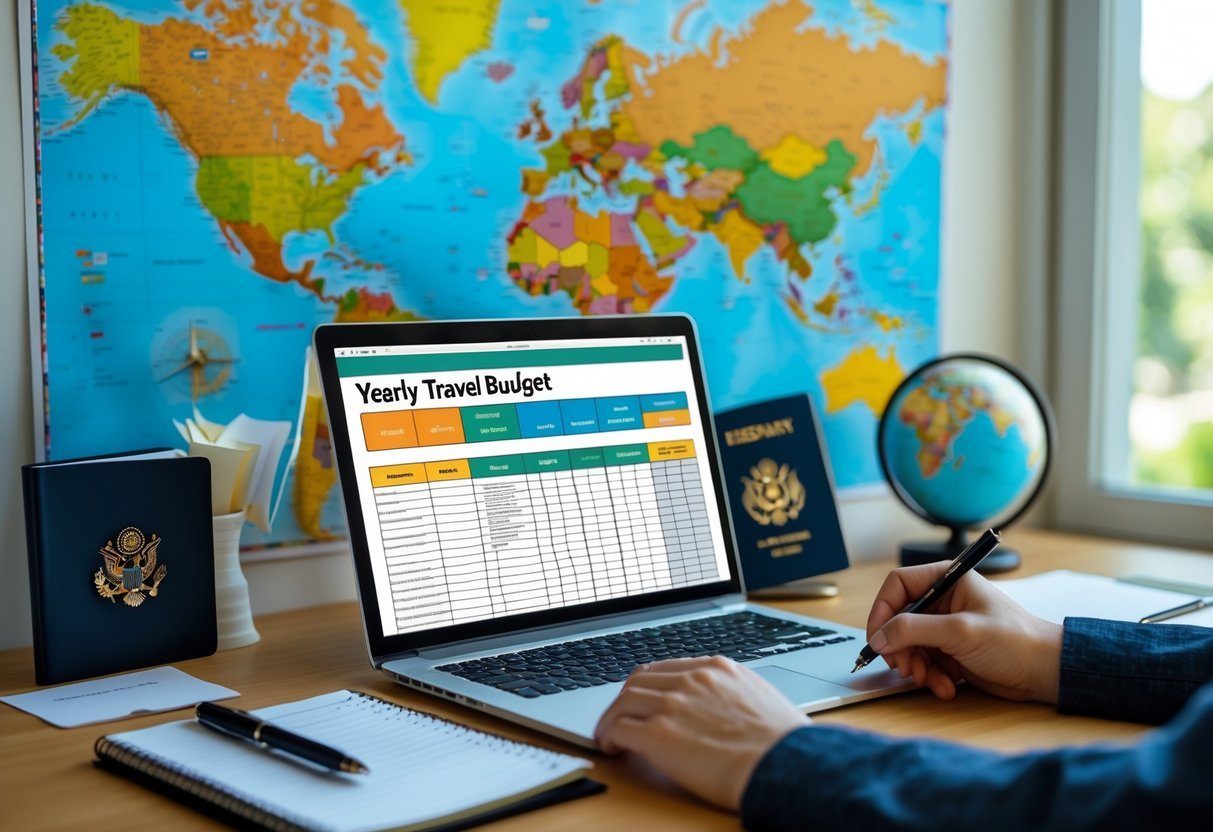
One more thing that makes a huge difference: I treat travel as a monthly bill, not a surprise.
- $2,400/year → $200/month into a separate travel account
- $4,800/year → $400/month into that same account
This is exactly what sites like DollarSprout recommend: a dedicated travel line item and a separate account. It turns big trips into predictable, boring, affordable chunks—a simple travel sinking fund strategy.
2. Choose Your Travel Persona: What Does Your Income Realistically Support?
Once I know my annual travel number, I ask: What kind of traveler does this actually make me?
Not the traveler I wish I was. The one my bank account can sustain year after year.
I like using flexible personas
inspired by the framework from Curry Forest. These aren’t rules; they’re reality checks that help you reverse engineer travel from finances.
Assume these are individual or couple numbers. Families will need to adjust up for kids and build a more realistic travel budget for families.
$30K–$50K: The Budget Explorer
- Annual travel budget (5–10%): roughly $1,500–$5,000
- Likely focus: short domestic trips + a few weekend getaways
What this might look like in a year:
- 2–4 weekend trips (driveable, budget stays)
- 1 modest domestic trip (3–5 days)
- Maybe 1 budget international trip every 1–2 years if you save aggressively
$60K–$90K: The Resourceful Traveler
- Annual travel budget: about $3,000–$9,000
- Likely focus: mix of domestic and 1–2 international trips
Possible year:
- 1 bigger international trip (7–10 days)
- 1–2 domestic trips (3–5 days)
- 1–3 weekend getaways
$100K–$200K: The Balanced Traveler
- Annual travel budget: about $5,000–$20,000
- Likely focus: more comfort, more flexibility, maybe a workation
Possible year:
- 1–2 international trips (7–14 days each)
- 2–4 domestic trips
- Optional: 1 extended workation if your job allows
$250K+: The Frequent Voyager
- Annual travel budget: $12,500–$50,000+ (if you still stick to 5–10%)
- Likely focus: frequent trips, business class upgrades, more last-minute choices
Here’s the key: you don’t have to “spend up” to your income tier. A $200K earner can absolutely travel like a Budget Explorer and hit other goals faster. A $60K earner might choose one big international trip and skip everything else.
I constantly ask myself: If I look back in 5 years, which trip will I be glad I didn’t cheap out on?
That question usually kills a lot of FOMO weekends and frees up money for the one or two trips that actually matter.
3. Break Your Year Into Trip Types (and Realistic Price Ranges)
Now we get practical. I take my annual travel number and break it into trip types with rough cost ranges. This is where the reverse-engineering really happens and where a multi trip travel budget planner becomes useful.
From the Curry Forest framework and my own experience, I use four main categories:
1. Weekend Getaway (2–3 nights, usually domestic/driveable)
- Accommodation: $80–$200/night
- Transport: $50–$300 (gas, train, or short flight)
- Daily spending (food + activities): $40–$120/day
Typical total: $250–$800 per trip
2. Short Domestic Trip (3–5 nights)
- Accommodation: $100–$250/night
- Flights/transport: $150–$500
- Daily spending: $60–$150/day
Typical total: $600–$1,800 per trip
3. International Trip (7–14 nights)
- Flights: $600–$1,500+ depending on region and season
- Accommodation: $40–$300/night (hostels to mid-range hotels)
- Daily spending: $40–$200/day (huge variation by country)
Typical total: $1,500–$5,000+ per trip
4. Workation / Extended Stay (3–8 weeks)
- Flights: similar to an international trip
- Accommodation: monthly rental or long-stay discount
- Daily spending: closer to
living costs
thanvacation costs
Typical total: $3,000–$8,000+ depending on location and length
Workations are where people get into trouble. They sound cheap (I’ll just live like a local!
) but the upfront costs are big, and you’re still paying some home expenses. Curry Forest is blunt about this: at lower income levels, a workation may require saving for multiple years or making serious trade-offs.
Here’s how I use these ranges to reverse-engineer my year and decide how much to budget for travel per year in practice:
- Start with annual travel budget (say $3,000).
- Pick a main trip type for the year (e.g., 1 international trip at $2,000).
- See what’s left for smaller trips (e.g., $1,000 → maybe 1 short domestic + 1 weekend).
Notice something: these trip types are not meant to be additive at full volume. Most people can’t do 2 big international trips, 3 domestic trips, and 6 weekends on a normal income without blowing past that 5–10% range.
So I pick a lane: This is my international year.
Or: This is my year of lots of small trips.
Trying to do both is how budgets quietly explode.

4. Design Your Year: Rank Trips by Meaning, Not Hype
Once I know what my budget can buy in theory, I force myself to answer a harder question: Which trips actually matter to me this year?
This is where I stop copying Instagram and start being honest. A few prompts I use:
- Who do I want to see? Family events, long-distance friends, aging relatives.
- What life moments are time-sensitive? Weddings, reunions, kids’ school breaks.
- What do I crave more: depth or variety? One big immersive trip, or several quick hits?
- What kind of energy do I have? Party city, nature reset, slow coastal town?
This mirrors the advice from minimalist and financial writers: rank trips by priority and meaning, not by what’s trending. The minimalist travel budgeting approach from Live the Minimalist Lifestyle is especially clear on this: limited funds should go first to the most meaningful travel.
Here’s the simple system I use as a step by step travel budget plan for the year:
- List every trip idea you’re considering for the year.
- Next to each, write a quick label:
non-negotiable
,would be nice
, orFOMO
. - Estimate a rough cost for each using the ranges above.
- Sort by meaning, not by cost or hype.
- Start allocating your annual budget from the top of the list down.
At some point, you’ll hit a line where the money runs out. Everything below that line becomes:
- Deferred to next year, or
- Redesigned (shorter, closer, cheaper), or
- Deleted because it was never that important.
This is the moment where your travel year stops being fantasy and becomes a plan.
5. Reverse-Engineer Each Trip: From Total Budget Down to Daily Spend
Now we zoom in. For each trip that survives the priority cut, I reverse-engineer the budget from the top down.
Instead of asking How much will this cost?
I ask: How can I design this trip to fit inside the amount I’ve already decided I can afford?
Here’s the structure I use, which lines up with the four pillars mentioned by Hyperfocus Adventures and others:
- Flights / transport
- Accommodation
- Food
- Activities + extras
Example: I’ve allocated $2,000 for a 10-day international trip.
- Set a hard total.
$2,000 is the ceiling. Not a suggestion. - Estimate flights first.
Let’s say I find realistic options around $800. That leaves $1,200. - Decide on accommodation style.
If I choose $80/night for 9 nights → $720. Now I have $480 left. - Divide the rest into daily spending.
$480 ÷ 10 days = $48/day for food, local transport, and activities.
Now I have a clear daily target. If I want more comfort or more paid activities, I have to move something else:
- Cheaper flights (flexible dates, nearby airports, off-season)
- Cheaper accommodation (hostels, guesthouses, staying slightly outside the center)
- Shorter trip (7 days instead of 10)
- Cheaper destination with a lower cost of living
This is exactly the trade-off mindset recommended by Upgraded Points: sometimes it’s better to shorten the trip or delay it so you can actually afford the experiences you care about, instead of going early and watching every dollar.
One more thing I always add: a 10–20% buffer for surprises. Delays, medical visits, last-minute taxis, baggage fees, currency swings. Minimalist travel budgeting guides are adamant about this, and they’re right. I’ve never regretted having extra; I’ve often regretted not having it.

6. Match Destination to Budget (Not the Other Way Around)
Here’s where a lot of people blow up their annual plan: they fall in love with a destination first, then try to force their budget to stretch around it.
I flip that. I start with a fixed amount and ask: What destinations let me have the best experience for this money?
Some rules I use, heavily influenced by the skeptical tone of Hyperfocus Adventures:
- Cheap flight + expensive city = budget trap.
A $300 flight to a city where every meal is $40 and hotels start at $250/night is not a deal. - Expensive flight + cheap country can be a win.
If you pay $900 to get there but spend $30–$60/day once you arrive, the total can still be very reasonable. - Off-season is your friend.
Shoulder seasons can cut costs dramatically while keeping most of the experience. - Swap famous for similar.
ThinkWinter Park instead of Vail
,Reno instead of Vegas
, or a smaller coastal town instead of the most Instagrammed one.
When I’m being honest with myself, I also ask:
Do I want this place, or do I want the idea of this place?
Would I enjoy a less-famous but more affordable alternative just as much?
Sometimes the answer is No, I really want this place.
In that case, I don’t try to hack it. I just accept that I need to:
- Save longer
- Cut other trips
- Or push it to next year
That’s not failure. That’s how you avoid the We went to Paris but couldn’t afford to do anything
story and one of the biggest travel budget mistakes to avoid.
7. Make It Sustainable: Systems So You Can Travel Every Year
One good year of travel is easy. Ten good years of travel without financial chaos? That’s harder.
This is where I borrow from the idea of financially sustainable travel
described by The Professional Hobo: it’s not about being ultra-cheap; it’s about making sure your travel spending stays below what you earn over time, even when life throws curveballs.
Here are the systems I use to keep my travel habit sustainable and to consistently allocate income to travel savings:
1. Separate Travel Fund
- Automatic monthly transfer (my 5–10%) into a dedicated account
- I pay for trips from that account only
- No mixing with emergency fund or rent money
2. No Big Trips on High-Interest Debt
- If I’m carrying expensive credit card debt, I downshift travel hard
- Maybe one cheap weekend or a visit to family, but no $3,000 vacations
3. Track During the Trip
- Simple note app or spreadsheet
- Daily log of what I actually spent vs. what I planned
- Adjust mid-trip if I’m burning through cash too fast
4. Post-Trip Review
- Where did I underestimate? (Usually food and local transport.)
- What did I overspend on that I didn’t really care about?
- What was worth every dollar?
That last question is crucial. If I realize I barely used the fancy hotel but loved the food tours, I know to shift future budgets away from lodging and toward experiences.
Over a few years, this turns into a personal playbook: your own travel persona, backed by data, not vibes. It’s an affordable yearly travel planning system you can actually stick with.
8. Put It All Together: Your One-Page Annual Travel Plan
If you want to make this real, here’s the one-page exercise I’d actually do today. Think of it as your quick-and-dirty travel savings plan for the year and a way to compare annual vs per trip travel budget at a glance:
- Calculate your annual travel number.
Net income × 5–10% (or less if you’re tackling debt). - Translate it into a monthly transfer.
Annual travel budget ÷ 12 → automatic transfer into a travel account. This is your simple travel budget framework by paycheck. - Pick your main persona for the year.
Budget Explorer, Resourceful Traveler, Balanced Traveler, or Frequent Voyager. - List all trip ideas and rank them.
Non-negotiable / would be nice / FOMO. This is where you’re prioritizing trips on a limited budget. - Assign a rough cost to each trip type.
Weekend, short domestic, international, workation. - Allocate your annual budget from the top of the list down.
Stop when the money runs out. Everything below the line gets cut, shrunk, or moved to next year. - For each surviving trip, reverse-engineer the budget.
Total → flights → accommodation → daily spend → 10–20% buffer. - Commit to tracking and reviewing.
During the trip and after. Adjust next year’s plan based on what you learn.
The goal isn’t to travel the most. It’s to travel in a way that feels rich now and still makes sense to your future self.
If you can look at your calendar and your bank account and feel calm about both, you’ve nailed it.