
I love peak season travel. Full planes, packed airports, that buzz of everyone going somewhere important. I just don’t love paying double for the privilege.
If you’ve ever watched a fare jump $200 overnight and wondered if the airlines were messing with you, you’re not alone. The good news: there is a system behind the chaos. Once you understand it, you can bend it in your favor.
This guide is about doing exactly that: using smart timing, fare alerts, and a few routing tricks to keep peak season travel costs under control. Think of it as flying in high season like the rich people do
—without paying rich-people prices.
1. First, Accept the Hard Truth: Peak Season Is Designed to Squeeze You
Let’s start with the uncomfortable bit. Airlines don’t just respond to peak season; they plan around it.
Think about holidays, school breaks, big events. Airlines know you’re emotionally invested: you’re going home for Christmas, taking the kids to Disney, or flying to a once-in-a-lifetime festival. Behavioral economists would say your price resistance
drops. Airlines quietly agree.
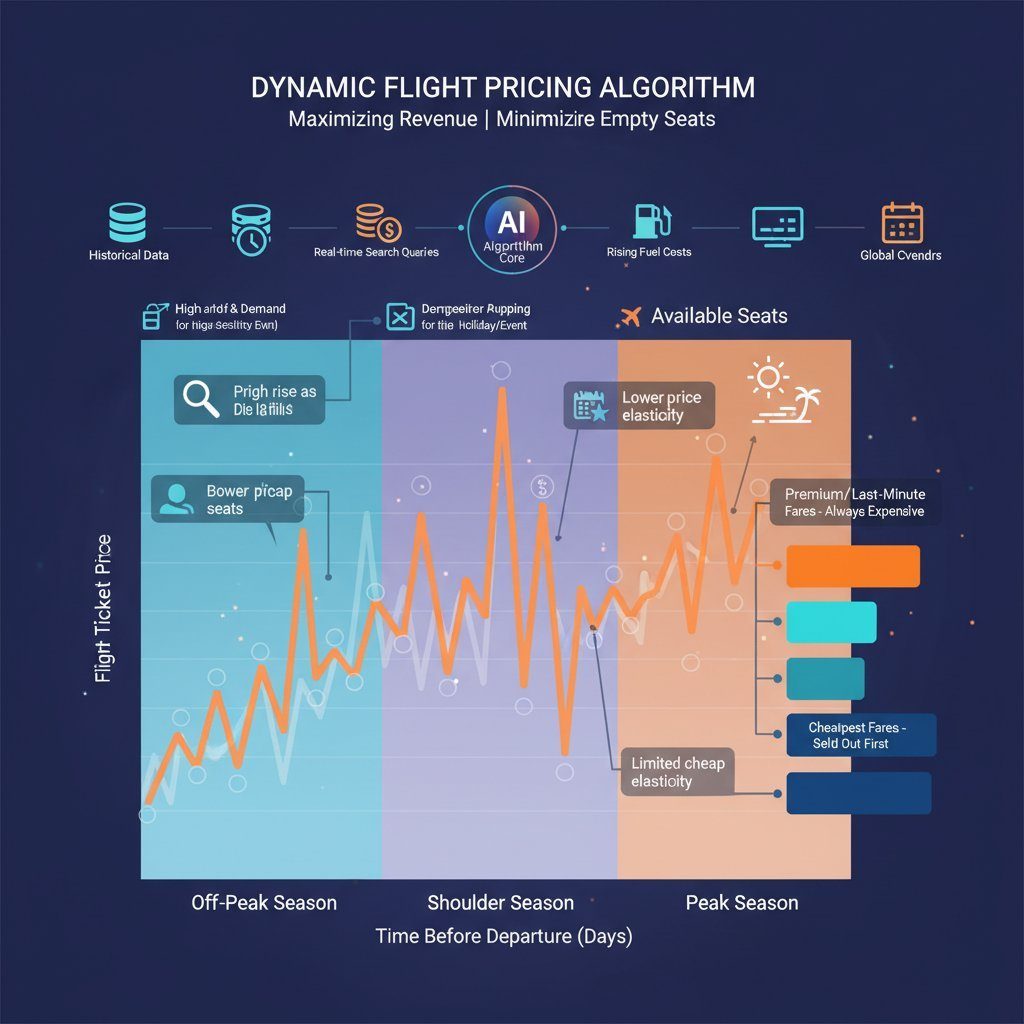
Behind the scenes, AI-driven systems watch demand in real time. Seats are split into fare buckets. The cheapest buckets sell first; as they disappear, the algorithm nudges you into higher tiers. That’s why a flight can jump from $184 to $480 in a couple of weeks around Christmas, or why early July is consistently brutal compared with late August.
Here’s the mindset shift that matters for anyone trying to avoid surge pricing flights: you’re not hunting for a magic day to book. You’re navigating demand. Once you stop chasing myths like book on Tuesdays
and start reading demand patterns, you’re already ahead of most travelers.
2. Decide: Are You Willing to Shift Your Dates or Just Your Expectations?
Before you even open a search engine, ask yourself one question honestly:
What’s more flexible—your dates or your budget?
If your dates are locked (wedding, school break, fixed holiday), your main job is to book smart and early. If your dates are flexible, you can play a much more interesting game with peak season vs off season airfare.
Here’s how to frame it:
- Locked dates, fixed event: Aim for the best price within reality, not a miracle. Use fare alerts for peak season, book in the recommended window (about 1–3 months domestic, 2–8 months international), and avoid the worst days.
- Flexible dates, fixed destination: Use full-month calendars on tools like Google Flights to slide your trip by a day or two. Tuesdays, Wednesdays, and sometimes Saturdays are your friends.
- Flexible dates and destination: You’re in the sweet spot. You can chase shoulder seasons, alternative airports, and even mistake fares. This is where the biggest savings live and where cheap peak season flight strategies really pay off.
Peak season doesn’t disappear, but you can often step just outside its core. Flying the Tuesday before Thanksgiving instead of Wednesday, or coming back on a Monday instead of Sunday, can shave hundreds off a family trip.
3. Use Fare Alerts Like a Radar, Not a Slot Machine
Most people treat flight searches like a slot machine: pull the lever, hope for a jackpot, repeat in incognito mode. That’s exhausting and mostly pointless.
I treat airfare alerts for high season travel as my radar. They watch the sky; I only act when something interesting appears.
Here’s a simple system that works well during peak travel season:
- Step 1: Set your baseline. Run a search for your route and dates. Note the current price and what feels
acceptable
to you. This matters because you need a target. - Step 2: Turn on alerts. Use tools like Google Flights, KAYAK, or specialized bots like AirTrackBot. They’ll track price movements and, in some cases, even tell you
buy now
orwait
with a confidence score. - Step 3: Watch the pattern, not every blip. Prices can change multiple times a day. A $20 swing isn’t a signal; a $100 drop or a steady upward trend is.
- Step 4: Decide your trigger. Maybe it’s
if this drops below $650, I book
. When your alert hits that number, you act. No second-guessing.
The goal isn’t to hit the absolute rock-bottom fare. It’s to land in the lower part of the normal range and avoid the painful spikes that hit people who wait too long or book blindly.

4. Beat Surge Pricing with Timing: Days, Weeks, and Seasons
Timing is where most of the real savings hide. Dynamic pricing airline tickets might sound mysterious, but the patterns are surprisingly human.
Within the year: avoid the obvious traps
Peak seasons are predictable:
- Summer: especially early July and school holidays.
- Winter holidays: Thanksgiving, Christmas, New Year’s.
- Spring break: March–April, depending on region.
- Local events: festivals, Golden Week, Carnival, big conventions.
Instead of asking when are flights cheap?
, ask: where is it not peak right now? Peak seasons are staggered globally. Europe’s summer might be off-peak for parts of Asia, and vice versa.
If you can shift your destination or go just before or after the core dates, you’re effectively stepping into shoulder season, where prices are often dramatically lower and budget peak season vacation planning becomes much easier.
Within the week: fly when others don’t want to
Airlines price by demand, not by fairness. So:
- Most expensive days: Friday departures, Sunday returns.
- Cheaper days: Tuesday, Wednesday, and sometimes Saturday.
- Cheaper times: mid-day flights, late-night red-eyes.
If you’re willing to fly out on a Wednesday and back on a Tuesday instead of the classic Friday–Sunday combo, you’re already dodging the worst of the surge.
Booking window: not too early, not too late
There’s no universal magic day, but there are sensible windows if you want smart timing for flight booking:
- Domestic: roughly 1–3 months before departure.
- International: roughly 2–8 months before departure.
Book within two weeks of departure during peak season and you’re basically volunteering to subsidize the airline’s profits. Book 10–11 months out and you’re guessing before the airline has even finished optimizing its schedule.
Use alerts to watch how prices behave in your window. If they’re creeping up steadily, that’s your cue to lock something in.
5. Route Tricks: Alternative Airports, Hidden Peaks, and Risky Hacks
Sometimes the cheapest ticket isn’t about when you fly, but how you structure the route. This is where alternate airport route tricks and cost saving flight routing hacks come into play.
Alternative airports that actually make sense
Big cities often have multiple airports. Some are dominated by legacy carriers; others are playgrounds for low-cost airlines. That matters.
- Think Oakland vs. San Francisco, Newark vs. JFK, Gatwick vs. Heathrow.
- Secondary airports can unlock cheaper routes and budget carriers, especially during peak season.
- But factor in ground transport, time, and baggage fees. A $60 cheaper flight that costs you $40 in transfers and two extra hours may not be worth it.
I like to run a quick comparison: total cost (fare + transport + baggage) vs. convenience. If the savings are real and the hassle is manageable, I’ll happily fly into the less sexy
airport.
Watch for hidden local peaks
Here’s a subtle trap: you might think you’re traveling off-peak, but your destination isn’t.
Example: You book a random week in October to Europe thinking it’s quiet. But your destination city has a major trade fair or festival. Suddenly, hotels and flights spike. Local calendars matter as much as your own.
Before you book, do a quick search: [city] public holidays
, [city] festivals
, or check tourism sites. If you see a big event, either embrace it (and budget for it) or shift your dates.
Skip-lagging and other gray-area tactics
Skip-lagging (booking a longer route and getting off at the layover) can sometimes undercut peak prices. But it comes with real risks:
- Airlines can cancel the rest of your itinerary if they catch it.
- You can’t check bags (they’ll go to the final destination).
- It can violate airline terms of carriage.
I treat skip-lagging as a last resort, not a standard strategy. If you use it, understand the rules and accept the risk. There are safer ways to save money and beat airline surge pricing without flirting with a canceled ticket.

6. Choosing Between Budget and Full-Service: The Price Tag Is Lying to You
Peak season is when budget airlines look most tempting. That $199 fare to Europe? It’s whispering your name. But the base fare is only half the story.
Here’s how I compare:
- Base fare vs. total fare: Add baggage, seat selection, meals, and airport transfers. Suddenly that $199 ticket might be $350+.
- Airport location: A cheap flight to a far-flung secondary airport can mean expensive taxis or long trains.
- Flexibility: Budget carriers often have brutal change fees and limited protections. During peak season, when disruptions ripple through the system, that matters.
On the flip side, legacy carriers aren’t always more expensive once you factor in what’s included. Sometimes a slightly higher fare with a bag and better schedule is the smarter move.
My rule: never compare just the headline price. Compare the total cost of the trip and the risk you’re taking on. Peak season is not the time to gamble everything on a razor-thin connection and a carrier with no support.

7. When to Stop Watching and Just Book
This might be the most important part: knowing when to stop.
Dynamic pricing means fares can always move. You could book today and see a $40 drop tomorrow. You could wait for that drop and watch the price jump $200 instead. There’s no way to win every time.
So I use a simple framework to avoid the most common peak season booking mistakes:
- Set a realistic target. Based on alerts, past experience, and your budget, decide what
good enough
looks like. - Watch the trend. If prices are flat or gently drifting down, you can wait (within your booking window). If they’re climbing steadily, that’s your signal.
- Book when your target hits. When a fare meets your number, you book and move on. No doom-scrolling flight prices for weeks.
Remember: airlines design these systems to make you feel like you’re always one click away from a better deal. You’re not. You’re one click away from either a reasonable fare or a more expensive one.
Your job isn’t to beat the algorithm. It’s to avoid being the person who pays the highest price on the plane.
8. Put It All Together: Your Peak Season Playbook
Let’s turn this into something you can actually use for your next trip.
- Map the demand. Identify if your dates hit a major holiday, school break, or local event at your destination. A quick peak travel season price comparison across dates can reveal nasty surprises.
- Decide your flexibility. Can you move dates by a day or two? Fly midweek? Use a different airport?
- Set alerts early. 2–8 months out for international, 1–3 months for domestic. Let tools track the noise and send you fare alerts for peak season instead of refreshing endlessly.
- Use calendars, not guesses. Check full-month views to spot cheaper days and shoulder-season sweet spots.
- Compare total trip cost. Budget vs. full-service, primary vs. secondary airports, including bags and transfers. Don’t let a fake “cheap” fare trick you.
- Pick your trigger price. Decide what you’ll happily pay and book when you see it.
If you do just those six things, you won’t always get the absolute cheapest ticket. But you’ll consistently avoid the worst of peak season surge pricing—and that’s where the real savings are.
The airlines are betting you’ll panic, procrastinate, or cling to myths. You don’t have to. You just have to be a little more deliberate than the average traveler.
Next time you see a packed holiday departure gate, ask yourself: How many of these people paid more than they needed to?
Then quietly enjoy knowing you probably weren’t one of them.