I’ve lost count of how many times I’ve opened a rental car site, seen a “$39/day” deal, and thought, Nice, that’s cheaper than flying.
Then the final total shows up with fees, insurance, parking, and suddenly I’ve priced out a small used car.
This guide is for that moment before you lock yourself into a rental car money trap. I’ll walk through how I actually decide between car, train, bus, and budget flights in the U.S. — with real numbers, not wishful thinking.
As you read, keep one question in mind: What am I really paying for — money, time, or convenience?
1. First Filter: Distance, Group Size, and Time (Your “Mode Shortlist”)
Before you compare prices, you need a shortlist. Not every mode makes sense for every trip, and that’s where most car vs train vs bus vs flight cost comparisons go off the rails.
Here’s how I quickly narrow it down:
- Under ~300 miles (e.g., NYC–DC, LA–Vegas): I compare car vs bus vs train. Budget flights usually lose on time once you add airport hassle.
- 300–700 miles (e.g., Chicago–DC, Atlanta–Miami): I compare car vs budget flight vs overnight bus/train.
- 700+ miles (e.g., Boston–Miami, LA–Seattle): I start with budget flights vs overnight bus/train, and only add a car if I really need it at the destination.
Then I layer in group size:
- Solo traveler: Bus or train often wins on cost; budget flights can win on time.
- Couple: Bus/train/flight are still competitive; a car starts to make sense on shorter routes.
- 3–5 people: Car costs get split; flights and train tickets multiply. The car suddenly looks much cheaper.
Research backs this up: driving often wins for groups and trips under roughly 600 miles, while flying can be better for longer distances or when time is tight (source).
Quick rule of thumb: If you’re solo and under 600 miles, don’t default to a rental car. At least price out bus and train first — especially if you’re trying to find the cheapest way to travel in the USA.
2. The Rental Car Trap: Why “$39/Day” Is Almost Never $39/Day
Rental cars are where a lot of U.S. trips quietly go over budget. The headline rate is only the start of the hidden costs of rental cars in the US.

Here’s what I actually include when I compare a rental car to other modes:
- Base rate: In real life, think $50–$85/day, not the teaser rate you see in the ad.
- Airport premium: Airport locations charge about 18.4% more on average than off-airport branches. A typical week: ~$555 at the airport vs ~$469 off-site — an $86 “convenience tax” (source).
- Insurance: $15–$30/day if you’re not covered by your own policy or credit card.
- Fuel: For a week of moderate driving, $40–$80 is realistic.
- Parking: In big cities, $20–$50/day plus hotel parking. This is the line item people forget.
- Tolls: Either pay as you go or get hit with rental-company toll programs and admin fees.
And if you’re thinking, I’ll just drive my own car, that’s free,
it isn’t. AAA estimates maintenance at roughly $0.06–$0.10 per mile. A 1,000-mile round trip quietly adds $60–$100 of wear and tear (source). That matters if you’re doing a rental car vs own car road trip costs comparison.
When a rental car is a money trap:
- You’re flying into a transit-rich city (NYC, Boston, DC, Chicago, San Francisco).
- You’ll mostly stay in central areas with expensive parking.
- You don’t actually need a car every day — just for one or two side trips.
In those cases, I usually do this instead: public transit + occasional rideshare. If I really need a car, I rent it for just that day from a non-airport location. That one change can save more than any coupon code.
Off-airport hack: Going off-site usually makes sense when weekly savings are above about $80–$100 and the round-trip cost to reach the off-site location stays under $30–$40 (source). Ignore this, and you’re walking straight into the classic rental car money trap.
3. Driving vs Flying: The Only Comparison That Actually Matters
Most people compare driving vs flying like this: Gas vs plane ticket.
That’s why they get the answer wrong, especially when they try to DIY a drive vs fly cost calculator USA in their head.
Here’s the more honest formula I use, inspired by tools like this calculator:
Driving cost = fuel + tolls + (miles × maintenance rate) + parking + hotels on the way + road meals
Flying cost = ticket(s) + seat/baggage fees + airport parking or rideshare + local transport or rental car at destination
Then I add an optional piece:
Time cost = hours of travel × what an hour is worth to you (even if that’s just $15–$20).
Two things usually flip the result:
- Group size: Driving costs are shared; flight tickets multiply. A family of four can often drive for the cost of one or two plane tickets.
- Trip length: Under ~600 miles, driving often wins on both cost and sanity. Over that, flying starts to look better, especially if you’d need a hotel night on the road.
Here’s how that plays out in real life:
- 500-mile trip, solo: Gas + wear might be $120–$150. A budget flight might be $120–$180. Once you add parking, tolls, and your time, the flight can easily win.
- Same trip, four people: Driving might still be ~$150 total. Four flights at $150 each is $600 before bags. Driving almost certainly wins on cost.
My rule: If I’m solo and the drive is more than 8–9 hours, I aggressively look for a budget flight. If I’m with 3–4 people, I’ll tolerate a longer drive before flying makes sense. That’s the heart of any honest rental car vs bus vs flight time and cost comparison.
4. Car vs Train: When Rails Beat Roads (and When They Don’t)
In the U.S., trains are not universally great. But where they work, they really work — especially if you’re doing a rental car vs Amtrak cost comparison on busy routes.

Here’s the key difference in how I think about it:
- Car costs are mostly fixed per vehicle (rental, insurance, fuel, tolls) and get cheaper per person as you add passengers.
- Train costs scale per seat. Every extra person is another ticket.
So:
- Solo or couple on a busy corridor (Boston–NYC–DC, some California routes): Train can be cheaper and faster, especially when stations are central and parking is expensive.
- Family or group: Car usually wins on cost, especially outside the Northeast Corridor.
Hidden train vs car factors I always check:
- Parking at destination: In some cities, a few days of parking can cost more than a train ticket.
- Hotel nights: A long drive might require a hotel stop; an overnight train with a sleeper can replace that cost and give you real rest.
- First/last mile: For trains, I add rideshares or local transit to and from the station. For cars, I add city parking and maybe a transit pass if I’ll park-and-ride.
Regional reality check:
- Northeast Corridor (Boston–NYC–Philly–DC): Train is often the sweet spot for solos/couples. Driving is stressful and parking is brutal.
- Much of the rest of the U.S.: Trains are slower, less frequent, or nonexistent. Car wins on flexibility; bus or flight may win on cost/time.
When I choose train over car: I’m solo or with one other person, I’m going city-center to city-center, and I don’t need a car at the destination. I also value arriving less tired and being able to work, read, or sleep en route. For many budget travelers, this is the sweet spot in the train vs bus vs flight for budget travelers debate.
5. Bus vs Budget Flights: The True Bottom-of-the-Budget Battle
If you’re really trying to save money, the real fight is often bus vs budget flight, not car vs anything. This is where the cheapest way to travel in the USA usually shows up.
Modern intercity buses (Megabus, FlixBus, Greyhound, regional lines) can be shockingly cheap: $20–$60 for routes that would cost hundreds by air. But there are trade-offs.
How I compare them:
- Cash cost: Bus almost always wins. Even with a checked bag, it’s hard for a budget flight to beat a $30–$50 bus ticket.
- Time: Buses are slower and more vulnerable to traffic. A 4-hour flight day (door-to-door) might replace a 10–12 hour bus ride.
- Comfort: This is personal. Some people sleep fine on buses; others arrive wrecked. Overnight buses can save a hotel night but cost you a day of feeling human.
When I lean bus:
- I’m on a tight budget and time is flexible.
- The route is under 8–9 hours, or it’s an overnight where I’m okay trading sleep quality for savings.
- Airfare is high because of events, holidays, or last-minute booking.
When I lean budget flight:
- The bus is 10–15 hours and the flight is 2–3 hours.
- I value arriving rested and having a usable first day.
- Once I add the value of my time, the flight’s higher price makes sense.
Watch out for: Budget airline fees (bags, seat selection, early boarding) and airport transfers. A “$59” flight can quietly become $150+ if you’re not careful. This is especially important when you’re weighing budget flights vs rental car for weekend trips and trying not to get burned by extras.
6. Big Cities vs National Parks: Where a Car Is Worth Every Dollar (and Where It’s Not)
This is where people overspend the most: renting a car where it’s a liability, and skipping a car where it’s essential. It’s also where a lot of car rental mistakes that waste money happen.
In big, transit-rich cities like New York, Chicago, Boston, DC, San Francisco:
- Public transport is relatively affordable: single rides around $2.50–$3, weekly passes roughly $25–$35 (source).
- Daily rental costs balloon once you add insurance, fuel, and parking — often $50–$85/day base + $15–$30/day insurance + $20–$50/day parking.
- A car often creates more problems (traffic, parking, stress) than it solves.
In these cities, I almost always:
- Use public transit + walking + rideshare.
- Skip the rental car entirely, or rent it only for a specific day trip from a downtown location.
That’s when not to rent a car for travel: when it just sits in a garage racking up fees while you ride the subway.
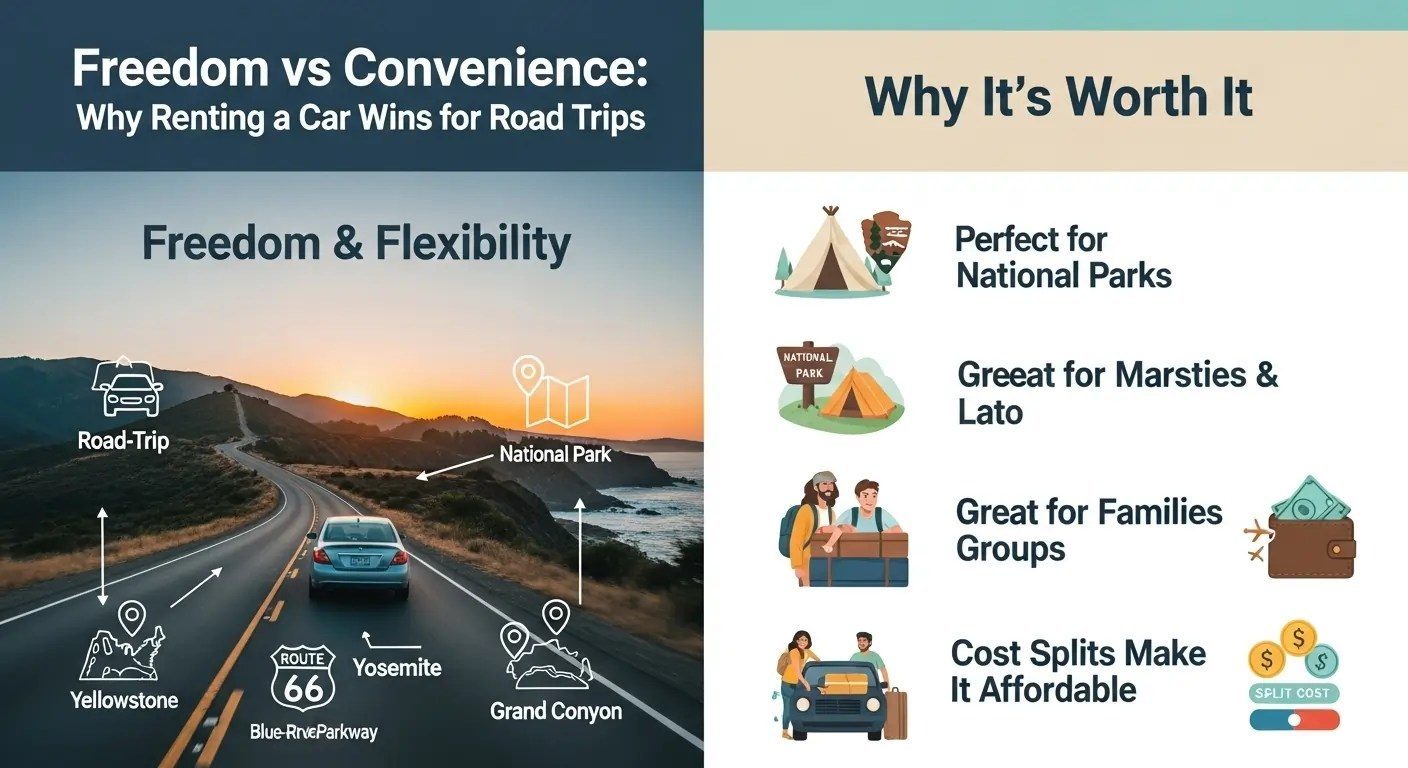
In national parks, small towns, and rural areas:
- Public transport is limited or nonexistent.
- Distances between sights are large; rideshares may be unavailable or expensive.
- A car gives you freedom to explore viewpoints, trailheads, and small towns on your own schedule.
Here, a rental car is often non-negotiable. The question isn’t car or no car?
It’s How do I get the car as cheaply and smartly as possible?
My favorite hybrid strategy:
- Fly into a big city, use public transit while you’re there.
- Pick up a rental car later from a non-airport location for the national park / road trip portion.
- Return the car before your last city days so you’re not paying to park it.
This kind of mix-and-match approach is what makes a cross country USA travel cost comparison more interesting — and often much cheaper.
7. A Simple Decision Framework You Can Reuse for Any Trip
Let’s turn all this into a quick, reusable checklist. When I plan a trip, I literally walk through these steps. Think of it as your personal cost guide for US domestic transportation.
- Define the basics
Distance (one-way), number of travelers, trip length, and how fast you need to arrive. - Shortlist modes
Under 300 miles: car vs bus vs train.
300–700 miles: car vs budget flight vs bus/train.
700+ miles: budget flight vs overnight bus/train; add car only if you truly need it there. - Ask: Do I need a car at the destination?
If yes (national parks, spread-out cities, multi-stop road trip): car moves up the list.
If no (dense city with good transit): car moves down the list. - Price the real costs, not the headlines
For car: base rate (or wear on your own car) + insurance + fuel + tolls + parking + hotel stops.
For train/bus: ticket + station transfers + maybe a hotel if it’s an overnight connection.
For flights: ticket + bags + seat fees + airport transfers + local transport or rental car.
This is where you really see the difference in rental car vs bus vs flight time and cost instead of just guessing. - Add your time value (optional but powerful)
Decide what an hour is worth to you (even $15–$20). Multiply by total travel hours for each option. Add to the cash cost. - Check comfort and stress
Will you arrive exhausted? Will you be driving in heavy traffic or at night? Is an overnight bus/train realistic for you?
Sometimes the “cheapest” option is the one that ruins your first day. - Make the call
If one option is clearly cheaper and you’re okay with the time and comfort, take it.
If costs are close, choose based on what you value more: flexibility (car), productivity/relaxation (train), speed (flight), or savings (bus).
One last thought: households in the U.S. already spend about 18% of their income on transportation, and roughly 96% of that goes to car-related expenses (source). You don’t have to add an overpriced rental car on top of that by default.
Next time you plan a trip, don’t just ask, Is it cheaper to drive or fly?
Ask instead: For this distance, with this group, and this schedule, which mode gives me the best mix of money, time, and sanity? The answer will change trip by trip — and that’s exactly the point.