I don’t care what the headline price says. The only number that matters is what you actually pay to check out – and that’s where a “cheap” hotel or “budget” Airbnb can quietly double in cost.
In this guide, I’ll walk you through how I really compare the real cost of cheap hotels vs Airbnb, step by step. We’ll look past the marketing, add up every fee, and factor in food, loyalty points, and even your travel style. By the end, you’ll know which stay is actually cheaper for your trip
– not just in theory, but in total dollars.
1. Stop Staring at Nightly Rates: Build a Real Checkout Total
When I compare a hotel and an Airbnb, I start with one simple rule:
Ignore the big bold nightly rate. Only trust the final checkout screen.
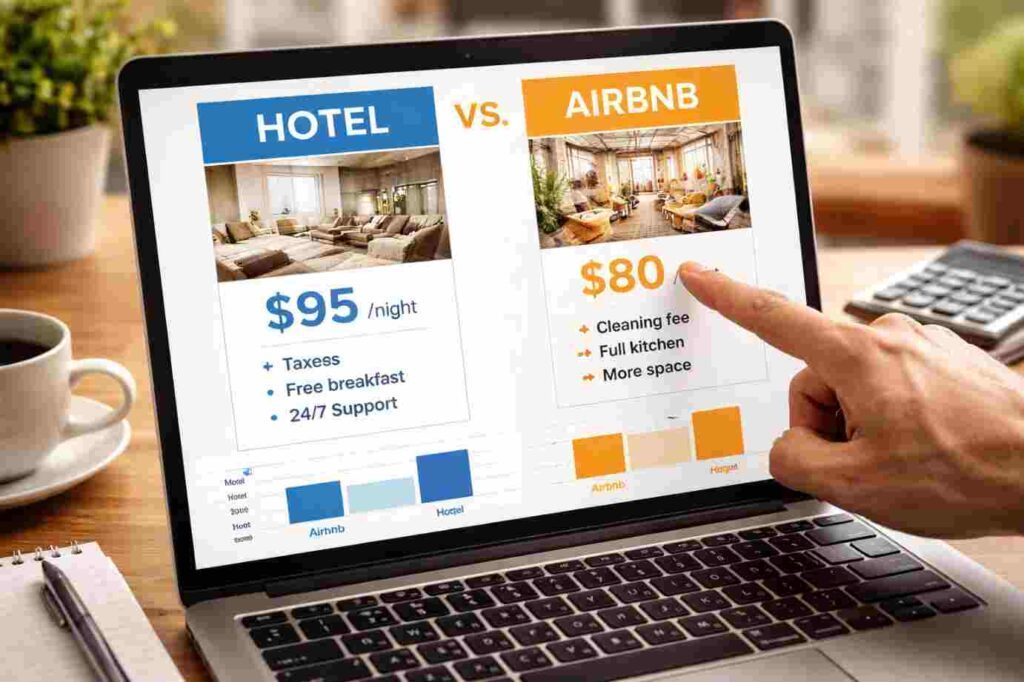
That’s the only place you see the true cost of budget accommodation. Here’s what I manually add up for each option when I do a real total stay price comparison:
- Hotel: base nightly rate × nights
- + taxes (often 10–18% depending on city)
- + resort fee / destination fee (very common in US cities and resorts)
- + parking (if you’re driving)
- − value of free breakfast, lounge access, or points (we’ll come back to this)
- Airbnb / vacation rental: base nightly rate × nights
- + cleaning fee (flat, often big)
- + service fee (Airbnb’s cut)
- + local taxes
- + any extra guest fees, pet fees, or parking
Recent multi-city data shows that for a 3-night stay, the median Airbnb checkout total is about 56% higher than the listed nightly-rate subtotal, and in some markets the markup goes over 70% (source). That’s a huge gap between what you think you’re paying and what you actually pay.
Hotels aren’t innocent either. Hidden hotel fees and charges like resort fees and parking can quietly add $30–$70 per night. But there’s one big difference:
Airbnb’s biggest extra cost (cleaning) is usually a one-time fee. That’s what makes short stays so tricky when you compare hotel vs Airbnb prices.
Takeaway: Before you decide anything, click through to the final price on both the hotel site and Airbnb. Screenshot or write down the total for the whole stay, not per night. That’s your real comparison and the basis for any honest cost guide: hotel vs Airbnb.
2. The Stay-Length Trap: Why 1–3 Nights Usually Favour Hotels
If you’ve ever wondered why a “$120/night” Airbnb suddenly costs $420 for two nights, you’ve met the villain: the cleaning fee.
For short stays, that flat fee is brutal. Here’s how I think about it when I compare nightly rate vs total price:
- 1–2 nights: Hotels usually win on price for solo travelers and couples.
- 3 nights: Hotels still win in most US markets for 1–2 people; New York is a rare exception where Airbnb can edge ahead.
- 4+ nights: Airbnbs start to become competitive, especially in expensive hotel cities.
Why? Because that cleaning fee gets spread out:
- $120 cleaning fee over 2 nights = $60 per night extra
- $120 cleaning fee over 6 nights = $20 per night extra
Meanwhile, hotel prices don’t change much per night. So the longer you stay, the more that Airbnb cleaning fee cost impact “dilutes.”
Data from several analyses backs this up: for a 3-night stay for one or two people, hotels are cheaper in 27 of 28 US markets (source). Only ultra-expensive hotel cities like New York flip the script.
Rule of thumb I use:
- City break, 1–3 nights, 1–2 people: I start with hotels and only check Airbnb if hotels are unusually pricey.
- 4+ nights: I always run the numbers on both, especially if I want a kitchen.

3. Party Size: When One Airbnb Beats Two Hotel Rooms
Here’s where Airbnb can suddenly go from “overpriced” to “obvious winner”: groups and families.
Most hotel pricing assumes 2 people per room. Once you’re a family of four or more, you’re often looking at:
- Two standard rooms, or
- A pricey suite, or
- Cramped living with kids on sofa beds and rollaways
Now compare that to a 2–3 bedroom Airbnb with a living room and kitchen. Even if the nightly rate looks higher than a single hotel room, you’re replacing two rooms with one unit.
One large study found that when a family would otherwise need two hotel rooms, Airbnbs become cheaper in 19 of 28 markets (source). That’s a big shift just from party size.
And it’s not just money. Separate bedrooms can be the difference between everyone actually sleeps
and we all come home exhausted.
How I decide for groups:
- 3+ adults or a family with kids: I always price out one larger Airbnb vs two hotel rooms.
- If the Airbnb is within ~10–15% of the hotel total, the extra space usually makes it worth it.
- If the Airbnb is significantly more but includes a kitchen and free parking, I factor in food and parking savings before deciding.

4. Food Costs: The Hidden Budget Killer (or Saver)
This is the part most people skip, and it’s where your “cheap” hotel can quietly become the expensive option.
Ask yourself: How are we actually going to eat on this trip?
For a family of four on a 7-night US vacation, realistic numbers look like this:
- Hotel, eating out most meals: roughly $840–$1,400 per week on food.
- Airbnb with kitchen, cooking breakfast + some lunches: roughly $350–$700 per week.
That’s a potential $500–$700 difference just from having a kitchen and using it a bit (source).
So even if the Airbnb is a little more expensive on paper, the total trip cost can be lower once you factor in food. This is where a simple hotel vs Airbnb total stay price comparison often flips.
On the flip side, many mid-range hotels include:
- Free breakfast (huge for families)
- Evening snacks or lounge access for elites
- Coffee/tea all day
Those perks can easily be worth $10–$30 per person per day. If you’re a couple on a short trip, a hotel with a solid free breakfast can beat an Airbnb where you’d still buy groceries and cook.
How I estimate food impact:
- Estimate restaurant cost per person per day (be honest).
- Estimate how many meals you’d realistically cook in an Airbnb.
- Subtract the value of any free hotel breakfast or lounge access.
- Compare: lodging + food (hotel) vs lodging + food (Airbnb).
Sometimes the “more expensive” lodging is actually cheaper once you feed everyone.
5. Loyalty Points, Perks, and the Real Value of a Hotel Night
If you stay in hotels even a few times a year, ignoring loyalty programs is like leaving a 20–30% discount on the table.
Here’s what I factor in when I compare a hotel to an Airbnb and try to calculate total accommodation cost:
- Points earned: hotel programs + travel credit cards can easily give you 10–20% back in future travel value.
- Elite perks: free breakfast, room upgrades, late checkout, lounge access.
- Promos: double points, bonus nights, etc.
When you add it all up, loyalty perks can effectively reduce hotel costs by 20–30% versus the sticker price, especially if you redeem points smartly later.
Airbnb has experimented with loyalty-style features, but nothing comes close to the big hotel chains yet. So if you’re a frequent traveler, the “expensive” hotel might actually be the better long-term deal.
My personal rule: If a hotel is within ~15–20% of an Airbnb’s total price, and I’ll earn/benefit from points and perks, I usually pick the hotel for short stays and business trips.
6. Location, Convenience, and the Cost of Your Time
Sometimes the cheapest-looking place is the most expensive once you factor in time and transport.
Example: You find a “bargain” Airbnb 40 minutes outside the city center. The nightly rate is $40 cheaper than a central hotel. Great, right?
Maybe not. Add up:
- Daily train/metro/bus fares or rideshares for everyone
- Extra travel time each day (which you could spend exploring or resting)
- Less flexibility for late nights or early mornings
Once you price in transport, that cheap Airbnb can easily cost more than a central hotel. And that’s before you factor in the mental load of navigating back and forth.
On the other hand, in rural areas, small towns, and beach/mountain destinations, Airbnb-style rentals may be the only way to get space, a kitchen, or even any accommodation at all. Limited hotel supply can make hotels both expensive and basic, while home-style rentals dominate the market.
Questions I ask myself:
- Will I be out all day or spending lots of time in the room?
- Is the Airbnb’s location actually convenient, or just cheap?
- How much will I spend on transport from each option?
- Is late-night arrival or early departure going to be a hassle with a host?
If I’m out all day and just need a clean, central base, a hotel usually wins. If I’m working remotely or staying a week and want to “live” in the space, an Airbnb can be worth a slightly worse location.
7. Risk, Rules, and the “No Chores” Factor
Money isn’t the only cost. There’s also friction.
With hotels, you usually get:
- 24/7 front desk
- Standard check-in/out process
- Daily housekeeping (or at least easy access to fresh towels)
- Clear safety and security protocols
With Airbnbs, you might get:
- Self check-in that works perfectly… or doesn’t
- House rules (no visitors, quiet hours, chores before checkout)
- Host cancellations or last-minute changes
- More variability in cleanliness and safety
For some trips, that trade-off is fine. For others, it’s not worth any savings.
I ask myself:
- Business trip or important event? I lean hard toward hotels for predictability.
- Family vacation where I want zero chores? A hotel with breakfast and housekeeping can be worth paying more.
- Long stay, flexible schedule, want to cook and spread out? I’m more willing to accept Airbnb friction.
There’s also the no responsibility
factor. In a hotel, you’re not worrying about dishes, trash, or whether you’ll get a bad review for leaving a towel in the wrong place. That mental freedom is part of the value, even if it doesn’t show up on the receipt.

8. A Simple Framework to Decide: Hotel or Airbnb for This Trip?
Let’s pull this together into something you can actually use when you’re staring at 12 tabs of “deals.”
Step 1: Define the trip
- How many nights?
- How many people?
- City break, beach, mountains, or small town?
- Business, quick getaway, or slow vacation?
Step 2: Get real totals
- Open 2–3 hotel options and 2–3 Airbnbs.
- Click through to the final checkout price for your exact dates and group size.
- Write down the total stay cost for each (not per night).
This is where you’ll see the difference between the marketing and the true cost of budget accommodation, including hotel taxes and fees explained on the final screen and the full list of Airbnb fees vs hotel resort fees.
Step 3: Adjust for food and perks
- Estimate food costs for each option (restaurant-heavy vs kitchen use vs free breakfast).
- Subtract the value of hotel points and perks if you use them.
- Add transport costs if one option is much farther out.
Step 4: Factor in friction
- How much do you value predictability on this trip?
- Are you okay with house rules and light chores, or do you want a true
no-responsibility
stay?
Step 5: Decide with your priorities, not the marketing
- If you’re a solo traveler or couple on a short city trip, a hotel is usually cheaper and easier.
- If you’re a family or group on a longer stay, an Airbnb with a kitchen often wins on total cost and comfort.
- If prices are close, let space, location, and convenience break the tie.
The point isn’t to be “team hotel” or “team Airbnb.” It’s to stop being fooled by cheap-looking nightly rates and start using a simple hotel price comparison strategy that looks at total stay prices.
Next time you plan a trip, try this: pick one upcoming stay, run the full comparison, and see if your instinct matches the math. You might be surprised which option is actually cheaper for you.