I don’t care what the search results say: the cheapest-looking hotel is very often not the cheapest hotel.
If you’ve ever clicked a £79 per night deal and ended up paying £110+ after taxes, “service fees”, and a mysterious “resort fee”, you already know the game. The real question is: How do I compare hotel prices in a way that reflects what I’ll actually pay?
Below is the system I use to compare the total hotel stay cost across different booking sites, spot hidden hotel fees, and avoid the usual booking mistakes.
1. The Big Trap: Comparing Nightly Rates Instead of Total Cost
Most people compare hotels like this: open three tabs, look at the nightly rate, pick the lowest. That’s exactly how you overpay.
Here’s what’s really happening behind those numbers when you compare hotel prices across booking sites:
- Base rate vs. total rate: Some sites show only the base room price. Others include taxes and some fees upfront. You’re not comparing like-for-like.
- Junk fees: Resort fees, “service charges”, city taxes, cleaning fees (for apartments) often appear late in the booking flow.
- Different refresh times: Prices are dynamic. One site may have updated rates from the hotel 5 minutes ago; another is still showing yesterday’s snapshot.
As Travel Fine Print points out, once you add all the taxes and fees, prices often converge. That “£20 cheaper” option can vanish by the time you hit the payment page.
My rule: I never compare nightly rates. I compare the final, all-in total on the last page before payment for the exact same room type and conditions. That’s the only way to see the true cost of a cheap hotel room.
Quick checklist for a fair comparison:
- Same hotel, same dates, same room type
- Same cancellation policy (flexible vs non-refundable)
- Same payment timing (pay now vs pay at property)
- Total price including all taxes and mandatory fees
Only then do I decide which site is actually cheaper.
2. Why the Same Room Shows Different Prices Everywhere
When I see a £40 gap for the same room, I don’t assume one site is lying. I assume the system is doing exactly what it’s designed to do.
Here’s what usually drives those differences when you do a third party hotel booking site comparison:
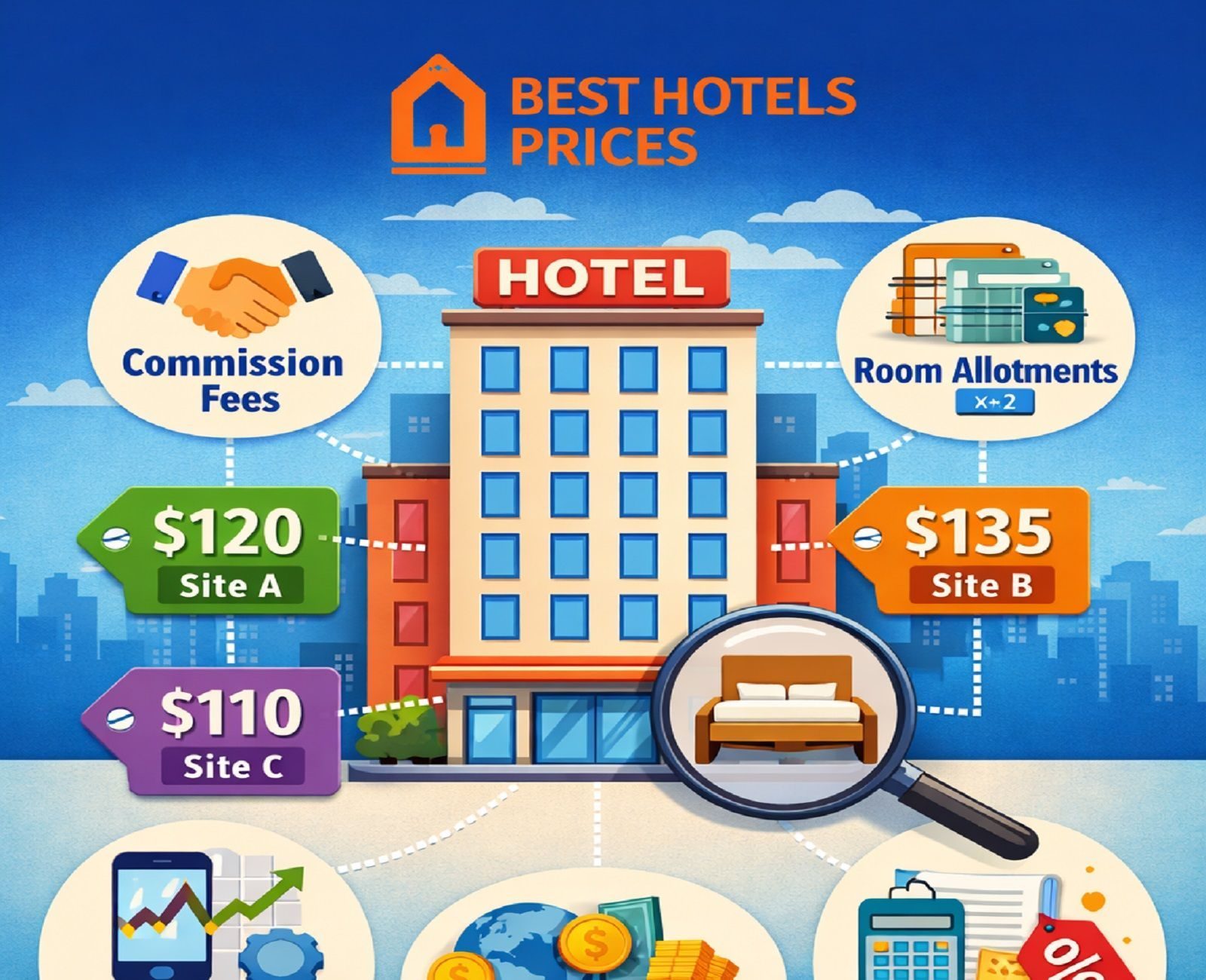
- Commissions & markups: Booking sites (OTAs) typically take 15–25% commission. Each one layers its own markups and discounts on top of the hotel’s base rate.
- Wholesale inventory: Some sites buy room blocks at wholesale rates and resell them. While that inventory lasts, they can undercut everyone else.
- Dynamic pricing speed: Hotels change prices constantly based on demand, events, and occupancy. Not every platform updates at the same speed.
- Member-only deals: Logged-in discounts (Booking.com Genius, Expedia One Key, hotel loyalty rates) can make one site look dramatically cheaper.
- Geo & currency quirks: Your IP, currency conversion timing, and local promotions can all nudge the price up or down.
Articles from Travel Scanner and Best Hotels Prices land on the same conclusion: the price you see is a product of commissions, timing, and how fees are displayed, not some grand conspiracy.
What I actually do: I assume every site is biased by its own business model. So instead of trusting any single platform, I use them against each other as a kind of manual hotel price comparison guide.
3. Direct vs OTAs: When “Book Direct” Is Really Cheaper (and When It’s Not)
You’ve seen the banners: Book direct for the best price.
Sometimes that’s true. Sometimes it’s just marketing.
Because of rate parity agreements, the base room price is often similar across Expedia, Booking.com, Hotels.com, and the hotel’s own site. The real differences come from:
- Member discounts: Expedia/Hotels.com often offer 10–15% member-only rates. Booking.com Genius can do something similar.
- Promo codes & bundles: OTAs run promo codes and flight+hotel bundles that can bypass parity and undercut direct prices by 5–30%.
- Loyalty perks: If you have hotel status (Marriott, Hilton, etc.), direct bookings usually unlock free breakfast, upgrades, late checkout. OTAs often don’t.
As Travel Arbitrage notes, direct is usually cheapest overall once you factor in loyalty benefits and elite perks, but OTAs can win on pure cash price when you stack member rates and promo codes.
How I decide between direct and OTAs:
- If I have status with that hotel chain: I almost always book direct. The value of breakfast, upgrades, and points usually beats a small OTA discount.
- If I don’t care about loyalty: I compare direct vs 2–3 OTAs on a total-cost basis and see if any OTA is at least 8–10% cheaper. If yes, I take the OTA.
- For bundles: If I’m booking flights + hotel, I always price the components separately and then compare to the OTA bundle. Sometimes the bundle is a genuine 15–25% win.
The key is to compare value, not just price. A slightly higher direct rate that includes breakfast and points can be cheaper in real life than a bare-bones OTA booking.
4. Hidden Fees, Cancellation Rules, and Other Ways “Cheap” Becomes Expensive
When a hotel looks suspiciously cheap, I assume I’m paying for it somewhere else. That’s where a mental hotel taxes and fees breakdown really helps.
Here’s where I look before I believe any “deal”:
- Resort & destination fees: These can add £10–£50 per night and are often mandatory. Some sites show them upfront; others bury them near the end. If you’ve ever wondered about hotel resort fees explained in one line: they’re mandatory extras that behave like a stealth price hike.
- City & occupancy taxes: Especially in Europe and big cities, these can be per person, per night, and not always included in the initial price.
- Cleaning & service fees: Common with apartments and vacation rentals. A low nightly rate with a huge cleaning fee is not a deal.
- Cancellation policy: A non-refundable rate that’s 8% cheaper is not a bargain if your plans are even slightly uncertain.
- Payment timing: Prepaid vs pay-at-hotel matters for cash flow and flexibility. I treat prepayment as a cost if my plans might change.
Sites like Travel Fine Print and Travoglad both hammer the same point: the cheapest headline price can be the most expensive once you factor in fees and restrictions.
My personal filter:
- If a site doesn’t show a clear breakdown of taxes and fees before payment, I don’t book there.
- If a rate is non-refundable, I want it to be at least 15–20% cheaper than a flexible option to justify the risk.
- If a fee is vague (
service charge
with no explanation), I assume there may be more surprises on arrival.

5. Manual Comparison vs Tools: How I Actually Check Multiple Sites
In theory, you could open Booking.com, Expedia, Hotels.com, the hotel’s own site, maybe Trip.com or Agoda, and manually compare everything. In practice, that’s a time sink.
So I use a hybrid approach: one or two good comparison tools + targeted manual checks. Think of it as your own total hotel stay cost calculator.
For example, Hotel Monitor pulls real-time prices from 5+ booking sites (Booking.com, Expedia, Hotels.com, etc.) for the exact hotel and dates I want. It doesn’t require an account, doesn’t store my data, and just shows me where the cheapest rate is right now.
On the more technical side, services like Travel Scrape do something similar at scale via APIs and scraping, mostly for businesses. The point is the same: automate the boring part.
My usual workflow:
- Use a comparison tool to see which 1–2 sites are cheapest for my dates.
- Open those sites + the hotel’s own site in separate tabs.
- Click through to the final checkout page on each and compare total cost, cancellation terms, and payment timing.
- Pick the best combination of price + flexibility + perks.
This way I’m not checking 10 sites manually, but I’m also not blindly trusting a single aggregator.
6. When a “More Expensive” Hotel Is Actually the Better Deal
Sometimes I deliberately book the more expensive option. Not because I like paying more, but because I care about total value, not just the number on the screen.
Here’s what I weigh against price when I compare the cheapest hotel rate vs total price:
- Breakfast included: If breakfast for two would cost £20–£30 per day, a rate that’s £10 higher but includes breakfast is a win.
- Location: A cheaper hotel 30 minutes away can cost you more in transport and time than a pricier central option.
- Amenities: Gym, pool, lounge access, late checkout, workspace – these matter if you’ll actually use them.
- Reviews & reliability: I’ll pay more to avoid a place with consistent complaints about cleanliness, noise, or overbooking.
- Flexibility: Free cancellation can be worth a lot if your plans are fluid.
As Travoglad notes, a slightly higher price can be a better deal once you factor in extras like breakfast, fitness centers, or upgrades. I agree – I just want to see the math clearly.
My mental test: I ask, If I strip away the marketing and just look at what I get for the total price, which option would I choose?
If the answer is the “more expensive” one, that’s the real cheap hotel for me.
7. A Simple Step-by-Step System You Can Reuse
If you want a repeatable way to compare hotel prices without losing an hour every time, here’s the system I use. It keeps you focused on true cost and helps you avoid the classic hotel booking mistakes.
Step 1: Shortlist 2–3 hotels
- Use any major site (Booking.com, Expedia, Trip.com, etc.) to find places that fit your location, rating, and basic needs.
- Don’t worry about price yet; just build a shortlist.
Step 2: Run each hotel through a comparison tool
- Use a tool like Hotel Monitor to see which booking sites are cheapest for your dates.
- Note the top 2–3 providers for each hotel.
Step 3: Open tabs and go all the way to checkout
- For each hotel, open: the cheapest OTA, one alternative OTA, and the hotel’s own site.
- Select the same room type and same cancellation policy on each.
- Click through to the final page before payment.
Step 4: Compare total cost and terms
- Write down the final total including all taxes and mandatory fees.
- Note: cancellation deadline, whether it’s prepaid or pay-at-hotel, and any extras (breakfast, points, perks).
- Don’t forget practical extras like hotel parking and resort fee costs if you’re driving or staying at a resort-style property.
Step 5: Decide based on value, not just price
- If one option is clearly cheaper with similar terms, take it.
- If prices are close, factor in breakfast, location, loyalty points, and flexibility.
- If you book a flexible rate, consider monitoring prices and rebooking if they drop before check-in.
This sounds like a lot, but once you’ve done it a couple of times, it’s a 10–15 minute process that can easily save you 15–25% per stay – exactly the kind of savings highlighted by tools that focus on hotel booking site fee transparency.
8. The Mindset Shift: Stop Chasing “Cheap”, Start Chasing “True Cost”
The hotel industry is built on the assumption that you’ll compare the wrong numbers. Nightly rates instead of totals. Base prices instead of all-in costs. Headline discounts instead of actual value.
Once you flip that and start asking, What will I really pay, and what do I really get?
the game changes. You stop chasing the illusion of a bargain and start looking for the real final price.
So next time you see a “cheap” hotel:
- Ignore the first number you see.
- Go to the final page before payment.
- Compare total cost, terms, and value across at least two sites and the hotel’s own site.
Do that consistently, and you’ll stop being the person who brags about a £60 room that quietly cost £95. You’ll be the one who understands hidden hotel fees and charges, knows how to find the real hotel final price, and pays less for better stays.