
I’ve yet to meet a CFO who feels they have real control over corporate travel budgets in New York, London, or Singapore. These are classic high-cost destinations, and they’re very good at draining a corporate card. But you’re not stuck.
In this guide, we’ll look at how to budget for high-cost cities, where business travel money actually goes, and the specific levers you can pull to keep trips under control—without turning every visit to New York, London, or Singapore into a punishment.
1. Start With the Real Problem: You’re Underestimating the Daily Cost
Most teams don’t have a New York
problem or a Singapore
problem. They have a math problem.
- They budget using a generic
average trip
number. - They ignore city-specific rates and hidden costs.
- They treat airfare as a one-off, not part of the daily burn.
Data from GBTA, GSA, ECA International and Amex GBT (summarized in this benchmark article) suggests a typical 2026 business trip runs about $1,293 for domestic U.S. and $3,594 for international travel. That’s the average. In high-cost destinations like New York, London and Singapore, your corporate travel budget can easily run 2–3x that baseline per day.
Here’s the mental model that works in expensive cities:
- Airfare – amortize it over the trip length (e.g., a $1,200 ticket over 4 days = $300/day).
- Lodging – use city-specific caps; New York and London can be ~3x cheaper markets.
- Meals & incidentals – follow GSA-style per diem tiers, not wishful thinking.
- Ground transport – assume at least $80–$100 per trip unless you have a clear plan.
If your internal budget for a New York business trip still assumes a $200/night hotel and $60/day meals
, you’re not budgeting. You’re hoping.

Takeaway: Before you try to reduce corporate travel costs
, fix the baseline. Build a realistic daily cost for each high-cost city, including airfare amortized per day.
2. New York, London, Singapore: How Expensive Are We Really Talking?
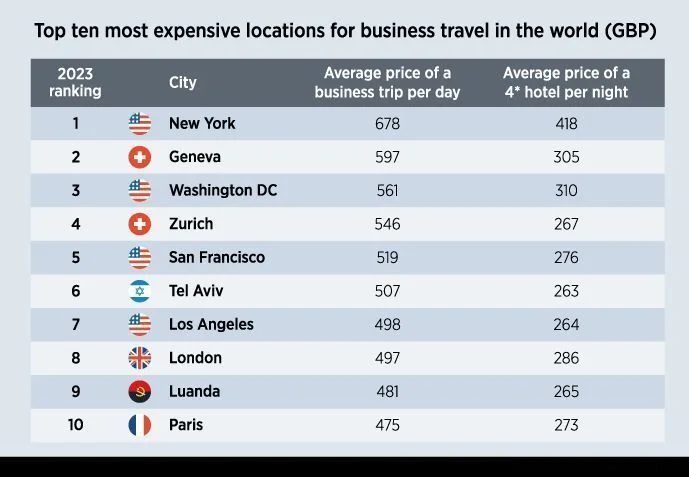
Let’s be blunt: these are premium markets for business travel. ECA International’s rankings (summarized here) put New York at the top worldwide, with London and Singapore not far behind.
- New York City – around £678 per day (roughly $800+), driven heavily by hotel rates and local expenses.
- London – about £497 per day, with four-star hotels around £286/night, up ~20% year-on-year.
- Singapore – roughly USD 515 per day, now one of the most expensive business travel destinations in Asia.
And that’s just the average business traveler. If your team books late, flies flexible fares, or insists on central locations and last-minute taxis, your real cost for corporate travel in these high-cost cities will be higher.
So the first strategic decision isn’t How do we make New York cheap?
It’s:
- Which trips truly justify a New York / London / Singapore price tag?
- Which can move to cheaper hubs or be handled virtually?
Trip purpose matters. Sales and client-facing trips often run 20–35% higher than internal meetings. Your corporate travel policy for expensive cities should reflect that. A blanket $X per trip
rule is lazy—and expensive.
Takeaway: Treat New York, London and Singapore as premium markets with their own rules. If you don’t differentiate by city and trip type, your business travel costs in New York, London and Singapore will keep surprising you.
3. Build a City-Specific Budget: From Formula to Policy
Once you accept that these are high-cost destinations, you can design a corporate travel budget that actually works. Start with a simple formula, then layer city-specific caps on top.
Most business trip calculators use some version of:
Total Trip Cost = Transportation + Accommodation + Meals + Miscellaneous
You’ll see this structure in tools like:
- CalculatorsHub Business Trip Cost Calculator
- CalculatorCorp Business Trip Cost Calculator
- CalculatorDoc Trip Cost Calculator
They all do roughly the same thing: force you to list out airfare/transport, hotel, meals, and incidentals. The value isn’t the math. It’s the discipline.
Here’s how to turn that into a practical policy for high-cost cities:
- Set city bands
Group destinations into tiers (e.g., Tier 1: New York, London, Singapore; Tier 2: major but cheaper hubs; Tier 3: low-cost markets). Each tier gets its own lodging and M&IE caps. This makes business travel cost comparison between New York, London and Singapore much clearer. - Use per diem-style daily rates
Borrow from GSA per diem logic: a single daily figure that covers meals and incidentals, plus a separate lodging cap. This simplifies approvals, expense reviews, and corporate travel expense planning. - Amortize airfare
For budgeting, spread airfare across trip days. A $1,500 ticket for a 3-day London trip is effectively $500/day. That’s the real daily burn you should compare across trips and cities. - Define what counts as “miscellaneous”
Tools like the CalculatorsHub and CalculatorCorp calculators explicitly call out parking, internet, tips, event fees, insurance, and currency fees. Your policy should too. If you don’t define it, it will show up later as hidden costs of business travel.
Takeaway: Use calculators not as gadgets, but as templates for your policy. Force every New York, London, or Singapore trip through the same structured estimate before it’s approved.
4. Airfare and Hotels: The Two Levers That Actually Move the Needle
In high-cost cities, most of your spend sits in two buckets: airfare and lodging. If you don’t control these, arguing over taxi receipts won’t save your corporate travel budget.
Airfare: timing and class-of-service
Corporate airfares are often higher than consumer prices because of refundable fares and late bookings. Research suggests:
- Booking 21+ days in advance and enforcing class-of-service rules explains about 60% of airfare variance between similar companies.
- On routes like New York–London, business class can be eye-watering, but consolidator fares can cut published prices by 45–60% if you know where to look (example comparison here).
A simple rule of thumb for managing corporate travel in high-cost destinations:
- Economy or premium economy by default for flights under 6–7 hours.
- Business class only when there’s a clear ROI (e.g., overnight flight into a critical client meeting) and ideally via negotiated or consolidator fares.
- Hard rule on minimum advance purchase unless there’s a documented exception.
Hotels: caps, location, and negotiation
Hotel ADRs in business districts are brutal, especially in high-cost cities:
- U.S. urban upscale properties average around $221/night, but New York can be much higher.
- London four-star business hotels are around £286/night, more than double cities like Vienna or Lisbon.
- Singapore’s post-pandemic recovery has pushed rates up sharply as well.
What actually works for affordable corporate travel in expensive cities?
- City-specific caps – not a global
$200/night
fantasy. Set realistic caps for New York, London, and Singapore based on current data and your own business trip cost breakdown. - Preferred hotels – negotiate corporate rates; even a 12–18% discount vs. best-available-rate is meaningful at these price levels.
- Location trade-offs – sometimes a 10–15 minute commute saves 20–30% on room rates. Decide where you draw the line and document it in your corporate travel policy for expensive cities.
Takeaway: If you only have time to fix two things, fix advance purchase rules and city-specific hotel caps. That’s where most of the money is.
5. Per Diems vs. Actuals: How You Pay Changes How People Spend
In high-cost cities, the way you structure meal and incidental policies can either stabilize your budget or blow it up.
Government benchmarks like U.S. GSA per diem rates are widely used even by private companies. They give you city-specific daily allowances for lodging and M&IE (meals & incidentals). High-cost cities like New York and San Francisco sit at the top tiers; London and Singapore have similarly elevated benchmarks in their respective systems.
Two ideas from per diem logic are especially useful when you’re trying to manage per diem rates in high-cost cities:
- Single daily M&IE figure – instead of micromanaging breakfast/lunch/dinner, you set one daily number.
- Prorated travel days – GSA typically uses 75% of the full rate on arrival/departure days, because you’re not on the road for three full meals.
Tools like the Business Travel Expense Calculator show how to apply these rules in practice, including mileage reimbursement and prorated per diems.
So what should you do in New York, London, Singapore?
- Use city-specific M&IE caps based on credible benchmarks and your own data.
- Apply 75% per diem on travel days to avoid overpaying.
- Decide whether you’re paying per diem (no receipts, more predictability) or actuals with caps (more control, more admin).
And don’t forget the small stuff that routinely pushes budgets 10–15% over plan:
- City taxes and service charges.
- Foreign transaction fees.
- Hotel-area meals that are 30–50% more expensive than the city average.

Takeaway: Pick a side: per diem or actuals-with-caps. Then stick to it. In high-cost cities, fuzzy rules around meals and incidentals are where budgets quietly die.
6. Hidden Costs in High-Cost Cities: What You’re Probably Missing
When you review travel budgets for New York, London, or Singapore, the same blind spots show up again and again. None of them are huge individually. Together, they’re the 10–15% overrun you keep seeing in your global corporate travel cost management reports.
- Local transport creep
Last-minute taxis, surge-priced rideshares, airport transfers, and short-notice car rentals. In many programs, ground transport averages around $94 per trip, but in these cities it can be higher if you don’t nudge people toward public transit or pre-booked options. - Hotel extras
Resort fees, Wi‑Fi charges, early check-in/late checkout, laundry, minibar, room service. Your policy should be explicit about what’s reimbursable. - Payment friction
Foreign transaction fees, dynamic currency conversion, ATM fees. These are small but predictable; either bake them into per diems or provide corporate cards that minimize them. - Events and incidentals
Conference fees, client entertainment, coworking day passes, printing, SIM cards, roaming. Calculators like those from CalculatorsHub and CalculatorDoc explicitly listmiscellaneous
for a reason—these items add up.
One practical move: require every trip request to include a line for incidentals (e.g., 10–15% of core costs) instead of pretending they don’t exist. It’s better to budget for them and then beat the number than to be surprised every time.

Takeaway: If your forecasts are consistently off by ~10–15%, it’s probably not your flights and hotels. It’s the everything else
bucket you’re not modeling.
7. Turn One Trip Into a Playbook: Using Data and Tools Properly
Most companies treat each New York or London trip as a one-off. That’s a missed opportunity. The real advantage comes when you turn individual trips into a repeatable playbook for corporate travel budgeting strategies.
Here’s a simple way to do it:
- Standardize inputs
Use a single calculator or template for all trips—something like the calculators from Best-Calculators, CalculatorsHub, or CalculatorCorp. Same categories, same assumptions, every time. - Tag trips properly
At minimum, tag by city, trip type (sales, internal, client project), and business unit. You can’t benchmark what you don’t categorize. - Compare forecast vs. actual
After each trip, compare the pre-trip estimate to the final expense report. Where did you overshoot? Where did you underestimate? Adjust your city-specific caps and per diem rates for high-cost cities accordingly. - Feed into broader planning
The Best-Calculators tool, for example, can integrate with employee cost and startup cost calculators. That’s how you move fromWhat did this trip cost?
toWhat does it really cost to run this team or launch this market?
And keep the compliance side tight: correct IRS mileage rates by tax year, contemporaneous mileage logs, receipts over $75, clear documentation of business purpose. It’s not glamorous, but it protects you in audits and keeps your data clean enough to trust.
Takeaway: Don’t just approve and reimburse. Use each New York, London, or Singapore trip as data to refine your next budget and your overall travel strategy.
8. The Mindset Shift: From Policing Travelers to Designing Systems
If your travel policy reads like a list of don’ts
, you’ll get resistance and workarounds. In high-cost cities, that’s deadly. You can’t afford shadow policies and exceptions
on every trip.
Instead, think like a systems designer:
- Make the right choice the easy choice
Pre-approve preferred hotels, airlines, and booking channels. Build city-specific templates so travelers don’t have to guess what’s reasonable in Singapore vs. London. - Be transparent about trade-offs
If you’re asking someone to take a 6 a.m. flight or stay outside the city center to save money, say why. Tie it to bigger goals: runway, profitability, headcount. - Differentiate by impact
A trip that can close a seven-figure deal should not be constrained by the same rules as an internal offsite. Your policy should reflect business value, not just cost. - Review annually
New York, London, and Singapore move fast. Hotel rates, per diems, and airfare patterns change. If your caps are more than a year old, they’re probably wrong.
In other words: stop trying to win the game by arguing over coffee receipts. Design a system that makes it hard to overspend on the big stuff and easy to stay within guardrails on the small stuff.
Final takeaway: High-cost cities will always be expensive. Your job isn’t to make New York cheap. It’s to make every New York, London, or Singapore trip predictable, justified, and repeatable. Once you do that, the budget stops being a surprise—and starts being a strategic tool.