Category Focus: Avoid Mistakes With Seat Assignment Fees
This article sits squarely in the Avoid Mistakes category. The core issue is not that airlines charge for seat assignments; it is that travelers routinely misread what those fees represent, when they are refundable under U.S. Department of Transportation (DOT) rules, and how those rules interact with airlines’ dynamic pricing systems. To avoid costly surprises, you need to understand how ancillary seat charges are structured and the narrow circumstances in which DOT rules require airlines to return that money.
Ancillary seat fees are not random add-ons. They are the visible output of pricing algorithms that treat your seat choice as a separate product from transportation. DOT rules, in turn, treat some of those products as part of the transportation you were promised and others as optional extras. The tension between those two views explains why some seat fees are refundable when things go wrong and others are not.
How Seat Fees Became a Separate Product From Transportation
To understand refund rules, you first need to see how airlines structurally separate “getting you from A to B” from “where and how you sit.” Historically, a standard economy ticket implicitly included a standard seat. Today, most airlines treat the seat you occupy as a monetizable attribute layered on top of the basic right to be transported.
Mechanically, this works through unbundling and dynamic pricing:
- Unbundling: Basic economy and similar fares strip out advance seat selection. You still have a legal right to a seat, but not to a specific one without paying extra. Higher economy fare types rebundle that right, often marketing it as “free seat selection,” even though the cost is embedded in the fare.
- Dynamic pricing: Seat fees are set by algorithms that respond to route, demand, time to departure, and seat desirability. The fee is not tied to the cost of operating the flight; it is tied to your perceived willingness to pay for comfort, predictability, or keeping a group together.
- Interface design: Booking flows often present a seat map with prices and a prominent “Continue with selected seats” button, while the option to skip seat selection or accept free auto-assignment is visually downplayed or delayed until check-in.
From a DOT perspective, this separation matters. DOT regulates the transportation service and certain unfair or deceptive practices around fees. Airlines, meanwhile, frame seat selection as an optional enhancement. Refundability hinges on which framing dominates in a given situation: was the fee truly optional, or did it purchase a specific aspect of the transportation you were promised but did not receive?
What DOT Rules Actually Touch in the Seat-Fee Ecosystem
DOT does not micromanage seat pricing. Airlines are largely free to charge what they want for seat selection, including aisle seats, extra legroom, and forward-cabin positions. Instead, DOT focuses on two main levers that indirectly shape seat-fee refunds:
- Unfair and deceptive practices: Airlines cannot misrepresent what a fee buys or hide material information about total trip cost until the last step of booking. This is where drip pricing and misleading seat-selection prompts come under scrutiny.
- Failure to provide purchased services: If you pay for a specific ancillary service and the airline fails to provide it, DOT expects a refund of that fee, even if the base ticket is nonrefundable.
Seat fees sit at the intersection of these principles. The key analytical question is: when does a seat fee represent a clearly defined service that was not delivered, and when is it simply a payment for the chance to influence seat assignment in a system that still ultimately guarantees you a seat?
When Ancillary Seat Fees Are Likely Refundable Under DOT Logic
DOT’s approach to ancillary fee refunds is built around the concept of non-delivery of a purchased service. For seat fees, that translates into scenarios where the airline’s actions break the link between what you paid for and what you received.
1. You Paid for a Specific Seat and Were Moved
Mechanism: When you pay for a specific seat (for example, 12A, extra legroom aisle), the airline is selling you a defined product: that exact location and its attributes. If the airline later moves you to a different seat and you do not receive equivalent attributes, the original product was not delivered.
Typical triggers include aircraft swaps, operational weight-and-balance changes, or re-seating for crew needs. Under DOT’s general refund principles, if the airline cannot or does not provide the specific seat or an equivalent one, you have a strong basis to claim a refund of the seat fee, even if you still travel on the same flight.
The trade-off for airlines is clear: the more granularly they monetize seat attributes, the easier it is for passengers to argue that a change constitutes non-delivery of a purchased service.
2. You Paid for Extra Legroom or a Premium Zone and Lost That Feature
Mechanism: Some seat products are defined by features rather than exact seat numbers: “extra legroom,” “exit row,” or “preferred zone” near the front. If an aircraft change or reconfiguration moves you to a standard seat without those features, the airline has removed the core benefit you paid for.
Under DOT’s logic, this is similar to paying for Wi‑Fi and having it inoperable for the entire flight: the ancillary service was not provided. Airlines that proactively refund these fees are essentially acknowledging that the fee is tied to a specific, measurable benefit, not just a vague preference.
3. You Paid for Seats on a Flight That Was Canceled or Significantly Changed
Mechanism: When a flight is canceled or significantly changed by the airline and you choose a refund instead of rebooking, DOT expects airlines to refund not only the base fare but also ancillary fees tied to that flight, including seat selection.
The logic is straightforward: the entire transportation contract for that flight, including its add-ons, has been voided by the airline’s action. Keeping the seat fee would mean charging you for a service that never had a chance to be delivered.
4. You Paid for Family Seating That the Airline Could Not Provide
Mechanism: Families with young children are a regulatory flashpoint. Airlines have increasingly adopted policies guaranteeing that children under a certain age can sit with an accompanying adult at no extra charge. Where a carrier still charges for family seating or sells “family seating packages,” the risk is that operational disruptions break the promise.
If you paid specifically to ensure that your child sits next to you and the airline fails to seat you together, DOT’s non-delivery principle again applies. The fee was tied to a clearly defined outcome—adjacent seating—that did not occur. Even as formal rules evolve, airlines are already adjusting practices to avoid being seen as monetizing parental anxiety without delivering the promised outcome.
When Seat Fees Are Structurally Hard to Recover
Not all frustrating seat-fee experiences translate into refund rights. The structure of airline pricing and DOT’s relatively narrow focus on non-delivery mean that many common complaints fall outside refundable territory.
1. You Paid for “Seat Selection” but Got a Different Seat of Similar Type
Mechanism: If you pay a fee simply to choose a standard seat in advance, and the airline later moves you to another standard seat, the airline can argue that the core service—advance seat selection within the standard cabin—was still provided. You influenced your seating outcome, even if the exact seat changed.
From a DOT perspective, this is weaker ground for refunds because the product is defined loosely. Unless the airline’s own marketing promises a specific seat number or location, the fee is more like a priority in the seat-allocation process than a guarantee.
2. You Changed Your Plans or Missed the Flight
Mechanism: When you voluntarily change flights, cancel a nonrefundable ticket, or miss a flight, airlines typically treat seat fees as sunk costs. The service—holding a seat for you on that original flight—was available; you simply did not use it.
DOT generally does not require refunds for services that were available but unused due to passenger choice or fault. The underlying logic is that the airline incurred opportunity cost by reserving that seat for you, even if you did not occupy it.
3. You Felt Pressured by the Interface Into Paying
Mechanism: Many travelers pay seat fees because the booking flow implies that not paying is risky. Warnings like “You may be separated from your party” or “Seats are going fast” create behavioral pressure. However, unless DOT finds that the interface is materially deceptive—misrepresenting the necessity of the fee—this pressure alone does not create a refund right.
In practice, this means that feeling misled by design is not the same as being sold a service that was not delivered. The system is built to push you toward paying without explicitly promising that payment is mandatory for transportation.
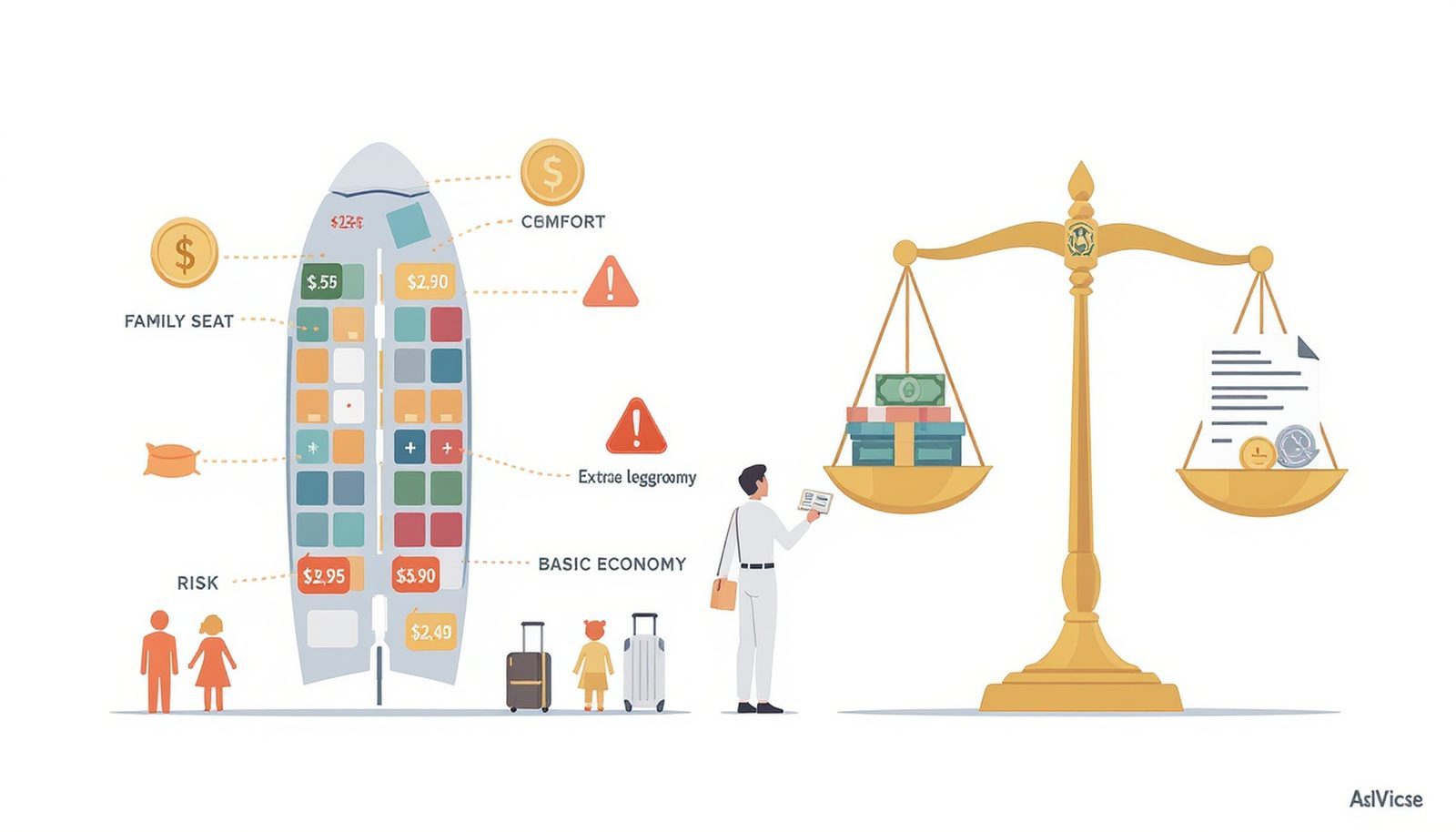
Comparing Fare Strategies: Basic Plus Fees vs. Higher Fares
One of the most consequential decisions travelers face is whether to buy a cheaper basic fare and add seat fees à la carte, or to pay more upfront for a fare that includes seat selection. DOT rules do not dictate which is better; instead, they shape how much risk you carry if things go wrong.
The table below compares the structural trade-offs between these two strategies, focusing on how ancillary fee refunds behave under typical disruptions.
| Dimension | Basic Fare + Paid Seats | Higher Fare With Included Seats |
| Upfront cash outlay | Lower base fare, variable seat fees added later | Higher base fare, seat cost embedded |
| Price predictability | Low: seat fees vary by flight, time, and demand | Higher: total cost visible earlier in booking |
| Refundability of seat value | Seat fee may be separately refundable if service not delivered | Seat value is blended into fare; refunds follow fare rules |
| Exposure to dynamic pricing | High: fees can spike close to departure | Moderate: seat cost locked in with fare |
| Family seating risk | Higher if relying on paid seats; partial protection from DOT norms | Lower if airline includes family seating in fare benefits |
| Complexity of claims | Need to track separate seat charges for refunds | Refund disputes focus on fare, not seat line items |
The key mechanism here is how value is packaged. Basic fares externalize seat costs into separate, visible fees that may be individually refundable if not delivered. Higher fares internalize seat value into the ticket price, making it harder to isolate and reclaim that value even when seat outcomes change.
Dynamic Pricing, Uncertainty, and the Limits of DOT Protection
Dynamic pricing algorithms introduce a layer of uncertainty that DOT rules do not directly address. Seat fees can change daily or even hourly, responding to load factors, booking patterns, and proximity to departure. This volatility affects both your decision to pay and your expectations about refunds.
How Dynamic Pricing Interacts With Refunds
When a seat fee is refunded because a service was not delivered, the refund amount is typically the amount you paid, not the current price of that seat. This means:
- If prices have risen, a refund may not be enough to buy an equivalent seat on a new flight.
- If prices have fallen, you do not get the difference back unless the airline voluntarily offers price protection.
DOT’s framework is transactional: it looks at whether the specific transaction you made was honored, not whether you can replicate the same comfort level at the same price later.
Uncertainty Around Inputs and Outcomes
Because airlines do not disclose the exact inputs to their seat-pricing algorithms, travelers cannot reliably predict when fees will be low or high. This opacity has two consequences:
- Overpayment risk: You may pay early to “lock in” a seat, only to see prices drop later, with no refund mechanism for the difference.
- Underprotection risk: You may delay paying, hoping for lower fees, and end up with fewer options or higher prices, especially for families needing multiple adjacent seats.
DOT rules do not compensate for these strategic risks. They only step in when the service you actually purchased is not provided.
Risk and Uncertainty: Where Travelers Are Most Exposed
Even with DOT protections, several structural risks remain around seat fees and their refundability. Understanding these risks helps you decide when paying for a seat is a calculated choice and when it is a gamble.
1. Health and Comfort Risks on Long Flights
For travelers with mobility issues, circulation concerns, or claustrophobia, seat choice is not just a comfort preference; it can affect health outcomes. Paying for extra legroom or an aisle seat may be a way to manage these risks.
The uncertainty arises when operational changes move you to a less suitable seat. While you may be entitled to a refund of the fee, the health risk remains, and there is no guarantee that an equivalent seat will be available at any price. DOT’s refund logic compensates financially but does not ensure that your underlying need is met.
2. Connection Risk and Front-of-Cabin Seats
Some travelers pay for seats near the front of the cabin to speed deplaning and protect tight connections. If a re-seat moves you farther back, the risk of a missed connection increases.
Here, the trade-off is between a relatively small seat fee and the potentially large cost of a missed connection. DOT may support a refund of the seat fee if the promised location was not delivered, but it does not automatically cover downstream costs like missed hotels or tours.
3. Family Separation and Emotional Stress
Families with young children face a distinct risk: the practical consequences of being separated on board. Emerging DOT pressure has pushed airlines to guarantee seating for children with an accompanying adult, but implementation can be uneven, especially on full flights or when aircraft changes occur.
Even when a refund is available for a failed family seating product, the stress of negotiating seat swaps at the gate or on board is not compensated. The system still relies heavily on other passengers’ willingness to move, which is outside both DOT’s and the airline’s direct control.
4. Information Gaps and Misaligned Expectations
Finally, there is a structural risk that travelers misunderstand what they are buying. Many assume that paying a seat fee guarantees a fixed outcome, when in reality it often buys a higher probability of that outcome within a fluid system.
DOT’s focus on non-delivery means that if the airline’s terms and conditions clearly reserve the right to change seats, your expectation of a guarantee may not align with the legal reality. The gap between perceived and actual protection is itself a form of risk.
Global Context: Why U.S. DOT Rules Only Partially Shape Outcomes
Outside the U.S., paid seat selection is even more normalized, especially on basic and light fares. Many international carriers treat almost every seat choice as a billable option, and local regulators may be less focused on ancillary fee transparency.
For itineraries that involve non-U.S. carriers or flights departing outside the U.S., DOT’s influence can be limited. While DOT can assert jurisdiction over certain practices affecting U.S. consumers, local law and airline policies often dominate. This means that the refund logic described above may not apply uniformly across your entire trip.
The structural trend, however, is consistent: airlines worldwide are decoupling seat choice from transportation and using dynamic pricing to monetize comfort and predictability. DOT rules act as a partial counterweight in the U.S. market, especially around family seating and non-delivery of paid services, but they do not reverse the global shift toward granular seat monetization.
Balanced Conclusion: Using DOT Rules Without Overestimating Them
Ancillary seat fees are not going away. Airlines have strong financial incentives to keep unbundling and dynamically pricing seat attributes, and travelers’ willingness to pay for comfort, predictability, and family cohesion sustains the model. DOT rules provide a targeted safety net, not a blanket shield.
On the protective side, DOT’s non-delivery principle means that when you pay for a clearly defined seat product—specific seat numbers, extra legroom, premium zones, or family seating—and the airline fails to provide it, you have a solid basis to reclaim that fee. Flight cancellations and significant schedule changes also trigger refunds of associated seat charges when you opt for a ticket refund.
On the limiting side, DOT does not regulate seat prices themselves, does not guarantee that you can repurchase equivalent comfort after a disruption, and does not compensate for strategic missteps in timing your seat purchase. Many situations that feel unfair—like being nudged into paying by a pushy interface or seeing prices drop after you buy—do not automatically create refund rights.
The practical implication is that avoiding surprise airline seat assignment fees is less about finding a loophole and more about aligning your expectations with how the system is built. Treat seat fees as payments for specific, sometimes fragile products within a dynamic allocation system. Use DOT rules to recover money when those products are not delivered, but recognize that the deeper tension—between airlines’ revenue goals and travelers’ desire for transparent, predictable seating—remains unresolved.