Everyone says, Europe is expensive in summer.
Helpful? Not really. Are we talking €80 a day? €250? More? If you don’t pin this down, you either over-save and never book the trip, or you arrive in Paris in July and realize your budget
was more fantasy than plan.
This guide walks you through how to build a realistic Europe summer daily budget – one that matches how you actually travel, covers the sneaky extras, and still leaves room for gelato, wine, and the odd splurge.
1. Decide Who You Really Are: Your Travel Style (Not Your Fantasy Self)
Most people underbudget because they plan for the traveler they wish they were, not the one they are. Let’s fix that first.
Roughly, you’ll land in one of three camps:
- Backpacker – Hostels, night trains, picnics, cheap beer, free walking tours.
- Budget-conscious – Simple hotels or apartments, mix of groceries and restaurants, a few paid experiences.
- Mid-range – Comfortable hotels or nice apartments, eating out most days, museums, tours, maybe a couple of day trips.
Here’s a summer daily budget range per person (excluding long-haul flights) that lines up with what multiple realistic Europe travel budget breakdowns and calculators show (example):
- Backpacker: €60–€90 in Western/Northern Europe, €40–€70 in Eastern Europe.
- Budget-conscious: €90–€140 in Western/Northern Europe, €60–€100 in Eastern Europe.
- Mid-range: €140–€220+ in Western/Northern Europe, €90–€150 in Eastern Europe.
If those numbers feel high, remember: summer adds about 30–50% to prices in many cities. That’s not pessimism; that’s what flight and hotel data show across multiple sources during peak season.
Now the uncomfortable bit: pick the category that matches your actual habits, not your idealized self. Ask yourself:
- Will I really cook most nights, or do I love restaurants?
- Am I genuinely okay with a 10-bed dorm and shared bathroom in July?
- Do I get cranky without air-con and a decent mattress?
Your honest answers will do more for your Europe summer daily budget than any spreadsheet.
2. Choose Your Europe: Expensive vs. Affordable Countries
There is no single Europe price.
A day in Zurich is not the same as a day in Krakow. Ignore this and your Europe trip cost per day will always feel off.
Think of Europe in three rough price bands for summer:
- High-cost (Western/Northern Europe): Switzerland, Norway, Denmark, Iceland, UK, Ireland, Netherlands, France, Germany, Sweden.
- Mid-cost (Southern/Western mix): Spain, Portugal, Italy, Greece, Croatia, Slovenia.
- Lower-cost (Central/Eastern/Balkans): Poland, Czechia, Hungary, Romania, Bulgaria, Albania, Serbia, Bosnia & Herzegovina.
For the same travel style, your Europe summer daily budget can drop by half just by shifting more days into the lower-cost band. Cost calculators and comparison charts (for example, on Slow Travelers) make this pretty obvious.
A practical way to use this when planning your Europe travel budget:
- Pick your must-see expensive cities (e.g., Paris, Amsterdam, Copenhagen).
- Limit them to 3–4 nights each.
- Balance with longer stays in cheaper cities (e.g., Krakow, Lisbon, Sofia, Tirana).
This isn’t about skipping the classics. It’s about not spending two straight weeks in the priciest cities in Europe and then wondering why your realistic Europe travel budget exploded.

3. Build Your Core Daily Budget: The Four Big Buckets
Once you know your travel style and which regions you’re visiting, you can build a core Europe trip cost per day. Break it into four simple buckets:
- Accommodation
- Food & drink
- Local transport
- Activities & incidentals
Here are realistic summer ranges per person, assuming you’re not doing anything extreme.
Accommodation
- Hostel dorms: €25–€40 in cheaper cities, €40–€60+ in big Western capitals.
- Budget hotels / private hostel rooms: €70–€120 per room in many cities; €120–€180+ in peak capitals.
- Mid-range hotels / apartments: €120–€200+ per room in popular Western cities in July/August.
Sharing a room (as a couple or with friends) can cut your per-person accommodation cost by about 25–35% compared to going solo. Many real-world Europe summer cost breakdowns show this clearly.
Food & drink
This is where people lie to themselves. If you say, I’ll just eat groceries
but you love restaurants, your Europe vacation expenses will blow up fast.
- Groceries + street food heavy: €20–€30/day in cheaper countries, €30–€40 in expensive ones.
- Mix of groceries and restaurants: €30–€50/day in cheaper countries, €40–€70 in expensive ones.
- Mostly restaurants with drinks: €60–€100+/day easily in Western capitals.
Supermarkets and discount chains (Lidl, Aldi, Mercadona, Carrefour) are your best friend if you want to keep your Europe accommodation and food budget under control.
Local transport
- Single metro/bus rides: €2–€3.50 in most cities.
- Day passes: €7–€12.
- Airport transfers: €10–€20+ depending on city.
If you stay central and walk a lot, you can often keep local transport to €5–€10/day on average.
Activities & incidentals
- Museums and major sights: €10–€25 each.
- Guided tours / day trips: €30–€100+.
- Random extras (toilets, lockers, tips, snacks): €5–€15/day.
A realistic baseline is €15–€30/day for activities and incidentals, with a few bigger days for tours or special experiences.
Put it together for a Western Europe summer mid-range day (per person, sharing a room):
- Accommodation: €70–€100
- Food & drink: €40–€60
- Local transport: €5–€10
- Activities & incidentals: €20–€30
Total: roughly €135–€200/day. That lines up with most mid-range Europe travel budget estimates for peak season.
4. Don’t Forget the Invisible Costs (They’re What Blow the Budget)
Most daily budgets
ignore the stuff you pay before you even land. That’s how people end up saying, We only spent €120/day!
and quietly forget the €1,200 flights and €200 in SIM cards, insurance, and fees.
To build a realistic Europe travel budget, you need to spread these costs out across your days.
Flights
- From North America, summer round-trips often run $800–$1,500+ depending on city and flexibility.
- From Australia/NZ, think AU$2,000–$3,000+ in peak season for two people, based on real trip reports.
Spread that over your days. Example: a $1,200 flight over 14 days adds about $85/day to your real cost. Over 28 days, it’s about $43/day. Suddenly your all-in Europe trip cost per day looks very different.
Internal transport
- High-speed trains: €30–€120+ per leg depending on distance and how early you book.
- Budget flights: €20–€80 if booked early, but watch luggage and seat fees.
- Buses: often cheaper but slower; great for budget travelers.
If you’re moving every 2–3 days, internal transport can easily add €10–€20/day when averaged out. Slow travel (staying longer in each place) cuts this dramatically and makes your Europe summer daily budget much easier to manage.
Connectivity
- Roaming from home providers: often $10–$15/day.
- Local SIM/eSIM: often €2–€4/day for reasonable data if you plan ahead.
Over a two-week trip, that’s another €30–€60 you should factor into your Europe travel budget planning.
Travel insurance
Most long-term travelers consider this non-negotiable. A common rule of thumb is about $30 per week for decent coverage. Over three weeks, that’s $90 – not huge, but it belongs in your budget.
Hidden fees
- Tourist taxes and city entry fees (e.g., Venice).
- Paid public toilets and luggage lockers.
- ATM fees and bad exchange rates at airports.
None of these are big individually, but together they can add €3–€5/day if you’re not paying attention. These are the hidden costs in Europe travel that quietly eat into your budget.
Once you add flights, internal transport, SIM, and insurance into your daily average, your €120/day
trip might actually be closer to €150–€170/day. That’s not failure; that’s clarity.
5. Set a Daily Number (Then Add a Buffer)
Now let’s turn all this into a single number you can actually plan around.
Here’s a simple framework for budgeting for Europe in summer:
- Pick your style and region mix. Example: 10 days Western Europe, 10 days cheaper countries, mid-range style.
- Estimate on-the-ground daily costs for each region.
- Add flights, internal transport, SIM, and insurance spread across your days.
- Add a 15–20% buffer for surprises and spontaneous fun.
Let’s run a quick example for a 20-day summer trip (per person, sharing rooms):
- 10 days Western Europe at €150/day = €1,500
- 10 days Eastern Europe at €90/day = €900
- On-the-ground total: €2,400
Now add:
- Flights: €900 (say $1,000 converted)
- Internal trains/flights: €250
- SIM + insurance + misc pre-trip: €150
Grand total: €3,700.
Divide by 20 days: €185/day.
Now add a 15% buffer (~€28/day):
Target daily budget: about €210/day all-in.
That’s the number you plan around. If you come in under, great. If not, you’re still covered and you’ve avoided the classic budget mistakes in Europe.
6. Use Daily Caps and Rollovers Instead of Micromanaging Every Euro
Once you’re on the ground, you don’t want to live inside a spreadsheet. But you also don’t want to wake up on day nine and realize you’ve burned through half your money.
Here’s a system that works well on real trips and keeps your Europe backpacking daily costs or mid-range budget under control.
1. Set a daily cap
Example: €120/day on-the-ground for a couple (excluding flights). That covers accommodation, food, local transport, and normal activities.
2. Track only the big stuff
- Accommodation (you usually know this in advance).
- Rough food spend (breakfast, lunch, dinner, drinks).
- Any big ticket items (museum passes, tours, day trips).
Don’t obsess over every coffee. Just keep a running note on your phone so you can see if your Europe summer cost breakdown is roughly on track.
3. Use rollovers
If you spend €90 on a slow day, you’ve saved €30. That rolls into a future day where you might spend €150 on a special dinner or a boat tour. Underspend on quiet days, fund the big moments later. Simple.
4. Separate shopping and souvenirs
Track personal shopping separately from your core daily budget. Otherwise, a new jacket in Milan makes it look like you’re overspending
on food and transport when you’re not.
The goal isn’t perfection. It’s knowing whether you’re roughly on track or drifting into we’ll figure it out later
territory.
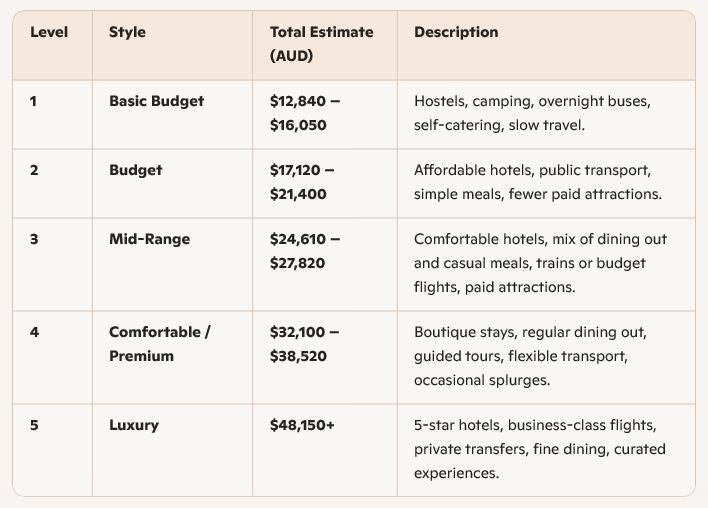
7. Pulling It All Together: Sample Daily Budgets You Can Actually Use
To make this concrete, here are all-in daily ranges (including a share of flights and internal transport) for a typical 10–20 day summer trip, per person. Use these as a sanity check for your own Europe travel budget planning.
Backpacker
- Western/Northern Europe: €90–€130/day all-in.
- Eastern Europe: €60–€90/day all-in.
Assumes hostels, lots of walking, cheap eats, and minimal paid activities. Great if you’re aiming for an affordable Europe summer trip and don’t mind cutting back on comfort.
Budget-conscious
- Western/Northern Europe: €120–€170/day all-in.
- Eastern Europe: €80–€120/day all-in.
Assumes private rooms, a mix of groceries and restaurants, some paid attractions, and smart transport choices. This is a realistic Europe travel budget for many couples and friends.
Mid-range
- Western/Northern Europe: €170–€230+/day all-in.
- Eastern Europe: €120–€170/day all-in.
Assumes comfortable hotels or apartments, daily eating out, regular paid experiences, and more flexible flight choices. If you’re asking, How much money per day for Europe if I don’t want to rough it?
this is your ballpark.
If your numbers are way below these, ask yourself: What am I assuming I’ll give up? Air-con? Eating out? Drinks? Museums? If the answer is nothing
, your budget probably needs a reality check.
If your numbers are way above, fine – you’re either planning a very comfortable trip or you’ve built in a huge safety margin. Just make sure you’re not over-saving so much that you delay the trip forever.
In the end, a good Europe summer daily budget isn’t about squeezing every euro. It’s about knowing your travel style, choosing your countries wisely, and being honest about what you’ll actually spend. Do that, and you can stop stressing over money and start worrying about more important decisions – like whether to have another gelato. (You should.)