
I don’t care how “cheap” a flight looks on the search results page. If I’m paying for bags, airport transfers, awful connection times, and $18 sandwiches, it’s not cheap. It’s just sneaky.
In this guide, I’ll walk you through how I build a real flight budget – one that includes every hidden cost: airports, transfers, food, and even the value of your time. By the end, you’ll be able to look at two flight options and say, with confidence: This one is actually cheaper overall.
1. Start With a Realistic Flight Formula (Not Just the Ticket Price)
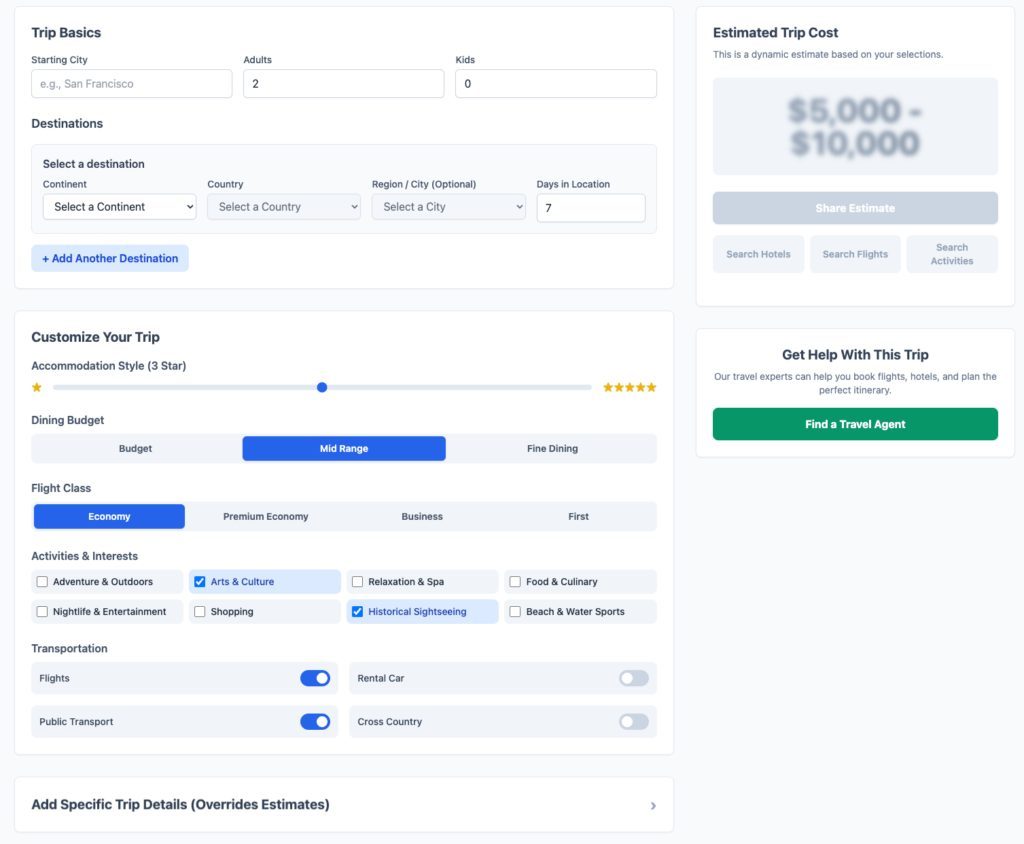
Most people stop at the number they see on the booking site. I don’t. When I’m doing a proper flight budget breakdown, I use a simple formula inspired by tools like the Travel Budget Calculator and other trip planners:
Total Flight Trip Cost =
Base fare + airline fees + airport transfers + airport food & extras + foreign payment fees + time cost.
It looks like a lot on paper. In practice, it’s very manageable once you break it into pieces.
- Base fare: The headline price you see on the booking site.
- Airline fees: Bags, seats, onboard food, changes, etc.
- Airport transfers: Getting to and from each airport, including late-night surcharges.
- Airport food & extras: Meals, snacks, water, Wi‑Fi, lounge passes.
- Foreign payment fees: Card foreign transaction fees, bad exchange rates, ATM charges.
- Time cost: What your time is worth when you choose long layovers or awkward airports.
The trick is to estimate each line before you book. You don’t need perfect numbers; you just need numbers that are honest enough to change your decision.

2. Decode Airline Fees: When a Cheap Fare Isn’t Cheap
Airlines are masters at turning a $99 fare into $220 by the time you hit the payment page. If you only remember one thing from this section, make it this: Always compare what’s included, not just the base fare.
From sources like Travel + Leisure and fee breakdowns on finance blogs, here’s what I always price into the true cost of flying:
Key airline costs to price in
- Baggage: Many basic economy fares include only a personal item. Carry-on and checked bags can run $30+ each way, and overweight bags can be brutal.
- Seat selection: Window, aisle, and extra-legroom seats often cost $15–$25+ per flight segment. Some airlines even charge for “standard” seats.
- Onboard food & drinks: On many routes, even snacks and soft drinks are paid. Think $8–$10 for a snack box or sandwich.
- Change & cancellation fees: Basic fares can be cheap but punishing if your plans change.
- Payment & booking fees: Some carriers add fees for certain cards or booking channels near checkout.
- Taxes & surcharges: Especially on international and award tickets, these can add hundreds of dollars.
How I compare two “similar” flights
Imagine two round-trip options:
- Flight A: $220 basic economy, no carry-on, no seat selection.
- Flight B: $280 standard fare, includes carry-on and seat selection.
My real comparison looks like this:
- Flight A: $220 + $35 carry-on each way + $20 seat each way = $330.
- Flight B: $280 all-in = $280.
On paper, Flight A looked cheaper. In reality, it’s $50 more – and less flexible.
Takeaway: Before you fall in love with a low fare, price out your normal behavior
– how many bags you actually bring, whether you care where you sit, and whether you’ll buy food onboard. That’s how you avoid the most common flight budgeting mistakes.

3. Airport Choice & Transfers: The Hidden Cost of “Cheaper” Airports
That bargain flight from the “secondary” airport? It might cost you more in Ubers and lost time than you save on the ticket. This is where hidden airport costs quietly wreck a budget.
Tools like the Travel Budget Planner hammer this home: local transport and transfers are one of the most underestimated costs.
How I price airport transfers (before I book)
For each airport on my route, I quickly check:
- Distance & time: How far is it from where I’m actually staying?
- Realistic transport options: Train, metro, bus, rideshare, taxi, hotel shuttle.
- Time of day: Will I arrive when public transport is closed, forcing a taxi?
Then I estimate:
- Home → departure airport (round trip).
- Arrival airport → accommodation (round trip).
Suddenly that “cheap” airport can add $60–$100+ in transfers alone. If you’re comparing airport taxi vs transfer cost, this is where the numbers get interesting.
Example: The fake savings of a distant airport
Say you’re choosing between:
- Airport X (central): Flight $350, train $8 each way to the city.
- Airport Y (far): Flight $290, taxi $45 each way to the city (no late-night public transport).
Real cost:
- Airport X: $350 + ($8 × 2) = $366.
- Airport Y: $290 + ($45 × 2) = $380.
Airport Y looked cheaper by $60. It’s actually more expensive – and you lose time in traffic.
Takeaway: Always add door-to-door costs, not just airport-to-airport. If you’re traveling as a couple or group, multiply transfer costs by the number of people – that’s where the difference really explodes.
4. Food, Water, and Wi‑Fi: The Airport & In-Flight Money Trap
Airport food is where budgets quietly bleed. You’re tired, hungry, and everything is 2–3× the normal price. If you don’t plan for it, you’ll underestimate your total trip cost including flights by a lot.
What I assume by default
For any flight day longer than about 5–6 hours door-to-door, I assume:
- 1–2 airport meals: $12–$20 each, depending on the country.
- Water & coffee: $5–$10.
- Onboard snacks or meals: $8–$15 if not included.
- Wi‑Fi or entertainment: $8–$20 if I know I’ll need to work.
That’s easily $25–$50 per person per travel day if you’re not careful.
How to budget smarter (without being miserable)
- Check what’s included: Some long-haul flights still include meals and drinks. If they do, you can cut your airport food budget.
- Bring your own snacks: Most airports allow food through security (liquids are the issue). Nuts, bars, sandwiches – they add up to real savings.
- Refillable bottle: Many airports have water fountains. Buy once, refill often.
- Wi‑Fi alternatives: Download shows, playlists, and offline maps before you leave. Pay for Wi‑Fi only if you truly need it.
Takeaway: Add a line in your flight budget called “Travel day food & extras”. Give it a realistic number. You’ll stop being surprised by how much you spend between your front door and your hotel bed.

5. Foreign Cards, Currency, and “Invisible” Payment Fees
Even if you nail the flight and airport costs, your bank can still quietly skim a few percent off every transaction. Articles on hidden travel costs point out the usual suspects: foreign transaction fees, bad exchange rates, and dynamic currency conversion.
Costs I always check before an international flight
- Foreign transaction fees: Many cards charge 2–3% on every foreign purchase, including online bookings with foreign merchants.
- ATM fees: Your bank + the foreign bank can both charge per withdrawal.
- Airport exchange kiosks: Terrible rates, often 5–10% worse than market.
- Dynamic currency conversion (DCC): When a terminal offers to charge you in your home currency – usually at a bad rate.
How I build this into my budget
- If I don’t have a no-foreign-fee card, I assume 2–3% extra on all foreign spending, including the flight itself if it’s processed abroad.
- I plan fewer, larger ATM withdrawals instead of many small ones to reduce per-transaction fees.
- I mentally add a small buffer (2–3%) to my total trip budget to cover currency slippage and bad rates.
And when the card machine abroad asks, Pay in USD or local currency?
I almost always choose local currency. That’s how you avoid the worst DCC rates.
Takeaway: A 3% fee on a $1,200 flight + $800 of trip spending is $60. Not huge, but not nothing. Either get a card with no foreign transaction fees or consciously add this cost to your budget instead of pretending it doesn’t exist.

6. The Cost of Your Time: Layovers, Red-Eyes, and Lost Days
Most people treat time as free when they compare flights. It isn’t. A $70 cheaper ticket that steals an entire day of your trip might be the most expensive choice you can make.
How I put a price on my time
You don’t need a perfect number. Just pick a rough value for your time – say $15–$30 per hour – and use it consistently.
Then ask:
- How many extra hours does this itinerary take door-to-door?
- Is that time in the middle of the night, when I’ll arrive exhausted?
- Does it cost me a vacation day, a workday, or a weekend?
Example:
- Flight A: $400, 6 hours total travel time.
- Flight B: $320, 12 hours total travel time with a long layover.
Extra time: 6 hours. If you value your time at $20/hour, that’s $120 of “time cost.”
Real comparison:
- Flight A: $400.
- Flight B: $320 + $120 (time) = $440.
Suddenly, the “cheaper” flight isn’t cheaper at all.
When I happily pay more
- To avoid arriving at 1 a.m. and paying surge pricing for taxis.
- To land early enough to actually enjoy the first day.
- To avoid brutal connections that increase the risk of missed flights and lost bags.
Takeaway: Add a time cost line to your flight budget. You’ll start choosing flights that are cheaper in the only currency that really matters: your life.
7. Put It All Together: A Simple Flight Budget Template You Can Reuse
Let’s turn this into something you can actually use. You don’t need a fancy app (though tools like the Trip Budget Calculator or a simple spreadsheet from Trusty Travel Tips can help). You just need a repeatable checklist – a quick flight budget planning guide you can run through every time.
My flight budget checklist
For each flight option, I fill in:
- Base fare: $____
- Bags: $____ (carry-on + checked + potential overweight)
- Seat selection: $____
- Onboard food & drinks: $____
- Airport transfers (home & destination): $____
- Airport food & extras: $____
- Payment/foreign fees: $____
- Time cost: $____
Then I add it up:
Total Flight Trip Cost = $________
Now I compare total vs total, not just fare vs fare. That’s the real price of “cheap” flights.
How this changes your decisions
- You might choose a slightly more expensive airline that includes bags and food.
- You might pick a closer airport that saves you hours and transfer costs.
- You might shift your dates to avoid peak surcharges and bad connection times.
- You might finally see that “cheap” red-eye for what it is: a very expensive next day.
Final thought: A flight is never just a flight. It’s a chain of costs – money, energy, and time – from your front door to your destination. Once you start budgeting for the whole chain, you stop getting surprised. And you start traveling on purpose.