
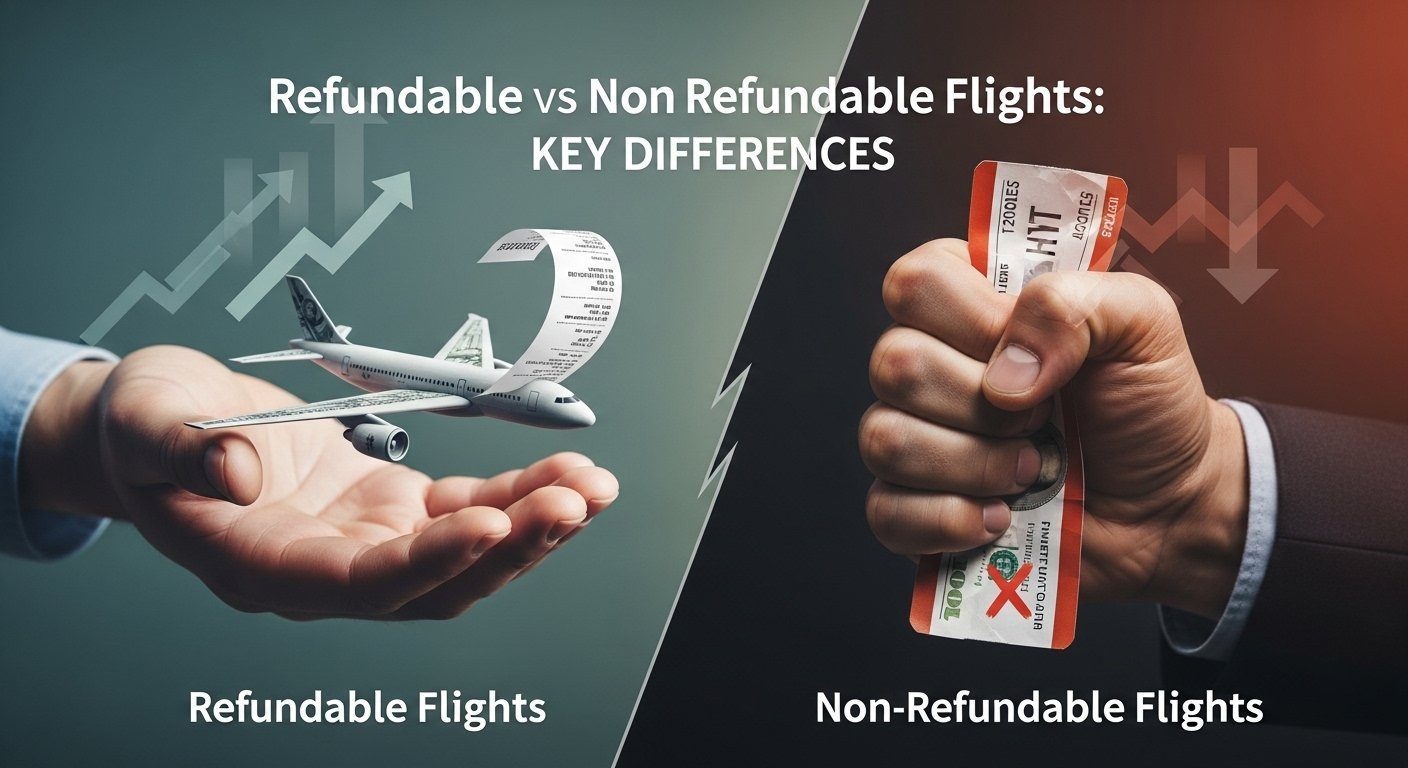
I used to click the cheapest fare without thinking. Then I started adding up all the trips I didn’t take. Weddings that moved. Work trips that vanished. Illness. Storms. Suddenly, that “nonrefundable, no changes” fine print didn’t feel like a bargain. It felt like a bet I kept losing.
This guide is my attempt to make that bet less emotional and more mathematical. We’ll look at refundable vs nonrefundable flights, when flexible tickets actually save you money, and when they’re just an expensive security blanket.
1. The Real Question: How Much Are You Willing to Lose?
When I compare refundable vs nonrefundable flights, I don’t start with airline rules. I start with a blunt question:
If this trip completely falls apart, how much money am I honestly willing to lose?
That number is your risk tolerance. Everything else hangs off it.
- Low tolerance: Losing $400 would sting for months. You value flexibility and sleep better knowing you can get your money back.
- Medium tolerance: You can live with losing a few hundred dollars once in a while, but not on every trip.
- High tolerance: You travel often, expect some trips to blow up, and treat the occasional lost ticket as the cost of playing the game.
Refundable tickets are basically insurance you buy from the airline. The price gap between refundable and nonrefundable is the premium
you pay to avoid losing the full fare if plans change.
So the core decision becomes:
Is the extra $X I pay now worth not risking the full $Y later?
Once you see it that way, the choice stops being moral (Am I being cheap?
) and becomes mathematical (Does this premium make sense for my risk?
). That’s where things get interesting.
2. The Math: When Paying More Upfront Actually Wins
Let’s make this concrete. Say you’re choosing between:
- Nonrefundable ticket: $300
- Refundable ticket: $500
The premium for flexibility is $200.
Now ask yourself: What’s the realistic chance I’ll cancel or need to change this trip?
Not the optimistic version. The real one. Work drama. Kids. Health. Weather. All of it.
Here’s a simple way to think about this flexible airfare cost comparison:
- If your chance of canceling is under ~20%, the refundable fare usually doesn’t make sense.
- If your chance of canceling is around 30–50%, the refundable fare starts to look reasonable.
- If your chance of canceling is over 50%, you’re basically gambling by buying nonrefundable.
Why? Because over time, those “cheap” nonrefundable tickets you never use add up to more than the occasional expensive flexible one. That’s the hidden cost of nonrefundable tickets most people don’t see until they add up a few years of travel.
There’s another twist: airline credits are weaker than cash. With most nonrefundable fares, you don’t get money back – you get a credit or voucher. That sounds fine until:
- You rarely fly that airline.
- The credit expires in 12 months.
- You forget it exists.
In those cases, the cheap
ticket becomes a total loss. A refundable fare that puts money back on your card can actually be the cheaper option over a few years of travel.
3. The Fine Print That Quietly Changes the Game
Before I ever pay extra for a refundable ticket, I run through a quick checklist of rules that already protect me. These often give you more flexibility than you think – even on nonrefundable fares.
24-Hour U.S. Rule: Your Free Undo Button
Under U.S. Department of Transportation rules, if you book a ticket at least seven days before departure, most airlines must let you cancel within 24 hours for a full refund. This usually applies whether the ticket is refundable or not, especially when you book directly with the airline.
How I use this:
- Grab a good fare now, then double-check dates, connections, and life logistics later that day.
- Use that 24-hour window to compare other airlines or routes without fear of being stuck.
That short safety net often means I don’t need to pay extra for a fully flexible fare if I’m booking within a stable window.
When the Airline Cancels or Delays You
Here’s a powerful rule most people underuse: if the airline cancels your flight or makes a significant schedule change (like a huge delay or terrible reroute), you’re usually entitled to a cash refund – even on a nonrefundable ticket. U.S. DOT rules and EU protections back this up in many cases.
So if your main fear is What if the airline melts down?
, paying for a refundable ticket doesn’t always buy you much extra. The law already gives you leverage.
Change Fees Aren’t What They Used to Be
Many major U.S. airlines have removed standard change fees on a lot of fares (not always on Basic Economy). You still pay any fare difference, but you’re not automatically hit with a $200+ penalty just to move your flight.
That means a nonrefundable ticket can be more flexible than it looks – as long as you’re okay with credits and possible fare differences instead of clean cash refunds.
4. Trip Types Where Flexibility Is Secretly Worth Gold
Not all trips are created equal. On some, I’ll happily gamble with a nonrefundable fare. On others, I want maximum escape routes.

High-Risk Trips: Refundable Often Makes Sense
I seriously consider refundable (or at least very flexible) tickets when:
- My schedule is chaotic – frequent business travel, on-call work, or family situations where plans change overnight.
- I’m booking far in advance – 6–12 months out, life has more time to throw curveballs.
- Multiple people are involved – kids, elderly parents, or a group where one person’s issue can derail the whole trip.
- I’m flying a budget carrier that charges brutal change/cancellation fees on nonrefundable tickets.
In those cases, the chance of something going wrong is high enough that paying more upfront can be rational, not indulgent. This is where a flexible travel booking strategy really earns its keep.
Fixed-Date Trips: Refundable Is Usually Overkill
On the other hand, there are trips where I almost never buy fully refundable fares:
- Weddings, graduations, or events that won’t move unless the world ends.
- Short leisure trips where I’m very sure about dates and time off.
- Cheap flights where the refundable version costs 3–4x more.
For these, I’d rather:
- Buy a solid nonrefundable fare.
- Use the 24-hour rule to double-check everything.
- Consider travel insurance instead of paying a huge premium to the airline.
When the risk of change is low, a pricey refundable ticket is usually just an expensive comfort blanket.
5. The Trap of “Cheap” Nonrefundable Fares
Nonrefundable tickets are marketed as the smart, frugal choice. Sometimes they are. Sometimes they’re a trap.

Basic Economy: The Illusion of Savings
Basic Economy is where I get the most skeptical. These fares are often:
- Nonrefundable and sometimes unchangeable.
- Last in line for seat selection, boarding, and sometimes even overhead bin space.
- Worth nothing if you cancel or miss the flight.
They look cheap on the screen. But if there’s even a moderate chance your plans might move, that deal
can turn into a 100% loss.
Standard Nonrefundable: Better, But Still Risky
Standard economy nonrefundable fares are more forgiving:
- You can often change them (sometimes with no change fee, sometimes with one).
- If you cancel, you may get a credit or voucher instead of cash.
The catch? Credits usually:
- Expire in about 12 months.
- Are non-transferable to another person.
- May have restrictions or blackout dates.
If you fly that airline regularly, this can be fine. If you don’t, you’re back in the land of wasted money.
So when I see a nonrefundable fare, I ask:
If I had to cancel, how likely am I to actually use a credit with this airline within a year?
If the answer is Not very
, the real cost of that nonrefundable ticket is higher than it looks. That’s where the nonrefundable ticket hidden costs really show up.
6. Travel Insurance vs Refundable Tickets: Which “Safety Net” Is Smarter?
There’s a third player in this game: travel insurance. And it can be a smarter way to buy flexibility than paying for fully refundable fares.
Standard Travel Insurance
Standard policies usually cover cancellations for specific reasons:
- Serious illness or injury.
- Family emergencies.
- Certain work-related issues.
- Some weather or disaster events.
They don’t cover I changed my mind
or I found a cheaper flight
. But they can be much cheaper than the price jump from nonrefundable to refundable.
If you’re weighing travel insurance against paying more for flexible travel, this is where a simple travel cancellation cost analysis helps: compare the insurance premium to the extra cost of a flexible fare.
Cancel For Any Reason (CFAR)
CFAR is the closest thing to buying a refundable life. You can cancel for almost any reason and get back a percentage of your trip cost (often 50–75%). Not all insurers offer it, and you usually have to:
- Buy it soon after your first trip payment.
- Cancel a certain number of days before departure.
But when it’s available, a common strategy is:
- Buy nonrefundable flights.
- Add good travel insurance (with CFAR if you want maximum flexibility).
- Skip the ultra-expensive fully refundable fares.
This combo often gives you more protection for less money than paying 3–4x for a refundable ticket, especially on pricey international routes. It’s one of the best ways to save money with flexible tickets without overpaying the airline.
7. A Simple Playbook: How I Decide in Under 5 Minutes
Here’s the quick decision process I actually use when I’m staring at those fare options and wondering if a flexible ticket is worth it:
- Check the 24-hour rule
Am I booking at least seven days before departure? If yes, I know I have a free 24-hour undo button. That already reduces the need for a fully refundable fare. - Estimate my cancellation risk
Gut check: Is there a low, medium, or high chance this trip changes or dies? Be brutally honest. - Look at the price gap
How much more is the refundable ticket? 20% more? 50% more? 3–4x more? The bigger the gap, the more the math has to justify it. - Check what “nonrefundable” really means
Can I change the ticket? Do I get a credit? How long is it valid? Could I realistically use it? This is where the cost of changing nonrefundable flights really matters. - Consider insurance instead
For expensive trips, I compare the cost of travel insurance (with or without CFAR) to the extra cost of a refundable fare. - Decide my maximum acceptable loss
If everything goes wrong, am I okay losing this amount? If not, I either pay for flexibility or don’t book yet.
Most of the time, I end up with a hybrid strategy:
- Nonrefundable fares for stable, near-term, or lower-cost trips.
- Flexible or refundable fares for chaotic schedules, long lead times, or critical trips.
- Travel insurance as a backup on expensive or complex itineraries.
In the end, it’s all about the travel risk vs cost trade off. The goal isn’t to avoid risk completely. It’s to choose your risks on purpose, instead of letting the fine print choose them for you.
Next time you see that tempting cheap fare, pause for a second and ask yourself: Am I really saving money here, or just pre-paying for a future headache?
The honest answer to that question is where the real savings usually hide.