
Why Roblox Ban Enforcement Has Become a High‑Risk System
This article aligns with the Avoid Mistakes category. The focus is not on whether Roblox is good or bad for children, but on how its design creates enforcement risks that parents, regulators, and even Roblox itself struggle to manage. Those risks now extend into what we can call “underage travel spend”: money that leaves household budgets and flows into a child’s virtual journeys across Roblox worlds, often without clear consent, visibility, or understanding.
Roblox combines three elements that, together, create systemic exposure:
- Always-on social layer: Children interact with strangers and friends in real time, across thousands of user-generated games.
- Virtual currency (Robux): Real money is converted into an in-game currency with non-intuitive exchange rates.
- Chance-based rewards and dark patterns: Randomized loot-style mechanics and time-limited offers nudge children to keep spending.
Regulators and courts increasingly treat this combination as a structural hazard rather than a collection of isolated bad actors. Nearly 80 U.S. lawsuits and multiple state Attorneys General actions argue that Roblox was built to attract children while failing to provide adequate safeguards or warnings. In parallel, academic research, including work from the University of Sydney, frames Roblox’s monetization as functionally similar to gambling for minors, especially where random rewards are monetized.
Understanding the mechanisms behind these risks is essential for avoiding costly mistakes: unexpected bills, legal disputes, and long-term damage to children’s relationship with money and online environments.
How Roblox Turns Underage Travel Spend Into Structural Financial Risk
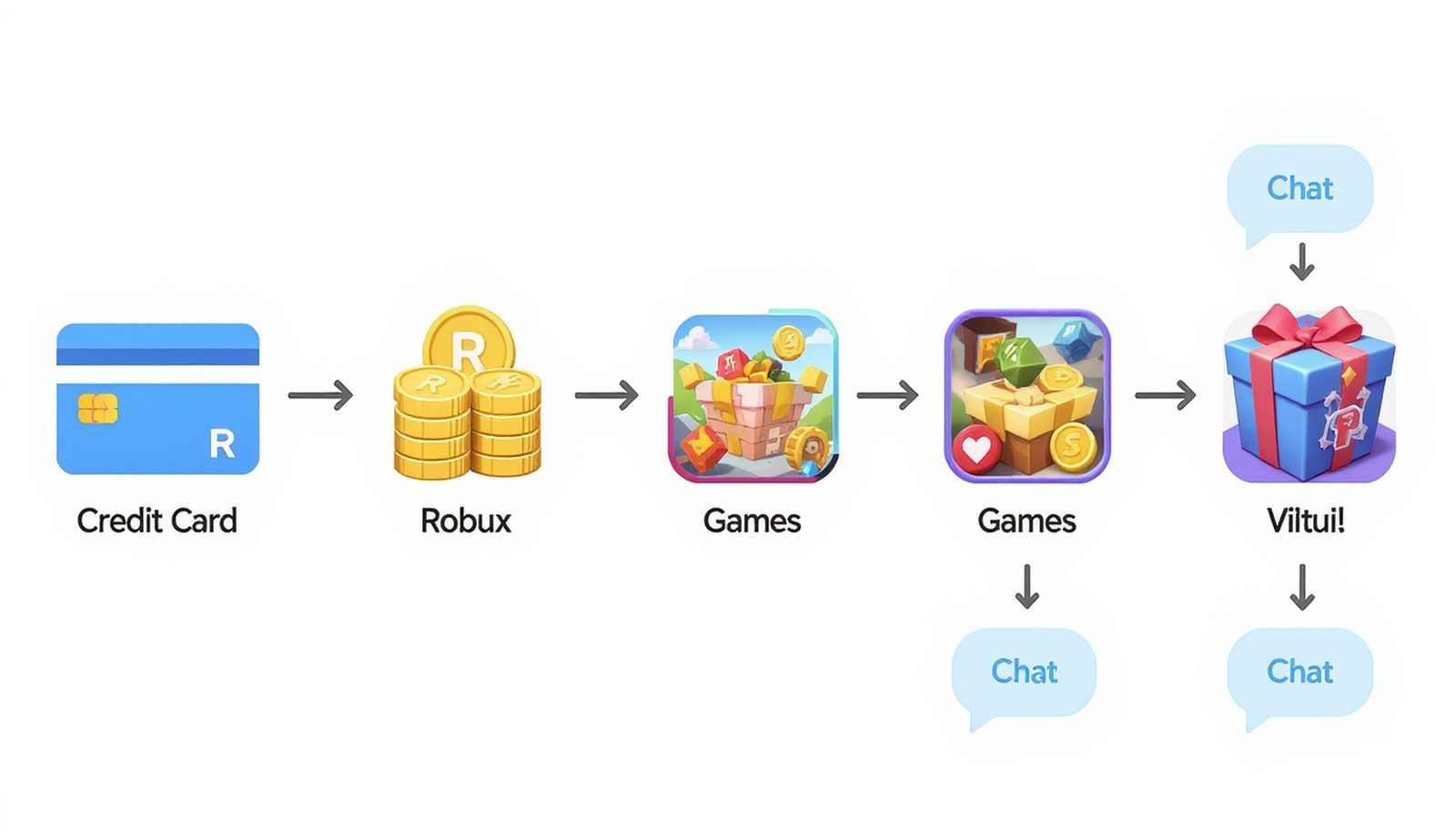
To see why enforcement is difficult, it helps to break down how money actually moves through Roblox from a child’s perspective. The process resembles a travel itinerary: funds leave a parent’s account, pass through a currency exchange, and then get scattered across many destinations (games) with limited visibility and weak checkpoints.
Step 1: Currency conversion obscures real-world value
Roblox relies on Robux, a virtual currency with a conversion rate that is not intuitive for children. The key mechanism is decoupling:
- Children see prices in Robux, not in dollars.
- Bundles and subscription tiers change the effective price per Robux.
- Once money is converted, it feels less like “real” money and more like points or tokens.
This decoupling is common in digital platforms, but Roblox’s child-centric audience amplifies the effect. Research cited in the decision intelligence summary indicates that children often cannot accurately map Robux back to real currency, which makes it easier for them to overspend without grasping the scale.
From an enforcement perspective, this creates a traceability gap. Parents see a single charge (for example, a Robux purchase or subscription) but cannot easily reconstruct how that value was fragmented across dozens of microtransactions inside different games.
Step 2: Random rewards and loot-box-like mechanics
Many popular Roblox experiences use chance-based mechanics: randomized crates, spins, or mystery items that can be purchased with Robux. The University of Sydney research highlights that these systems are structurally deceptive for children because:
- Outcome probabilities are opaque or not disclosed in child-friendly terms.
- Visual and audio effects mimic gambling-style reinforcement.
- Children are encouraged to “try again” to get rare items, blurring the line between play and wagering.
Australia’s 2024 ban on loot boxes for users under 15 is a critical test case. Despite the ban, the summary notes that monetized random rewards remain present in Roblox games, suggesting enforcement gaps rather than full compliance. This exposes several actors to risk:
- Regulators risk appearing ineffective if bans are not enforced in practice.
- Roblox risks being seen as non-compliant or evasive, especially if age gates are weak.
- Parents risk assuming that a legal ban equals practical protection, when the mechanics may still be accessible.
Step 3: Social pressure amplifies spending
Roblox is not a solitary game; it is a social environment. Children’s spending decisions are shaped by:
- Peer comparison: Friends show off rare items or premium avatars.
- Group events: Limited-time events or group activities that require purchases to fully participate.
- Creator incentives: Game developers design systems that reward continued spending because their income depends on it.
This social layer converts what might have been a one-time purchase into an ongoing stream of microtransactions. The mechanism is similar to a group trip where each new activity requires a small fee; no single purchase seems large, but the cumulative cost becomes significant.
Parents often underestimate this dynamic, leading to what the summary calls a structural power imbalance. Children are immersed in a high-pressure environment that parents cannot easily observe or interpret, especially when they are not familiar with the platform’s internal economy.
Safety, Grooming, and the Cross-Platform Enforcement Problem
Financial risk is only one side of the enforcement challenge. Roblox’s social design also creates systemic exposure to grooming, bullying, and exploitation. The key mechanism is the cross-platform migration of harmful interactions.
From in-game chat to external apps
According to the decision intelligence summary, harmful contact often begins inside Roblox and then moves to third-party platforms (messaging apps, social media, or voice chat services). This migration has several enforcement consequences:
- Fragmented evidence: Conversations and interactions are spread across multiple services, making it harder to reconstruct events.
- Ambiguous responsibility: It becomes unclear which platform is responsible for monitoring, reporting, and preserving data.
- Weaker parental oversight: Parents may focus on Roblox settings while missing parallel conversations on other apps.
Roblox has implemented age-based communication controls, filtered chat, and law-enforcement partnerships. However, the summary emphasizes that scale and circumvention limit their effectiveness. Children can misrepresent their age, use coded language, or move to unmonitored channels at the suggestion of bad actors.
Why lawsuits focus on design, not just moderation failures
The nearly 80 U.S. lawsuits and state Attorney General actions are not simply about isolated incidents. They argue that Roblox’s architecture is inherently unsafe for children because:
- It attracts a large population of minors with limited risk awareness.
- It enables persistent, semi-anonymous social contact.
- It lacks transparent, effective tools for parents to monitor and control interactions.
This legal framing matters for enforcement. If courts and regulators accept that the design itself is defective, the remedy is not just better moderation but potentially structural redesign of social and monetization features. That could include stricter age verification, default communication restrictions, or limits on how and when children can spend money.
How underage travel spend intersects with safety risk
Financial and safety risks are intertwined. Groomers and exploiters can leverage spending systems in several ways:
- Offering gifts or Robux to build trust and dependency.
- Pressuring children to make purchases or share account details.
- Using shared in-game experiences as a pretext to move conversations off-platform.
In this sense, underage travel spend is not just a budgeting issue; it can be part of a broader pattern of manipulation. Enforcement systems that treat financial and safety issues separately may miss these combined harms.
Comparing Enforcement Trade-Offs: Platform, Parent, and Regulator
Because the available information lacks detailed quantitative data and cross-platform benchmarking, we cannot say whether Roblox is uniquely risky compared with all other child-focused platforms. However, we can map the trade-offs faced by the three main actors: Roblox, parents, and regulators.
| Actor | Primary Goal | Key Mechanism | Enforcement Trade-Off |
| Roblox | Maximize engagement and revenue from microtransactions | Robux, user-generated games, social features | Stronger safeguards may reduce spending and growth; weak safeguards increase legal and reputational risk |
| Parents | Allow safe play while controlling costs and exposure | Device controls, Roblox settings, supervision | Tight controls reduce risk but may limit social participation; loose controls increase overspending and safety risk |
| Regulators | Protect minors and enforce existing laws | Loot box bans, consumer protection, data-sharing rules | Strict rules may be hard to enforce across platforms; weak rules risk public backlash and ongoing harm |
Why enforcement is structurally hard
Several structural features make robust enforcement difficult:
- Scale: Millions of daily users and countless user-generated games mean that manual oversight is impossible.
- Dynamic content: Game mechanics and monetization schemes can change rapidly, outpacing regulatory review.
- Jurisdictional fragmentation: Different countries have different rules (for example, Australia’s loot box ban), but Roblox operates globally.
- Information asymmetry: Roblox has detailed internal data on behavior and spending; parents and regulators do not.
These factors create a persistent gap between formal rules (such as loot box bans) and actual practice on the platform. Underage travel spend flows through this gap, often unnoticed until a crisis occurs—such as a large credit card bill or a serious safety incident.
Risk and Uncertainty: What We Still Don’t Know
Despite growing legal and academic attention, significant uncertainties remain. These gaps matter because they limit the precision of any enforcement strategy or policy response.
Unquantified financial harm
The summary notes a lack of quantified data on the magnitude of children’s overspending on Roblox: average losses, age distribution, and frequency of extreme cases. Without this data, it is difficult to:
- Assess whether current harms justify drastic regulatory interventions.
- Design targeted remedies (for example, caps by age or spending velocity limits).
- Compare Roblox’s risk profile to other platforms that use similar monetization.
Parents and policymakers are therefore operating with anecdotal evidence and high-profile cases rather than a clear statistical picture.
Cross-platform governance gaps
When grooming or exploitation moves off Roblox, responsibility becomes blurred. Key unknowns include:
- How platforms coordinate to preserve and share evidence.
- Which service bears primary responsibility for user protection when harm spans multiple apps.
- How law enforcement prioritizes and investigates such multi-platform cases.
These gaps mean that even well-intentioned enforcement efforts can fail to protect children or hold perpetrators accountable.
Opaque internal enforcement systems
Roblox’s internal detection algorithms, moderation staffing, and error rates (false positives and negatives) are not publicly detailed. Without independent audits or transparent reporting, regulators and parents cannot easily evaluate:
- How often harmful content or behavior is missed.
- Whether enforcement is consistent across regions and user groups.
- How quickly Roblox responds to emerging threats or regulatory changes.
This opacity complicates both legal proceedings and policy design. Courts may have to rely on expert testimony and limited disclosures, while regulators may struggle to verify compliance with bans or safety obligations.
Cumulative psychological harm
Researchers and public health authorities warn that early exposure to chance-based monetization and constant social pressure may contribute to long-term mental health issues and problem gambling behaviors. However, there is no widely accepted framework for measuring the cumulative psychological impact of:
- Repeated small financial losses.
- Social exclusion tied to spending (for example, not having certain items).
- Persistent anxiety about status and belonging in online spaces.
Without such a framework, it is difficult to calibrate penalties, design effective interventions, or communicate risk in a way that parents can act on.
Mechanisms Behind Parental Power Imbalance
Parents are often portrayed as simply needing to “be more vigilant,” but the decision intelligence summary points to a deeper structural imbalance. Several mechanisms contribute to parents’ loss of control over underage travel spend on Roblox.
Information asymmetry and interface complexity
Roblox’s settings and parental controls can be complex, especially for adults who are not familiar with gaming platforms. Meanwhile, children quickly learn how to navigate in-game menus, social features, and monetization options. This creates:
- Asymmetric expertise: Children understand the environment better than their guardians.
- Interface bias: The platform is optimized for engagement, not for parental oversight.
- Misleading mental models: Parents may assume that a one-time purchase or subscription is the main cost, underestimating ongoing microtransactions.
As a result, parents may believe they have set adequate limits when, in practice, children still have access to high-risk spending and social features.
Emotional and relational leverage
Underage travel spend is not just a financial issue; it affects family dynamics. The summary notes increased family conflict around Roblox spending. Mechanisms include:
- Children framing purchases as necessary to avoid social exclusion.
- Parents feeling guilty about limiting access to what appears to be a harmless game.
- Arguments escalating when unexpected charges appear, eroding trust.
These dynamics can weaken parents’ willingness to enforce strict rules, especially when they lack clear information about the risks and mechanisms at play.
Regulatory signaling and false reassurance
Legal actions and public advisories can have a paradoxical effect. When parents hear that loot boxes are banned for under-15s in a country like Australia, they may assume that the platform is now safe by default. However, the summary indicates that monetized random rewards persist in Roblox games despite the ban.
This creates a false reassurance effect:
- Parents reduce their own monitoring, believing regulators have solved the problem.
- Children continue to encounter high-risk mechanics, now with less parental oversight.
- Regulators may underestimate ongoing harm because formal rules appear strong on paper.
The gap between regulatory signaling and actual enforcement thus becomes a risk amplifier rather than a risk reducer.
Balanced Outlook: Navigating an Unfinished Enforcement Landscape
The current situation around Roblox, underage travel spend, and ban enforcement is neither a clear success nor a complete failure. It is an unfinished system in which incentives, technologies, and legal frameworks are still being renegotiated.
Where the system is improving
There are signs of progress:
- Roblox has introduced age-based communication controls and filtered chat, acknowledging the need for differentiated protections.
- Law-enforcement partnerships and centralized litigation in federal court indicate that authorities are taking systemic risks seriously.
- Academic research, such as the University of Sydney’s work, is clarifying how virtual currencies and random rewards affect children’s behavior.
These developments increase pressure on Roblox and similar platforms to redesign high-risk features and provide more transparency.
Where major risks remain
At the same time, structural risks persist:
- Monetized random rewards continue to operate in environments where they may be legally restricted.
- Cross-platform grooming chains remain difficult to monitor and regulate.
- Parents face a persistent information and power imbalance, leading to overspending and conflict.
- There is no robust, shared framework for measuring cumulative psychological and financial harm.
These unresolved issues mean that underage travel spend on Roblox remains a high-uncertainty domain, with potential for both individual and systemic harm.
Implications for avoiding mistakes
Because this article focuses on mechanisms rather than advice, the key takeaway is not a checklist of actions but a set of structural insights:
- Underage travel spend on Roblox is shaped by the interaction of currency design, random rewards, and social pressure.
- Enforcement gaps—between legal bans and platform practice, between in-game and off-platform behavior—create space for both financial and safety harms.
- Parents, regulators, and Roblox each face trade-offs that make simple solutions unlikely.
Recognizing these mechanisms can help all parties interpret new policies, lawsuits, or platform changes more accurately. As litigation progresses and regulatory frameworks evolve, the central question will be whether Roblox and similar platforms can realign their economic incentives with the safety and financial well-being of the children who use them.