I love a good flight deal as much as anyone. But after enough nights sleeping on airport floors, I’ve learned a painful truth: the cheapest ticket on your screen is not always the cheapest trip in real life.
This is where the big decision comes in: Do I book everything on one protected itinerary, or do I chase savings with separate tickets?
The answer isn’t always obvious, and getting it wrong can turn a $100 saving into a $1,000 mistake.
Let’s walk through the real trade-offs so you can decide when separate tickets are smart… and when they’re a trap.
1. One Itinerary vs Separate Tickets: What You’re Really Buying
On the surface, both options look similar: same airports, similar times, same destination. But behind the scenes, they’re completely different products.
- One itinerary (through ticket, one PNR)
All your flights sit under a single booking reference. The airline (or alliance) treats your journey as one contract. If something breaks, they’re generally responsible for getting you to the final destination. This is what people mean when they talk about a protected connection. - Separate tickets (self-transfer, multiple PNRs)
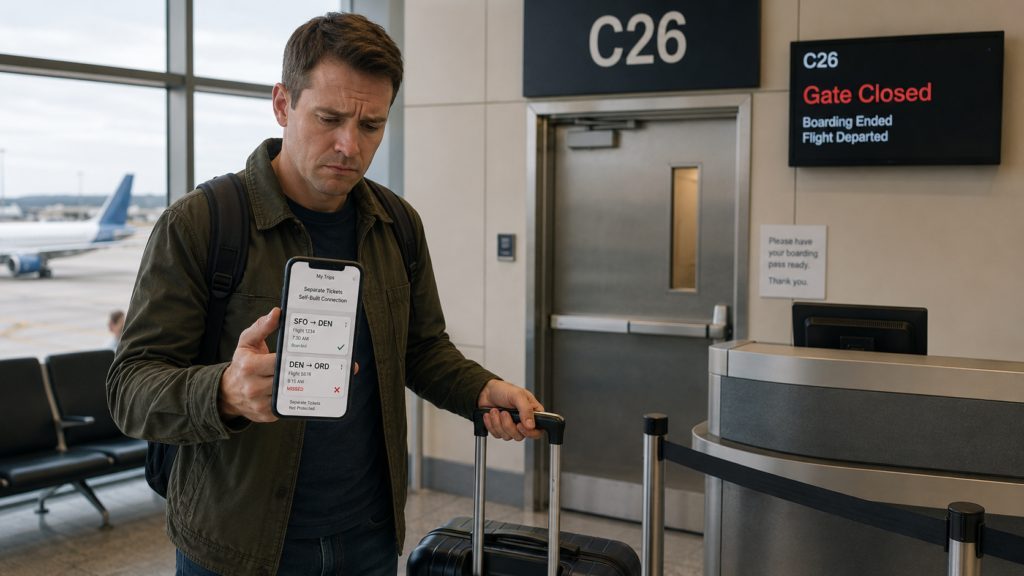
Each leg is its own contract. To the airlines, your flights are unrelated trips. If the first one is late and you miss the second, that’s usually your problem, not theirs. That’s the core risk of booking separate flight tickets.
As Provisional Booking and TravelStacks both point out, the key word is protection. One itinerary is protected. Separate tickets are not.
My rule of thumb: When I buy a single itinerary, I’m paying partly for the airline’s obligation to fix things. When I buy separate tickets, I’m accepting that I am the backup plan.
2. The Illusion of Savings: When Cheap Fares Turn Expensive
Separate tickets can absolutely save money. Tools like Google Flights, Skiplagged, and Airglitch are built to surface these combinations. Airglitch even focuses specifically on separate-ticket arbitrage and cheap flight combinations.
But here’s the catch: you’re trading guaranteed protection for a discount. That’s not always a bad trade, but you should know the real price of a self-connecting itinerary.
Think about the worst-case scenario, not just the best price:
- You save $120 by booking two separate tickets instead of one itinerary.
- Your first flight is delayed by 2.5 hours.
- You miss your second flight, which treats you as a no-show.
- Last-minute replacement ticket: $600+.
- Overnight hotel + meals: another $150–$250.
That smart
$120 saving just cost you $700+ and a wasted day. This is the hidden cost of cheap flight combinations that never shows up in the search results.
When separate tickets often do make sense:
- Short, simple routes on low-cost carriers where one-ways are naturally cheap.
- Trips where you’re intentionally staying a night (or more) in the connecting city.
- When the price difference is huge and you have a solid backup plan (insurance, flexible dates, generous layovers).
When one itinerary usually wins:
- Complex international trips with multiple connections.
- Peak seasons (summer, holidays) when rebooking options are scarce and expensive.
- Trips you absolutely must not miss: weddings, cruises, important meetings.
Before you click Book
, ask yourself: If this goes wrong, can I comfortably afford the fallout? If the answer is no, that cheap separate ticket isn’t really cheap. In a cost comparison of separate tickets vs a single ticket, risk is part of the price.
3. Baggage & Airport Reality: The Hidden Time (and Fee) Trap
On a single itinerary, life is simple: your bag is usually tagged to your final destination, and you just follow the signs to your next gate. There are exceptions (like entering the US or Canada, where you must collect and re-check bags for customs), but generally, the system is built to move you through.
On separate tickets, the game changes.
- You often have to collect your bag at the connection airport.
- You then need to exit the secure area, find check-in, and re-check your bag for the next flight.
- Then you go through security again, and sometimes immigration too.
- You may pay baggage fees twice, especially with low-cost carriers and separate bookings.
CoverTrip and Provisional Booking both stress this: checked bags are the biggest complication with separate tickets. Extra baggage fees on separate tickets can quietly erase your savings.
So I ask myself two questions before I book a self-transfer:
- Can I do this trip with carry-on only?
If yes, separate tickets become much less risky and more attractive. You avoid most of the baggage drama and many of the extra fees. - How much time do I really need?
For self-transfers, I personally aim for:
– 3+ hours for domestic connections
– 4–6 hours for international, especially when changing terminals or airlines
Anything less, and I assume I’m gambling. Those separate tickets long layover costs (extra meals, airport lounges, maybe a day room) are still cheaper than buying a brand-new ticket.

4. Missed Connections: Who Pays When Things Go Wrong?
This is the part most people underestimate.
On a single itinerary (a through ticket):
- The airline is generally responsible for getting you to your final destination.
- If you misconnect because of a delay, they usually rebook you for free on the next available flight.
- In the EU/UK, you may get cash compensation under EU261/UK261 for long delays on qualifying itineraries.
- Major carriers may provide hotel and meal vouchers for overnight disruptions.
On separate tickets (self-transfer flights):
- Each airline only cares about its own segment.
- If you miss the second flight, you’re usually a no-show.
- The second airline doesn’t have to rebook you, feed you, or house you.
- You may have to buy a walk-up fare at eye-watering prices.
Travel Fine Print and Mighty Travels both hammer this home: airline responsibility is tied to the ticket structure, not your intentions. It doesn’t matter that you obviously
meant to connect. If the tickets are separate, the system treats them as separate trips.
This is the real cost of a missed connection on separate tickets. You’re not just late; you’re starting from zero.
So how do I decide if the risk is worth it?
- Trip importance: If missing the trip would be devastating (wedding, cruise, once-in-a-lifetime event), I almost always book a single itinerary with a protected connection.
- Season: In summer and holidays, delays and full flights are common. Separate tickets become much riskier.
- Backup options: Are there multiple flights per day on that route, or just one? If there’s only one, separate tickets are a big gamble.
And if I must book separate tickets, I treat trip delay/interruption insurance as part of the ticket price. Premium credit cards and standalone policies can cover hotels, meals, and sometimes the cost of a new onward ticket after qualifying delays. Without that, I assume I’m self-insuring.
5. Flexibility vs Protection: What Matters More for This Trip?
Separate tickets aren’t all doom and gloom. They can be incredibly useful when used intentionally.
Where separate tickets shine:
- Mixing and matching airlines
You can fly a full-service carrier on the long-haul leg, then a low-cost airline to a smaller regional airport. This is great for reaching places that alliances don’t serve well and for creative multi-leg flights on one trip. - Building in stopovers
Want to spend 2 days in Istanbul on your way to Asia? Separate tickets make that easy without complex multi-city pricing. - Using points strategically
You might redeem miles for the long-haul and pay cash for a cheap regional hop, as CoverTrip notes. - Changing plans per leg
Each ticket can be changed or canceled independently (subject to each airline’s rules). That can be a big plus if your dates aren’t locked in.
On the other hand, Trip.com points out that multi-city or open-jaw tickets on full-service airlines can sometimes be cheaper and safer than stitching together one-ways, especially on complex international routes.
So I ask myself:
- Do I value flexibility more than protection on this trip?
- Is there a multi-city or open-jaw option that gives me both?
If a single itinerary can give me 80% of the flexibility with 100% of the protection, I usually take it. In the battle of separate tickets vs one itinerary, protection often wins when the stakes are high.

6. How to Safely Use Separate Tickets (When You Decide It’s Worth It)
Sometimes the savings or routing options are just too good to ignore. When I deliberately choose separate tickets, I treat it like a small project, not a casual click.
Here’s the checklist I use, drawing on advice from Skiplagged, CoverTrip, and others:
- Build generous layovers
– 3+ hours for domestic self-transfers
– 4–6 hours for international, or even an overnight if the route is critical
I assume I’ll need time for baggage claim, re-check, security, immigration, and a small delay. Long layovers are part of the real cost of self-connecting flights. - Research the airport layout
Different terminals? Separate buildings? Bus transfers? I check the airport map and forums so I’m not surprised by a 40-minute terminal transfer. - Travel carry-on only if possible
This single choice removes a huge chunk of risk and stress. No baggage claim, no re-check deadlines, fewer fees, and fewer extra baggage fees on separate tickets. - Check every airline’s rules
Baggage fees, check-in cutoffs, change/cancellation policies, and whether they ever through-check bags on separate tickets (some do, many don’t). These details matter a lot when you’re not on one itinerary. - Look at on-time performance
If an airline or route is notorious for delays, I either add more buffer or avoid using it as a critical first leg on separate tickets. - Have a Plan B
I ask:If I miss this connection, what will I do?
That might mean knowing the next available flights, having a backup route, or being mentally prepared to buy a new ticket. - Use insurance strategically
I check whether my credit card or travel policy covers trip delay/interruption on separate tickets. If not, I factor that risk into the price.
Separate tickets are a tool. Used carefully, they can unlock routes and savings you’d never see on a single itinerary. Used casually, they can ruin your trip.

7. A Simple Decision Framework: Which Should You Book?
When I’m staring at two tempting options on my screen, I run through this quick framework to compare a through ticket vs separate booking:
- How complex is the trip?
– 1–2 legs, short-haul, flexible dates → separate tickets can be fine.
– 3+ legs, long-haul, tight schedule → lean strongly toward one itinerary. - How critical is the timing?
– Vacation with wiggle room → more room for risk.
– Wedding, cruise, event, non-refundable tour → pay for protection and airline support on one ticket. - What’s the real price difference?
– Under $75–$100 difference on a big trip? I usually buy the protected itinerary.
– Several hundred dollars difference? I dig deeper, but I still factor in potential worst-case costs like hotels and walk-up fares. - Can I travel with carry-on only?
– Yes → separate tickets become much more attractive.
– No → I add extra hours or avoid self-transfers entirely. - Do I have a safety net?
– Good insurance, flexible plans, and multiple daily flights → more comfortable with separate tickets.
– None of the above → I treat separate tickets as high risk.
In the end, the question isn’t Which is cheaper?
It’s Which is cheaper once I include the risk?
That’s the real cost comparison of separate tickets vs a single ticket.
If you start thinking that way, you’ll still find great deals. You’ll just skip the ones that only look cheap until you’re stranded at a closed gate, watching your bargain
flight disappear down the runway.