I’ve lost money on flights in almost every way you can imagine. The worst hit? A missed connection on separate tickets that turned a “cheap” itinerary into a very expensive lesson.
If you’ve ever thought, I’ll just book the legs separately, it’s cheaper
, this is for you. The way you book your flights – single vs separate flight tickets – quietly decides who pays when something goes wrong.
Let’s walk through the real trade-offs so you can save money without gambling your whole trip on a risky connection.
1. Single Ticket vs Separate Tickets: What Are You Actually Buying?
Before we talk about the risk of booking separate flight tickets, it helps to be clear on what you’re really buying. Airlines and booking sites rarely spell this out.
When you buy a single ticket (also called a through ticket, roundtrip, or multicity on one booking):
- All flights sit under one reservation / one PNR.
- The airline (and its partners) sees your whole journey as
one contract
. - If your first flight is delayed, they generally have to get you to your final destination on that same ticket.
- Baggage rules are usually consistent and bags are often checked through.
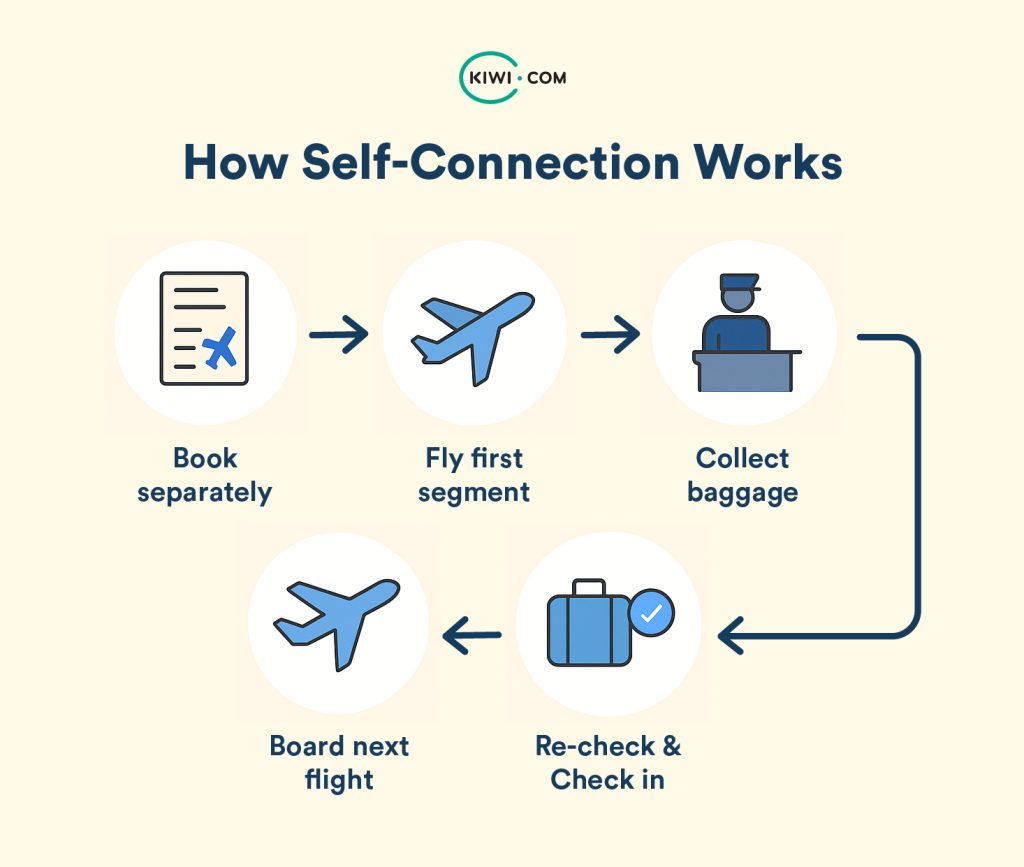
When you buy separate tickets (self-transfer, separate one-ways, or DIY connections):
- Each leg has its own reservation / PNR – legally, separate contracts.
- Airlines do not see your onward flights and don’t take them into account.
- If you miss the second flight, you’re usually marked as a no-show. No refund, no free rebooking.
- You often have to collect and re-check your bags and clear security again.
On paper, both options can show the same route. In reality, connecting flights on one ticket vs separate give you completely different levels of protection.
Key question: Are you buying a protected journey, or a string of unrelated flights and hoping they line up?
2. The Missed Connection Trap: Who Pays When Things Go Wrong?
This is where people lose hundreds of dollars without realizing they ever took a risk.
On a single ticket:
- If your first flight is delayed by weather, crew, or mechanical issues and you miss your connection, the airline generally must rebook you to your final destination at no extra fare.
- You might wait or be rerouted, but you’re usually not buying a brand-new ticket.
On separate tickets:
- The second airline just sees that you didn’t show up. The reason doesn’t matter.
- They can treat your ticket as forfeited.
- You’ll likely pay walk-up prices for a new ticket – often far more than you “saved” by splitting the booking.
As Real Journey Travels points out, each separate ticket is its own contract. The airline’s responsibility ends at the destination printed on that specific ticket, not the destination you’re aiming for in your head.
This is the core of the airline responsibility single ticket vs separate debate: on one ticket, they own the connection; on separate tickets, you do.
Travel insurance can sometimes help with the cost of missed connections on separate tickets, but many policies exclude self-connecting or make claims difficult. You have to read the fine print very carefully.
Rule of thumb: If you can’t comfortably afford a last-minute replacement ticket, be very cautious with separate tickets.
3. The Illusion of Savings: When Separate Tickets Really Are Cheaper (and When They’re Not)
Separate tickets can absolutely save you money. But the headline price is only half the story in any flight booking strategy single vs separate.
They tend to be cheaper when:
- You’re mixing a full-service airline + low-cost carrier (for example, a major airline to a hub, then a budget airline to a smaller city).
- You’re on short-haul or domestic routes where one-way pricing is competitive.
- You’re using points or miles for one leg and cash for another.
- You want a long stopover in a city that’s expensive to include on a single multicity ticket.
But for many complex international or multi-country trips, a single multicity ticket can actually be cheaper overall.
- Airline alliances (Star Alliance, SkyTeam, oneworld) often have special multi-region fares that only appear when you book everything together.
- Checked baggage is more likely to be included on a through ticket.
- You avoid paying multiple baggage and seat fees on separate low-cost segments.
Several sources, including Trip.com and Airtrip Masters, note that multi leg flights on one ticket often win on long-haul, 2–3 country itineraries.
So instead of asking, Which option has the lowest base fare?
ask:
- What’s the total cost once I add baggage, seat selection, and potential change fees?
- What’s the risk-adjusted cost if I factor in even a small chance of buying a last-minute replacement ticket?
My personal rule: If the saving on separate tickets is less than what a same-day replacement flight would cost, I usually stick with a single ticket.
4. Baggage & Airport Logistics: The Hidden Time Bomb in Separate Tickets
This is the part most people underestimate. It’s not just about flights; it’s about what happens in between.
On a single ticket (especially on one airline or alliance):
- Your bags are often checked all the way through to your final destination.
- If you misconnect, the airline reroutes your bags along with you.
- You usually stay airside – no need to re-check bags or clear immigration unless the country requires it.
On separate tickets:
- You often must collect your bags at the carousel.
- Then you have to re-check them with the next airline, possibly in another terminal.
- You may need to clear immigration, customs, and security again – especially on international routes.
- If your first flight is late, baggage claim is slow, or security lines are long, your connection time disappears quickly.
Sites like CoverTrip and Kiwi.com both hammer the same point: checked bags + separate tickets = high risk.
If you must self-connect, the safest play is:
- Travel with carry-on only whenever possible.
- Study the airport layout in advance: terminals, transfer buses, security checkpoints.
- Work backward from check-in and baggage deadlines (often 45–60 minutes before departure) and add generous buffer time.

Ask yourself: If my bag is last off the belt and the security line is brutal, do I still make this connection?
5. How Much Buffer Time Do You Really Need on Separate Tickets?
This is where people get bold… and broke.
On a single ticket, a 50–90 minute connection can be perfectly reasonable, because the airline is on the hook if things go wrong.
On separate tickets, that same 50–90 minutes can be a disaster, because you are on the hook for any rebooking costs after missed connection.
Based on guidance from multiple sources (including Skiplagged, Kiwi.com, and CoverTrip), here are conservative buffers I personally aim for on separate tickets:
- Domestic to domestic (same airport, carry-on only): 3 hours minimum.
- Domestic to domestic (checked bags or terminal change): 4 hours.
- International to domestic (with immigration + customs): 4–6 hours.
- International to international (new check-in, security, possible visa checks): 4–6 hours, sometimes overnight if the airport is notorious for delays.
Yes, that’s a lot of time. But remember: you’re not just walking from one gate to another. You’re:
- Deplaning with everyone else.
- Possibly waiting in immigration lines.
- Waiting at baggage claim.
- Re-checking bags and maybe changing terminals.
- Clearing security again.
And that’s assuming your first flight is on time.
Reality check: If you’re not willing to build in a 3–6 hour buffer, you probably shouldn’t be self-connecting on separate tickets.
6. Flexibility vs Protection: What Kind of Traveler Are You?
Separate tickets aren’t evil. They’re just a tool. The question is whether they fit your risk tolerance and travel style.
Separate tickets can make sense if:
- You’re prioritizing maximum savings and are comfortable with risk.
- You’re a frequent traveler who knows airports well and can adapt quickly.
- You’re traveling light (carry-on only).
- You have time flexibility – if you get stuck overnight, it’s annoying but not catastrophic.
- You’re intentionally building in long stopovers and don’t mind big gaps between flights.
A single ticket is usually better if:
- You’re on a tight schedule (weddings, cruises, tours, important meetings).
- You’re traveling with kids, older relatives, or anyone who needs extra time.
- You’re checking bags and can’t avoid it.
- Your budget can’t absorb a last-minute $300–$800 surprise.
- You’re doing a multi-country long-haul trip where alliance pricing and connection protection matter.

Personally, I treat separate tickets like a calculated gamble. I’ll use them when:
- The savings are substantial (not $40, more like $200+).
- I can build in a huge buffer or an overnight.
- I’m okay with the worst-case scenario: buying a new ticket at walk-up prices.
If any of those conditions aren’t met, I lean hard toward a single ticket.
7. A Simple Decision Framework: Should You Book Single or Separate?
When I’m planning a trip, I run through a quick mental checklist. You can use this as a mini playbook to avoid the classic mistakes booking separate flight itineraries.
Step 1: Compare both options properly
- Search your route as a single roundtrip or multicity on full-service airlines.
- Then search each leg as a separate one-way, including low-cost carriers.
- Add in baggage fees, seat fees, and any obvious extras.
Step 2: Put a price on the risk
- Look up the typical same-day fare for your most expensive leg.
- Ask yourself:
If I had to buy this at the last minute, could I?
- If the saving on separate tickets is smaller than that number, the risk may not be worth it.
Step 3: Check your constraints
- Do you need to arrive by a certain time?
- Are you checking bags?
- Are you comfortable with a 3–6 hour layover (or overnight) to protect yourself from separate tickets missed connection fees?
Step 4: Decide consciously, not emotionally
- If you choose separate tickets, do it knowing you’re taking on the risk – not because a search engine quietly stitched them together for you.
- If you choose a single ticket, accept that you might pay a bit more for peace of mind.
In other words: don’t let a $50 saving decide for you. Make the choice yourself, with eyes open.
8. The Bottom Line: When in Doubt, Protect the Expensive Part of Your Trip
Here’s the mindset that’s saved me the most money over time and helped me avoid missed connection costs:
- Protect the long-haul, expensive legs with a single ticket whenever possible.
- If you want to experiment with separate tickets, do it on short, cheap, regional hops where a replacement flight won’t wreck your budget.
- Never assume an airline will “understand” or “help you out” when you miss a separately ticketed connection. That’s not how the system is built.
So next time you’re staring at two tabs – one neat multicity ticket and one Frankenstein of separate one-ways – pause for a second.
Ask yourself:
- What am I really buying here – security or a gamble?
- If this connection fails, who pays – me, the airline, or maybe my separate ticket travel insurance coverage (if it even applies)?
Once you answer those honestly, the “cheaper” option often looks very different. That’s how you avoid the hidden costs of separate flight bookings and keep your budget – and your trip – intact.