I love the freedom and savings of self-transfer itineraries. I also know how brutally they can backfire.
On a normal through-ticket, the airline worries about Is this connection even possible?
and What happens if the first flight is late?
On a self-transfer, that’s all on you.
This guide is the timing cheat sheet I wish I’d had years ago: how long you really need for self-transfers, airport by airport and scenario by scenario, plus when a 1h35 layover is fine and when it’s a trap.
1. First, Be Honest: Are You a Good Candidate for Self-Transfer?
Before we talk minutes and terminals, start with one blunt question:
If this connection fails, can I afford to fix it?
Self-transfers are tempting. They can be up to 50% cheaper and let you build DIY flight connections that mix airlines, cabins, and routes you’d never see on a single ticket. But every real-world story points to the same trade-off: you’re swapping money for risk (example, example).
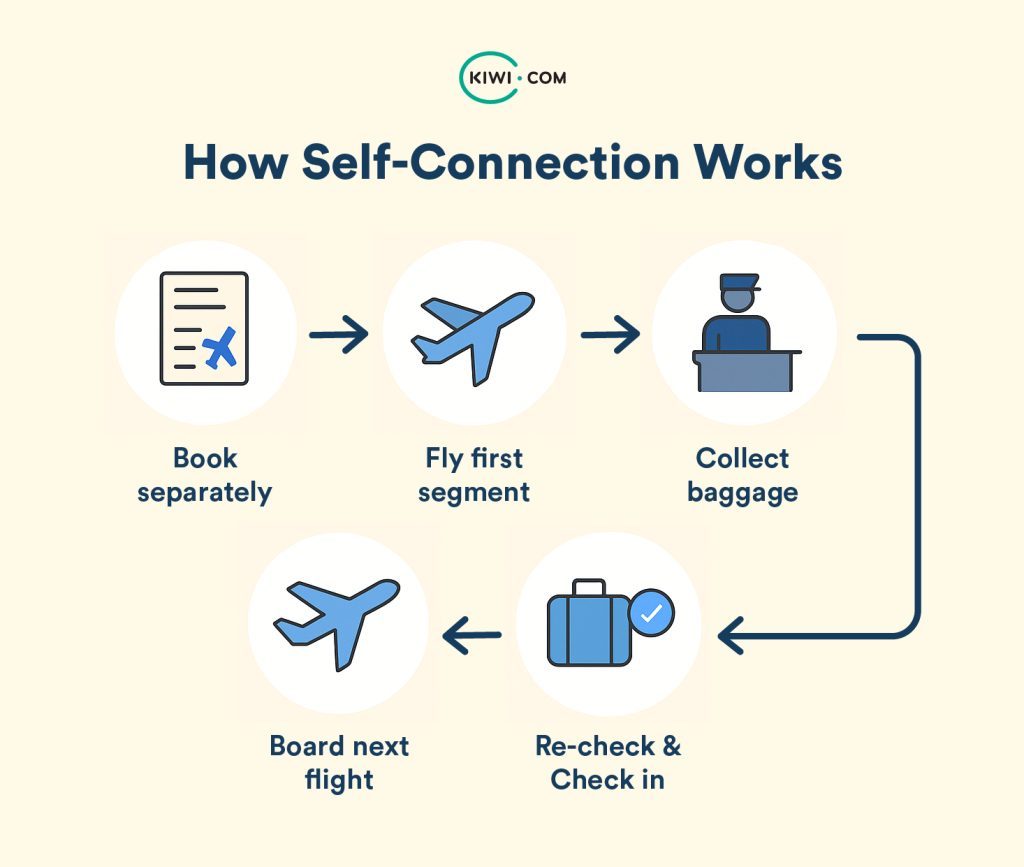
On a self-transfer you usually must:
- Deplane and go all the way to arrivals
- Clear immigration (if international)
- Wait for and collect your checked bags
- Walk to departures, check in again, drop bags
- Clear security (and sometimes exit immigration)
- Then reach your gate
That’s why the usual airline Minimum Connection Time (MCT) is almost meaningless for you. MCT assumes bags are interlined and you stay inside the secure area. On a self-transfer, you’re doing the full airport dance twice.
So, self-transfer makes sense if:
- You’re comfortable with risk and can buy a last-minute ticket if needed
- You’re traveling light (ideally carry-on only)
- You’re not heading to a fixed-time event (cruise, wedding, tour departure)
- You’re okay with long layovers and the occasional airport sprint
If that already sounds stressful, a protected connection is probably a better fit.
2. How Much Time Do You Really Need? (Forget Airline MCTs)
Let’s talk numbers. Industry MCTs are the legal minimum
for a single ticket, not a comfort guideline. For self-transfers, I treat them as a floor and then add 60–120 minutes.
Here’s the rule-of-thumb baseline I use for self transfer layover time when things go reasonably well:
- Domestic → Domestic (same country)
Carry-on only, familiar airport, same terminal: 2–3 hours
With checked bags and/or terminal change: 3–4 hours - Domestic → International
You must check in again, clear exit security, maybe immigration: 3–4 hours - International → International
Staying airside (rare on self-transfer): 2–3 hours
Full arrival + re-check + security: 4–6 hours - International → Domestic (e.g., arriving in the US)
Immigration, baggage claim, customs, re-check, security: 4–5 hours minimum, more at peak times
Compare that to IATA’s typical minimum self transfer connection time: about 1h35 for international–international and 1h for domestic–domestic. Those might work on a protected ticket. On a DIY flight connection, they’re often a gamble.
My own rule of thumb:
- For a protected connection, add 30–60 minutes beyond the airport’s MCT
- For a self-transfer, add 2+ hours beyond MCT, especially with checked bags
It’s not about the shortest possible layover. It’s about a safe layover time for self transfer that doesn’t leave you sweating at the baggage carousel.
3. Airport-by-Airport: How Long You Need at Major European Hubs
Now to the practical part: airport by airport self transfer guide. These are the big European hubs where self-connecting flights are common and timing really matters.
London Heathrow (LHR)
Heathrow is huge, fragmented, and usually busy. British Airways suggests:
- 60 minutes for same-terminal connections
- 90 minutes if changing terminals (often with buses or the Underground)
For a self-transfer, I treat those as the bare minimum for a protected ticket, then add serious padding:
- Self-transfer, same terminal, carry-on only: 3 hours
- Self-transfer, terminal change and/or checked bags: 4–5 hours
Why so much? Because you’ll likely need to:
- Clear UK immigration (if arriving from outside the UK/Ireland)
- Wait for bags (Heathrow is not famous for speed)
- Transit between terminals
- Queue again for security
For Heathrow, a DIY flight connection timing of 1h35 is less a plan and more a dare.
Frankfurt (FRA)
Frankfurt is more compact than Heathrow, and Lufthansa keeps most connections in Terminal 1. Published MCTs are around 45 minutes for many connections.
For self-transfer, I’d aim for:
- Schengen → Schengen, carry-on only: 2.5–3 hours
- Schengen → Non-Schengen or vice versa, with passport control: 3–4 hours
- Checked bags or terminal change: 4 hours+
Frankfurt can be efficient, but passport control queues spike badly at peak times. If you’re landing from outside Schengen and re-checking bags, 45 minutes is fantasy.
Amsterdam Schiphol (AMS)
Schiphol’s official MCTs are famously short:
- ~40 minutes for Schengen–Schengen
- ~50 minutes when non-Schengen and passport control are involved
That’s for protected connections. For self-transfers:
- Schengen → Schengen, carry-on only: 2–2.5 hours
- Non-Schengen → Schengen or vice versa: 3–4 hours
- With checked bags: 4 hours+
Schiphol can be a dream on a good day and a nightmare when security or immigration is understaffed. For self connecting flights, I don’t cut it close here anymore.
Paris Charles de Gaulle (CDG)
CDG is the classic looks fine on paper, chaotic in real life
hub. Typical guidance:
- ~60 minutes for same-terminal connections
- ~90 minutes for inter-terminal transfers
For self-transfers, I treat CDG as a high-risk, high-buffer airport:
- Same terminal, carry-on only: 3 hours
- Terminal change and/or passport control: 4–5 hours
- Checked bags + terminal change: 5–6 hours
If you’re tempted by a 1h35 self-transfer at CDG because it matches some generic guideline, ask yourself: Am I okay buying a new long-haul ticket if this goes wrong?
4. Is 1h35 Enough for a Self-Transfer? When It Works (and When It Doesn’t)
That 1h35 number pops up a lot because IATA often uses it as a reference for international–international connections. But that’s for protected connections where:
- Your bags are checked through
- You may stay airside
- The airline is on the hook if you miss the flight
On a self-transfer, 1h35 is only remotely plausible in a very narrow set of conditions.
1h35 might work if:
- Both flights are domestic in the same country
- You have carry-on only
- You know the airport well and it’s small and efficient
- You’re okay with a non-trivial chance of failure
1h35 is usually a bad idea if:
- Any leg is international
- You have checked bags
- You need to change terminals or even airports
- You’re traveling with kids, seniors, or anyone who can’t sprint
- You don’t have the right visa to clear immigration if required
Real-world stories show people making 35–45 minute self-transfers… and others missing flights with 90 minutes because of a late arrival, slow baggage, or a surprise terminal change. The pattern is clear: 1h35 is not a safety margin; it’s a coin flip.
My personal threshold for safe layover time for self transfer is simple:
- If I’m not willing to lose the second ticket and pay for a new one, I don’t book a self-transfer under 3 hours for domestic
- For international self-transfers, I aim for 4 hours or more
5. The Big Variables: What Quietly Eats Your Layover Time
Two self-transfers with the same layover length can feel completely different. The difference usually hides in the details we ignore when we’re chasing a cheap fare.
Here’s what I always factor in now when planning self transfer layovers:
- Immigration & visas
On a self-transfer, you often must enter the country to re-check bags. That means you need the right visa, and you’re exposed to immigration queues. No visa, no connection. - Customs & baggage claim
Checked bags are the biggest time wildcard. A 20-minute wait is great. A 60-minute wait is not rare at busy hubs. If your bag is delayed, your whole connection is delayed. - Terminal layout & transport
Some airports are one big building. Others are a patchwork of terminals connected by buses or trains. Every transfer step is another chance to lose 10–20 minutes. - Security queues
On a self-transfer, you almost always go through security again. At peak times, that can be 30–60 minutes by itself. - Time of day & season
Early morning and late afternoon banks, holidays, and summer peaks all stretch queues. A 3-hour layover at 11 a.m. on a Tuesday in February is not the same as 3 hours on a Friday evening in July. - Your own pace
Are you okay power-walking with a backpack? Or are you pushing a stroller and shepherding a family of four? Be honest and add time accordingly.
When in doubt, I add an extra hour. Worst case, I get a coffee or a lounge visit. Best case, I avoid a very expensive lesson.

6. How to Build a Safer Self-Transfer (Without Wasting Your Day)
Self-transfers don’t have to be reckless. With a bit of planning, you can keep the savings and reduce the stress.
Here’s how I design timing for self connecting flights now:
- 1. Start with the airport’s MCT, then add your buffer
Look up the airport’s MCT (even though it doesn’t protect you) and then add 2–3 hours for self-transfers. If that feels excessive, remember: you’re doing arrivals + departures from scratch. - 2. Go carry-on only if humanly possible
This is the single biggest risk reducer. No baggage claim, no re-check line, fewer things that can go wrong. If I must check a bag, I automatically add at least 1 extra hour to my self transfer layover buffer time. - 3. Avoid last flights of the day
If your second leg is the last flight, you have no backup. Earlier flights give you more rebooking options (even if you’re paying out of pocket). - 4. Build in a
Plan B
Before I book, I check: If I miss this, what’s the next flight? How much is a walk-up fare? Is there a train or bus alternative? I don’t like discovering this at the gate. - 5. Consider overnight self-transfers
Sometimes the smartest move is a 12–18 hour layover. Sleep, shower, maybe see the city, and start the next leg fresh. It turns risk into a mini-trip. - 6. Use insurance and transfer protection wisely
Some booking platforms offerself-transfer protection
that covers rebooking if you miss a connection. Read the fine print carefully. A good travel insurance policy can also soften the blow of delays and missed flights.
These small choices don’t remove the risk of missed flights on self transfer, but they make it much more manageable.
7. Quick Reference: My Personal Minimums by Scenario
If you just want a cheat sheet to sanity-check your next booking, this is what I personally use as minimums for self-transfers when I care about making the connection:
- Small/medium airport, domestic → domestic, carry-on only: 2.5–3 hours
- Large hub (LHR, CDG, FRA, AMS), domestic/Schengen → domestic/Schengen, carry-on only: 3 hours
- Any self-transfer with checked bags at a major hub: 4 hours+
- International arrival into the US, then domestic self-transfer: 4–5 hours
- International → international self-transfer with full arrival + re-check: 4–6 hours
- Critical trip (cruise, wedding, tour start): either a protected ticket or an overnight self-transfer
For Schengen self transfer layover time, I treat big hubs like FRA, AMS, and CDG the same way: generous buffers, especially if I’m crossing the Schengen border mid-journey.
If your planned layover is shorter than these numbers, ask yourself:
Am I okay if this goes wrong and I have to buy a new ticket at walk-up prices?
If the answer is no, you already know what to do: either lengthen the layover or ditch the self-transfer and book a self transfer vs protected connection that actually protects you.